

GCSE Statistics Resit: Your Results-Day Plan
GCSE statistics resit guidance with a practical results-day plan, topic milestones, past-paper tactics and free MathsGenie resources to rebuild your grade.
Results day compresses months of work into one small line on a screen. If the grade is lower than you hoped, it can feel final. It is not. A GCSE statistics resit is a chance to use evidence from your first attempt, rebuild weak topics and approach the examination with a more deliberate plan.
Your first steps are practical: speak to your school or college, confirm whether a review of marking is sensible, identify your exam board and arrange a summer resit entry. Then use topic questions before moving to complete papers. The MathsGenie GCSE Statistics revision hub brings together past papers, worksheets and exam questions for that process.
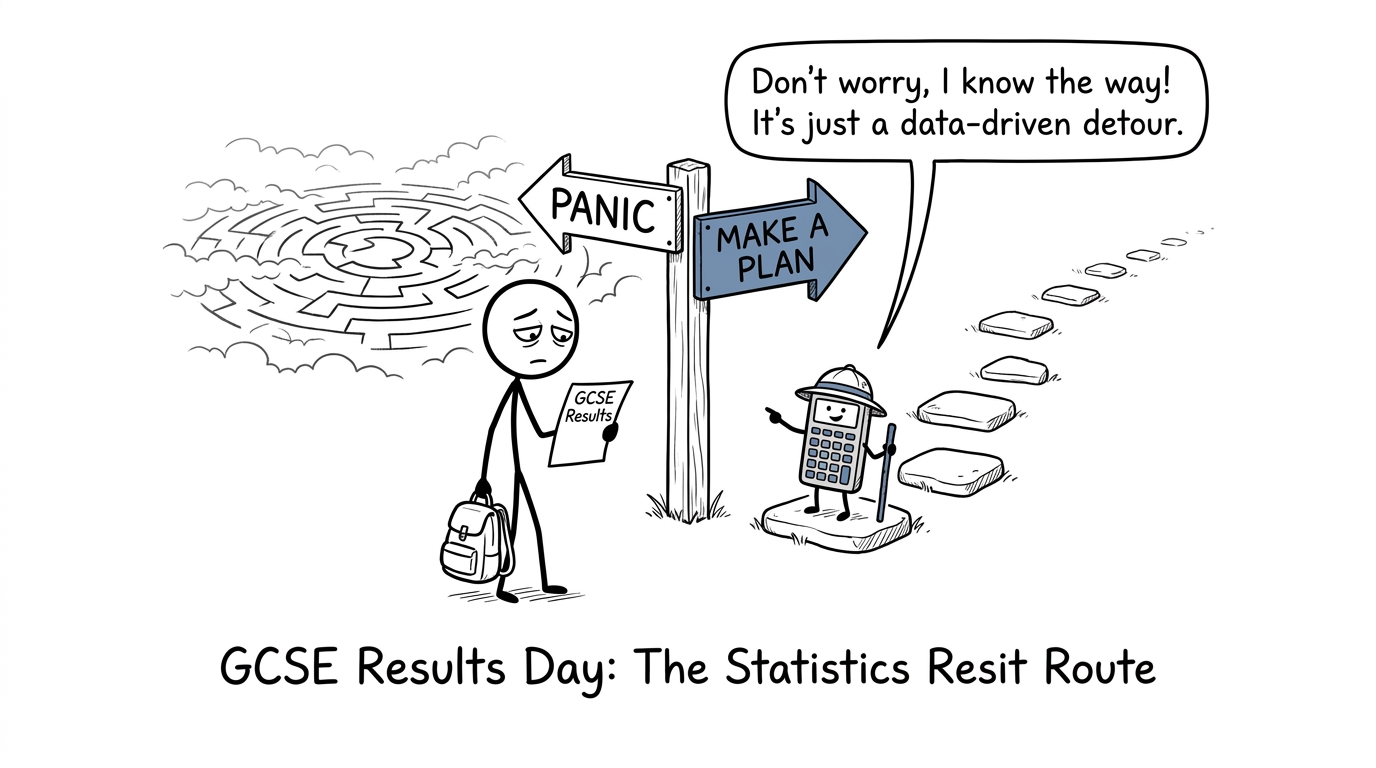 A student choosing a calm revision plan instead of a maze of panic
Your GCSE Statistics resit checklist
Before beginning revision, make sure you can answer these questions:
- Which exam board and specification did you take?
- Were you entered for foundation or higher tier?
- How many marks were you from your target grade?
- Can your teacher access your marked scripts?
- When is the entry deadline set by your school or examination centre?
- Which topics cost you the most marks?
- Which papers and mark schemes will you use for practice?
Do not assume that every GCSE Statistics course has the same content or paper structure. Resources for AQA, Edexcel and CCEA can be found through the GCSE Statistics exam-board pages. If you took Edexcel, use the dedicated Edexcel GCSE Statistics revision page to keep your practice matched to the specification and tier.
What to do immediately after results day
Ask whether your result should be reviewed
A disappointing result does not automatically mean the marking was wrong. Ask your teacher to compare your marks with the published grade boundaries and, where available, inspect your marked scripts.
Schools and colleges can request access to scripts and official post-results services with your consent. A review of marking can leave a mark unchanged, raise it or lower it, so discuss the evidence and any fee before proceeding. Deadlines change between examination series; contact your exams officer promptly rather than relying on a date found in an old article.
Confirm when you can retake Statistics
The November GCSE series is generally limited to GCSE English Language and GCSE Maths. GCSE Statistics is normally retaken in the following summer examination series. Ask your centre to confirm the current timetable, entry deadline, cost and whether it accepts private candidates.
Statistics is a separate qualification from GCSE Maths. Resitting GCSE Statistics will not change your GCSE Maths grade, and practising only ordinary Maths papers will not cover the full Statistics specification.
Keep the correct specification and tier
Find the exam-board logo and qualification code on a previous paper, statement of results or course document. Your school can confirm these details if you are uncertain. Also discuss whether your original tier remains appropriate. Foundation and higher papers have different grade ranges and demands, so this decision should be based on your target grade and current evidence rather than pride.
A milestone-based GCSE Statistics retake plan
A resit becomes manageable when it is divided into stages. The times below are flexible: shorten or extend each phase according to the date of your examination.
Milestone: diagnose before revising
During the first week, complete part of a paper or a broad set of questions without notes. Mark it carefully and sort every lost mark into one of four categories:
- missing knowledge;
- incorrect method;
- weak interpretation;
- avoidable examination error.
This distinction matters. A student who knows how to calculate a summary statistic but misreads the context has a different problem from a student who cannot select the method. Use the GCSE question bank to test individual areas rather than repeatedly attempting questions you already find comfortable.
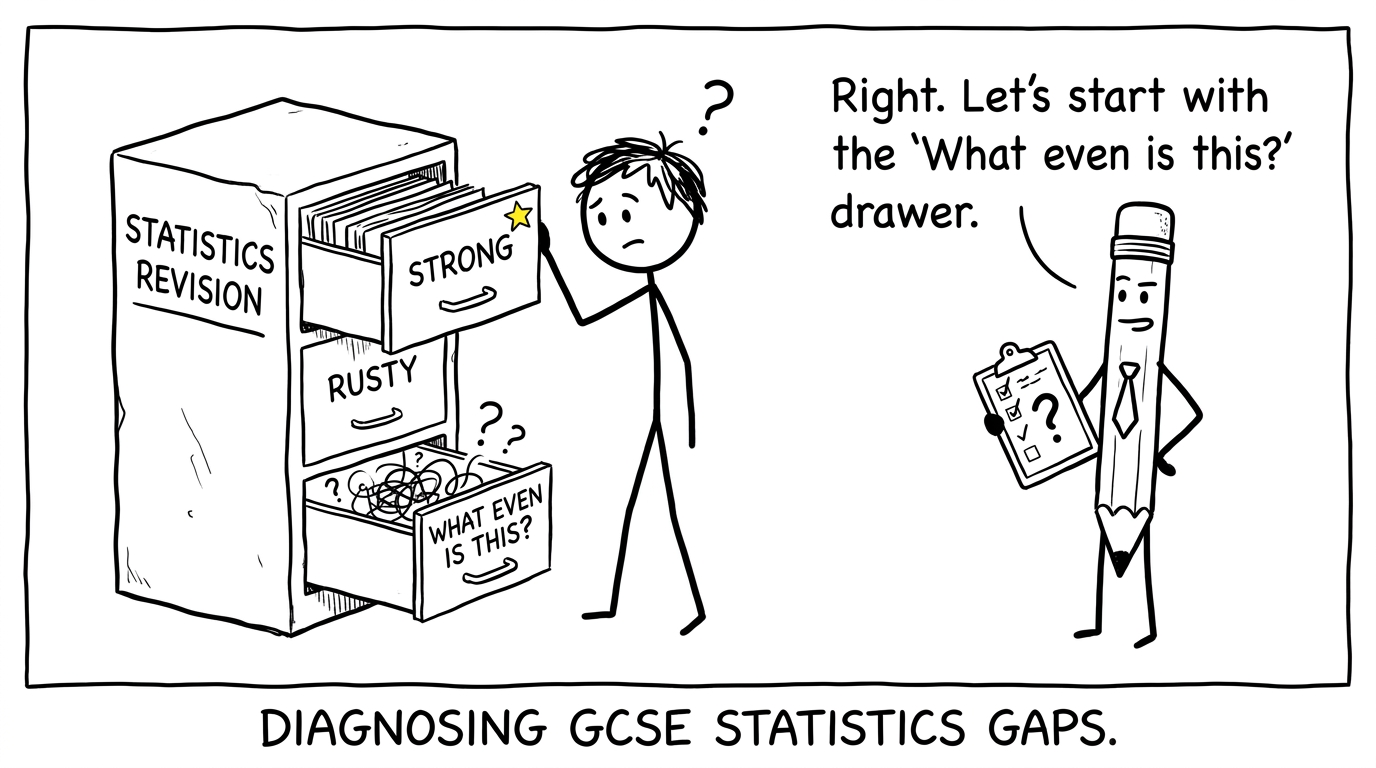 A humorous filing cabinet sorting Statistics topics into different levels of confidence
Milestone: rebuild the core topics
Spend the next four to six weeks revising in short, focused blocks. Your specification may include data collection, sampling, averages and spread, charts, probability, correlation, time series, index numbers and probability distributions.
A useful session has three parts: review the idea, answer questions without support, then check the mark scheme. Record the exact reason for each mistake. If standard deviation is a gap, for example, the standard deviation exam questions and solutions show how marks are allocated on Edexcel-style questions.
Do not revise Statistics as a list of calculator instructions. Examiners also reward conclusions in context, comparisons supported by data and evaluation of how information was collected. Practise writing complete statistical statements.
Milestone: connect topics under examination conditions
Once most individual topics feel secure, begin mixed practice. Complete sections from the Edexcel GCSE Statistics sample assessment paper or select the corresponding papers for your own board through the Statistics hub.
At first, work without a time limit and concentrate on choosing methods independently. Then introduce timed sections. Your target is not merely to finish quickly; it is to make sensible decisions while the clock is running.
If you are following CCEA and moving averages need attention, use the CCEA moving averages questions rather than substituting a resource from another specification.
Milestone: complete full past papers
In the final four to six weeks, sit complete papers using the permitted equipment and official time allowance. Keep unseen papers for this stage where possible.
After each attempt:
- mark it using the official mark scheme;
- correct every lost mark in a different colour;
- revisit the weakest topic with a worksheet;
- repeat difficult questions several days later;
- track raw marks without guessing future grade boundaries.
Use MathsGenie GCSE Statistics past papers and worksheets alongside mark schemes and solutions. The purpose of a past paper is diagnosis, not simply producing a score.
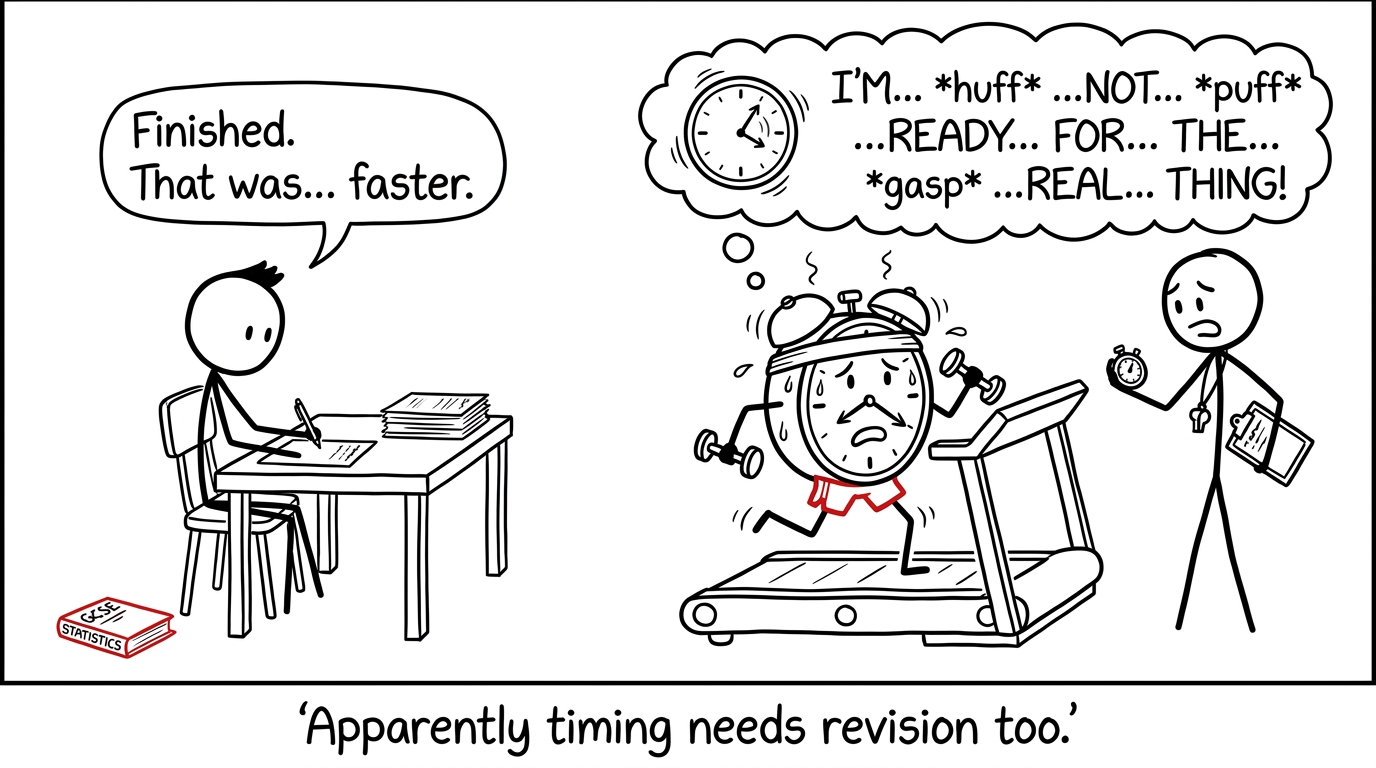 A student and an exhausted alarm clock practising timed examination papers
Common mistakes when resitting GCSE Statistics
Revising before analysing the first attempt
Starting again at the first page of a revision guide feels organised, but it may waste time. Begin with evidence from scripts, teacher feedback and diagnostic questions.
Memorising methods without interpreting results
Statistics is about what data can justify. Include units, refer to the context and avoid claiming that correlation proves causation.
Ignoring data collection and evaluation
Sampling, bias, reliability and questionnaire design can appear less technical than calculations. They still carry marks and require precise statistical language.
Using papers from the wrong board or tier
Some topics overlap, but wording, content and assessment structures differ. Always prioritise resources matched to your current specification.
Reading solutions instead of practising
A solution can look obvious after someone else has completed it. Close the notes and reproduce the reasoning independently. That small discomfort is where revision becomes learning.
Turn the first result into useful evidence
Resitting GCSE Statistics is not about repeating the same year more intensely. It is about making better decisions: diagnose accurately, repair one weakness at a time and practise full papers only when the foundations are ready.
Begin with the free MathsGenie GCSE Statistics resources. Choose your exam board, work through the worksheets and practice questions, then use past papers, mark schemes, video solutions, mini tests and predicted papers where available. Put each task into your revision planner and let consistent milestones carry you towards the retake.











