GCSE Statistics Grade Boundaries History: 2019-2025
GCSE Statistics grade boundaries history from 2019 to 2025, with AQA and Edexcel trends explained clearly for smarter revision and target-setting.
A grade boundary can feel like a finish line that moves while you are running towards it. Yet the GCSE Statistics grade boundaries history tells a more reassuring story: boundaries fluctuate because papers vary in difficulty, not because exam boards arbitrarily decide to make a grade harder to achieve.
Recent AQA and Edexcel figures do not show a simple upward trend. Boundaries were relatively low in the exceptional grading period around 202220222022, generally rose as grading returned to pre-pandemic standards, and then shifted again according to each paper. The practical lesson is simple: use past boundaries as a guide, never as a prediction.
GCSE Statistics grade boundary trends at a glance
- A grade boundary is the minimum total raw mark needed for a grade.
- AQA and Edexcel GCSE Statistics are each marked out of 160160160 across two papers.
- Foundation and higher tier have separate boundaries.
- There were no summer GCSE examinations in 202020202020 or 202120212021, so those years are not directly comparable.
- Summer 202220222022 used a more generous grading approach during the transition from pandemic arrangements.
- Summer 202320232023 returned to pre-pandemic grading standards.
- Boundaries can move up or down when the demand of the papers changes.
- Marks from different exam boards should never be compared as though the papers were identical.
You can see the complete figures on the AQA GCSE Statistics grade boundaries and Edexcel GCSE Statistics grade boundaries pages.
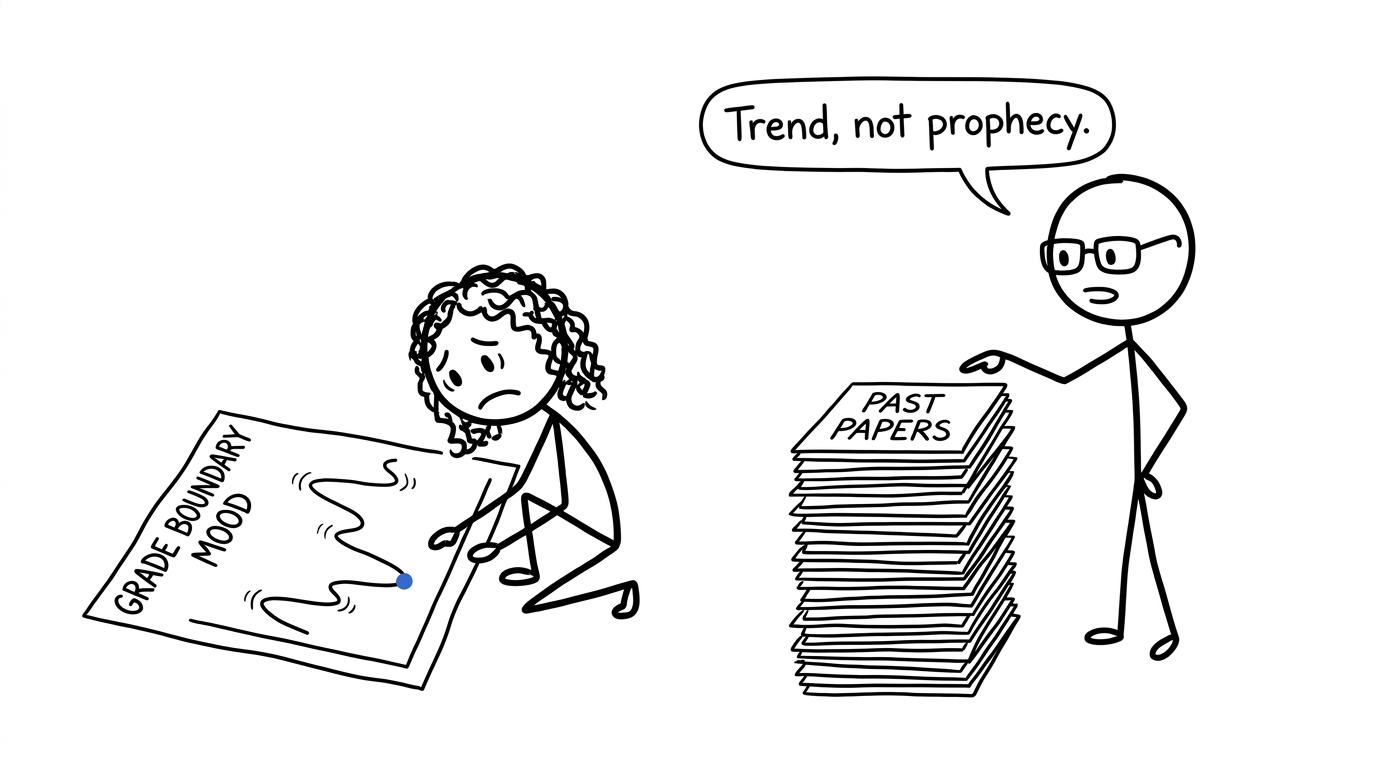 A student learning that a grade-boundary trend is not a prophecy
Past AQA GCSE Statistics grade boundaries
The table shows selected subject-level boundaries. Each figure is the total mark required across both papers, out of 160160160.
| Summer series | Foundation grade 555 | Foundation grade 444 | Higher grade 999 | Higher grade 777 | Higher grade 444 |
|---|---|---|---|---|---|
| 201920192019 | 939393 | 818181 | 139139139 | 114114114 | 555555 |
| 202220222022 | 878787 | 696969 | 113113113 | 828282 | 363636 |
| 202320232023 | 989898 | 757575 | 128128128 | 959595 | 404040 |
| 202420242024 | 108108108 | 858585 | 135135135 | 989898 | 424242 |
| 202520252025 | 106106106 | 828282 | 129129129 | 959595 | 383838 |
What changed on AQA?
AQA shows why one isolated boundary can be misleading. The higher-tier grade 999 boundary fell from 139139139 in 201920192019 to 113113113 in 202220222022, then rose to 128128128 in 202320232023. That large movement reflects both the assessments and the exceptional grading context of 202220222022.
The boundary reached 135135135 in 202420242024 before falling to 129129129 in 202520252025. Foundation followed a similar recent pattern: grade 444 rose from 757575 in 202320232023 to 858585 in 202420242024, then eased to 828282 in 202520252025.
This is fluctuation, not evidence that boundaries rise forever. Students following this specification can combine the figures with AQA GCSE Statistics revision resources, where past papers and mark schemes reveal what those totals actually require.
Past Edexcel GCSE Statistics grade boundaries
Edexcel also has a maximum total of 160160160 marks. Again, these are selected overall boundaries rather than notional boundaries for individual papers.
| Summer series | Foundation grade 555 | Foundation grade 444 | Higher grade 999 | Higher grade 777 | Higher grade 444 |
|---|---|---|---|---|---|
| 201920192019 | 959595 | 777777 | 122122122 | 888888 | 303030 |
| 202220222022 | 949494 | 767676 | 121121121 | 828282 | 242424 |
| 202320232023 | 898989 | 717171 | 120120120 | 848484 | 272727 |
| 202420242024 | 929292 | 707070 | 125125125 | 878787 | 282828 |
| 202520252025 | 878787 | 686868 | 121121121 | 808080 | 242424 |
What changed on Edexcel?
Edexcel’s boundaries were more stable than AQA’s across these selected years, although meaningful movement still occurred. The higher grade 999 boundary stayed between 120120120 and 125125125 from 202220222022 to 202520252025. The grade 777 boundary rose from 828282 in 202220222022 to 878787 in 202420242024, before dropping to 808080 in 202520252025.
At foundation tier, the grade 444 boundary declined from 777777 in 201920192019 to 686868 in 202520252025. That does not automatically mean the qualification became easier. A lower boundary often indicates that the assessment was more demanding for that cohort.
The Edexcel GCSE Statistics revision hub lets you place these numbers beside the corresponding papers, questions and mark schemes.
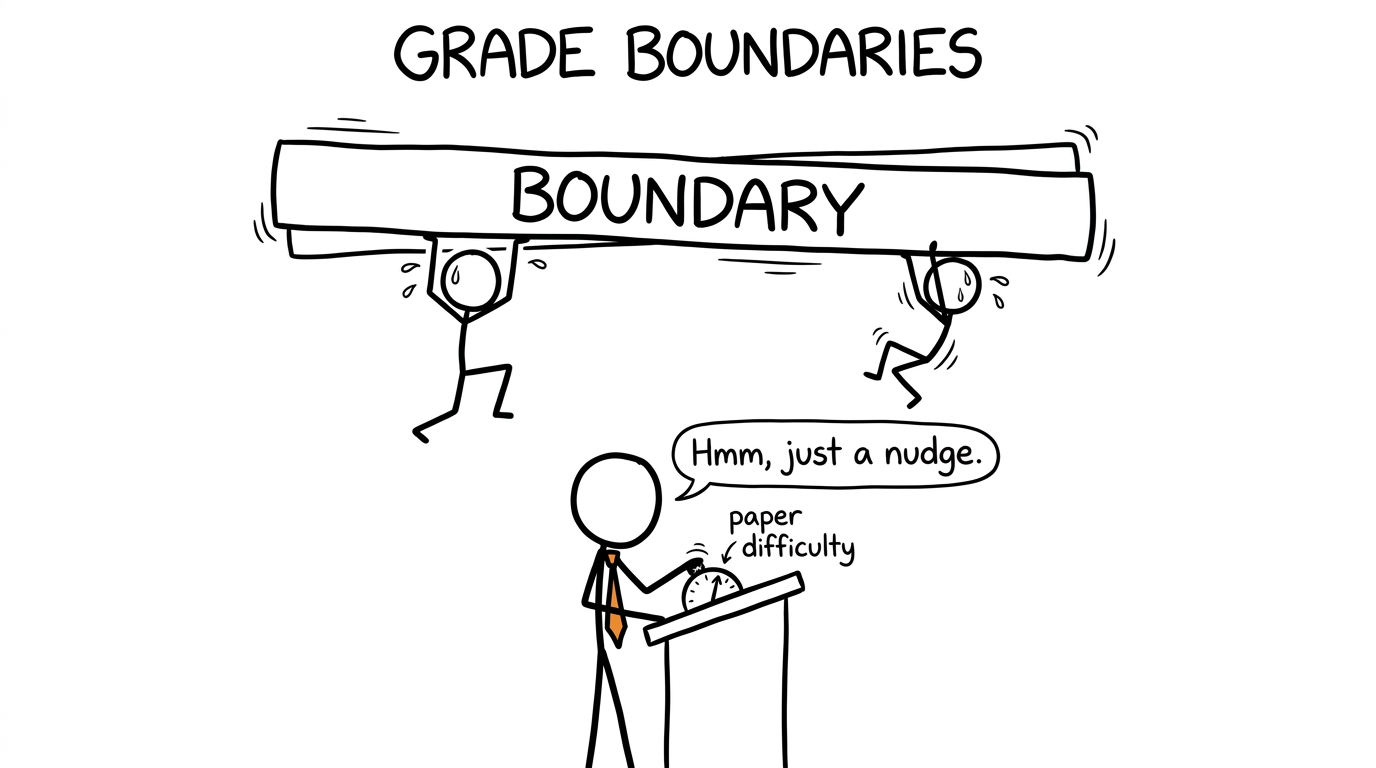 Examiners adjusting boundaries to account for paper difficulty
Why GCSE Statistics boundaries change
Exam boards set boundaries after students have taken the papers. Senior examiners consider statistical evidence and the quality of work produced around potential boundary marks. This helps maintain a comparable qualification standard when one paper is more or less demanding than another.
A raw mark can be converted into a percentage using:
percentage score=raw mark160×100\text{percentage score}=\frac{\text{raw mark}}{160}\times 100percentage score=160raw mark×100Percentages can make trends easier to compare within the same qualification. They still do not make AQA and Edexcel papers interchangeable, because their questions and assessment demands differ.
Ofqual advised schools not to use the exceptional autumn 202020202020, autumn 202120212021 or summer 202220222022 boundaries as the main indication of normal grading standards. For realistic target-setting, 201920192019 and the summer series from 202320232023 onwards provide more useful reference points.
How to use boundary history in revision
Choose the correct board and tier, then complete a whole paper under timed conditions. Mark it strictly and compare your total with several relevant boundaries rather than selecting the most favourable year.
Build in a margin above your target. Aiming at an exact historical boundary leaves no protection against careless errors or a future shift. More importantly, turn every lost mark into a topic for action. The GCSE Statistics revision centre brings together AQA, Edexcel and CCEA past papers, question banks and worksheets.
If data presentation is costing marks, revisit histograms revision. For quartiles and running totals, use the cumulative frequency revision guide. These focused repairs are more valuable than trying to guess next summer’s boundary.
Common mistakes when analysing boundaries
Treating a boundary as a forecast
A past boundary belongs to a particular paper and cohort. The next boundary is not fixed before the examination.
Comparing different boards directly
A mark of 100100100 on AQA does not represent precisely the same performance as 100100100 on Edexcel. Compare results within the correct specification.
Mixing foundation and higher figures
Foundation and higher are separate assessments with different boundaries. Always check the tier printed on the paper.
Using pandemic-era figures without context
The grading arrangements surrounding 202020202020 to 202220222022 were exceptional. Those figures should not be treated as a normal long-term baseline.
Chasing a boundary instead of improving topics
The boundary is outside your control. Your preparation is not. Use MathsGenie’s revision lessons, practice questions, mini tests, video solutions and mark schemes to make your score resilient.
Turn the trend into a revision plan
The history has no secret code. Boundaries move because assessment difficulty and grading context move. Strong preparation therefore means aiming beyond one remembered figure.
Start with the free GCSE Statistics past papers and revision resources. Complete the correct board and tier, mark every answer carefully, repair weak topics and return to another paper. MathsGenie’s past papers, predicted papers, practice questions and mark schemes turn an uncertain boundary into something more useful: a clear next step.