GCSE Spanish: Revise Every Day or Rest?
GCSE Spanish revise every day or rest? Learn why short, spaced practice plus planned recovery can improve recall without exhausting your revision routine.
Revision guilt has a strange rule: the day you rest is often the day you feel you should be working hardest. Yet if you are wondering whether to revise GCSE Spanish every day or rest, the best answer is not simply one or the other.
Short, frequent Spanish practice usually supports retention better than occasional cramming. But that does not mean completing a demanding session seven days a week. A sensible plan combines regular contact with Spanish, active recall, sleep and planned lighter days. Full rest days are valuable when you are tired, overwhelmed or balancing several GCSE subjects.
The aim is not to create an unbroken streak. It is to remember vocabulary, apply grammar and communicate clearly when the exam arrives.
The short answer
Use this checklist as your starting point:
- Practise Spanish on most days, rather than forcing an intense session every day.
- Keep ordinary sessions short enough to repeat consistently.
- Use active recall instead of repeatedly reading vocabulary lists.
- Revisit material after a gap so your memory has to work.
- Include at least one lighter day or complete rest day when needed.
- Protect sleep, particularly during exam season.
- Rotate listening, speaking, reading and writing.
- Leave enough time for maths and your other GCSE subjects.
A pattern of five focused sessions, one light-contact day and one complete rest day can work well. It is a framework, not a scientific prescription. Your school timetable, current confidence and proximity to the exams should shape the final plan.
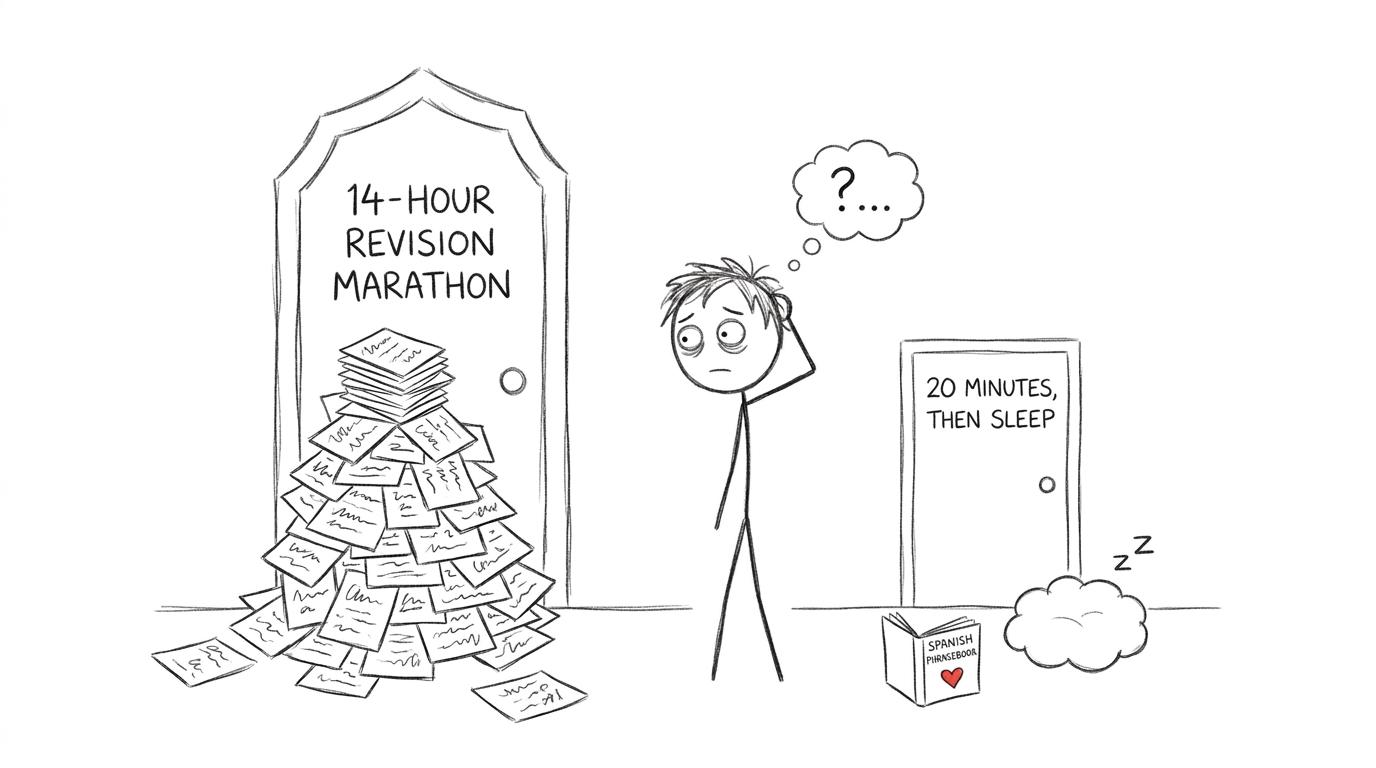 A student choosing between a revision marathon and a short session followed by sleep
Why daily contact can help GCSE Spanish
Language learning involves information that can fade when it is not retrieved: vocabulary, verb forms, grammatical structures, pronunciation and familiar sentence patterns. Meeting this material regularly makes forgetting less dramatic.
The important word is contact, not intensity. Ten minutes spent recalling vocabulary without notes can be more useful than an hour spent looking at a highlighted list. The first activity asks your brain to produce an answer. The second can create familiarity without proving that you could retrieve the word independently.
Research reviewed by the Education Endowment Foundation supports the potential value of retrieval practice and spacing learning over time. The EEF also advises caution: classroom implementation matters, and evidence does not justify pretending that one rigid schedule works for every pupil or every subject.
That distinction matters. Revising every day is not automatically effective. The quality, timing and difficulty of the activity matter more than preserving a streak on a calendar.
Spacing needs gaps
Spaced practice means returning to material across separate sessions rather than concentrating all your effort into one sitting. The gap is not wasted time. It creates some forgetting, which makes later retrieval more demanding.
For Spanish, you might retrieve a vocabulary set, leave it for several days and then test it again in a different order. Words recalled easily can wait longer. Words repeatedly forgotten should return sooner.
This is also a useful principle for maths. MathsGenie's GCSE maths revision timetable guide explains how spaced topic practice, feedback and timed questions can fit into a sustainable week.
Why rest days are part of learning
Rest is not the opposite of revision. It is one of the conditions that allows revision to remain useful.
Sleep supports attention and memory consolidation. UK guidance commonly suggests that teenagers need around 888 to 101010 hours of sleep, although individual needs vary. Cutting sleep to fit in late-night vocabulary work can leave you less able to concentrate, retrieve information and manage several exams the following day.
A rest day can also protect the next session. If seven compulsory study days make you abandon the plan after a fortnight, a six-day plan you can maintain is better. Consistency should be judged across weeks, not by whether every box was ticked.
There are two useful kinds of recovery:
- A light day: a brief vocabulary check, a short listening clip or saying a few prepared answers aloud.
- A full rest day: no Spanish revision, particularly after an exhausting school week, illness or a demanding mock exam.
Neither erases previous learning. The real danger is usually an unplanned gap that stretches for weeks, followed by panic-driven cramming.
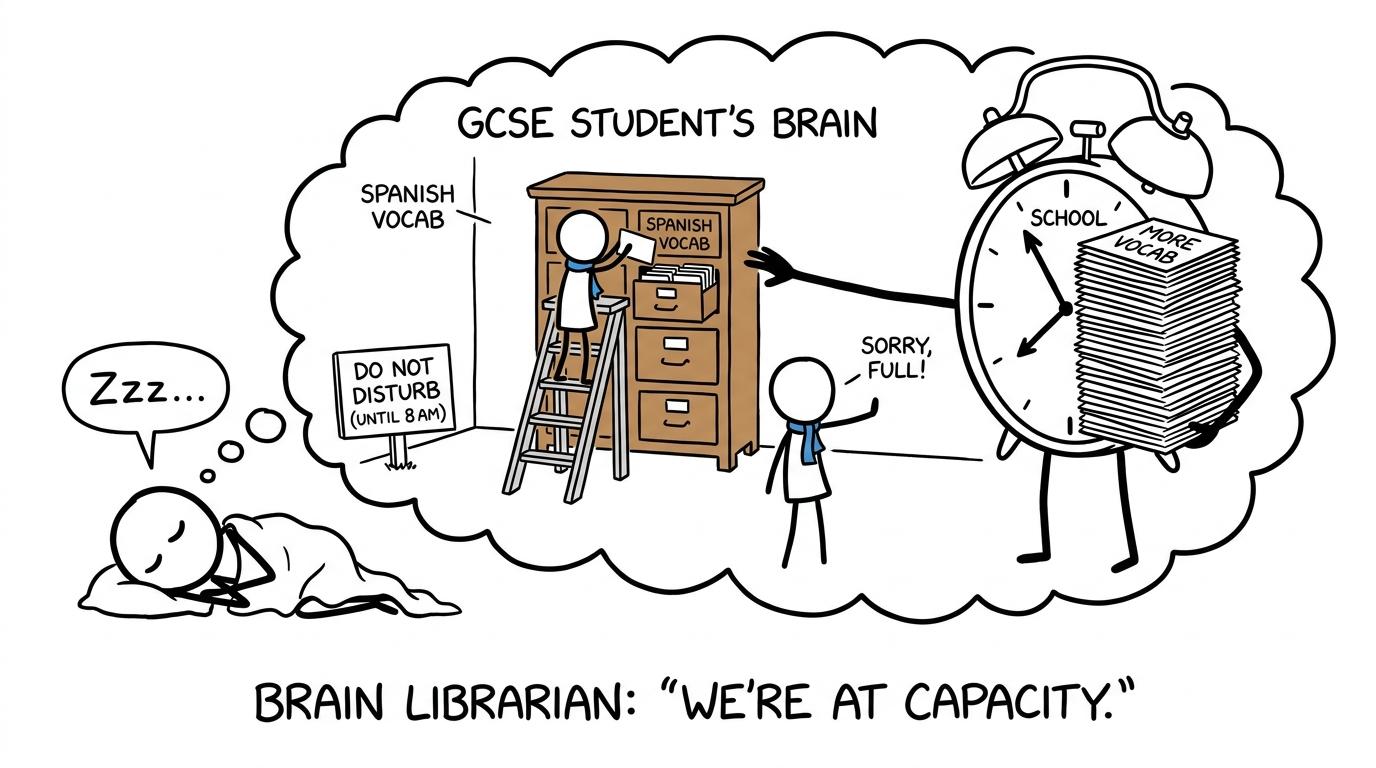 A brain librarian shelving Spanish vocabulary while a student sleeps
A balanced weekly GCSE Spanish schedule
The following rhythm provides frequent retrieval without treating every day as a test of endurance.
| Day | Suggested focus |
|---|---|
| Monday | Short vocabulary retrieval and pronunciation |
| Tuesday | Listening practice followed by checking errors |
| Wednesday | Grammar retrieval and a brief writing task |
| Thursday | Rest or very light contact |
| Friday | Speaking practice and spontaneous responses |
| Saturday | Longer mixed session using exam-style material |
| Sunday | Complete rest or a short review of difficult items |
Ordinary sessions might last around fifteen to thirty minutes. A weekend session could be longer if your concentration remains strong. The closer you get to an assessment, the more you can introduce timed tasks, but increasing pressure should not remove sleep or recovery.
This pattern is deliberately flexible. If Thursday contains after-school activities, make that the rest day. If Saturday is busy, move the mixed session. A schedule only works when it survives contact with your real life.
Maths students can use the same principle through MathsGenie's twenty-minute GCSE revision routine. A small, defined task is easier to begin and easier to repeat than the vague instruction to “revise everything”.
What to do during each Spanish session
GCSE Spanish assesses several different capabilities. Current specifications vary by exam board and examination year, so check whether you follow AQA, Edexcel, OCR or Eduqas and use the correct specification. Listening, speaking, reading and writing all require attention; for example, the current AQA specification allocates 25%25\%25% to each of those four areas.
A useful session should have one clear purpose:
Retrieve before looking
Begin without notes. Recall vocabulary, write down a verb form, describe a photograph aloud or list phrases connected to a theme. Then check your answers carefully.
Retrieval works best with feedback. If you reproduce the wrong spelling repeatedly and never correct it, practice can strengthen the error rather than repair it.
Mix recognition with production
Recognising a Spanish word in a multiple-choice question is not the same as producing it in speaking or writing. Include tasks that make you generate language independently.
Speaking also needs actual speech. Silently planning an answer cannot fully test pronunciation, pace or whether you can continue after forgetting a word.
Rotate the four skills
Do not turn every session into vocabulary flashcards. Vocabulary supports the course, but it must eventually work inside listening extracts, translations, conversations and written responses. Rotate your focus and periodically combine the skills in exam-style tasks.
Keep a small error list
Record specific weaknesses, such as confusing two words, missing adjective agreement or losing accuracy in a particular tense. Your next session should begin with one of those errors.
This attempt, check, repair and retest cycle is equally important in maths. The MathsGenie GCSE maths revision hub brings together free revision lessons, practice questions, exam papers and solutions for foundation and higher tier students.
How to balance Spanish with GCSE maths
The hidden problem with a seven-day Spanish plan is opportunity cost. Time spent on one subject cannot also be spent repairing weaknesses elsewhere. GCSE preparation is a portfolio, not a single project.
Start by identifying what each subject actually needs. Spanish may benefit from frequent, short retrieval because vocabulary and pronunciation fade without contact. Maths may require a longer block for learning a method, completing exam questions and checking a mark scheme.
A practical evening could therefore contain one brief Spanish task and one focused maths task. On another evening, Spanish can be the main subject while maths receives a small maintenance session. You do not need to give every subject equal time every day.
As the maths exams approach, use GCSE past paper timing guidance to move gradually from topic practice towards timed papers. MathsGenie's one-month maths revision plan can also help you decide where lessons, mini tests, mark schemes and paper practice belong.
The principle is simple: maintain Spanish regularly, but let your weakest subjects and nearest exams influence where the longer blocks go.
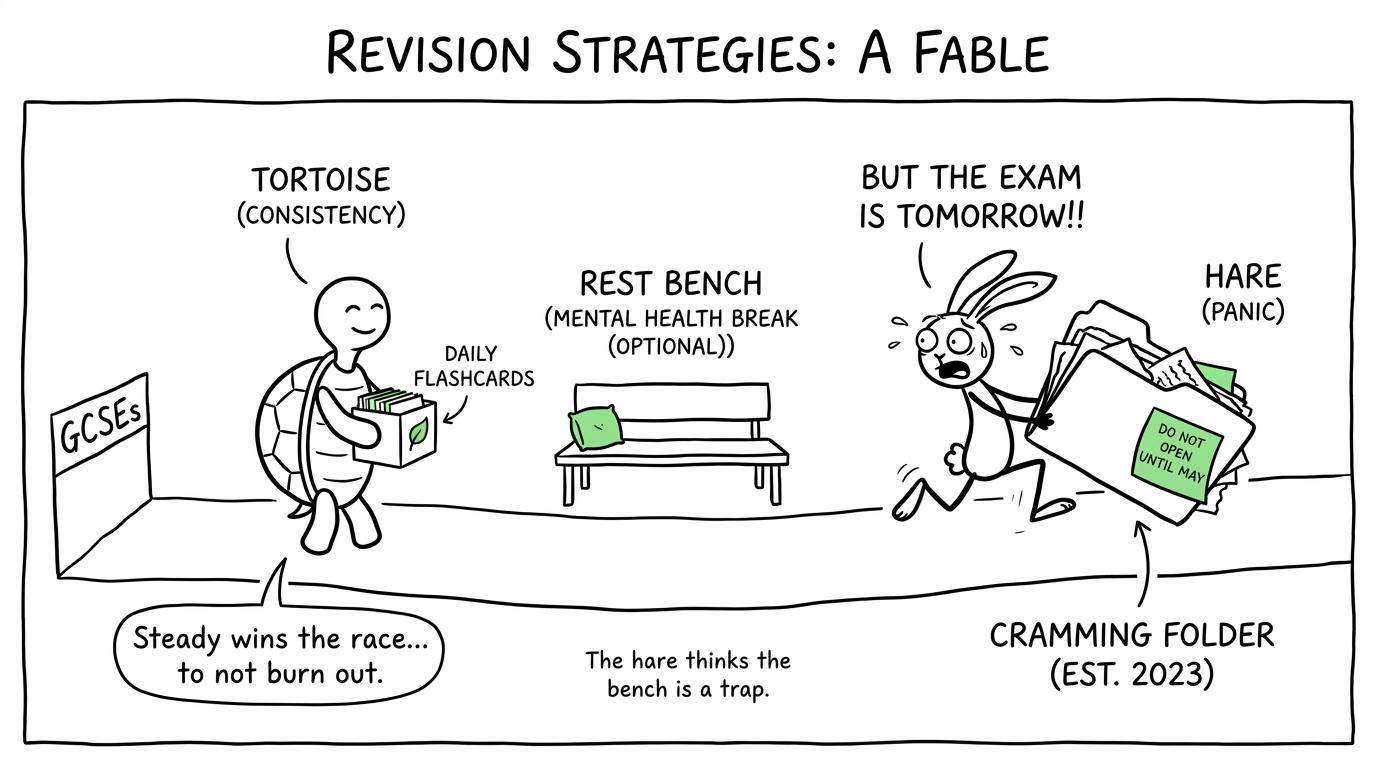 A calm flashcard tortoise racing a frantic cramming hare
Signs that you need a rest day
Take a lighter or complete rest day when:
- you are repeatedly reading without processing;
- simple mistakes are increasing because you are exhausted;
- revision is pushing bedtime later;
- anxiety is making every session less productive;
- you are ill or struggling to concentrate;
- your schedule has become impossible to sustain.
One poor session does not always mean you need to stop. Sometimes changing activity is enough: switch from writing to listening, or from a full task to a short retrieval check. But persistent exhaustion is not a challenge to defeat through more exhaustion.
Near an exam, the same restraint matters. MathsGenie's night-before GCSE plan prioritises focused practice, preparation and sleep rather than a final marathon.
Common revision mistakes
Treating a streak as proof of learning
A calendar shows attendance, not retention. Test what you can recall and use rather than counting consecutive days.
Revising only the comfortable skill
Students who enjoy reading may avoid speaking. Others memorise prepared speaking answers but neglect listening. Your plan should include the skill you would most like to escape.
Making every session too long
If your minimum session requires unusual motivation, it is too large. Keep a short version available for busy school days.
Rereading instead of retrieving
Notes and vocabulary lists are useful for checking, but they should not dominate. Close the page, attempt the task and then correct it.
Sacrificing sleep
Late-night revision can feel committed while reducing next-day attention. Set a stopping time. Sleep should be treated as part of exam preparation.
Ignoring other GCSE subjects
Spanish is one part of your timetable. Reserve space for mathematics, English, science and your other options. For shorter maths practice, MathsGenie's forty-five-minute tests can help you build paper skills without always completing a full paper.
Build a rhythm you can keep
So, should you revise GCSE Spanish every day or take rest days? Aim for regular contact on most days, but plan recovery rather than waiting for burnout to choose it for you. Short retrieval sessions, feedback, spaced revisits and sufficient sleep are more valuable than an impressive but fragile streak.
Then give every subject the kind of practice it needs. For maths, start with the free MathsGenie revision lessons and practice questions, use mini tests to expose gaps, and progress to past papers and predicted papers. Mark your work, watch the video solutions and return to mistakes after a gap.
A sustainable plan rarely looks heroic. It simply keeps bringing you back to the right task, rested enough to learn from it.