GCSE Spanish Foundation vs Higher: Key Differences
GCSE Spanish foundation vs higher explained: compare grades, vocabulary, grammar, exam tasks, risks and how to choose the right tier with confidence.
A tier decision can feel like a judgement on your ability. It is not. It is an exam-entry decision about which paper gives you the strongest chance of earning the best grade your current Spanish can support.
The essential difference in GCSE Spanish Foundation vs Higher is that Foundation targets grades 111 to 555, while Higher targets grades 444 to 999. But the change goes further than a harder vocabulary list. Higher assessments use more complex language, longer or less supported tasks and greater expectations of independence, range and accuracy. You must normally take listening, speaking, reading and writing at the same tier.
The reformed GCSE Spanish specifications, first assessed in summer 202620262026, are offered by boards including AQA, Pearson Edexcel and Eduqas. Exact timings and task formats vary, so check your own specification rather than relying on a friend's paper.
Foundation vs Higher at a glance
| Feature | Foundation tier | Higher tier | | --- | --- | | Main grade range | Grades 111 to 555 | Grades 444 to 999 | | Highest available grade | Grade 555 | Grade 999 | | Vocabulary expectation | Approximately 1,2001{,}2001,200 lexical items | Approximately 1,7001{,}7001,700 lexical items | | Language complexity | Familiar vocabulary and more limited complexity | Broader vocabulary and more complex structures | | Speaking assessment | Usually 777 to 999 minutes | Usually 101010 to 121212 minutes | | Reading and listening | Shorter or more accessible material | Longer, denser and more demanding material | | Writing | More structured and shorter responses | Longer, more independent responses | | Tier entry | All components at Foundation | All components at Higher | | Main risk | Your result is capped at grade 555 | Falling below the available grade range can lead to a U |
A student just below the grade 444 standard on Higher may receive an allowed grade 333 if their mark falls within the narrow safety-net range. This is not a guaranteed fallback. A lower mark receives an unclassified result.
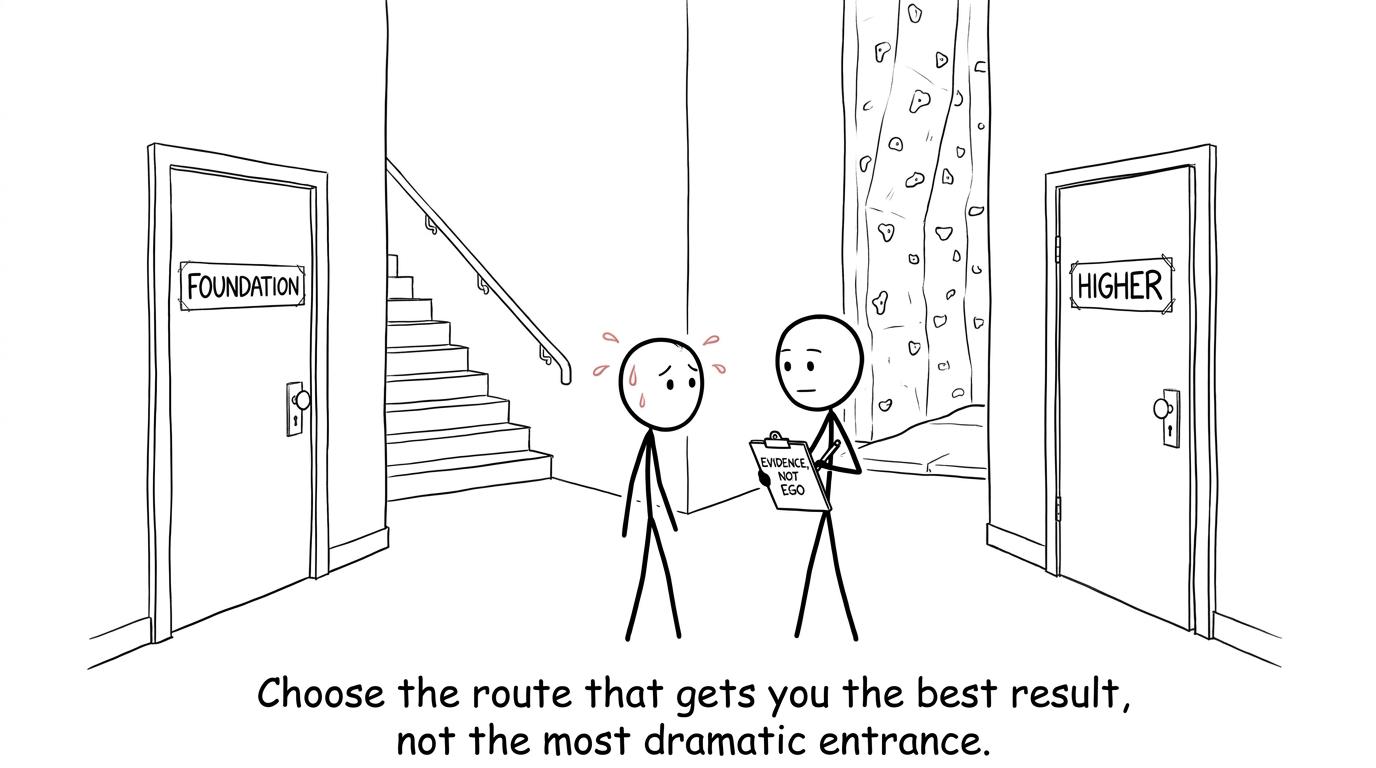 A student choosing between Foundation and Higher Spanish using evidence rather than ego
What stays the same on both tiers
Both tiers assess the same four broad skills: listening, speaking, reading and writing. Under the current specifications, each component contributes 25%25\%25% of the qualification. Neither tier allows you to ignore a weak skill and compensate entirely through another.
Students also encounter broadly shared themes, such as people and lifestyle, popular culture, communication and the wider world. The precise headings differ between exam boards, but Foundation is not a separate course about easier topics. A conversation about school, holidays or technology may appear on either tier. What changes is the language used and the depth of response expected.
Both tiers also assess pronunciation, grammar, vocabulary and the ability to communicate meaning. Current specifications include tasks such as dictation, reading aloud, role play, picture-based discussion and translation, although the order and detailed format depend on the board.
The vocabulary gap is specific, not unlimited
The current subject content gives Foundation students a defined vocabulary base of approximately 1,2001{,}2001,200 lexical items. Higher students learn that core plus roughly 500500500 further items, producing a total of approximately 1,7001{,}7001,700.
That does not mean every word in a paper must come directly from a memorised list. Specifications make limited provision for language such as inflected forms, derivations, proper nouns and words whose meaning can be inferred. AQA's dictation, for example, may contain a small number of words beyond its prescribed list.
The practical difference is that Higher students must recognise and produce a wider range of language with less hesitation. Foundation rewards secure control of common language. Higher keeps that foundation but asks students to cope when the wording is less predictable.
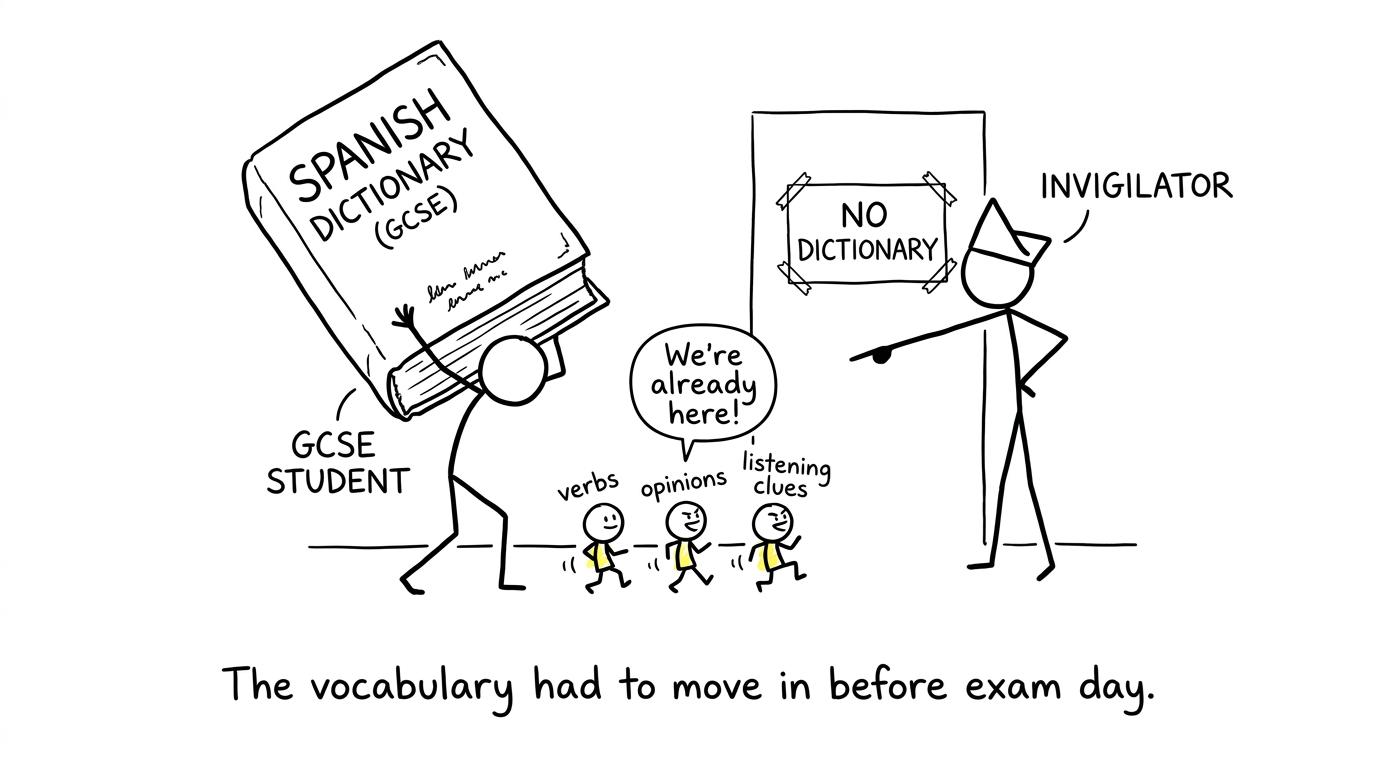 A GCSE student discovering that a dictionary cannot do the revision for them
Grammar changes in range and independence
Higher is not simply Foundation spoken faster. The grammatical demand changes too.
At Foundation, success comes from using familiar structures accurately: clear verb forms, agreements, opinions, reasons and references to different time frames. At Higher, students need to understand and use a broader grammar range, connect ideas more naturally and sustain accurate language across longer responses.
The important distinction is between recognising a structure and producing it independently. You might understand a complex sentence in a reading passage but struggle to create one under writing-exam pressure. Higher requires more of both.
This is similar to tiering in maths: knowing an isolated rule is different from selecting it inside an unfamiliar problem. MathsGenie's guide to GCSE maths topics by board and tier explains the same underlying principle: Higher includes secure core knowledge as well as additional demand.
How each Spanish paper changes
Listening
Higher listening tends to contain more language, greater complexity and more details to separate. Students may need to identify attitude, distinguish similar options or retain information across a longer extract.
Timings are not identical across boards. On current AQA papers, listening lasts approximately 353535 minutes at Foundation and 454545 minutes at Higher, including reading time. Pearson Edexcel uses different durations under its current specification. Always practise with papers for your board and tier.
Dictation also tests more than recognising the general message. You need to turn sound into accurate written Spanish, including grammatical endings and spelling.
Speaking
The Foundation speaking assessment lasts 777 to 999 minutes, while Higher lasts 101010 to 121212 minutes. Both tiers receive supervised preparation time, currently 151515 minutes on the new AQA, Edexcel and Eduqas specifications.
Higher candidates generally face longer interactions and must maintain communication for longer. The difference is not a requirement to sound like a native speaker. It is about responding clearly, developing answers, handling less predictable questions and showing a suitable range of language.
Reading
Higher reading uses more complex texts and demands greater confidence with inference, grammar and unfamiliar combinations of familiar words. Translation from Spanish into English is also longer: current requirements set a minimum of approximately 353535 words at Foundation and 505050 words at Higher.
Foundation reading is still not a simple vocabulary-matching exercise. Students must read precisely, notice negatives and time references, and avoid adding details that the text never gives.
Writing
Writing reveals one of the clearest structural differences. Foundation offers more scaffolding and shorter tasks; Higher expects extended, independent communication.
On current AQA papers, Foundation includes short sentences responding to a photograph, an approximately 505050-word task, grammar questions, translation and an approximately 909090-word overlap task. Higher includes translation, the overlap task and an open-ended response of approximately 150150150 words. Edexcel and Eduqas arrange their tasks differently, but the broad movement from supported writing to sustained writing remains.
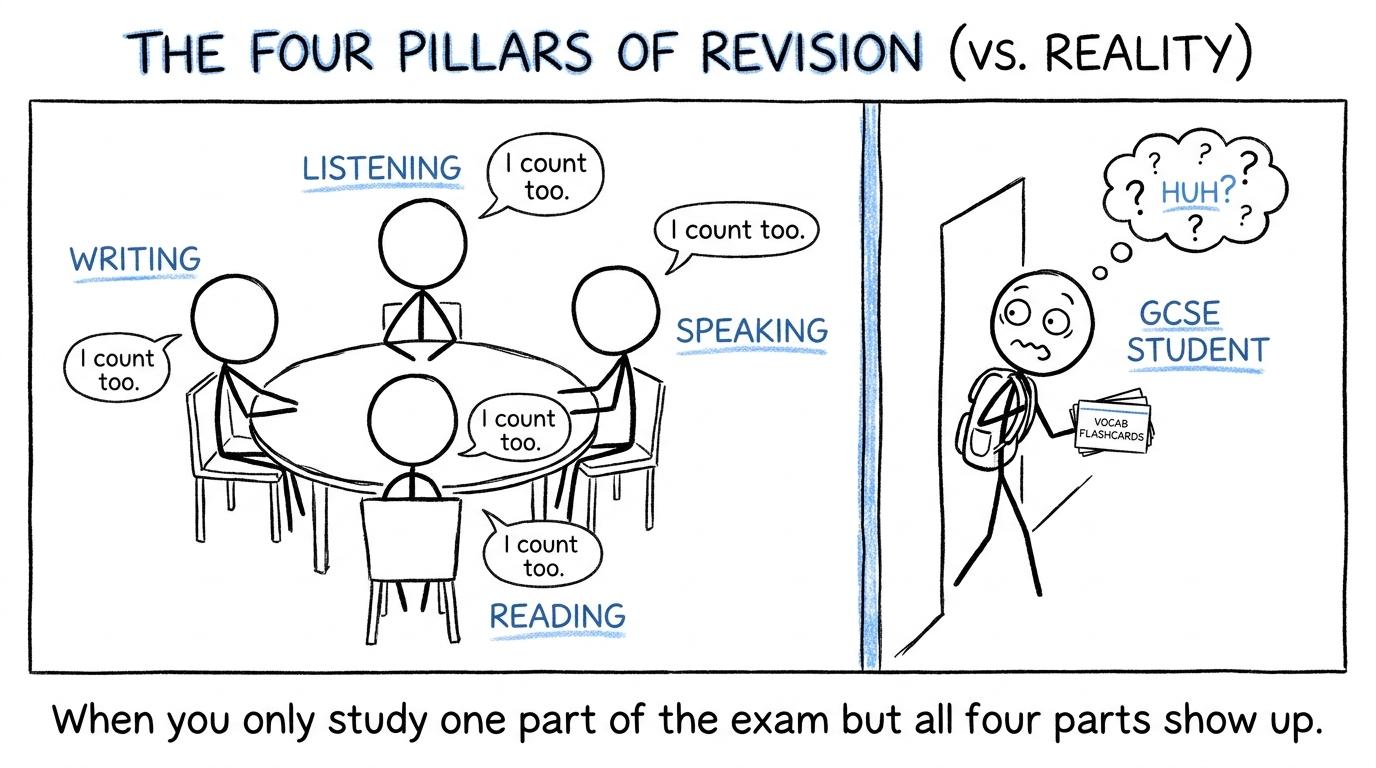 Listening, speaking, reading and writing reminding a student that they all count
Is a grade 5 better on Higher than Foundation?
No. A grade 555 has the same value whichever tier you sat, and the tier is not printed on your certificate. Exam boards are required to maintain comparable standards for grades available on both tiers.
This matters because Higher is not automatically the more impressive entry. If grade 555 is your realistic target, Foundation can provide a more accessible route without reducing the value of that grade. Higher becomes necessary when grade 666 or above is a realistic aim.
Grade boundaries change between exam series, so do not make your decision using an old raw-mark percentage alone. Use several current specification papers, teacher assessments and performance across all four skills.
How to choose the right tier
A sensible tier decision considers evidence rather than one unusually good or bad mock.
Use this checklist:
- Confirm your exam board and current specification.
- Compare results from several timed assessments.
- Review listening, speaking, reading and writing separately.
- Ask whether grade 666 or above is a realistic target.
- Check whether you can complete Higher tasks, not merely understand parts of them.
- Discuss your evidence with your Spanish teacher before entries are finalised.
A student consistently working around grades 444 or 555 is not automatically better served by Higher. Foundation may offer a safer route to the same grade. Conversely, a student demonstrating secure grade 666 performance should not accept a grade-555 ceiling without discussing Higher entry.
The diagnostic process is familiar to MathsGenie students. The guide to finding your weakest GCSE topics shows how to replace guesswork with marked evidence. You can organise that evidence using the free revision planner.
Revise for the tier you will actually sit
Once your tier is confirmed, make most practice match it. Learn the specified vocabulary and grammar, then complete tasks in the real format and within the correct time.
Use a simple cycle:
- attempt a timed task;
- mark it using the official mark scheme;
- record the exact reason each mark was lost;
- practise that language or exam skill;
- retest it using a different task.
Do not spend every session rereading vocabulary. Retrieval, dictation, spoken responses and timed writing expose different weaknesses. The four skills need four forms of practice.
For a manageable routine, adapt MathsGenie's 20-minute GCSE revision method. As exams approach, the one-month GCSE revision plan provides a useful structure for combining targeted practice with timed assessment.
Common mistakes when comparing the tiers
Assuming Higher gives extra credit simply for being Higher. It does not. Your final grade matters, not the label on the paper.
Believing Foundation contains only basic recall. Foundation still assesses translation, dictation, grammar, spontaneous speaking and accurate communication.
Choosing from one total mock mark. A total can hide a serious weakness in speaking or listening. Look at each component.
Using resources from the old specification. Students taking the reformed qualification need materials matching first assessment from 202620262026, including the current reading-aloud and dictation requirements.
Mixing exam boards. AQA, Edexcel and Eduqas share national requirements but differ in timings, task order and paper design.
Treating past papers as the end of revision. The improvement happens after marking. MathsGenie's guide to using past papers properly explains how to turn errors into a focused revision list.
Make the tier decision, then build the result
Foundation and Higher are different routes through the same qualification. Foundation limits the maximum grade to 555 but offers tasks targeted across grades 111 to 555. Higher opens grades 666 to 999, while increasing the language range, task length and risk at the lower end.
Choose using repeated evidence, your target grade and advice from the teacher who has seen all four of your skills. Then stop revisiting the label and start improving the performance.
For your maths exams, use the same disciplined approach. Start at the free GCSE Maths revision hub, identify the right board and tier, and combine revision lessons, practice questions and mini tests with mark schemes and video solutions. When your foundations are secure, move into timed past papers and Edexcel GCSE predicted papers. The route matters, but what you repeatedly practise matters more.