

GCSE Spanish Examiner Reports: What They Reveal
GCSE Spanish examiner reports reveal recurring mistakes in listening, speaking, reading and writing. Turn their feedback into smarter revision habits.
An exam can feel mysterious from the student side of the desk. You revise vocabulary, practise answers and hope the recording is kind. Then, months later, examiners publish a document explaining where candidates lost marks and what stronger responses did differently.
That is the real value of GCSE Spanish examiner reports. Across recent reports, the recurring messages are remarkably practical: read every instruction, answer precisely, secure basic vocabulary, recognise distractors, communicate across different time frames and avoid writing more than the task requires.
One important qualification applies in 202620262026. Revised GCSE Spanish specifications were first taught from September 202420242024 and assessed for the first time in summer 202620262026. Reports from earlier series still reveal valuable habits, but their exact task formats may belong to the previous specification. Always compare advice with the specification and sample assessment materials for your own board.
The examiner-report checklist
If you only remember the essentials, make them these:
- Check your exam board, tier and specification before using a report.
- Treat basic vocabulary as examinable, not too easy to revise.
- Read the rubric, command and bullet points before answering.
- Expect distractors, negatives, changes of opinion and paraphrases.
- Give precise answers rather than copying large sections.
- In speaking, respond naturally instead of forcing in a memorised script.
- In writing, cover every required point before adding complexity.
- Practise grammar in context, especially verbs, agreement and time frames.
- Turn every repeated examiner comment into a specific revision action.
The principle is familiar to anyone who uses a mark scheme well. Feedback is not there merely to describe the past. It is there to change what you do next.
What GCSE Spanish examiner reports actually contain
An examiner report is written after scripts and speaking assessments have been marked. Principal examiners summarise how candidates approached particular questions, identify common misunderstandings and explain what tended to distinguish successful responses.
A report is not a secret list of next year's questions. Nor is every criticism relevant to every candidate. It is better understood as a map of recurring pressure points: the moments when knowledge has to survive time pressure, unfamiliar wording and the temptation to rush.
Recent Eduqas reports, for example, have highlighted secure knowledge of basic vocabulary, careful reading of rubrics, concise responses, translation, grammatical accuracy and appropriate coverage of writing prompts. Pearson's published assessment feedback similarly stresses short, relevant comprehension answers and translations that make sense as complete language. These patterns matter more than any isolated difficult word.
From the first assessment of the revised specifications in summer 202620262026, the precise assessment model has changed. For example, current AQA Spanish contains listening, speaking, reading and writing components, each worth 25%25\%25%, with dictation in listening and reading aloud in speaking. Pearson Edexcel and Eduqas also introduced revised qualifications for first assessment in 202620262026. Use older reports for durable lessons, but use current sample papers for the exact format.
Listening: the answer is often hidden behind a distractor
Listening reports repeatedly show that recognising one familiar word is not enough. A recording may mention two activities before revealing which one the speaker actually prefers. It may begin positively and then change direction. A negative can reverse the meaning of an otherwise familiar sentence.
Examiners commonly flag:
- selecting an answer after hearing a matching keyword;
- missing negatives or changes of opinion;
- confusing numbers, times, dates and quantities;
- giving several possibilities when one precise answer is required;
- leaving an answer blank instead of making an informed attempt.
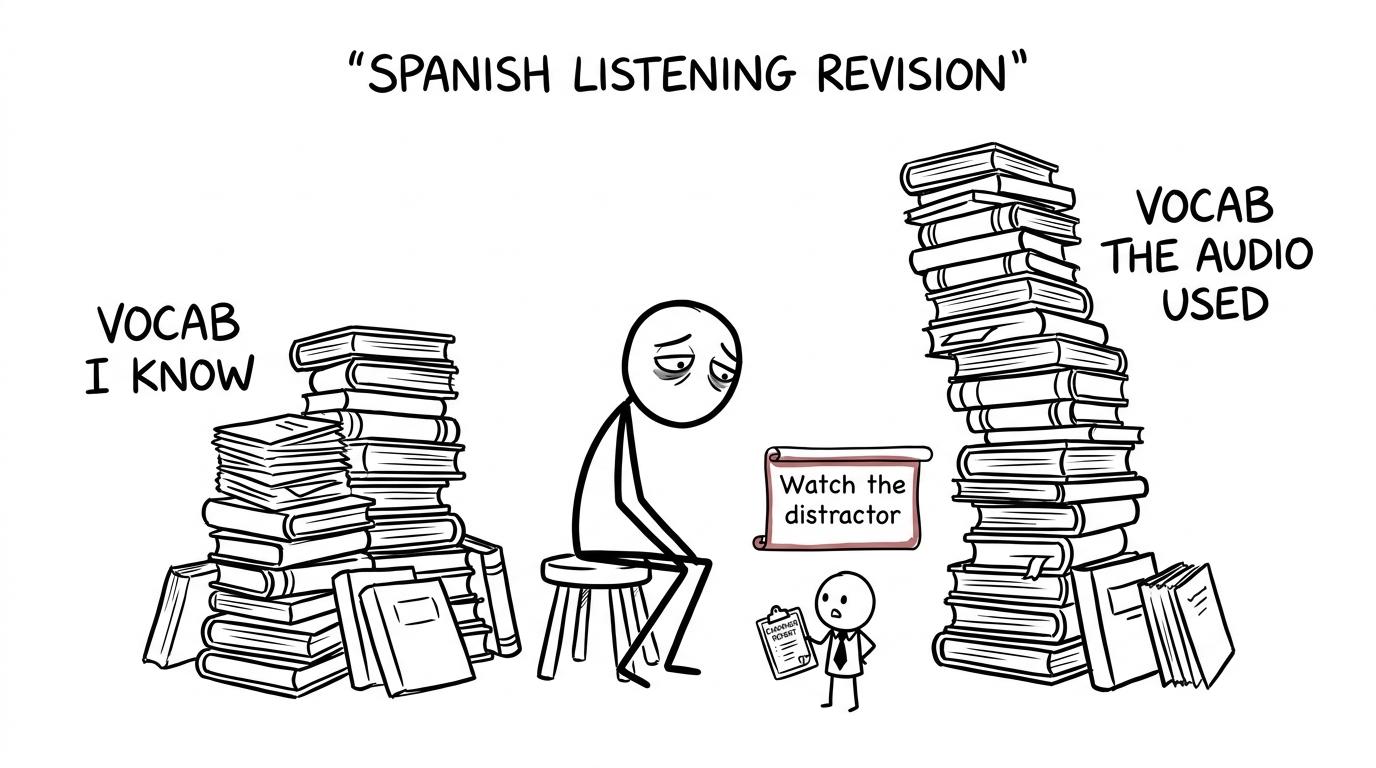 A student discovers that Spanish listening vocabulary has brought a distractor
Smarter revision therefore means practising meaning, not just word recognition. During the reading time, identify what each question wants: a reason, opinion, person, place or time. While listening, wait for the whole relevant idea before committing yourself.
The revised specifications make sound-to-spelling knowledge even more visible through dictation tasks. Practise common sound patterns, accents where required and grammatical endings. Hearing a verb is useful; hearing whether it refers to the present, past or future is better.
Reading and translation: precision beats copying
Reading questions often look safer because the text remains on the page. That safety can be deceptive. Reports regularly describe candidates copying too much, overlooking a small qualifying word or answering a nearby question rather than the one asked.
The most reliable habits are simple:
- identify the exact information requested;
- look for paraphrase rather than expecting identical wording;
- check pronouns, negatives and time markers;
- keep comprehension answers concise;
- reread your translation as natural English.
A translation should communicate the meaning of the complete passage. Word-by-word substitution can produce an English sentence that does not make sense, particularly when idioms, reflexive verbs or Spanish word order are involved. If your version sounds unnatural, return to the clause and ask what it means as a whole.
Current reading assessments may also test the ability to infer a plausible meaning from context. That does not require a lucky guess. Use the surrounding sentence, familiar word families and the grammatical role of the unknown word.
Speaking: communication is not a memorised monologue
Speaking reports tend to reward candidates who listen, respond and develop ideas. Strong performance is not the same as delivering the longest possible answer. A role-play may need a short, accurate response, while a discussion gives more room for opinions, reasons and varied language.
Common weaknesses include:
- one-word answers where development is possible;
- responses that do not match the question asked;
- over-rehearsed material forced onto the wrong topic;
- weak pronunciation that obscures meaning;
- dependence on one time frame;
- losing time by overdeveloping an early task.
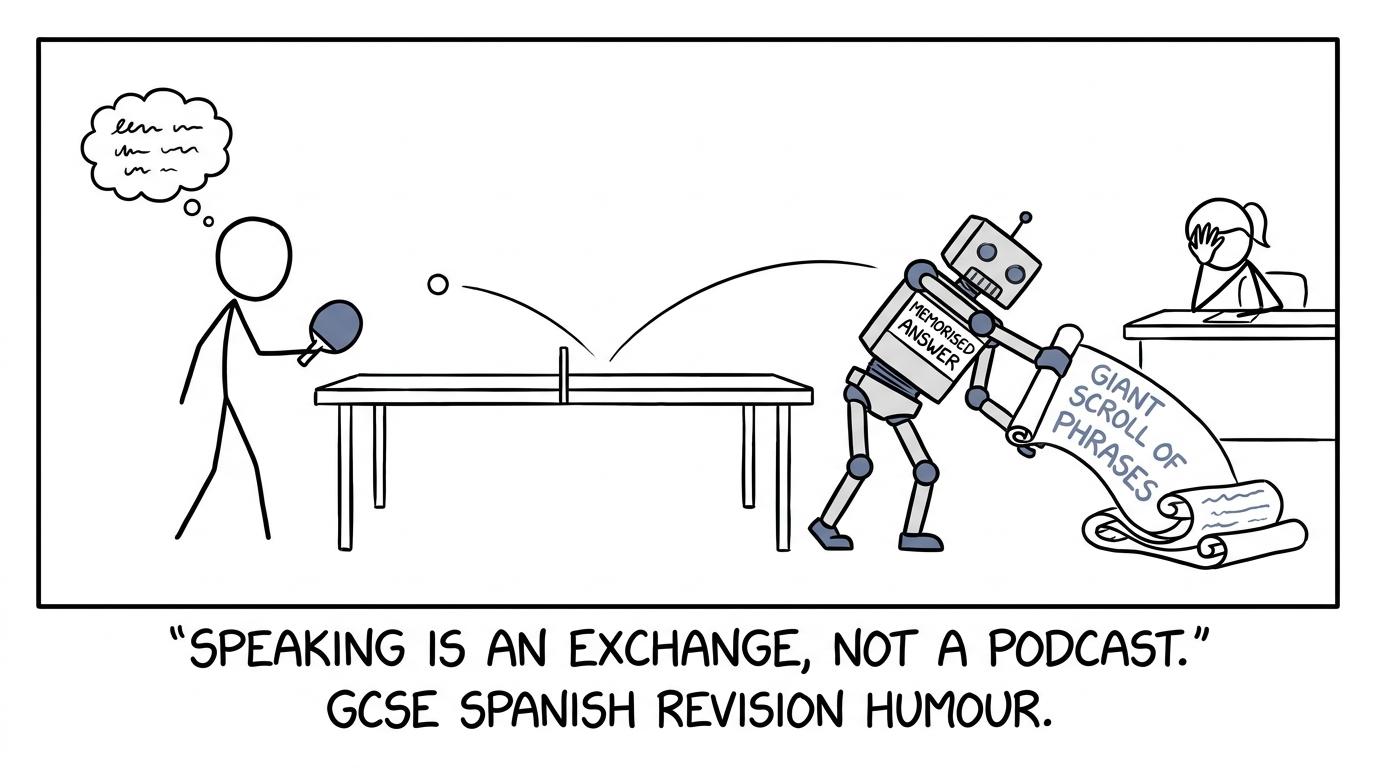 A memorised monologue discovers that speaking should be an exchange
For revised GCSE Spanish, read-aloud tasks make pronunciation and sound-symbol knowledge especially relevant. But natural interaction still matters. Practise hearing the question word, identifying the time frame and giving a direct first sentence before extending the answer.
A useful speaking session is not simply repeating one polished script. Ask a teacher or revision partner to change the order and wording of questions. That small uncertainty creates the skill the examination needs: adapting language you know to the prompt actually given.
Writing: cover the task before trying to impress
Writing exposes a common revision trap. Students sometimes prepare ambitious paragraphs and then reproduce them regardless of the question. Examiner feedback repeatedly returns to task fulfilment: read the rubric, address every bullet point and remain relevant.
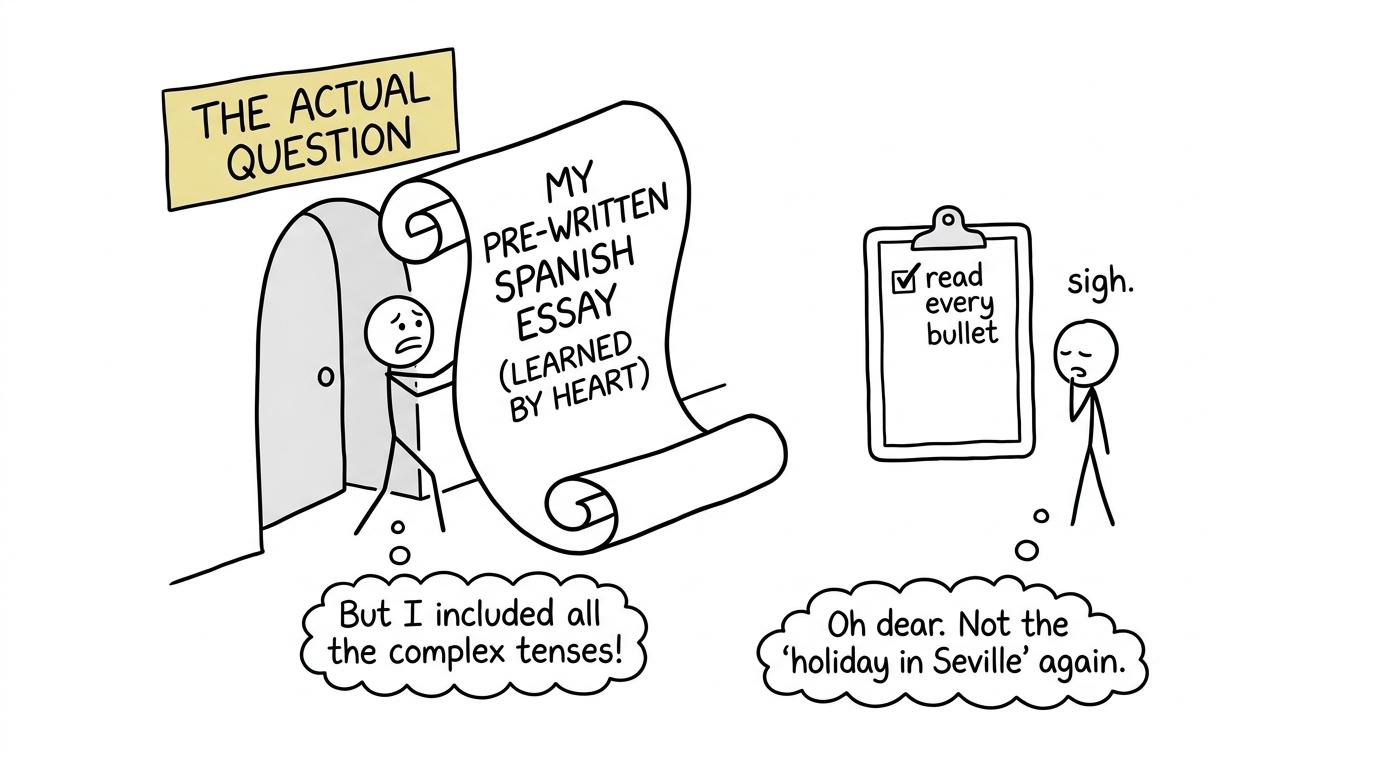 A prepared essay attempts to squeeze through the doorway of the actual question
Reports commonly flag:
- missing one or more bullet points;
- confusing the required time frame;
- inaccurate verb endings;
- incorrect gender and adjectival agreement;
- confusion between forms of ser and estar;
- omitted accents or careless spelling;
- unnecessarily long responses that create extra errors.
Complexity helps only when it remains controlled. A clear opinion with a relevant reason and an accurate verb is more valuable than an elaborate sentence whose meaning collapses. Before writing, map each bullet point to one part of your response. Afterwards, check verbs first, then agreement, spelling and accents.
This is not an argument for safe, repetitive Spanish. It is an argument for earned complexity. Secure the sentence you can control, then extend it with a reason, contrasting view, time phrase or subordinate clause.
How to turn examiner feedback into smarter revision
Reading reports passively creates the feeling of revision without much change. The better approach is a feedback loop.
Find repeated patterns
Read the latest available report for your specification and, where formats remain comparable, one or two earlier reports. Record only comments that reveal a transferable issue, such as missing negatives, weak verb control or incomplete bullet-point coverage.
Convert comments into actions
“Candidates lacked precision” is too vague to practise. Turn it into a rule: For reading questions, underline exactly what information is requested and answer only that.
“Basic vocabulary was insecure” can become: Practise numbers, dates, time, weather, food, colours and common verbs through short listening and retrieval sessions.
Test the action under exam conditions
Apply the rule to a current-specification sample question or past paper task. Mark it, note whether the same error appeared and repeat the task later without your notes.
This diagnose, practise, check cycle transfers directly to maths revision. MathsGenie's guide to finding your weakest GCSE topics explains how to classify lost marks by their cause rather than merely recording a score. The twenty-minute GCSE revision routine offers a manageable model for retrieval, timed practice and error logging.
Common mistakes when using examiner reports
The first mistake is using a report for the wrong specification. AQA, Pearson Edexcel and Eduqas do not necessarily use identical task structures or mark schemes. Check the qualification code and assessment year.
The second is treating old task-specific advice as current. Reports from summer 202520252025 and earlier relate chiefly to the previous GCSE Spanish specifications. Their advice about precision, vocabulary and accuracy remains useful, but the revised courses assessed from 202620262026 include changed tasks and assessment objectives.
The third is highlighting everything. If every paragraph becomes important, nothing guides your revision. Choose three recurring weaknesses and attach an action to each.
The fourth is reading feedback without attempting questions. Examiner insight becomes useful only when it changes a response under pressure.
Finally, do not confuse “short” with “incomplete”. A comprehension answer should usually be concise, but a speaking discussion or extended writing task may require developed communication. The mark scheme and command determine the appropriate depth.
The wider lesson for maths revision
A Spanish examiner report and a maths mark scheme reveal the same uncomfortable truth: knowing content and earning marks are related, but they are not identical. Instructions, precision and checking matter.
Students preparing for maths exams can use the same method. Start in the GCSE Maths revision hub, choose the correct board and tier, and diagnose errors with questions rather than intuition. The GCSE maths topics by board and tier checklist helps establish the right coverage.
Then test your technique with Edexcel GCSE Maths past papers, or select the equivalent board collection from the main hub. Use the mark scheme and video solutions to distinguish a knowledge gap from a reading, method or checking error. If time is limited, the one-month GCSE maths revision plan provides a structured route through targeted practice and timed papers.
Make the examiner's hindsight your foresight
Examiner reports are valuable because they compress thousands of responses into a few recurring lessons. For GCSE Spanish, those lessons are clear: know the basics securely, listen beyond keywords, read precisely, speak responsively, fulfil the writing task and control the grammar you choose to use.
Do not try to memorise an entire report. Extract a small number of habits, practise them on material for your current specification and check whether your errors change.
For maths, build the same disciplined loop with MathsGenie. Use free revision lessons to repair understanding, practice questions and mini tests to build accuracy, then past papers and predicted papers to develop timing. Mark schemes and video solutions complete the process. Feedback stops being a verdict when it becomes your next action.











