GCSE Russian February Half-Term Revision Plan
GCSE Russian February half term revision made manageable: strengthen speaking, vocabulary and exam skills while protecting time for maths, sleep and rest.
February half-term can feel deceptively spacious. At the beginning, there appears to be plenty of time. Then a few late mornings, family plans and unfinished homework quietly consume the week.
The answer is not to make Russian your only subject. Effective GCSE Russian February half term revision means using a small number of focused sessions to strengthen vocabulary, speaking and exam technique while preserving time for GCSE maths, other subjects and genuine rest.
This plan gives Russian a clear purpose each day without allowing it to take over the holiday. You will diagnose weaknesses, practise all four language skills and finish with a practical list of what to continue after half-term.
Your half-term revision checklist
Before the week begins, make five decisions:
- Confirm that you are taking Pearson Edexcel GCSE Russian and check your tier with your school.
- Collect your specification, vocabulary resources, class materials and available past-paper tasks.
- Identify two weak themes rather than attempting to revise everything.
- Schedule five focused Russian sessions across the week.
- Protect separate time for maths, other subjects and rest.
Pearson Edexcel GCSE Russian assesses listening, speaking, reading and writing. Each skill contributes 25%25\%25% of the qualification. Students take one tier across all four papers, and dictionaries are not permitted in the assessments, including formal speaking preparation time.
That structure tells you something useful: a revision plan built entirely around vocabulary lists is incomplete. Words matter, but you must also retrieve them while listening, recognise them in texts and use them independently in speech and writing.
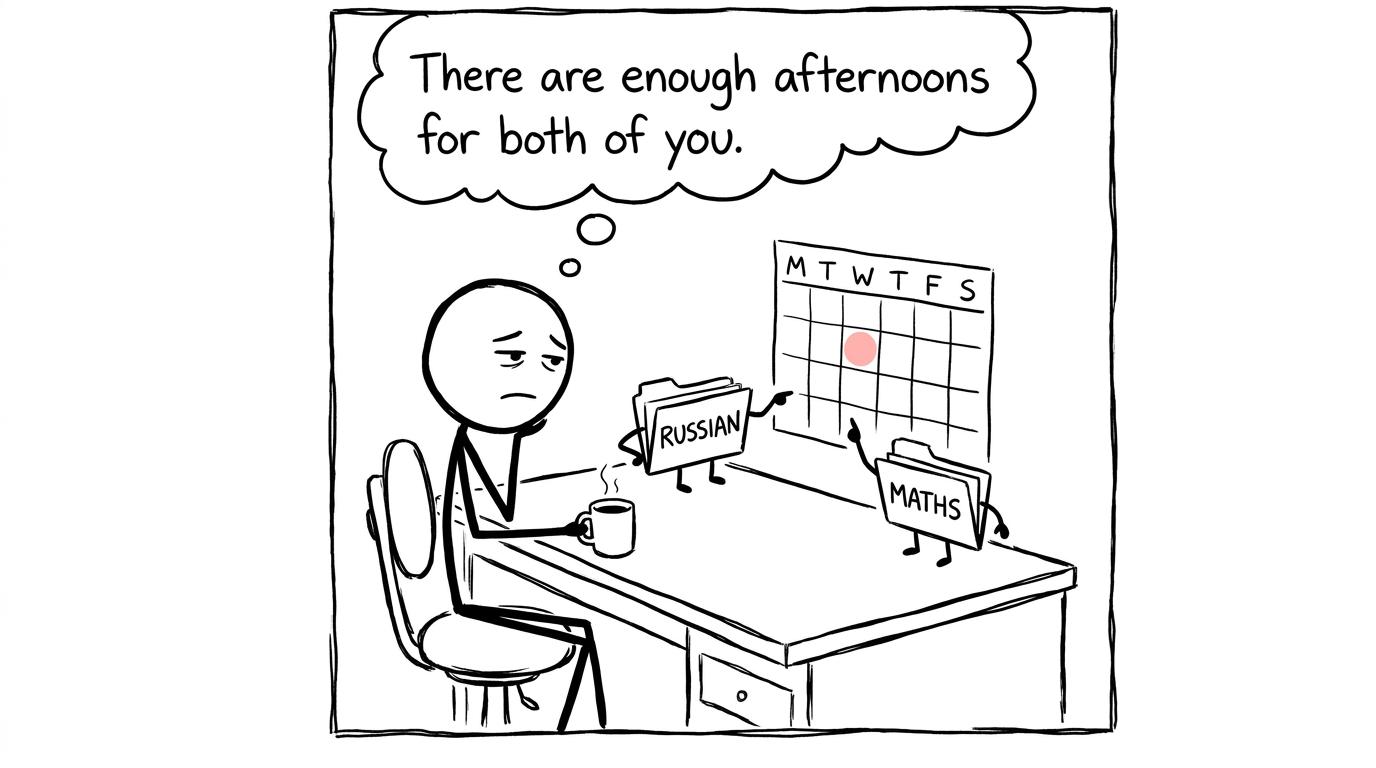 A student calmly sharing half-term between Russian and maths
Start with a short Russian audit
The most valuable first session is diagnostic. Revision becomes inefficient when you begin with the topic you enjoy rather than the skill that is costing you marks.
Review a recent assessment, teacher feedback or a selection of exam-style tasks. Divide your findings into four headings:
- Listening: Do unfamiliar voices, speed or distractors cause difficulty?
- Speaking: Do you hesitate because vocabulary is missing, or because you cannot build sentences quickly?
- Reading: Are mistakes caused by unknown words, neglected question instructions or inaccurate translation?
- Writing: Are you losing control of cases, verb forms, agreements, spelling or structure?
Then select two themes that need attention. Under the current Pearson Edexcel specification, the broad themes include identity and culture; local area, holiday and travel; school; future aspirations, study and work; and the international and global dimension.
Keep the diagnosis narrow. “I need to improve Russian” is too vague to guide a session. “I need vocabulary for school rules and more reliable past-tense verbs” gives you something you can actually practise.
This same principle works in maths. The GCSE maths revision timetable guide explains how specific weaknesses create a more useful schedule than broad labels such as “algebra” or “geometry”.
A focused GCSE Russian February half term revision plan
The plan below uses five main sessions, with lighter retrieval between them. Move the days around if necessary. The order matters more than the calendar.
First session: diagnose and organise
Complete the audit above and create a one-page priority sheet. Include:
- two weak themes;
- one grammatical weakness;
- one speaking target;
- one listening target;
- vocabulary that repeatedly disappears under pressure.
Do not spend the whole session designing a beautiful timetable. The priority sheet should be functional, quick to update and visible whenever you revise.
Second session: vocabulary you can retrieve
Choose one weak theme and divide its vocabulary into useful groups: nouns, verbs, opinions, time phrases and connectives. Include language that helps you express different time frames rather than isolated topic words alone.
Use active recall. Cover the Russian, retrieve it, check it and return to missed items later. Reverse the direction too. Recognising a Russian word is not the same as producing it when speaking or translating from English.
End by saying several original sentences aloud. The aim is not to memorise one perfect paragraph. It is to make useful language flexible enough to survive a slightly unfamiliar question.
Third session: listening and reading under control
Use short listening extracts and reading passages rather than completing an entire paper without review. Before listening, scan the question for names, time references, opinions and the language in which you must answer.
After each extract, identify why an answer was missed. Possible causes include:
- an unknown word;
- a familiar word spoken in an unfamiliar context;
- a negative or contrast being overlooked;
- an answer copied without sufficient precision;
- uncertainty about the question instruction.
Apply the same discipline to reading. GCSE Russian includes translation from Russian into English, so your English must communicate the meaning accurately rather than imitate Russian word order mechanically.
Fourth session: speaking without a script
The Pearson Edexcel speaking assessment contains a role-play, a picture-based task and a conversation. Your school will provide the exact arrangements and assessment date, so check those rather than relying on a general online calendar.
Practise responding aloud to prompts from your chosen themes. Begin with brief, accurate answers, then add a reason, detail or different time frame where appropriate. Record yourself if possible and listen for long pauses, repeated vocabulary and endings that become unclear.
Avoid learning one answer so rigidly that a small change in wording causes panic. A stronger method is to prepare reusable building blocks: opinions, justifications, comparisons, past experiences and future intentions.
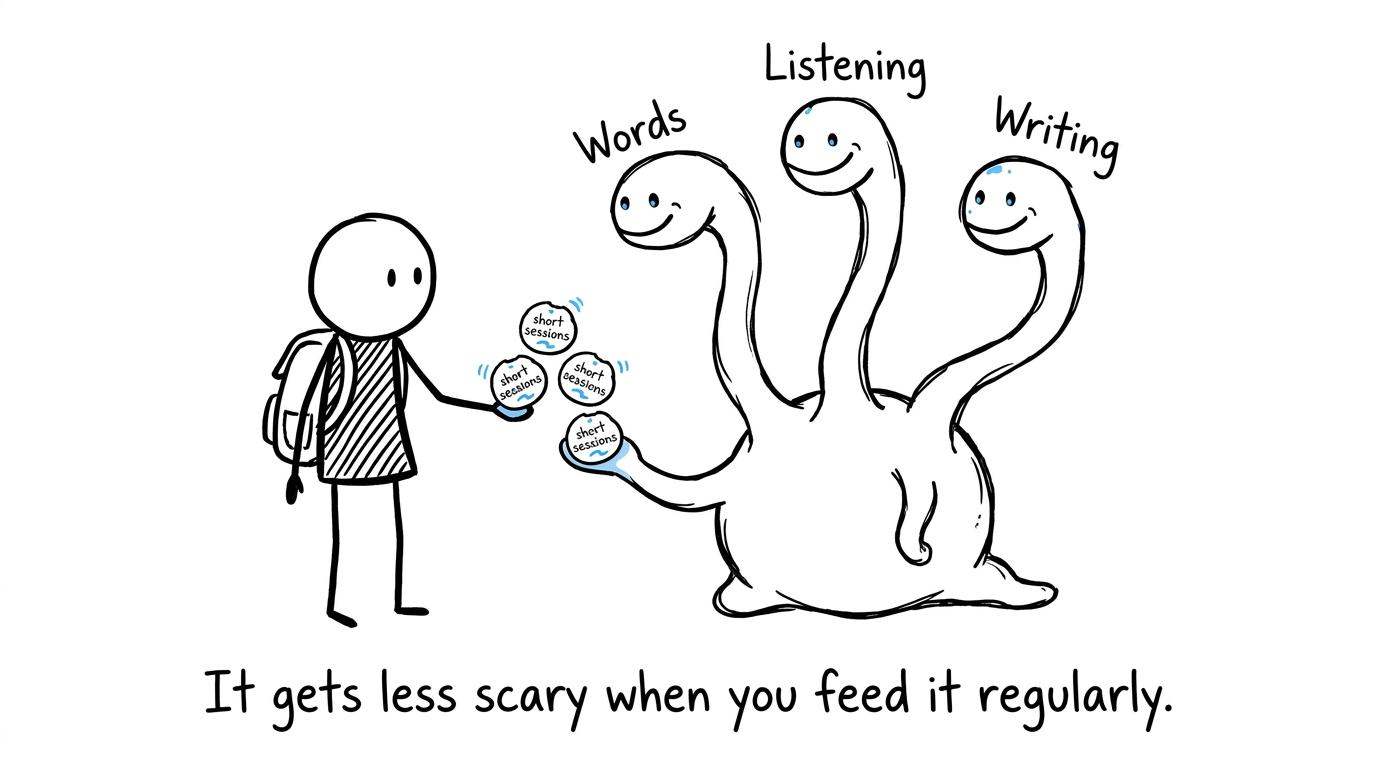 A friendly revision creature being fed short sessions
Fifth session: writing and translation
Choose a task appropriate to your tier and complete it without a dictionary, because dictionaries are not permitted in the examination. Plan briefly before writing. Check that you have answered every bullet point and that the response communicates clearly.
During review, separate ambitious errors from avoidable errors. An ambitious error may come from attempting a complex structure. An avoidable error might be a familiar spelling, agreement or verb form that you could have checked from memory.
Also practise translation from English into Russian. Do not treat translation as a word-for-word substitution exercise. First identify the intended meaning, time frame and grammatical relationships. Then produce natural, accurate Russian using structures you can control.
Final check: retest and plan the return to school
At the end of half-term, repeat a small part of your original diagnostic. Test the vocabulary again, answer fresh speaking prompts and revisit one corrected piece of writing.
Your final page should contain three continuing priorities for the next fortnight. Half-term should create momentum, not act as the final revision window before the examinations.
How to keep maths moving during Russian revision
A language can absorb unlimited time because there is always another vocabulary set to learn. Give Russian boundaries so that maths does not quietly disappear from your week.
On three or four days, add a short maths block before or after Russian. The twenty-minute GCSE maths revision routine is useful when the timetable is crowded. Choose one precise topic, recall the method, answer questions and mark the work immediately.
If you need to identify gaps, use the GCSE maths topics by exam board and tier. Maths specifications differ between Edexcel, AQA, OCR and Eduqas, so practise material that matches your board and foundation or higher tier.
A sensible half-term balance might include:
- five focused Russian sessions;
- three short maths topic sessions;
- one GCSE maths mini test or timed paper section;
- at least one day without formal revision.
If you are unsure whether full papers belong in your plan yet, read when to start GCSE past papers. A paper is useful when it is marked and followed by targeted repair. Simply accumulating completed papers is not the same as improving.
Use the same revision loop in both subjects
Russian and maths look different on the page, but good revision follows a similar cycle:
- retrieve what you know without notes;
- attempt an exam-style task;
- check it carefully;
- identify the precise cause of each error;
- practise that weakness;
- retest it after a gap.
In Russian, the error might be a missed negative, weak verb ending or incomplete role-play response. In maths, it might be a misunderstood method, arithmetic slip or missing line of working.
For a structured maths version of this process, use the GCSE one-week maths revision plan. Revision lessons and practice questions should repair knowledge first. Past papers and Edexcel GCSE maths predicted papers can then test whether that knowledge remains available under timed conditions.
Common mistakes during the half-term crunch
Trying to cover every Russian theme
Breadth feels productive, but hurried coverage leaves little behind. Choose two themes and develop vocabulary, comprehension and production within them.
Spending the week copying notes
Neat notes can support revision, but they do not prove that you can retrieve vocabulary or respond under exam conditions. Close the book regularly and produce an answer from memory.
Ignoring speaking until school restarts
Speaking improves through repeated retrieval. Short, frequent oral practice is more manageable than one intimidating session near the assessment.
Memorising answers without flexibility
Prepared language is useful. A fixed script is fragile. Practise changing the person, tense, opinion and detail so that your language can adapt to the question asked.
Completing tasks without analysing errors
A score tells you how the task went. Error analysis tells you what to do next. Write a specific correction after every session.
Letting Russian replace every other subject
Half-term revision should reduce future pressure, not move it elsewhere. Keep small maths sessions alive, especially on topics that have already appeared on your weakness list.
Treating rest as wasted time
An exhausted final weekend rarely repairs an unrealistic plan. Decide when each session ends and keep that promise.
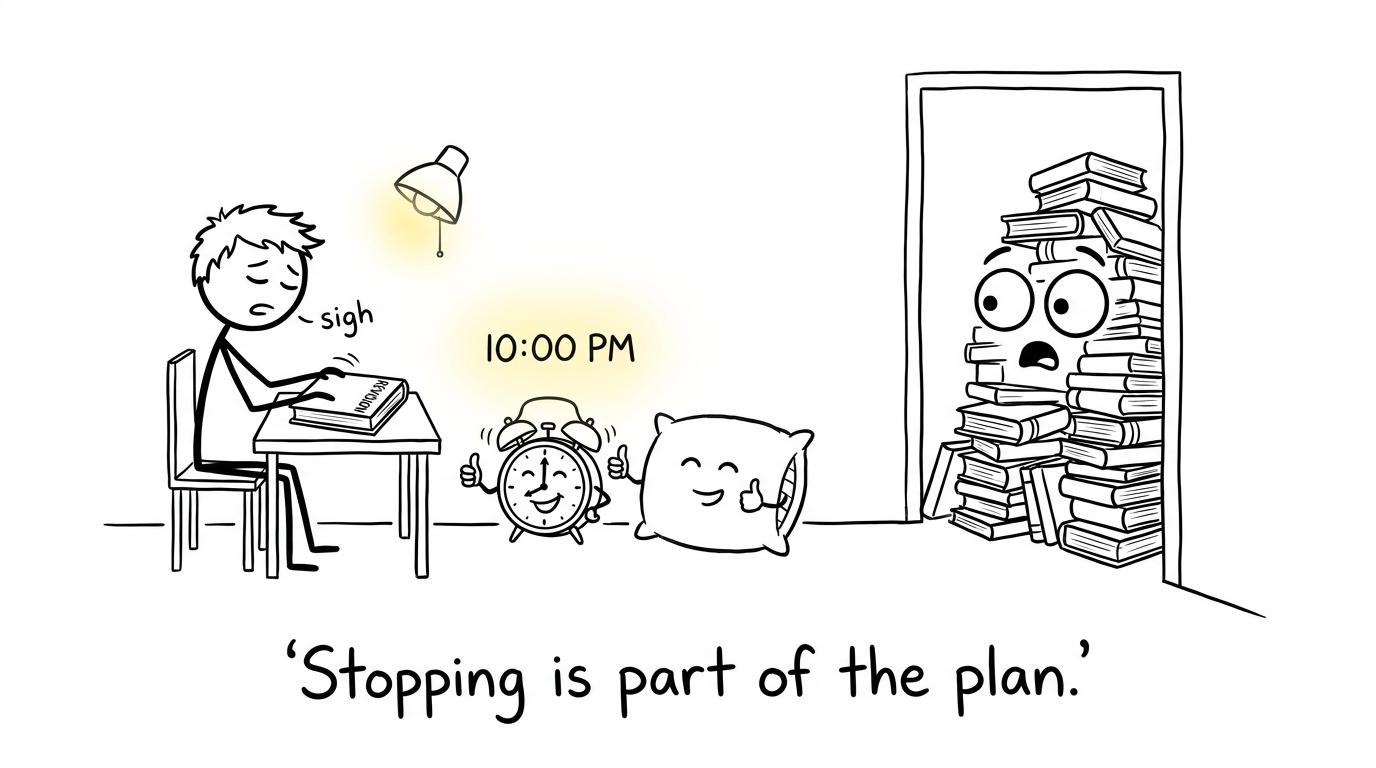 A student ending revision at a sensible time
Finish half-term with momentum, not exhaustion
The best half-term plan is not the one that fills every hour. It is the one you can continue when lessons, homework and normal routines return.
For Russian, leave the week with stronger retrieval, several corrected exam tasks and three clear priorities. For maths, maintain a modest rhythm of topic practice and honest marking. If you need help deciding what to revise next, the MathsGenie GCSE and A Level revision hub brings together free revision lessons, practice questions, mini tests, past papers, predicted papers, mark schemes and video solutions.
Start with one weak maths topic today. Learn the method, practise it, mark it and record the next action. Then give Russian its planned session, and allow the rest of half-term to remain a holiday too.