GCSE Russian Christmas Holiday Revision: A Calm Plan
GCSE Russian Christmas holiday revision need not take over. Build a balanced plan for vocabulary, speaking and exam skills while protecting your break.
Christmas revision can quietly expand to fill every available day. One vocabulary list becomes five, a short listening task becomes an entire afternoon, and the holiday begins to feel like an unusually cold extension of school.
A reasonable GCSE Russian Christmas holiday revision plan should prevent that. For many students, four to six focused sessions of around 202020 to 303030 minutes across a two-week break will be enough to maintain vocabulary, identify weaknesses and return to school ready to improve. If you have mocks immediately after Christmas or substantial gaps, increase some sessions to 303030 to 454545 minutes, guided by your teacher's advice.
The aim is not to finish the course. It is to keep Russian familiar without losing the rest, sleep and family time that the holiday is meant to provide.
A reasonable revision checklist
Before creating a detailed timetable, keep these principles in view:
- Take at least two or three completely revision-free days.
- Schedule short Russian sessions rather than one large language marathon.
- Include listening, speaking, reading and writing across the break.
- Use active recall instead of repeatedly reading vocabulary lists.
- Prioritise weaknesses revealed by classwork, mocks or teacher feedback.
- Leave room for your other GCSE subjects, particularly maths and English.
- Stop at a planned time rather than continuing until you feel exhausted.
This is a maintenance plan, not a punishment. A holiday can contain both progress and genuine time off.
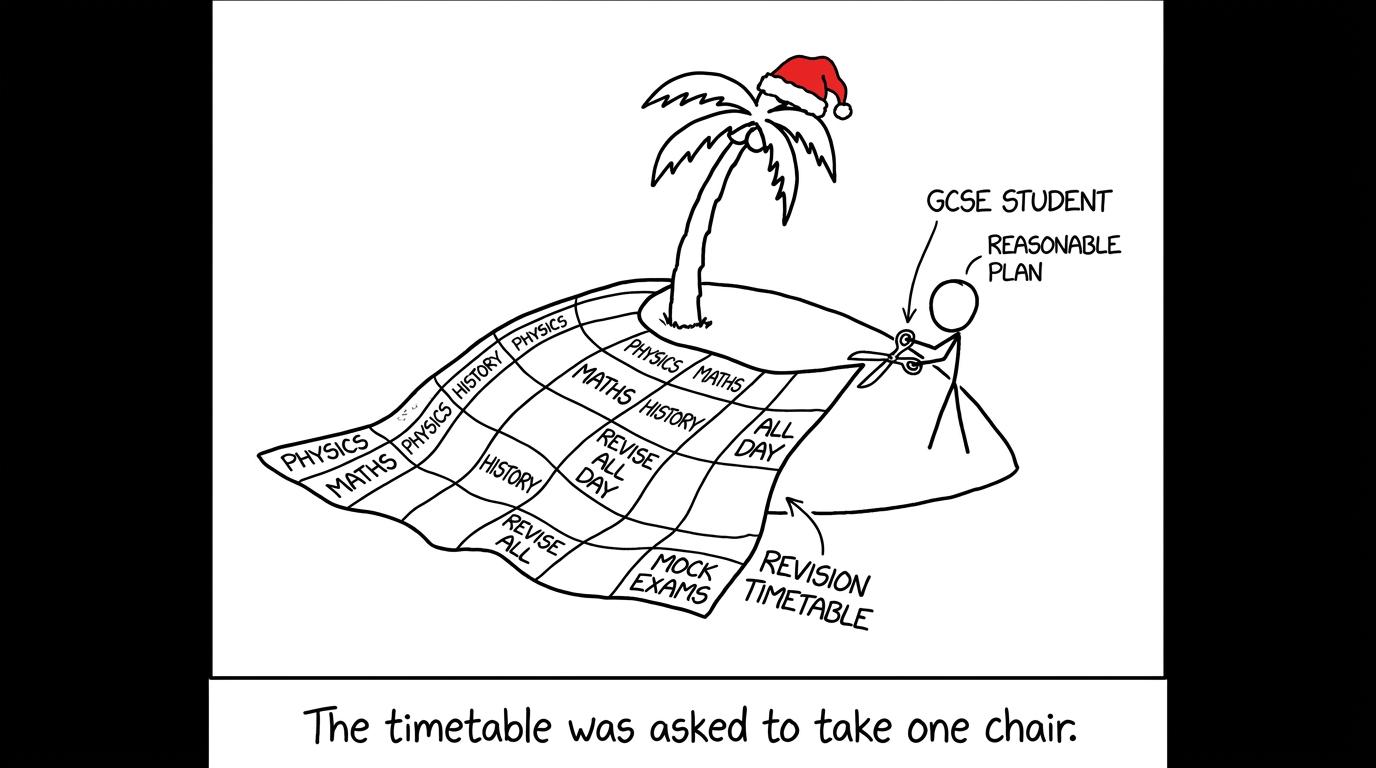 A student protects their Christmas holiday from an oversized revision timetable
How much GCSE Russian revision is reasonable?
There is no official number of hours that every student should complete. Your appropriate workload depends on your current knowledge, mock results, school deadlines and proximity to the speaking assessment.
The following ranges are sensible starting points rather than requirements:
| Your situation | A reasonable starting point |
|---|---|
| You are broadly on track | Four sessions of 202020: 303030 minutes |
| You have several known gaps | Five or six sessions of 303030 minutes |
| Mocks follow soon after Christmas | Five or six sessions of 303030: 454545 minutes |
| Your teacher has set specific work | Complete that work first, then add only targeted practice |
Quality matters more than the total. Thirty attentive minutes spent retrieving vocabulary and correcting errors can be more useful than two distracted hours copying notes.
The same idea applies when Russian must share the holiday with maths. MathsGenie's guide to building a realistic GCSE maths revision timetable encourages targeted, repeatable sessions rather than an unsustainable schedule. Use one master timetable for all your subjects so that Russian is not planned in isolation.
Build the plan around the four language skills
The current Pearson Edexcel GCSE Russian qualification assesses listening, speaking, reading and writing separately, with each skill contributing one quarter of the qualification. Students take the same tier across all four papers, and dictionaries are not permitted in the examinations, including speaking preparation time.
That does not mean each holiday session must be divided into four equal pieces. It means your overall plan should not become vocabulary-only revision while speaking and listening disappear.
Listening
Complete a short listening activity and answer questions without pausing on the first attempt. Listen again to identify what prevented understanding: unfamiliar vocabulary, speed, a grammatical ending or a distractor.
Passive exposure may help Russian sound more familiar, but exam preparation needs a task. Decide what you are listening for before pressing play: the main message, a particular detail, an opinion or a reference to past or future events.
Speaking
Speaking is easy to postpone because it feels less comfortable than silent revision. Give it a small, repeatable place in the plan.
Practise answering a few questions aloud, describing a photograph or responding to a possible role-play situation. Record yourself if that helps you notice hesitation and unclear pronunciation. The goal is not to memorise an enormous script. It is to become more capable of producing accurate language when the exact question is not known in advance.
Reading
Choose short texts that match your course and tier. Read once for the general meaning, then return for details, opinions and time references. Keep a compact list of recurring words that genuinely blocked comprehension.
GCSE Russian reading also includes translation into English. Translation requires accurate meaning, not an elegant rewrite that adds information absent from the Russian text.
Writing
A useful writing session can be short. Plan and produce one paragraph that includes opinions, reasons and appropriate references to different time frames. Afterwards, check verb forms, agreements, spelling and whether every part of the task has been addressed.
Avoid writing several long answers without feedback. One carefully checked response usually reveals more than a pile of unmarked pages.
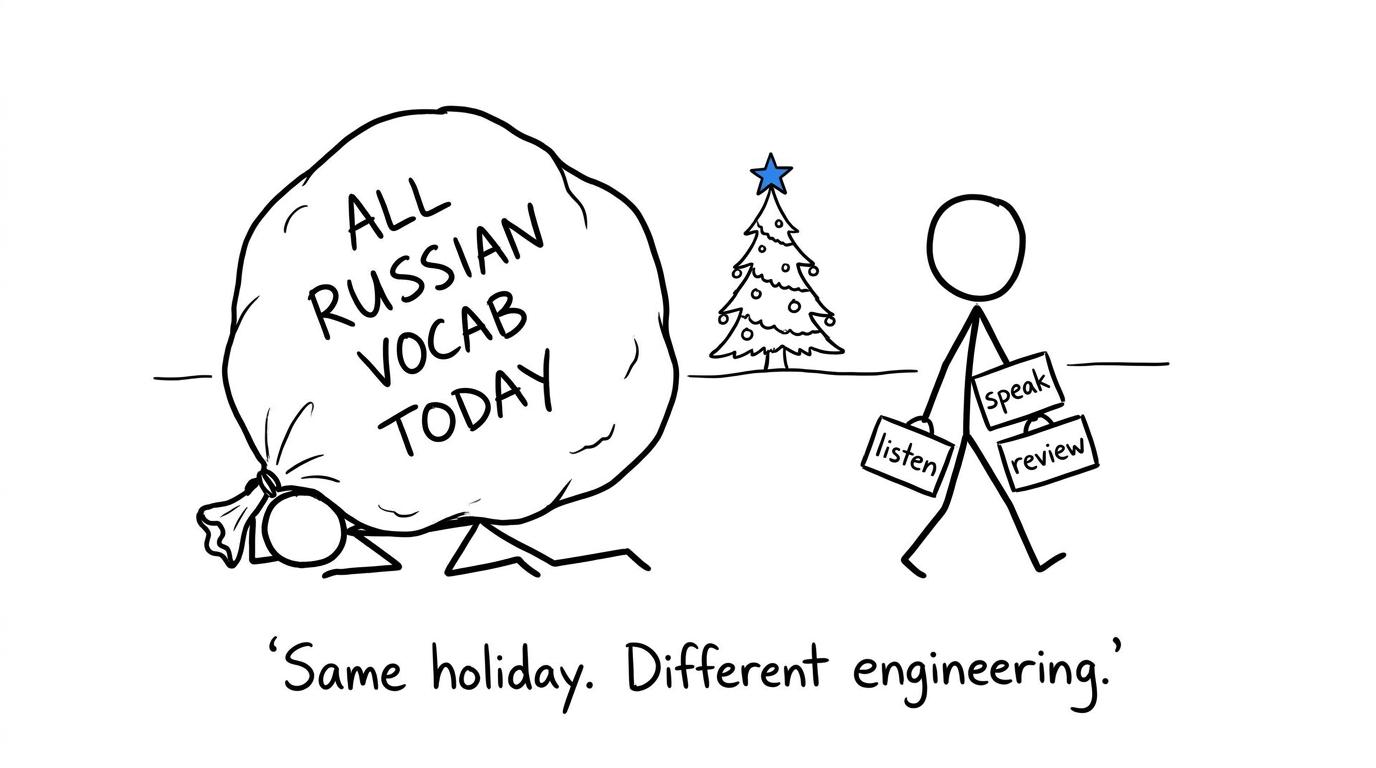 One student carries an impossible vocabulary sack while another uses small revision parcels
A calm two-week structure
Start by placing celebrations, travel, family plans and genuine rest on the calendar. Revision fits around life during the Christmas break, not the other way round.
A balanced pattern could look like this:
- Early in the holiday: one diagnostic session using recent classwork or a short exam-style task.
- Before Christmas: one vocabulary-and-listening session and one speaking session.
- Christmas period: several days with no planned revision.
- After Christmas: one reading-and-translation session and one writing session.
- Before returning to school: one mixed review and a brief plan for January.
You do not have to revise Russian every day. Spacing sessions across the holiday gives you repeated opportunities to retrieve language after some forgetting has occurred. That is more useful than concentrating the same amount of work into one sitting.
For a model of how a small session can remain purposeful, adapt the rhythm in MathsGenie's twenty-minute revision routine: retrieve from memory, practise actively, check the result and choose the next small target. The content differs between Russian and maths, but the planning principle travels well.
Decide what deserves your time
Revision becomes unreasonable when every topic is treated as equally urgent. Begin with evidence.
Review your latest mock, class assessment, marked writing and teacher comments. Then create a short list of specific gaps. “Russian grammar” is too broad. “Using past-tense verb forms accurately” or “recognising numbers in listening tasks” gives you something you can actually practise.
Sort possible tasks into three groups:
- Must do: school assignments, approaching assessments and repeated weaknesses.
- Useful: vocabulary maintenance and brief practice across all four skills.
- Can wait: remaking attractive notes, learning obscure vocabulary or completing full papers before the relevant content has been taught.
Maths students can apply the same evidence-led method using MathsGenie's guide to finding weak GCSE topics. For maths-specific diagnosis, the free GCSE maths revision hub provides board-based lessons, questions and papers for AQA, Edexcel, OCR, Eduqas, WJEC and CCEA.
Use active revision, not festive-looking admin
It is possible to spend an hour making a colour-coded vocabulary sheet without testing whether you can recall a single word. Attractive resources are not automatically effective resources.
A stronger Russian session might include:
- recalling vocabulary before checking the answers;
- producing a sentence aloud from a prompt;
- completing a short listening or reading task;
- translating a brief passage in the required direction;
- checking an answer against a mark scheme or teacher feedback;
- revisiting errors later in the holiday.
Retrieval should feel slightly difficult. That difficulty is useful because it exposes what is not yet secure. MathsGenie's advice on stopping GCSE content from being forgotten uses the same sequence: retrieve, space the next attempt and practise in the form used by the examination.
Protect sleep and time away from revision
Teenagers commonly need substantial sleep, with established clinical guidance generally placing the healthy range at around eight to ten hours each night. Late-night revision should not become the price paid for fitting too much into a day.
Choose a stopping time before starting. Keep meals, movement, social plans and screen-free rest in the schedule. If a session is repeatedly being skipped, make it shorter or move it rather than allowing unfinished work to create guilt across the whole holiday.
A plan is only reasonable if it can survive an ordinary family Christmas. It should bend when plans change.
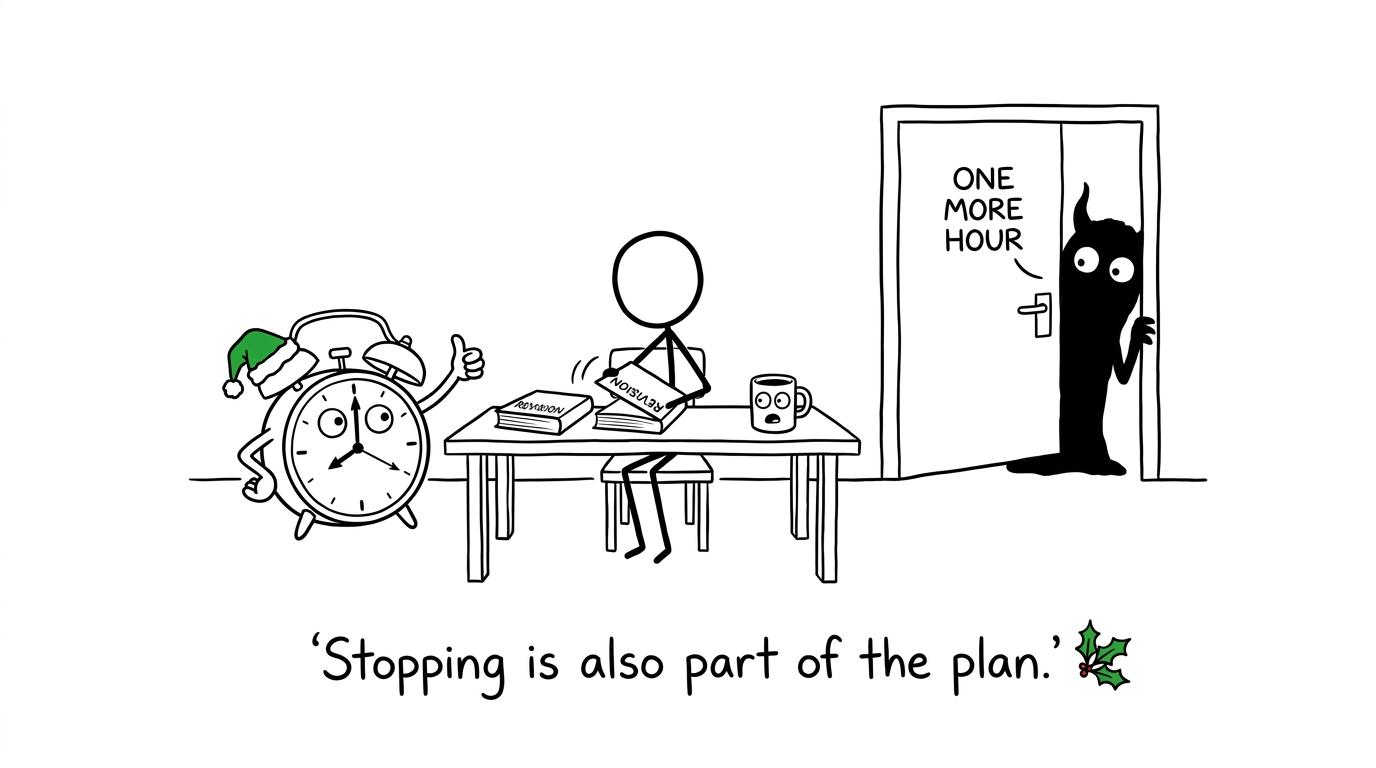 A student closes the revision book while the one-more-hour monster waits outside
Keep maths moving without doubling your workload
If you are also preparing for GCSE maths exams, Russian should not create a second full-time timetable. Alternate subjects and use compact tasks.
On a Russian day, complete a short language session and leave maths alone unless a deadline demands otherwise. On another day, use a maths mini test or targeted topic set. MathsGenie's revision resources hub collects short tests, practice materials and predicted papers, while the guide to using GCSE past papers properly explains the paper, mark, fix and retest cycle.
Full papers are not necessary every day. When maths paper practice is appropriate, choose the correct board and tier. For example, the Edexcel GCSE maths past papers include mark schemes and worked solutions where available.
For Russian, use materials supplied by your school and the official resources for your precise specification. MathsGenie is a maths resource, so it should support the maths portion of your holiday rather than being presented as a source of Russian papers.
Common Christmas revision mistakes
Planning every day
A timetable without free days assumes that nothing unexpected will happen. Build in blank space from the beginning.
Revising only comfortable vocabulary
Familiar flashcards create a reassuring sense of speed. Spend more time on words, grammar and skills that you cannot yet retrieve reliably.
Ignoring speaking until spring
Speaking improves through repeated production. A few brief attempts across Christmas are more manageable than trying to manufacture confidence immediately before the assessment.
Completing tasks without checking them
Unmarked work does not tell you what to change. Use available mark schemes, model criteria and teacher feedback, then record one precise correction.
Treating hours as the only measure of success
Track completed targets, corrected mistakes and successful recall. Time matters, but sitting at a desk is not the same as learning.
Sacrificing sleep to catch up
If the plan requires regular late nights, the plan is too large. Reduce optional tasks and speak to your teacher if compulsory work feels unmanageable.
Finish the holiday with a smaller, clearer list
Good Christmas revision does not end with every page completed. It ends with Russian still familiar, your main weaknesses identified and enough energy left to begin the new term well.
Choose four to six purposeful sessions, cover all four language skills across the break and protect several completely free days. Then use your final session to write a short January priority list based on what the holiday practice revealed.
For the maths side of your GCSE preparation, make MathsGenie GCSE revision your next stop. Use the free revision lessons and practice questions to repair individual topics, mini tests to check recall, and past papers, predicted papers, mark schemes and video solutions when you are ready for exam practice. The best holiday plan is not the fullest one. It is the one you can complete, learn from and calmly continue.