

GCSE Results: Didn't Get the Grades You Wanted?
GCSE results: didn't get the grades you wanted? Explore reviews, resits, sixth-form choices and a calm, practical plan to improve your maths next.

There is a strange moment on results day when a few printed numbers seem to become a verdict on everything. They are not. If your GCSE results didn't get the grades you hoped for, your immediate options are to speak to your school or college, check whether a review of marking is sensible, discuss alternative course entry and consider a resit.
The disappointment is real, but the result is information rather than identity. It tells you where you are today. It does not decide how far you can go.
Your results-day checklist
Before making a big decision, work through these steps:
- Take time to read your results properly.
- Write down the grades required for your preferred sixth form, college, apprenticeship or course.
- Speak to your school, exams officer or intended post-161616 provider.
- Ask for your marks and whether your school recommends accessing your script.
- Check whether a review, resit or different course would best support your goal.
- Confirm every deadline in writing.
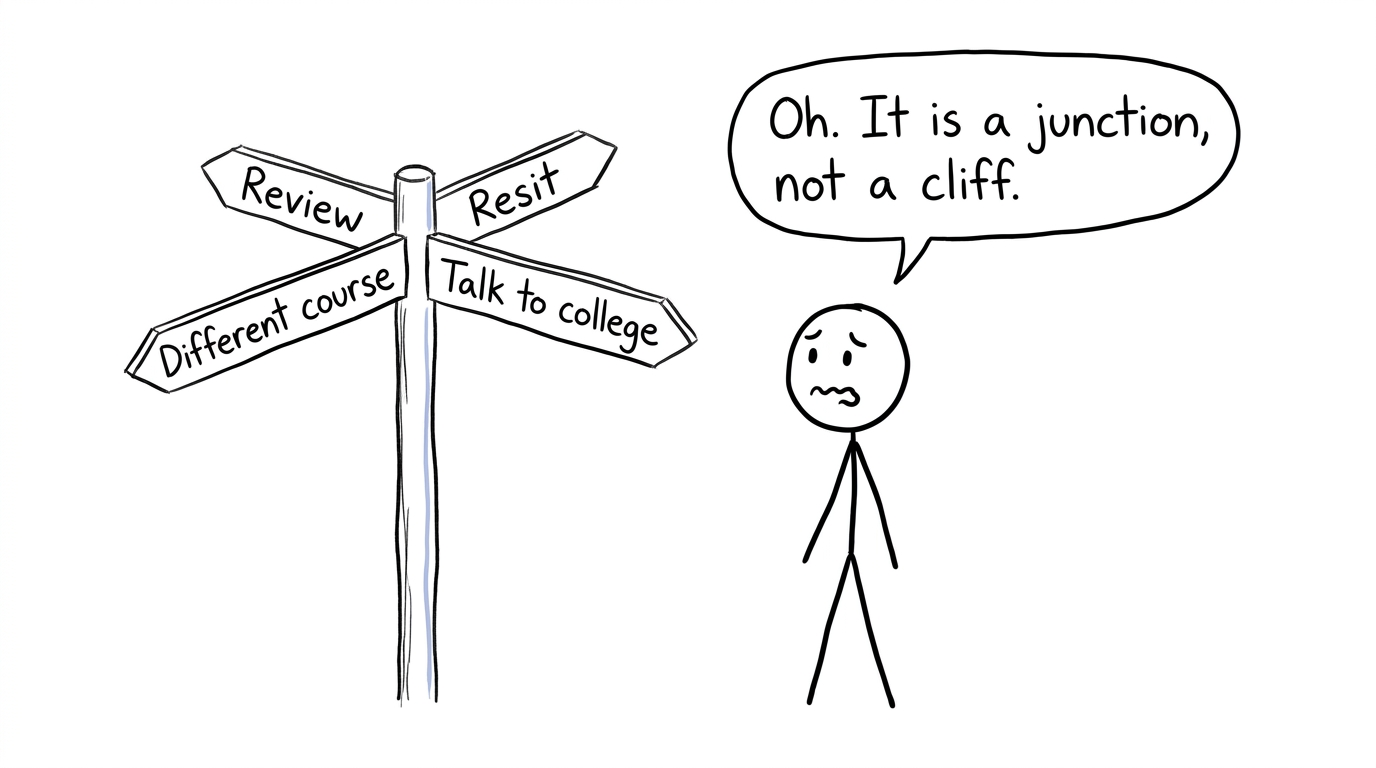 A student discovers that disappointing results are a junction rather than a cliff
GCSE disappointing results options
Speak to your sixth form or college first
Entry requirements matter, but a missed grade does not always end the conversation. The Department for Education advises students to speak directly to their chosen provider because it may have some flexibility, particularly where a required grade was narrowly missed.
Ask precise questions:
- Can I still enrol on my chosen course?
- Could I begin another suitable course and transfer later?
- Can I retake GCSE maths alongside my programme?
- Is there a related course with different entry requirements?
- Would another Level 222 or Level 333 route be more appropriate?
Do not assume that silence means rejection. Contact the admissions team and explain your complete result profile. Requirements differ between providers and courses, so the answer must come from the institution itself.
If you are considering A Level maths, read MathsGenie's guide to the move from GCSE to AS and A Level maths. It explains why secure algebra and numerical fluency matter beyond Year 111111.
Check whether the grade may be wrong
A disappointing result and an incorrect result are different problems. If the mark seems surprising, speak to your school or college promptly. It can use the relevant exam board's access-to-scripts service to inspect your marked paper and help decide whether a review of marking is justified.
A review checks whether the mark scheme was applied correctly. It is not simply another examiner generously awarding extra marks. Your mark and grade can rise, remain unchanged or fall, and a fee may apply. Your school normally submits the request with your permission; private candidates should speak to their exam centre or exam board.
Ask for:
- your mark for each paper or component;
- the relevant grade boundary;
- your teacher's view of the marked script;
- the cost, risk and deadline for a review.
Deadlines are set for each exam series, and schools may impose earlier internal deadlines. Act quickly rather than relying on dates shared by friends or found in an old post.
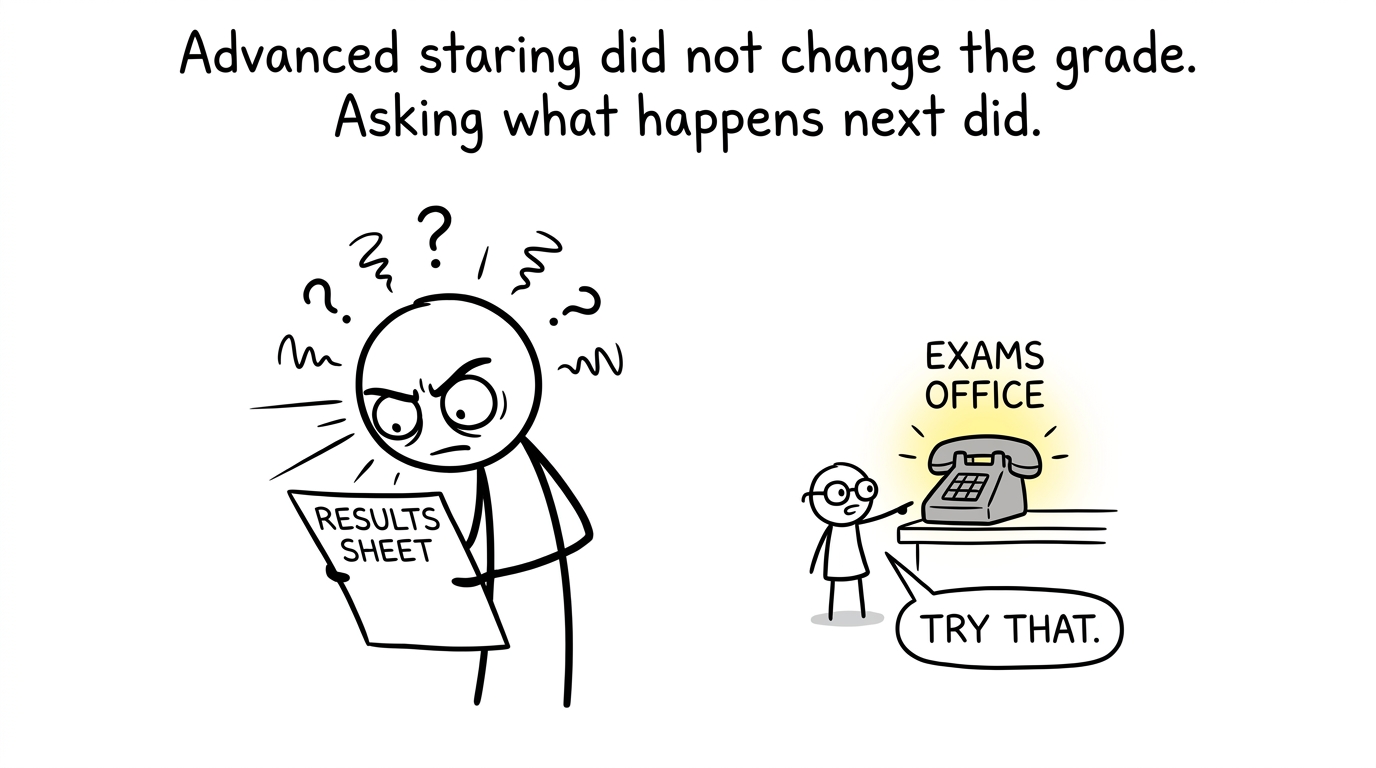 A student learns that contacting the exams office works better than staring at a grade
Consider a GCSE maths resit
In England, eligible students in post-161616 education who have not achieved grade 444 or above in GCSE maths must continue studying maths under the government's condition-of-funding rules. This is technically a study requirement, not an automatic requirement that every student sits the next available exam, so discuss the timetable with your provider.
GCSE maths and English language examinations are available in November to students who were aged 161616 or over on 313131 August of that year. Other GCSE resits are generally taken in the following summer. For GCSE resits, students normally retake all examined components.
November may suit someone who narrowly missed grade 444 and has retained most of the course. A summer entry may provide more rebuilding time. Your school or college should help decide the appropriate timing, exam board and foundation or higher tier.
For a fuller roadmap, read what happens if you fail GCSE maths. If tier choice contributed to the result, the foundation versus higher maths guide can support a more evidence-based conversation.
Explore a different route without treating it as second best
A different course can still lead towards the same broad career. Your alternatives might include another A Level combination, a vocational qualification, a T Level, an apprenticeship or a course at a different college.
The useful question is not, "Which route looks most impressive today?" It is, "Which route gives me the strongest chance to progress?"
Check the actual requirements for later steps too. A university course, apprenticeship or employer may have specific GCSE expectations even when your immediate college course does not. A careers adviser or admissions team can help you distinguish a temporary detour from a genuine barrier.
How to prepare differently for a maths resit
Repeating the same revision routine usually repeats the same weaknesses. Begin with evidence.
Choose the correct board and tier through the GCSE maths revision hub, then complete a timed paper. MathsGenie has dedicated collections for Edexcel GCSE maths past papers, AQA GCSE maths past papers and OCR GCSE maths past papers, alongside resources for Eduqas and other boards.
Use this revision loop:
- Sit a suitable paper or mini test under timed conditions.
- Mark it carefully using the mark scheme.
- Label every lost mark by topic and cause.
- Use a revision lesson and practice questions to repair the weakest skill.
- Watch a video solution when the method remains unclear.
- Retest the topic before attempting another full paper.
A paper is most valuable after it has exposed something you can fix. MathsGenie's guide to using GCSE past papers properly explains this process in greater depth. Closer to the exam, add GCSE predicted papers to practise switching between topics.
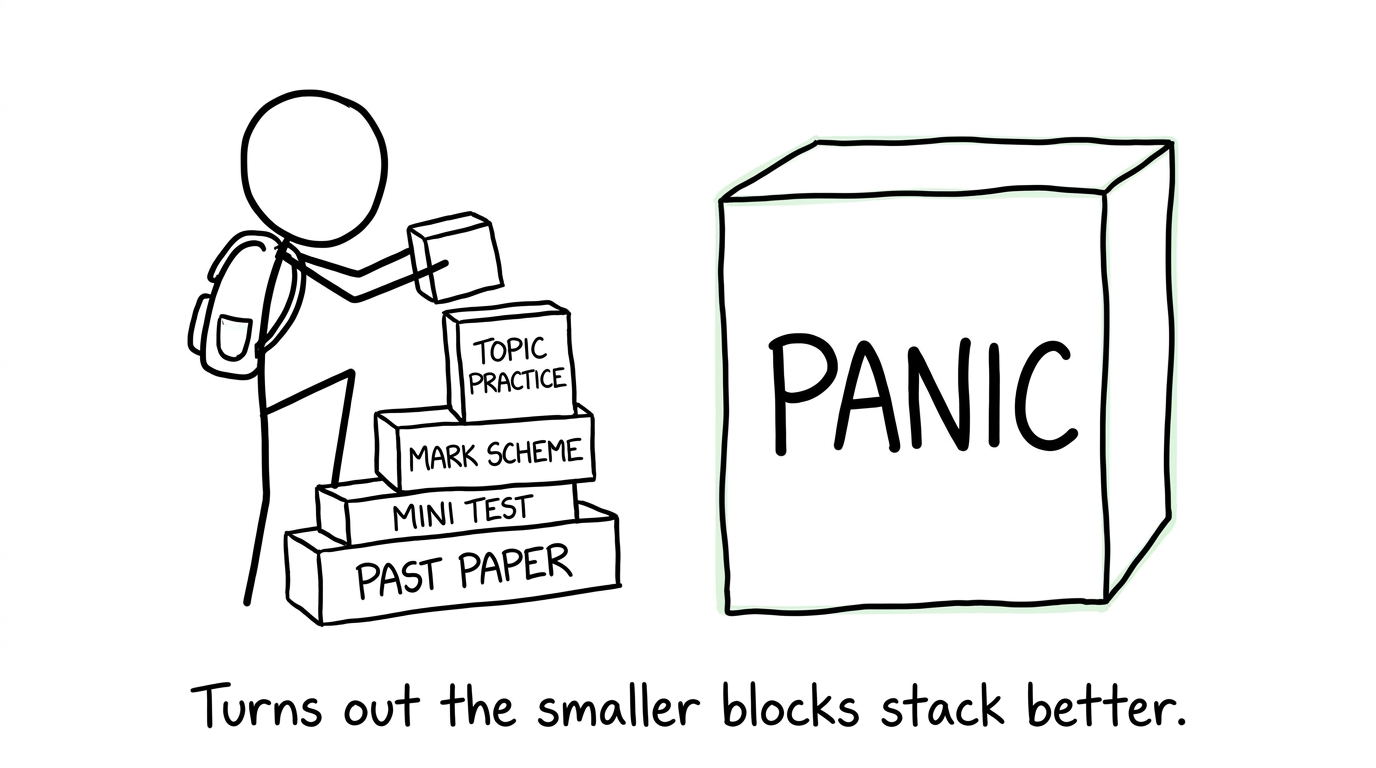 Small revision steps stack more effectively than one large block of panic
Common mistakes after disappointing GCSE results
Assuming nothing can change
A course may have alternatives, and a review or resit may be appropriate. Ask before abandoning the plan.
Requesting a review without evidence
Being close to a boundary does not prove an error. Ask a teacher to inspect the script and remember that marks can fall as well as rise.
Missing deadlines
Reviews, enrolment decisions and November entries all have deadlines. Confirm them with the relevant school, college or exam centre.
Revising everything equally
A resit plan should target the topics and exam habits that cost marks. An error log is more useful than restarting the entire textbook.
Treating the result as a judgement
A grade records performance in a particular assessment series. It cannot measure your character, future effort or capacity to improve.
Your next result can be different
When GCSE results do not match the plan, the instinct is to think the road has closed. Usually, it has divided. You may need a conversation, a review, a different course or another attempt at the exam.
Make the next decision from evidence rather than embarrassment. Speak to your provider, confirm the rules and choose the option that protects your longer-term goal.
If a maths resit is part of that route, begin with MathsGenie's free revision lessons, practice questions and mini tests. Build confidence through past papers, mark schemes and video solutions, then use predicted papers as the exam approaches. A disappointing grade is a starting score, not the final line of the story.











