

What Happens If You Fail GCSE Maths? Next Steps
GCSE maths fail worries? Learn what happens next, retakes, college rules, jobs and a clear plan to pass with Maths Genie lessons and papers.
If you fail GCSE Maths, it feels personal, but it’s mostly paperwork
If you’ve just opened results and realised you didn’t pass GCSE maths, the first feeling is usually a hot, quiet panic. Not the dramatic kind. The practical kind. What does this mean for sixth form? College? Apprenticeships? My future? The truth is that failing GCSE maths is rarely the end of anything, but it is the start of some decisions. And those decisions get easier when you replace rumours with a plan.
Most students don’t fail because they’re “bad at maths”. They fail because they ran out of time, ran out of confidence, or revised in a way that felt busy but didn’t translate into marks. The good news is that GCSE maths is one of the most “fixable” qualifications you can retake, because the content is stable and the mark schemes reward method.
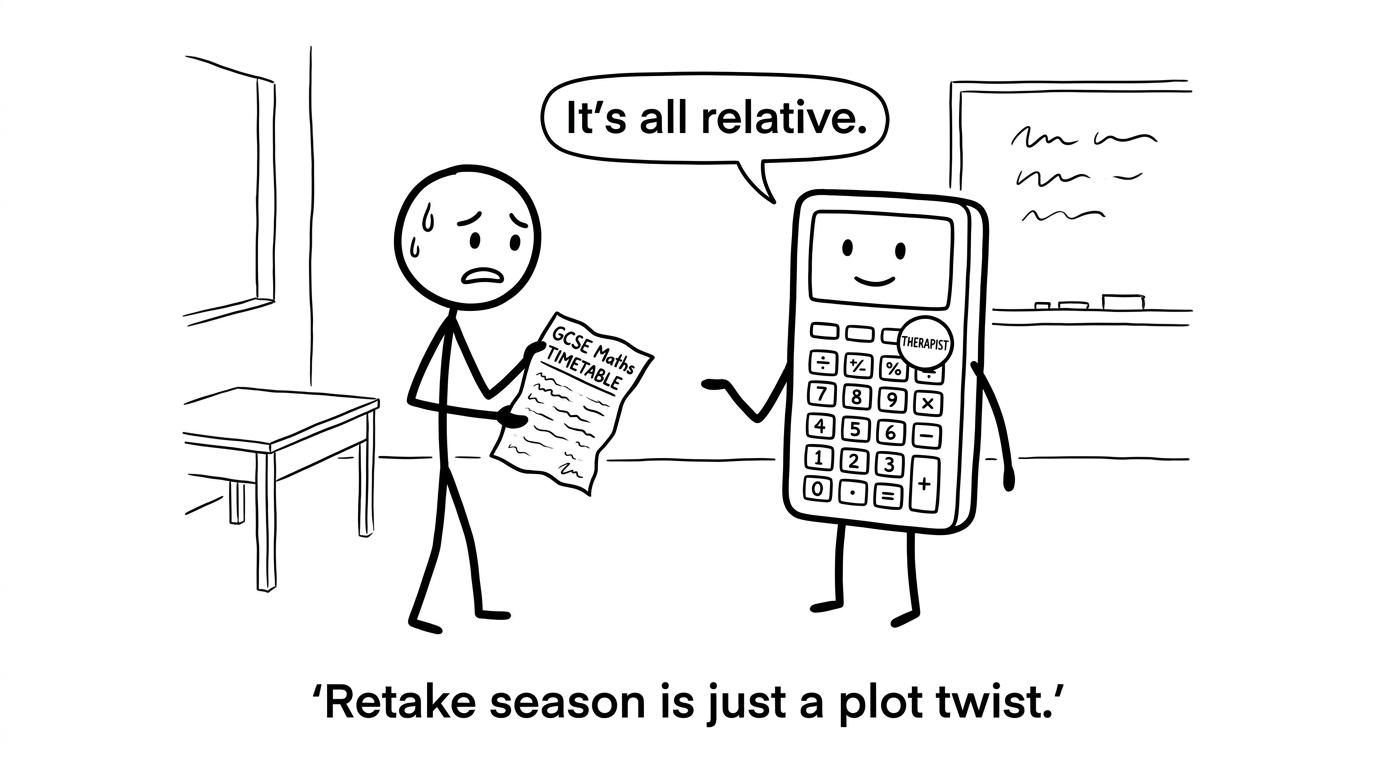 A nervous student talks to a therapist calculator
Quick checklist: what happens next after a GCSE maths fail?
Here’s the reality-check list students wish they’d had on results day:
- Your grade will stay on your record, but you can retake GCSE maths.
- Many sixth forms and colleges require you to continue maths until you achieve at least a grade 444.
- Some courses (especially science, business, computing, and health-related routes) may ask for a grade 444 or 555.
- Retakes typically happen in November (mainly for re-sits) and again in summer.
- You can still progress in lots of pathways while retaking GCSE maths alongside.
- The fastest improvement usually comes from targeted topic practice plus past paper technique.
Maths Genie is built for exactly this: structured lessons, exam questions by topic, mini tests, and predicted papers with mark schemes.
Useful starting points:
- GCSE Maths Revision (Edexcel pathway)
- GCSE Predicted Papers (Edexcel)
- Target Grade Mini Tests
- GCSE Resources Hub
What “fail” means in GCSE maths (and why the boundary matters)
In GCSE maths, “fail” usually means you achieved below a grade 444 (a standard pass). A grade 444 is the benchmark most schools, colleges, employers, and training providers use, although some competitive pathways prefer a grade 555.
It’s also worth remembering that your tier affects your maximum grade:
- Foundation tier covers grades 111 to 555.
- Higher tier covers grades 444 to 999.
So two students could both feel disappointed, but be in different situations: one might be a few marks away from a 444, and another might need to rebuild core number skills. Both are solvable GCSE stories; they just need different plans.
Will you have to retake GCSE maths?
For many students, yes. If you’re staying in education after Year 11 (sixth form, college, training provider), the usual expectation is that you continue working towards a grade 444 in GCSE maths if you didn’t get it the first time.
This isn’t a punishment. It’s a policy response to a real-world truth: functional number skills unlock doors. Budgeting, payslips, data in the news, apprenticeships, driving theory, university entry requirements; they all quietly lean on maths.
Different providers interpret requirements differently, and entry rules vary by course and exam board. But as a general rule:
- Many Level 3 courses (A Levels, BTECs, T Levels) allow you to start while retaking GCSE maths alongside.
- Some courses may ask for a minimum grade in GCSE maths before you can enrol.
- Apprenticeships often require maths and English either upfront or as part of the programme.
If you’re unsure, ask the provider for their published entry requirements; then treat the retake as a project with a deadline.
November retake vs summer retake: which is better?
The November retake is popular because it’s close enough that your knowledge hasn’t evaporated. If you were near a grade 444, it can be the simplest route: a few weeks of focused revision and exam practice can convert “nearly” into “done”.
The summer retake gives more time, which helps if the gaps are bigger or if you’re balancing a heavy college timetable. More time only helps, though, if you use it well. Extra months spent vaguely “going over stuff” rarely moves a GCSE grade.
A good rule of thumb:
- If you were within touching distance of a 444, aim for November.
- If you need to rebuild foundations (especially number, algebra, and basic problem-solving), summer may be healthier.
Either way, the method is the same: diagnose weaknesses, practise by topic, then switch to papers.
The part nobody tells you: GCSE maths retakes are won in the mark scheme
A GCSE maths paper isn’t just testing whether you can get the final answer. It’s testing whether you can show a chain of reasoning that earns marks even when your arithmetic slips.
That’s why Maths Genie’s mix of exam questions, solutions, and mark schemes matters. You’re not revising to “know maths”. You’re revising to collect marks.
Here are two worked examples showing how small changes in method can rescue a grade.
Worked example: turning a messy percentage problem into guaranteed marks
A common retake pain point is percentages. Suppose a jacket costs £484848 after a 20%20\%20% discount. What was the original price?
Let the original price be xxx.
After a 20%20\%20% discount, you pay 80%80\%80% of the original:
0.8x=48 0.8x = 48 0.8x=48Divide both sides by 0.80.80.8:
x=480.8=60 x = \frac{48}{0.8} = 60 x=0.848=60So the original price was £606060.
Why this helps your GCSE grade: you’ve shown a clear method. Even if you typed something wrong on the calculator, your setup 0.8x=480.8x=480.8x=48 usually earns method marks.
If this topic has been costing you marks, practise it properly with a lesson then exam questions, not just flashcards:
Worked example: a two-step equation that retake students often rush
Solve 3(2x−5)=273(2x-5)=273(2x−5)=27.
Start by expanding:
6x−15=27 6x - 15 = 27 6x−15=27Add 151515 to both sides:
6x=42 6x = 42 6x=42Divide by 666:
x=7 x = 7 x=7The habit to build for GCSE maths is writing one line per decision. It slows you down in a good way: fewer dropped negatives, fewer skipped steps, more marks.
If algebra is your weak area, start where the marks are easiest to pick up:
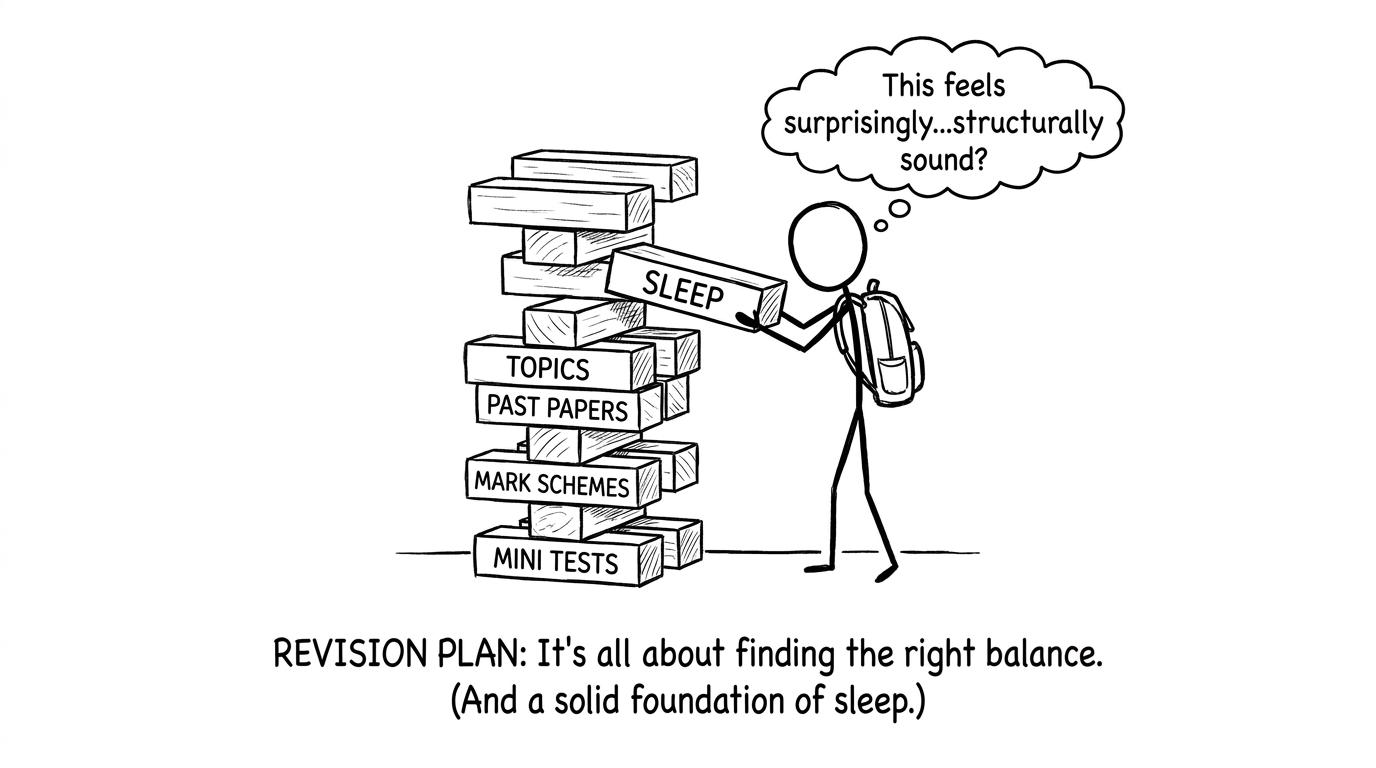 A student builds a revision plan out of Jenga blocks
Foundation or Higher for a resit: what should you choose?
This is one of the most important GCSE decisions, and it’s emotional because it feels like “aiming lower”. But it isn’t. It’s aiming accurately.
- If you need a grade 444 to move forward, foundation tier can be a smart choice because the paper is designed around grades 111-555.
- If you’re consistently working at grade 444-555 and want to push up, higher tier gives access to grades 666-999, but the risk is dropping below 444 if the harder content overwhelms you.
The simplest approach is evidence-based: do a full practice paper under timed conditions, mark it honestly, and see where you land. Maths Genie’s paper collections and mark schemes make that process straightforward.
Try:
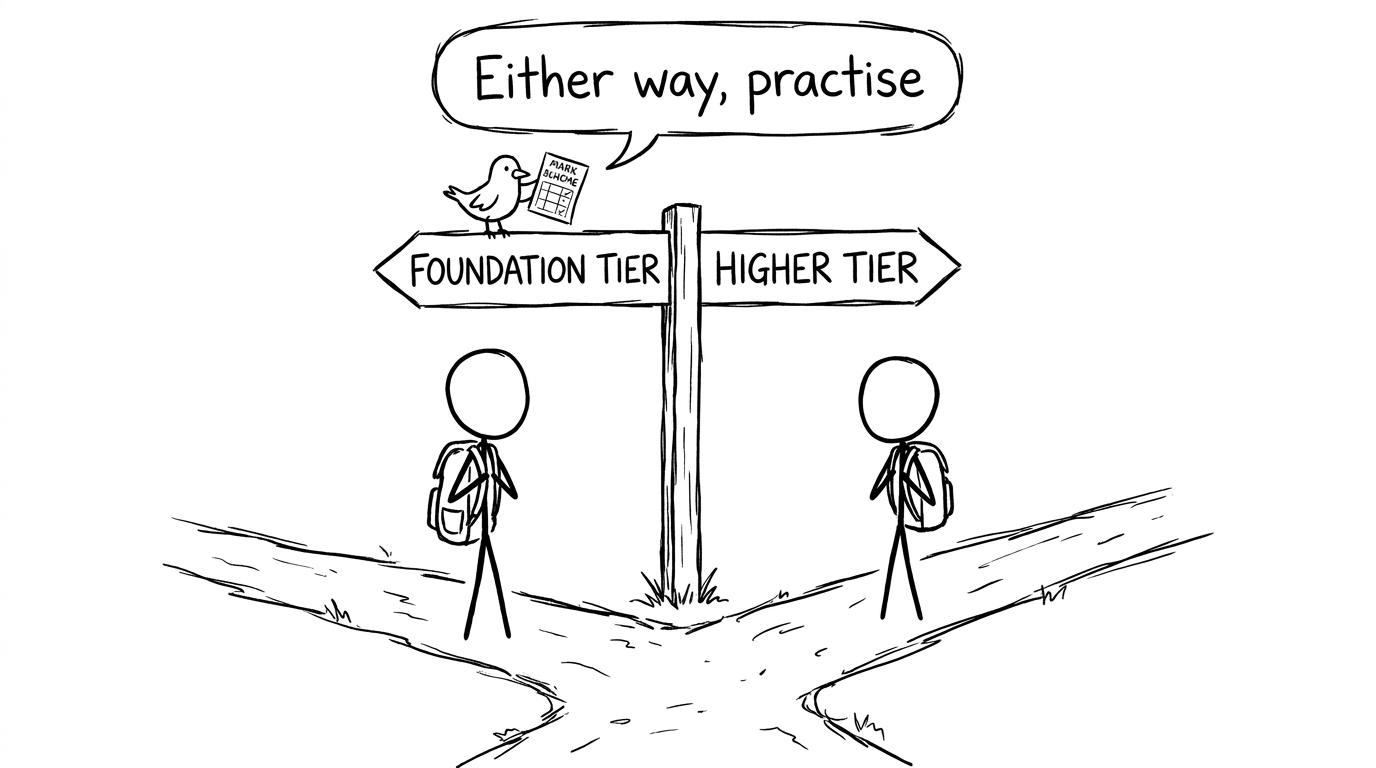 Two students choosing between Foundation and Higher
A realistic 4-week GCSE maths retake plan (that doesn’t rely on motivation)
Motivation is a spark. A plan is a furnace. If you failed GCSE maths, build a routine that works even on low-energy days.
Week 1: Diagnose and rebuild the highest-value basics
- Do one mini test to reveal gaps.
- Relearn the top weak topics using short lessons.
- Practise exam questions immediately after each lesson.
Use:
Week 2: Focus on the topics that repeatedly appear
For most GCSE papers, these areas are consistent mark-makers:
- Number (fractions, percentages, ratio)
- Algebra (rearranging, solving, graphs)
- Geometry (angles, area, Pythagoras)
Pick one topic a day, then finish with mixed questions so your brain learns to switch.
Week 3: Papers, mark schemes, and learning your patterns
Do at least two full papers under timed conditions. Mark them with brutal honesty. Then write a “mistake log” with three columns:
- What went wrong?
- What should I do next time?
- One example question to practise.
This is where grades jump, because you stop repeating the same errors.
Week 4: Predicted papers and exam technique
Predicted papers aren’t magic, but they are excellent training for the blend of topics and the style of wording you’ll face in GCSE maths.
Use:
Common mistakes that keep students stuck below a grade 4
These mistakes are common in GCSE maths retakes because they come from stress, not ability:
- Answer-only writing: you might be right, but you’ve given the marker no route to award method marks.
- Rushing the first step: many questions are won or lost in the setup (like 0.8x=480.8x=480.8x=48). Slow down at the start.
- Tier mismatch: taking higher tier when you need a secure 444 can be risky if you’re not consistently above it.
- Practising what you already like: comfort-topic revision feels productive but doesn’t move your grade.
- Not using mark schemes properly: reading a solution isn’t learning. Re-do the question from scratch a day later.
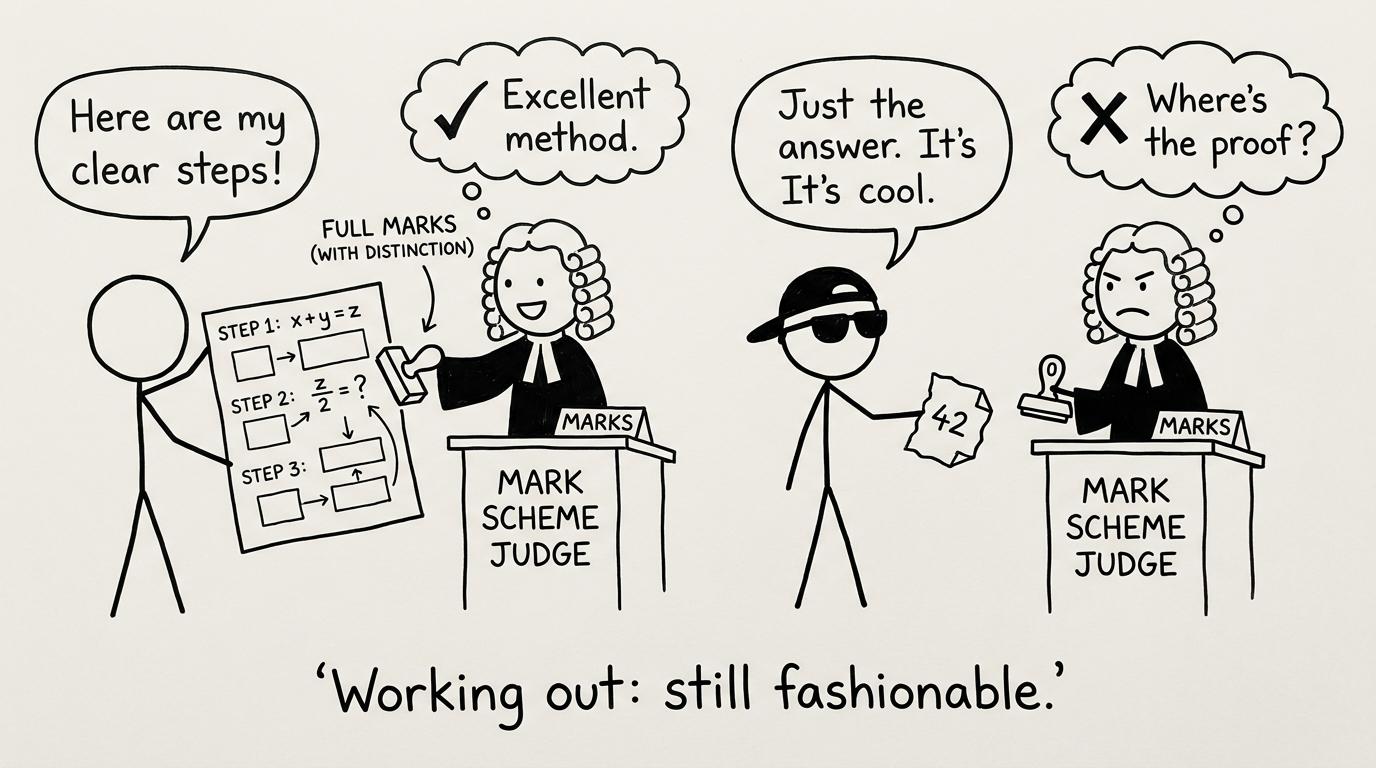 A mark scheme judge rewards clear working
The ending you want is still available
If you failed GCSE maths, you haven’t “proved” anything about your intelligence. You’ve simply received information: your current approach didn’t produce the marks you needed yet. The next part is less about talent and more about making revision boringly effective: clear methods, regular practice, and honest marking.
Start today with a diagnostic mini test, rebuild the topics that leak marks, then move onto timed papers and predicted papers. Maths Genie is designed to make that loop simple: revision lessons, exam questions, mark schemes, video solutions, mini tests, and predicted papers all in one place.
Go here to begin your retake plan:
- GCSE Resources Hub
- GCSE Maths Revision (Edexcel pathway)
- GCSE Predicted Papers
- Target Grade Mini Tests
Your GCSE result is a snapshot. Your next result is a choice, and you can build it, one mark at a time.










