GCSE Resit Exam Stress: A Calm, Practical Plan
GCSE resit exam stress can feel overwhelming. Use this calm, practical plan for the week before and exam morning, with clear routes to support.
Resitting an exam carries a particular kind of pressure. You know what the exam room feels like, and you may fear the same result happening again. But GCSE resit exam stress is not proof that you are unprepared or incapable. It is your mind reacting to something that matters.
The aim is not to eliminate every nerve. It is to make the final week predictable: revise a few priorities, practise recalling what you know, protect your sleep and prepare practical details early. On the morning itself, focus only on the next manageable action.
Your calm resit checklist
During the final week:
- Choose a small number of high-value topics or skills.
- Use short, focused revision sessions with proper breaks.
- Complete some timed practice, but not paper after paper.
- Review mistakes using mark schemes or model answers.
- Keep sleep and waking times reasonably consistent.
- Prepare equipment, travel and exam details in advance.
On exam morning:
- Eat and drink something if you can.
- Arrive with enough time to avoid rushing.
- Avoid comparing revision with other students.
- Use slow breathing if your body feels overwhelmed.
- Start with the question in front of you, not the final result.
Why a resit can feel different
A resit contains memory as well as uncertainty. You may remember opening a difficult paper, running out of time or receiving a disappointing grade. That history can make one exam feel like a verdict on your ability. It is not. A resit is one new performance on one new paper. Your task is simply to collect as many marks as you can now.
Try separating facts from predictions. “I did not get the grade last time” is a fact. “I will definitely fail again” is a prediction. The first can guide your preparation; the second consumes energy without improving it.
Confidence grows from evidence: finishing a timed section, correcting an error or recalling a method without notes. Small completed tasks are more persuasive than telling yourself not to worry.
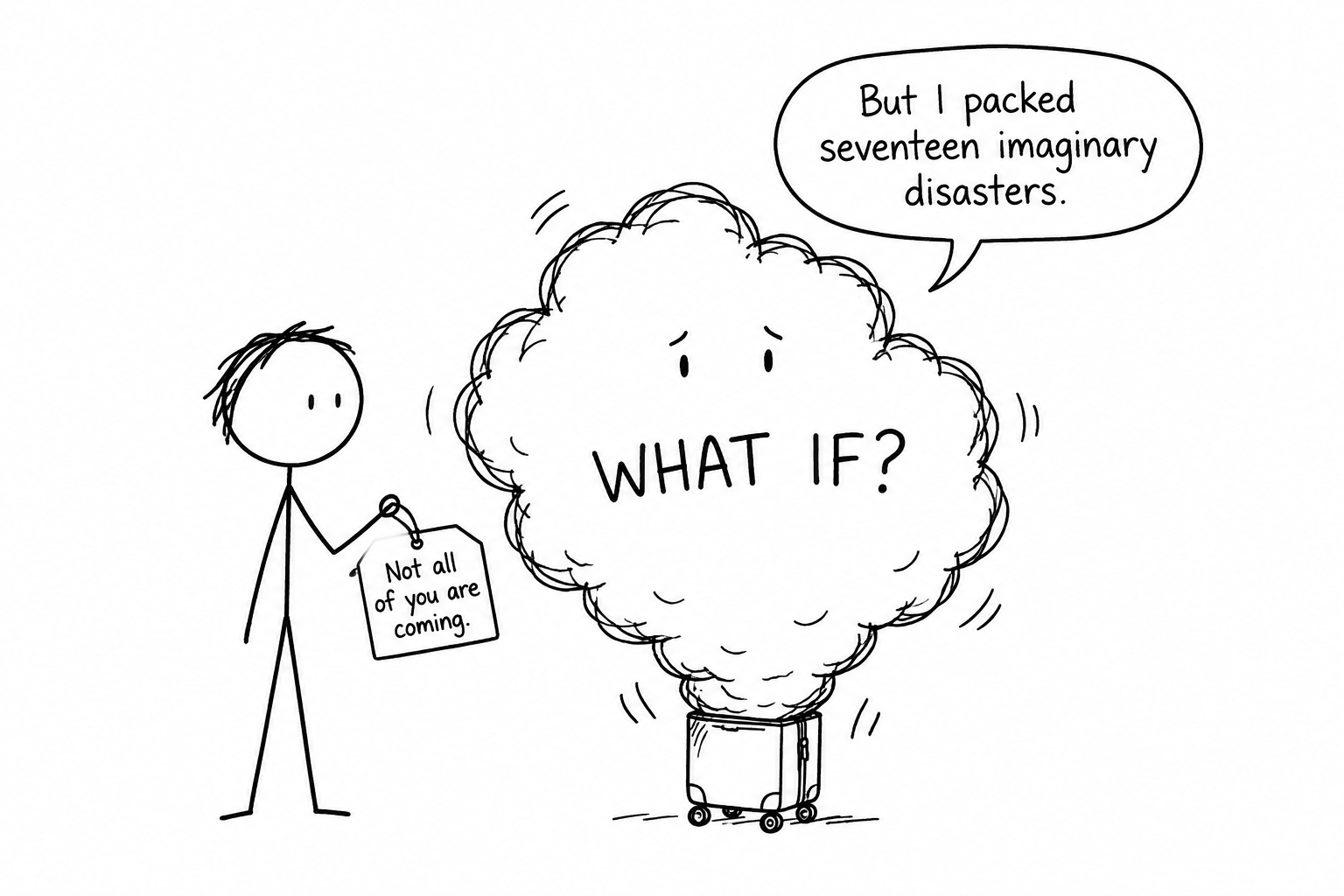 A student calmly refuses to pack seventeen imaginary exam disasters
What to do in the week before your resit
Reduce the size of the plan
When anxiety rises, students often create enormous revision schedules. The plan looks reassuring briefly, then becomes another source of guilt.
Instead, choose two or three priorities each day. For GCSE Maths, these might be topics identified from a marked paper. MathsGenie's GCSE revision timetable guide can help you turn those priorities into realistic sessions.
For English Language, focus on the skills required by your exam board's specification and paper structure. Check whether you are taking AQA, Edexcel, OCR or Eduqas because question wording and assessment structures differ.
Practise retrieval, not just recognition
Reading notes can feel comfortable because the answer is visible. The exam requires you to produce knowledge and methods without that support.
Close the notes and attempt a question. Afterwards, compare your answer with the mark scheme, identify one specific weakness and try a similar task. For Maths, the free MathsGenie revision lessons and practice resources combine explanations, questions and solutions so revision leads to action.
Past papers can reveal timing problems and recurring gaps, but they need not dominate every day. The guide to using GCSE past papers effectively explains how to balance full papers with targeted practice. Use predicted papers as extra exam-style practice, never as a guarantee of what will appear.
Rehearse without exhausting yourself
Complete one timed section in a quiet place. Put away your phone and use only the materials permitted in the exam. The aim is familiarity, not punishment.
Mark the work carefully and look for patterns such as misreading questions, missing units, weak quotations or spending too long on early questions. If a full paper leaves you drained, complete a shorter section or mini test. The GCSE exam week checklist offers a calmer alternative to panic cramming.
Protect sleep rather than chasing perfection
Sleep supports attention, memory and emotional regulation. Keep your bedtime and waking time reasonably steady, stop intensive work before bed and place your phone somewhere that discourages endless checking.
One poor night does not automatically ruin an exam. If sleep is difficult, rest quietly rather than calculating how badly the day must go. Keep the evening deliberately light and use the MathsGenie night-before plan to decide when to stop.
A practical exam-morning routine
Prepare your bag the night before. Check your timetable, venue, transport and permitted equipment. For Maths, confirm whether the paper is calculator or non-calculator and take the required geometrical equipment. Follow your centre's current instructions.
Eat something familiar if possible and drink enough water. Avoid experimenting with large amounts of caffeine or energy drinks, especially if they make you shaky.
If panic begins, breathe in gently, then let the out-breath last a little longer. You can also ground yourself by noticing your feet on the floor, the chair supporting you and neutral objects nearby.
Once the paper starts, read the instructions carefully. If one question freezes your thinking, mark it, move on and return later. In English Language, watch the suggested time and marks. In Maths, show your working because correct stages may earn marks even when the final answer is wrong.
Common mistakes that increase exam anxiety
Trying to relearn the entire course
The final week is for strengthening priorities, not covering every page. Target gaps that are likely to produce marks.
Comparing preparation
Another student saying they revised for six hours tells you little about the quality of that work. Comparison replaces your plan with somebody else's performance.
Treating one question as a prediction
A difficult opening question can trigger thoughts about the whole result. Pause and move to something more accessible. One question is not the paper.
Marking practice without learning from it
A score alone does not improve the next attempt. Use video solutions and mark schemes to locate the exact method, reading skill or timing decision that needs attention.
Keeping serious anxiety secret
Seek support if anxiety is persistent, causes panic, stops you sleeping or eating, or makes daily life difficult. Speak to a parent, carer, teacher, tutor, exams officer or GP. Your school or college may also offer pastoral or counselling support.
Childline supports people under 19 on 0800 1111, while Samaritans can be reached on 116 123. If you or someone else is in immediate danger, call 999 or go to A&E. If agreed access arrangements are unclear, contact your exams officer before the exam.
Walk into the exam with a smaller job
You do not need to feel completely calm before you can perform well. You need a plan that still works while you are nervous.
Choose today's priorities, practise retrieving answers, correct mistakes and prepare the practical details. Then stop. On the morning, your job is not to predict your grade. It is to read one question, make one decision and earn one mark at a time.
For GCSE Maths, start with MathsGenie's free revision lessons, practice questions, mini tests, past papers, predicted papers, mark schemes, video solutions and revision planner. Build a manageable plan, gather evidence of progress and let preparation carry some of the confidence for you.