

GCSE Religious Studies Revision Environment: Does It Matter
GCSE religious studies revision environment advice: learn what genuinely improves focus, memory and exam practice, and what is mostly overrated.
Revision advice often makes the room sound more important than the revision. Find a silent desk. Buy a better lamp. Play the perfect soundtrack. Arrange your notes until the colours agree.
So, does your GCSE religious studies revision environment genuinely affect how much you remember? Yes, but not in the way social media sometimes suggests. A reasonably quiet, comfortable and distraction-controlled space can support concentration. It cannot compensate for passive revision, while effective self-testing can still work at an ordinary kitchen table.
The useful principle is simple: your environment should make good revision easier to begin and harder to interrupt. It does not need to be beautiful. It needs to help you recall beliefs, use sources of authority, compare viewpoints and construct balanced arguments.
The quick revision environment checklist
Before revising, ask:
- Can I work here without frequent conversations or interruptions?
- Is my phone out of sight and difficult to reach?
- Do I have the specification, questions and mark scheme I need?
- Is the space comfortable without making me sleepy?
- Can I write a timed answer here occasionally?
- Am I testing myself, rather than merely rereading?
- Can I repeat this routine on several days?
If most answers are yes, your setup is probably good enough. Begin.
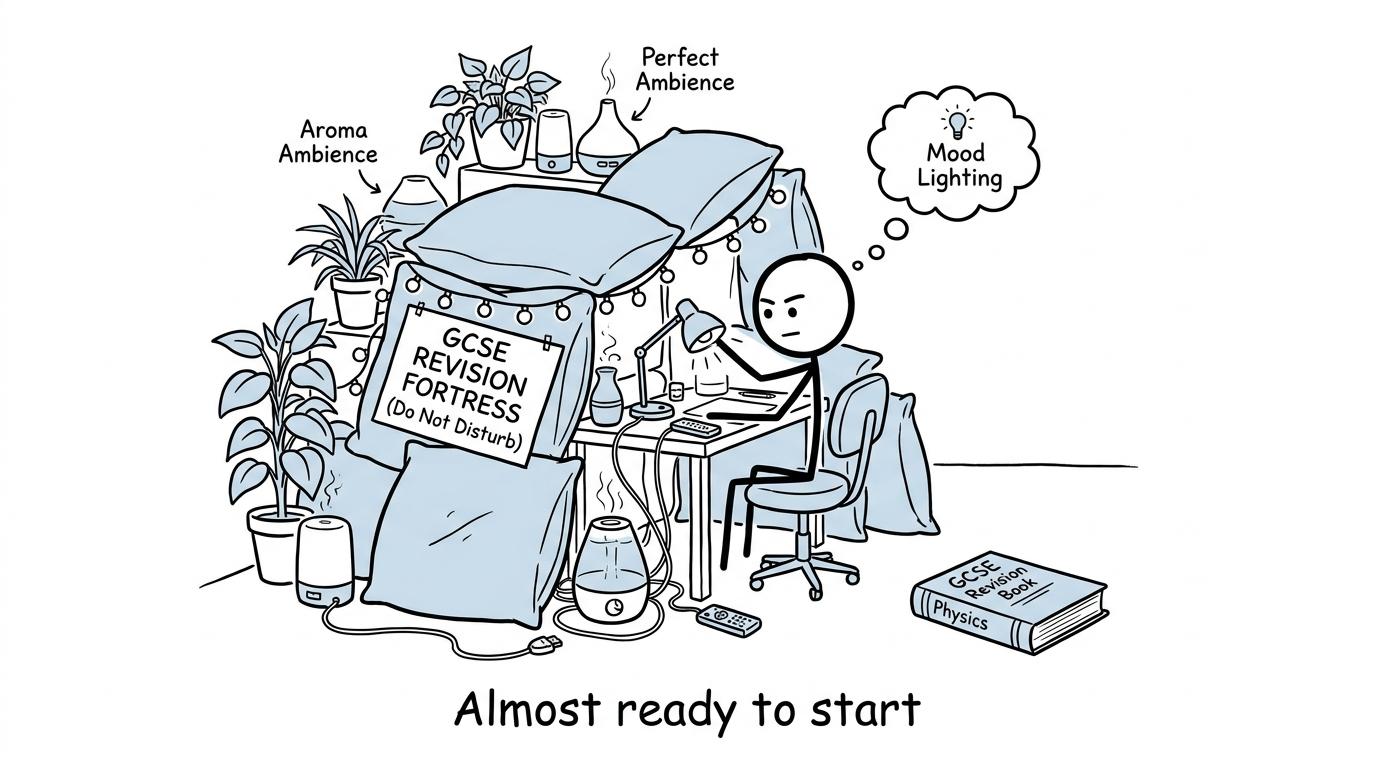 A student builds an elaborate revision fortress while the book waits unopened
Why your revision environment can matter
Learning requires attention. Each notification, conversation or unnecessary browser tab gives your attention somewhere else to go. Returning to the original task then takes effort, particularly when that task is demanding.
GCSE Religious Studies is not simply a collection of quotations. Current assessment requirements in England give substantial importance to both knowledge and understanding and to analysis and evaluation. Across AQA, Edexcel, OCR and Eduqas, the precise paper structures differ, but students must know relevant content and use it in reasoned, well-supported responses.
That combination matters. Remembering a teaching requires focused retrieval. Deciding whether it supports an argument requires focused thinking. A distracting environment can interfere with both.
Research on learning generally supports active retrieval and revision spread over time. Evidence also suggests that managing irrelevant distractions can help, although environment is only one part of the picture. The strongest conclusion is not that everyone needs perfect silence. It is that uncontrolled interruptions make difficult thinking more difficult.
Environment matters less than revision method
A silent room can create the appearance of productivity. You can sit there for an hour, read the same page repeatedly and remember very little tomorrow.
Active revision is different. It asks your memory to do some work. For Religious Studies, that might mean:
- recalling key beliefs without looking at notes;
- explaining how a teaching influences believers;
- sorting arguments by viewpoint or tradition;
- planning an evaluative answer from a statement;
- writing a paragraph under timed conditions;
- checking the response against a board-specific mark scheme;
- returning to the same material after a gap.
This reflects a wider finding from learning research: attempting to retrieve information generally produces more durable learning than repeatedly looking at it. Feedback matters too, because confidently retrieving an inaccurate quotation or explanation can reinforce the mistake.
The same principle applies when balancing RS with maths. A pleasant desk is useful, but completing questions and checking errors is more valuable than admiring organised notes. MathsGenie's GCSE maths revision hub supports that active cycle with revision lessons, practice questions, papers and solutions.
What the best GCSE Religious Studies revision space looks like
There is no universal room. There are, however, several useful characteristics.
It reduces avoidable distractions
Put your phone in another room, inside a bag or with someone you trust. Turning it face down beside your hand still leaves the possibility of interruption visible.
Close unrelated tabs. Gather your textbook, specification checklist, quotations and question materials before starting. Every missing item becomes an excuse to leave the task.
If your home is busy, consider a school revision room, public library or another safe shared space. Headphones can reduce background noise, but music with lyrics may compete with the language-heavy work involved in planning and writing RS answers. If music helps you settle, compare your performance with instrumental audio, neutral background sound and silence rather than assuming your favourite option is best.
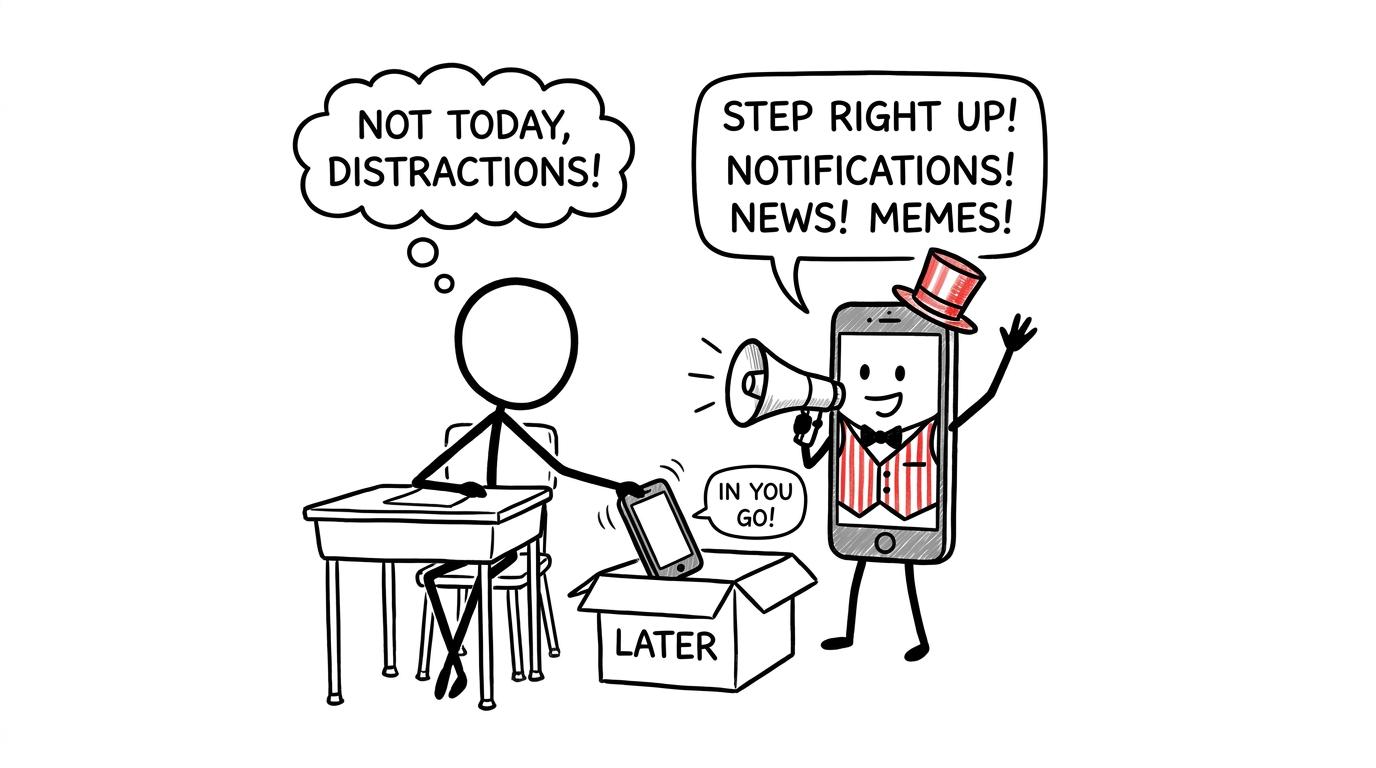 A determined student puts a notification-loving phone into a box labelled Later
It is comfortable, but not too comfortable
You need enough light to read clearly, a stable surface for writing and a position you can maintain without discomfort. You do not need specialist furniture.
Beds are often poor places for extended written practice because they encourage a different habit: rest. Yet a student with limited space should not conclude that revision is impossible. A cleared corner of a table, a clipboard or a regular library seat can all become effective cues for focused work.
Consistency is more valuable than decoration. Returning to a workable place at a regular time reduces the number of decisions needed before you start.
It contains the right resources
Your exam board matters. AQA, Edexcel, OCR and Eduqas do not use identical question structures, timings or mark schemes. Keep your own specification and board-specific materials nearby. Revision becomes less efficient when you memorise content that is not required or practise an answer structure designed for another board.
For maths, the same rule applies: use resources matched to your exam board and foundation or higher tier. MathsGenie's GCSE maths topics by exam board and tier can help you identify the correct route before beginning practice.
Should you always revise in the same place?
Using the same place can strengthen a routine. You sit down, open the correct materials and know what happens next. That is helpful when motivation is unreliable.
But complete dependence on one environment is less helpful. Your examination will not take place at your bedroom desk. Occasionally revise somewhere quieter, sit at a plain table or complete a timed response in conditions resembling an exam hall.
The aim is not to make revision unpleasant. It is to check that your knowledge can be retrieved without familiar posters, background music or notes acting as prompts.
This is particularly important for full-paper practice. Maths students can apply the same idea using Edexcel GCSE maths past papers or resources for their own board. Sit the correct paper under controlled conditions, then use the mark scheme and video solutions afterwards. MathsGenie's guide to using GCSE past papers properly explains the wider attempt, mark, fix and retest cycle.
Quiet revision or revising with friends?
Both can work, but they serve different purposes.
Independent revision is usually better for honest retrieval, timed answers and diagnosing what you personally cannot remember. Group revision can be useful for discussing alternative viewpoints, testing definitions and challenging the reasoning in an argument.
A group stops being useful when conversation replaces retrieval. Give the session a defined task and an end time. Each person could arrive with questions, compare planned arguments and then complete an individual check without notes.
Judge the session by evidence. What could you explain afterwards that you could not explain before? If the answer is unclear, the group may have been socially enjoyable without being academically effective.
Build an environment around a repeatable routine
A good space works best when paired with a clear sequence:
- choose one narrow topic;
- recall what you know without notes;
- check omissions and inaccuracies;
- answer or plan an exam-style question;
- use the mark scheme or teacher feedback;
- record one specific improvement;
- revisit the topic on another day.
Spacing revision across multiple sessions is generally more effective for lasting retention than concentrating every encounter into one sitting. The precise interval is less important than returning after some forgetting has occurred.
A timetable makes those returns visible. If maths is competing with RS and your other GCSEs, use the principles in the MathsGenie GCSE revision timetable guide or adapt the one-month GCSE maths revision plan. Plan specific tasks rather than writing vague entries such as “revise maths” or “do RS”.
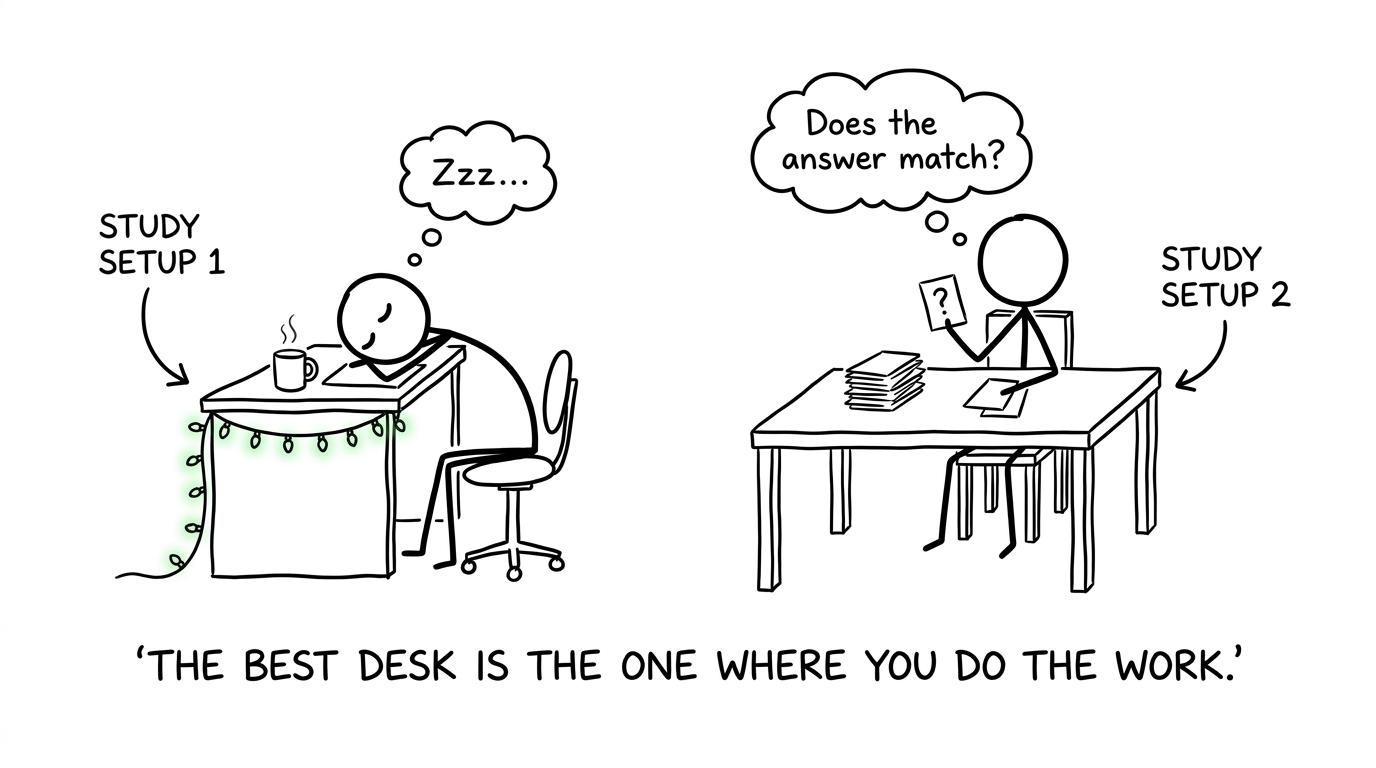 A plain table beats a glamorous desk because the student is actively self-testing
Test whether your environment actually works
Do not choose a revision setup entirely by mood. Run a simple comparison over several sessions.
Use similar tasks in two realistic environments. After each session, record:
- how quickly you started;
- how often you became distracted;
- how much work you completed;
- how accurately you recalled the content later;
- whether you could explain and evaluate, not merely recognise notes.
Recognition can be misleading. A quotation may look familiar without being available when the exam paper is closed in front of you. Delayed self-testing gives better evidence than how productive a session felt.
Maths provides an especially clear version of this test because performance is measurable. Complete a short set such as the Edexcel GCSE maths mini tests, mark it and note the errors. Repeat comparable practice in your alternative environment. The better setup is the one supporting focused, accurate work, not the one that photographs best.
Common revision environment mistakes
Waiting for perfect conditions
Noise, limited space and family routines are real constraints. Improve what you can, but do not postpone all revision until an ideal room appears. A short focused session in an imperfect place beats a perfectly planned session that never begins.
Treating organisation as revision
Tidying materials is useful when it removes friction. Recopying headings, rearranging stationery and redesigning a timetable repeatedly can become avoidance. Set a brief preparation limit, then start retrieval.
Keeping the phone within reach
Willpower is a fragile revision tool. Physical distance is usually more reliable than repeatedly deciding not to check a notification.
Using noise to avoid difficult thinking
Background audio may feel comforting while making language-heavy work harder. Test it against silence using recall and written performance, not preference alone.
Revising only what feels familiar
A comfortable environment can encourage comfortable topics. Use specifications, marked questions and mini tests to choose what needs attention. In maths, predicted papers can expose gaps once topic knowledge is established, but they should lead back to focused practice rather than become a guessing exercise.
Make the environment serve the work
Your GCSE Religious Studies revision environment matters, but it is an amplifier rather than the engine. It can protect your attention, reduce the effort needed to begin and make regular practice more likely. It cannot turn rereading into retrieval or replace accurate feedback.
Create the simplest space in which you can think clearly. Remove the phone. Open the correct specification. Recall, write, check and return later. Then use occasional exam-style conditions to ensure your knowledge travels with you.
For the maths part of your GCSE programme, let MathsGenie's free GCSE revision resources provide the structure: revision lessons to rebuild understanding, practice questions and mini tests to strengthen recall, and past papers, predicted papers, mark schemes and video solutions to reveal what to fix next. Your desk does not earn the marks. The work you repeatedly do there can.











