GCSE Psychology Extracurricular Club: Does It Help?
GCSE psychology extracurricular club benefits explained: learn when a subject society may support your grade and when independent revision matters more.
A club can feel like a hopeful shortcut. Join a room full of motivated students, discuss fascinating experiments and somehow become better at the exam. But does a GCSE psychology extracurricular club genuinely improve your grade?
The honest answer is: it can help indirectly, but membership alone will not raise your marks. A useful club creates structured opportunities to retrieve knowledge, explain ideas, evaluate evidence and practise research methods. An unfocused club can simply consume time that would have been better spent answering exam questions.
For students also preparing for GCSE maths, the decision matters. Psychology may involve data, graphs, averages and interpretation, but a weekly club must not quietly replace the targeted maths revision needed for your foundation or higher tier papers.
The quick verdict
A psychology club is most likely to support your grade when it:
- follows your exam board's specification;
- makes every student retrieve and explain knowledge;
- includes application and evaluation, not just discussion;
- uses exam questions and mark schemes;
- corrects misconceptions promptly;
- strengthens research-methods and data skills;
- fits into your timetable without displacing essential revision.
It is less likely to help when meetings become passive lectures, unrelated debates or elaborate poster-making sessions. Enjoyment still has value, but enjoyable enrichment and efficient exam preparation are not always the same thing.
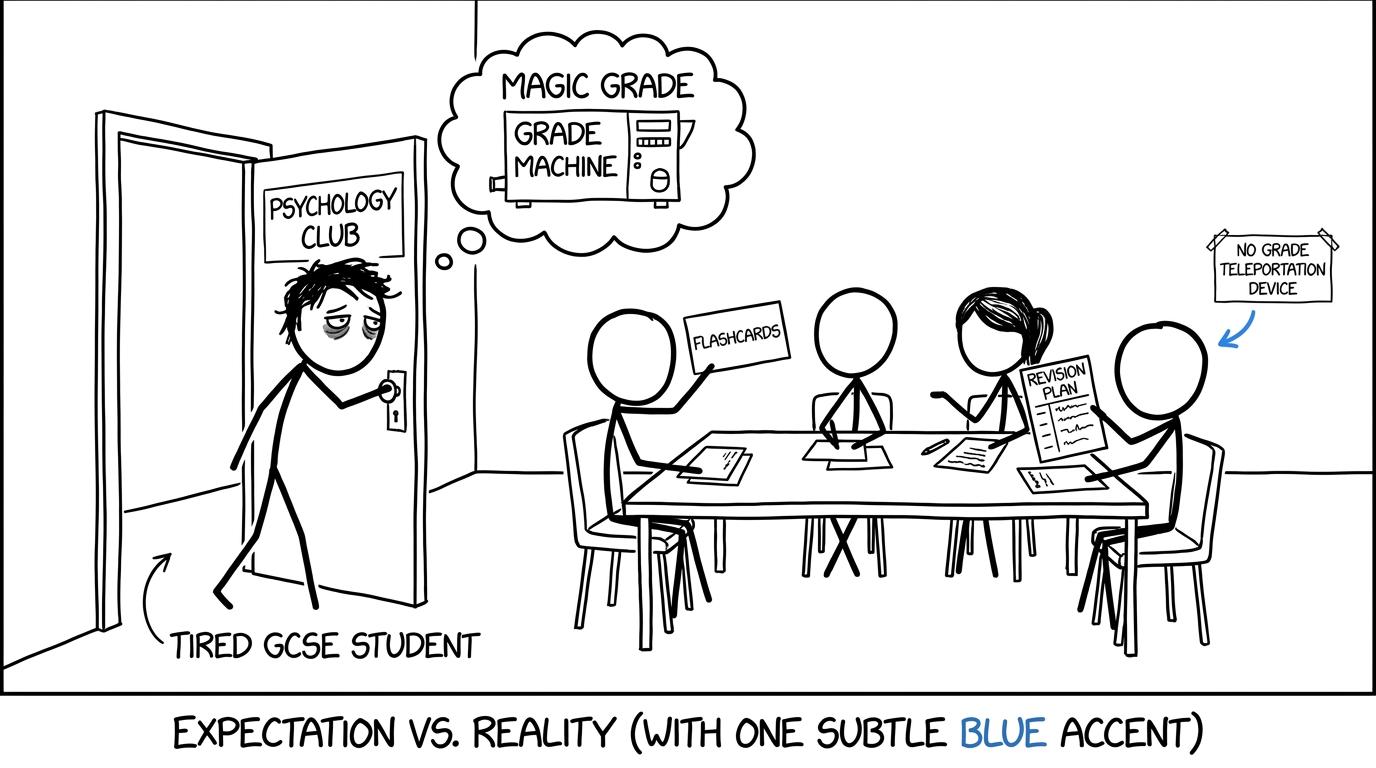 A student discovers that psychology club contains discussion and flashcards rather than a grade teleportation device
Why a psychology club might improve exam performance
The strongest case for joining is not that extracurricular participation automatically produces higher grades. Research into extracurricular activities often finds associations with educational outcomes, but causal effects are difficult to establish. Students who volunteer for academic clubs may already be motivated, organised or confident.
A better question is therefore: what will you actually do in the club?
Educational evidence supports carefully structured collaborative learning and metacognitive approaches. Collaboration works best when pupils have a shared goal, everyone participates and the task requires genuine thinking. Metacognition involves planning an approach, monitoring understanding and evaluating what needs to change.
A well-run subject society can provide both.
Explaining ideas exposes weak understanding
Reading about memory or social influence can create a feeling of familiarity. Explaining the same idea without notes is different. Missing terminology and uncertain links become visible.
In a useful meeting, students might take turns explaining a theory, identifying evidence and answering follow-up questions. This is retrieval practice rather than recognition. It is also harder to hide behind a highlighted page when somebody asks, “Why does that evidence support the conclusion?”
That principle transfers directly to maths. You do not fully know a method because it looked sensible in a video. You know it when you can select and use it independently. MathsGenie's GCSE maths revision hub supports that progression through lessons, questions and exam-board resources.
Discussion can develop application and evaluation
Ofqual's assessment requirements for GCSE Psychology divide assessment between knowledge and understanding, application, and analysis and evaluation. The required overall weightings are approximately 35%35\%35% for AO1, 35%35\%35% for AO2 and 30%30\%30% for AO3.
That means factual recall is essential, but it is not the whole qualification. Students must apply psychological ideas and make reasoned judgements about evidence, procedures and conclusions.
A structured club can make those skills more natural. One student can propose an evaluation point, another can challenge whether it is relevant, and the group can improve the explanation. The important word is structured. A lively opinion is not automatically an AO3 response. Claims still need accurate psychological reasoning.
Research methods connect psychology and maths
Research methods are not an optional extra. Ofqual requires them to be assessed across the assessment objectives and to account for at least 20%20\%20% of the total marks in GCSE Psychology qualifications.
This is where psychology can reinforce some mathematical habits. Depending on the specification and question, students may need to interpret data, consider sampling, understand graphs or discuss conclusions drawn from evidence. A club can explore why a result may be misleading, how variables are controlled or whether a sample represents a population.
Students taking GCSE maths can strengthen the underlying numerical skills through GCSE Statistics revision. The subject is not a substitute for psychology research-methods teaching, but its work on data collection, representation, averages, correlation and probability can make unfamiliar information feel more manageable.
What an effective GCSE psychology extracurricular club looks like
The club should sit close enough to the specification to improve examinable skills while leaving some room for curiosity. A sensible meeting could contain:
- a short no-notes retrieval task;
- one specification-linked concept or study;
- a scenario requiring application;
- a discussion of one evaluation issue;
- an exam question completed independently;
- marking followed by a specific correction.
This sequence matters. Conversation develops ideas, but independent writing reveals whether each student can convert those ideas into marks.
The same learn-practise-mark-fix cycle powers effective maths revision. If you are unsure how to organise it, the 20-minute GCSE maths revision routine shows how focused work can fit around a busy school day.
Questions to ask before joining
Do not judge a club only by its name. Ask the organiser:
- Which exam board and specification does it support?
- Will meetings include exam questions?
- How will answers be checked?
- Does everyone participate or do a few confident students dominate?
- Will the programme revisit material over time?
- How much work is expected outside meetings?
AQA, Pearson Edexcel and OCR specifications share the regulated assessment objectives, but their content and paper structures are not identical. Revision should always match the qualification your school has entered you for.
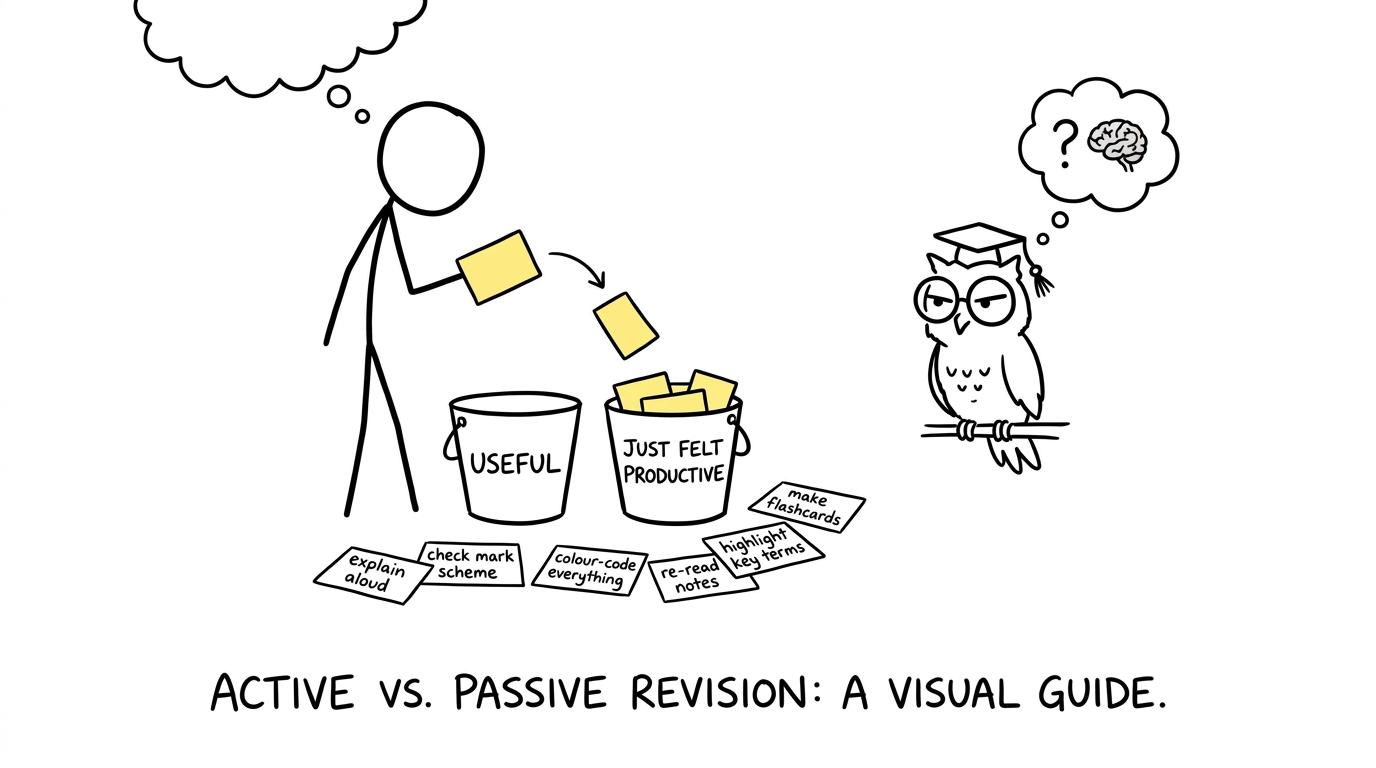 A student sorts active revision and merely productive-looking tasks into different buckets
When joining may not help your grade
Every hour has an opportunity cost. A club can be worthwhile and still be the wrong choice at a particular moment.
It replaces higher-priority revision
Suppose psychology is secure but algebra repeatedly costs you marks. Adding another psychology session may feel productive because it is comfortable, while the larger weakness remains untouched.
Use evidence rather than mood. A marked paper or mini test can reveal which topics need attention. MathsGenie's guide to finding your weakest GCSE topics explains how to turn lost marks into a focused revision list.
The sessions are interesting but not examinable
Psychology offers endless possibilities for documentaries, debates and popular claims about behaviour. These can encourage wider interest, but the exam rewards knowledge and skills defined by the specification.
A strong organiser makes the distinction clear: “This is enrichment” or “This develops AO2 application.” Without that distinction, students can leave with many memorable facts and few usable exam responses.
Group work becomes passive
Collaborative learning does not mean sitting beside other students while one person supplies every answer. If you can attend without retrieving, writing, deciding or receiving feedback, the meeting may create confidence without competence.
Useful participation should feel mentally active. You should sometimes be uncertain, make an attempt and then correct it.
There is no feedback loop
Completing questions is only half the process. Improvement happens when you compare your response with the mark scheme, identify why marks were lost and try again.
The same rule applies across subjects. Read MathsGenie's guide to using GCSE mark schemes effectively for a practical attempt-mark-classify-correct routine.
How to balance psychology club with GCSE maths revision
Treat the club as one component of your week, not the organising principle for everything else.
Start with fixed commitments: lessons, homework, sleep and the club meeting. Then protect short maths sessions for topics identified from your own papers. A realistic plan is usually stronger than a beautiful timetable that collapses after two days.
The GCSE revision timetable guide can help you build sessions around specific actions rather than vague labels such as “revise maths”.
Your maths sessions should normally include:
- one clearly defined foundation or higher topic;
- a revision lesson when the method is uncertain;
- independent practice questions;
- immediate checking with a mark scheme or video solution;
- a later reattempt without notes.
Past papers should then test whether those repaired skills survive in a mixed, timed setting. The guide to using GCSE past papers properly explains why the real revision happens after the paper, when mistakes are classified and corrected.
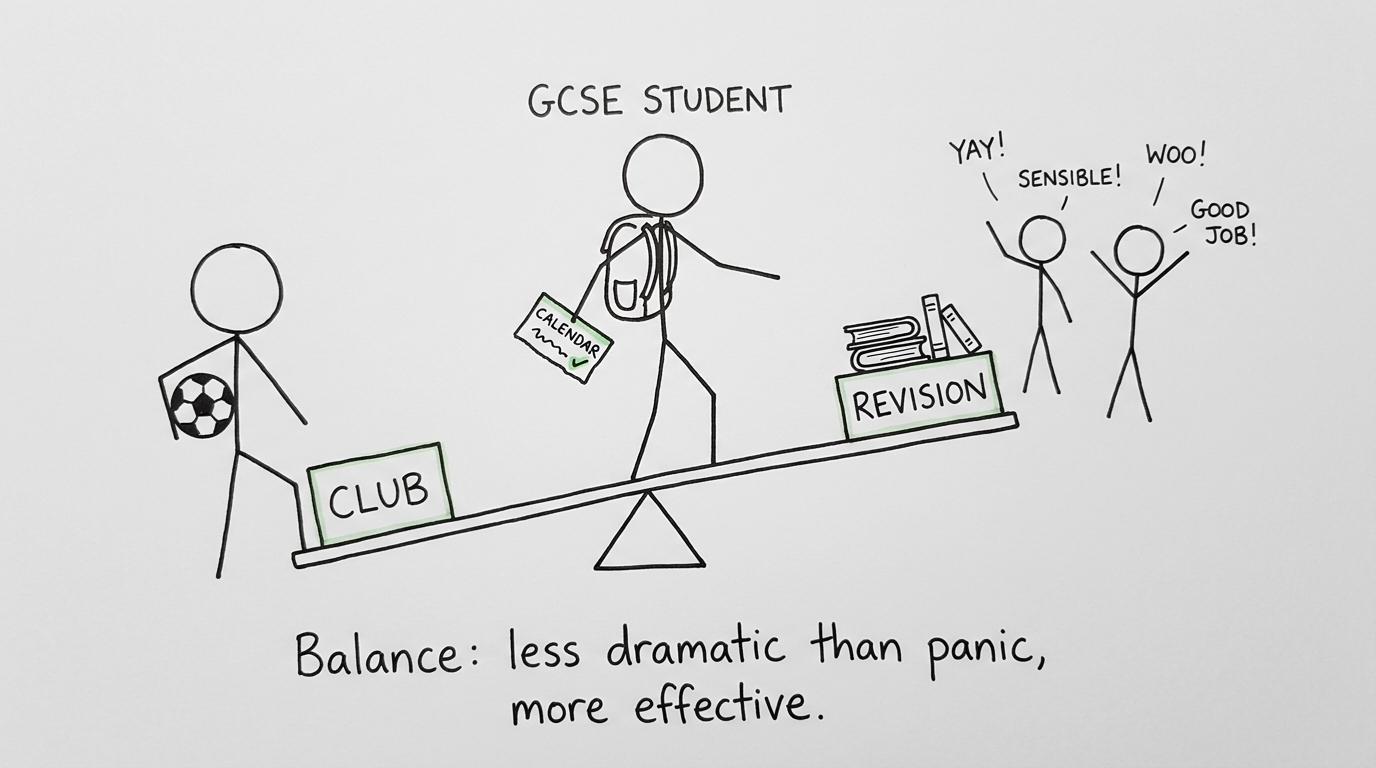 A student balances psychology club and revision using a small calendar
Common mistakes when using a subject club for revision
Assuming attendance equals progress
Being present is not evidence of learning. Measure progress through independent recall, completed questions and improved marked responses.
Revising only enjoyable topics
Clubs naturally drift towards memorable themes. Keep a specification checklist so quieter topics and research methods are not neglected.
Copying the strongest student
A polished group answer can hide individual gaps. Write your own response before comparing ideas.
Treating debate as evaluation
Evaluation requires accurate, relevant reasoning about psychological evidence or procedures. Personal agreement and disagreement are not enough.
Sacrificing maths practice
Psychology may reinforce data interpretation, but it cannot replace algebra, geometry, number, ratio, probability or the other content assessed in GCSE maths. Keep using board- and tier-appropriate questions.
Never testing under exam conditions
Discussion removes some of the pressure of independent writing. As the exams approach, combine club work with timed questions and complete papers.
The final judgement
Joining a GCSE psychology extracurricular club may help your grade when its activities mirror the thinking required by the exam: retrieve, apply, evaluate, write, mark and improve. It may also make the subject more engaging and give you a regular reason to revisit content.
But the club is a structure, not a guarantee. Its value comes from what happens inside the hour and what you do afterwards. If it displaces urgent revision, avoids exam questions or leaves mistakes uncorrected, membership alone is unlikely to change your result.
Keep the decision simple. Attend a few sessions, check whether you are producing better independent answers and review the cost to the rest of your timetable. Continue if the evidence is positive.
For maths, build the same evidence-led routine with MathsGenie. Choose your board and tier, use free revision lessons and practice questions to repair gaps, check your work with mark schemes and video solutions, then build confidence through mini tests, Edexcel GCSE maths past papers and predicted papers. A club may support progress. Deliberate practice is what turns that support into marks.