GCSE Physics AQA Grade Boundaries Explained
GCSE physics AQA grade boundaries explained with confirmed marks, tier differences, 2026 results day timing and practical next steps for students.
Results day compresses two years of lessons, practicals and calculations into one line on a results slip. If you are searching for GCSE Physics AQA grade boundaries, the most important fact is simple: the boundary is the minimum total mark needed for a grade, and it can change each year.
For summer 2026, GCSE results day is Thursday 20 August 2026. AQA will publish the confirmed boundaries at eight o'clock that morning. Until then, nobody can state the 2026 boundaries with certainty. The latest confirmed figures are from June 2025, so those are the useful historical reference below, not a prediction.
A quick results day checklist
- Confirm that you took AQA GCSE Physics, specification code 8463, rather than Combined Science.
- Check whether your entry was Foundation tier or Higher tier.
- Use the subject boundary for your total across both papers.
- Treat previous boundaries as context, not guaranteed targets.
- Speak to your school before requesting a review of marking.
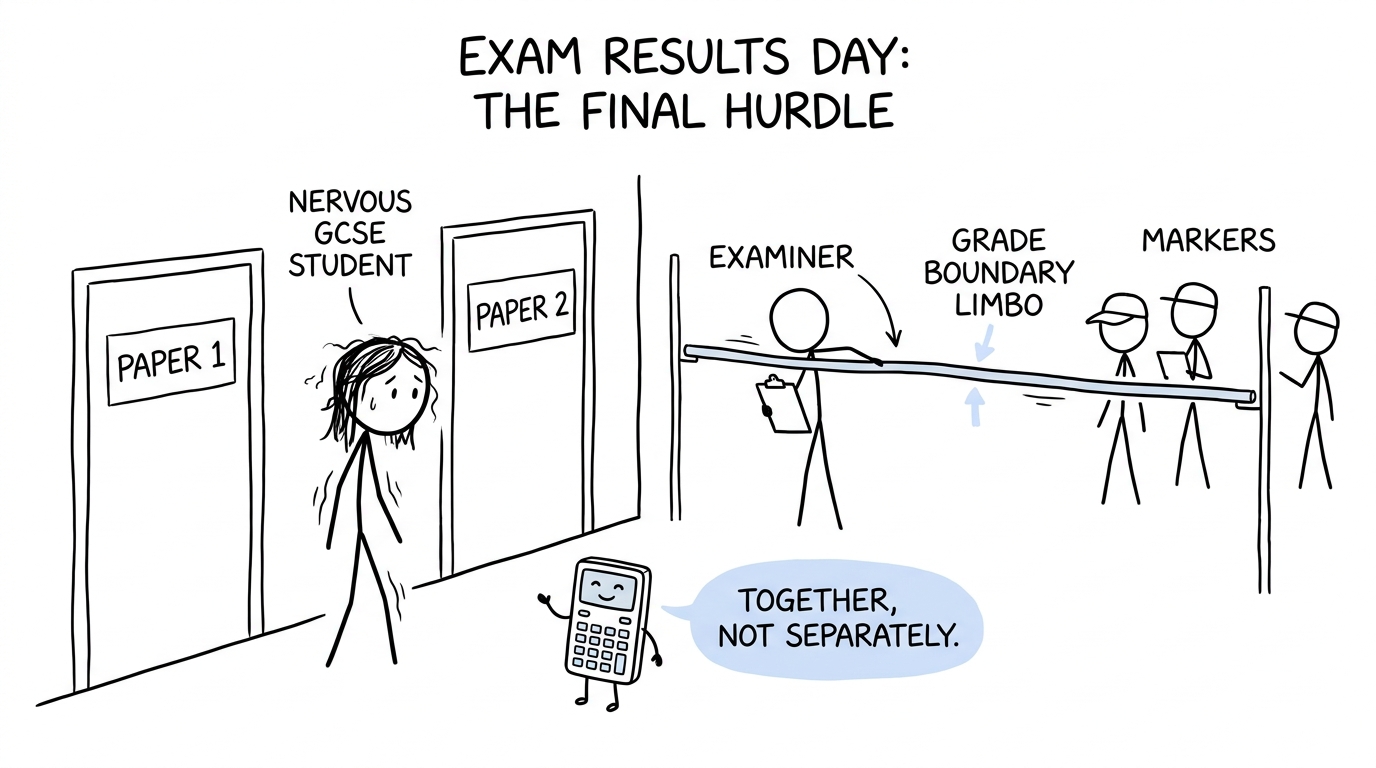 A nervous GCSE student discovers that both Physics papers contribute to one final result
Latest confirmed AQA Physics grade boundaries
AQA GCSE Physics has two written papers. Each is worth 100100100 marks and contributes 50%50\%50% of the qualification, giving a total of 200200200 marks.
The table shows the June 2025 subject boundaries. Percentages are included only to make the scale easier to understand.
| Grade | Higher tier mark | Higher percentage | Foundation tier mark | Foundation percentage |
|---|---|---|---|---|
| 999 | 152152152 | 76%76\%76% | Not available | Not available |
| 888 | 139139139 | 69.5%69.5\%69.5% | Not available | Not available |
| 777 | 126126126 | 63%63\%63% | Not available | Not available |
| 666 | 107107107 | 53.5%53.5\%53.5% | Not available | Not available |
| 555 | 888888 | 44%44\%44% | 144144144 | 72%72\%72% |
| 444 | 707070 | 35%35\%35% | 131131131 | 65.5%65.5\%65.5% |
| 333 | 616161 | 30.5%30.5\%30.5% | 959595 | 47.5%47.5\%47.5% |
| 222 | Not available | Not available | 595959 | 29.5%29.5\%29.5% |
| 111 | Not available | Not available | 242424 | 12%12\%12% |
These are minimum marks. On Higher tier in 2025, for instance, a total mark from 126126126 to 138138138 produced grade 777. A mark of 139139139 reached grade 888.
Foundation tier awards grades 555 to 111. Higher tier normally awards grades 999 to 444, with an allowed grade 333 for students who fall just below the grade 444 boundary. This is why the available grades differ between the two tiers.
Why AQA Physics grade boundaries change
Grade boundaries are not fixed percentages. AQA sets them after the papers have been marked, using statistical evidence and expert review of students' work around possible boundaries.
This adjustment matters because no two exam series are identical. If a paper proves more demanding, a comparable standard of work may correspond to a lower raw mark. If it proves less demanding, the boundary may rise. A higher boundary does not automatically mean grading has become harsher.
There is also no fixed quota saying that only a certain number of students may receive each grade. Your result depends on your marked work and where its total falls against the confirmed boundary.
How your final AQA Physics result is calculated
Paper 1 assesses energy, electricity, the particle model of matter and atomic structure. Paper 2 assesses forces, waves, magnetism and electromagnetism, plus space physics for the separate Physics qualification.
Your final subject mark is:
total mark=Paper 1 mark+Paper 2 mark\text{total mark}=\text{Paper 1 mark}+\text{Paper 2 mark}total mark=Paper 1 mark+Paper 2 markThe grade is awarded from that total. You do not need to achieve the same grade on each paper, and the notional boundaries sometimes shown for individual components are illustrative rather than separate grades.
This is useful during revision. A difficult Paper 1 does not end the story; marks recovered on Paper 2 carry equal weight. Use the AQA GCSE Physics past papers to practise combining performance across both papers rather than judging yourself from one topic.
What to do before and after GCSE Physics results day
Before results day, avoid trying to reverse-engineer a grade from online discussions. Unofficial mark schemes, remembered answers and predicted boundaries all contain uncertainty.
Instead, strengthen the skills that transfer between Physics and maths: rearranging equations, unit conversion, standard form and graph gradients. MathsGenie's AQA GCSE Physics revision guides organise the content by specification topic, while the distance to time relationship guide supports graph interpretation.
For targeted revision, revisit energy transfers in a system, series and parallel circuits and gravity. If calculations are costing marks, the AQA GCSE Maths revision guides can help repair the underlying method.
After receiving your result, check any entry requirements for your next course. If the grade is unexpected, ask your school for your component marks and advice. A review of marking can cause a result to rise, stay unchanged or fall, so it should be an informed decision rather than an automatic reaction.
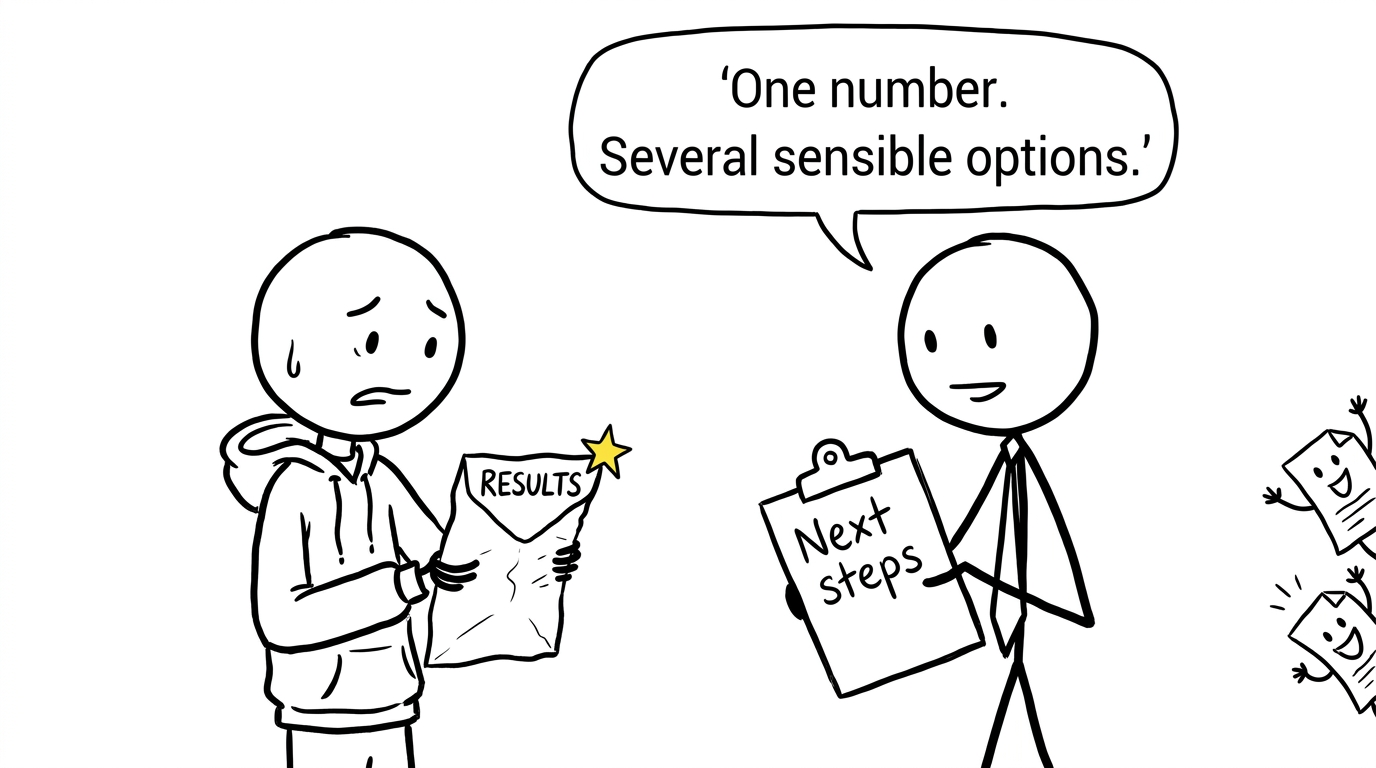 A GCSE student opens a results envelope while a teacher calmly points towards sensible next steps
Common mistakes when reading grade boundaries
Using Combined Science boundaries
AQA Combined Science: Trilogy has a different specification, assessment structure and double-grade system. Its boundaries cannot be used for separate GCSE Physics 8463.
Adding notional paper grades
Your certificate reports one Physics grade based on the combined mark. Individual paper boundaries do not create two grades that are averaged.
Treating 2025 marks as a 2026 prediction
Past boundaries show what happened under past papers. They cannot reveal the precise difficulty of a new series before marking is complete.
Comparing Foundation and Higher marks directly
The papers and available grade ranges differ. A grade 555 required different raw marks across the tiers in 2025, but both outcomes represented the awarded grade 555 standard.
Your next useful step
A grade boundary is a line drawn after marking. Revision is what moves your mark before that line exists.
Start with the AQA GCSE Physics revision guides, complete a timed paper, and mark it honestly. The guide to using AQA Physics past papers properly explains how to turn each lost mark into a focused revision task.
MathsGenie brings revision lessons, practice questions, past papers, mark schemes, video solutions, mini tests and predicted papers into one calm routine. Do not spend revision season guessing the boundary. Build enough secure marks that the uncertainty matters less.