x

Revision notes for AQA GCSE Physics Gravity. Open the guide for explanations and worked examples. Written against the AQA GCSE Physics (8463) specification, so the content matches what's examinable rather than general Physics background.

Gravity

What you'll learn

  • What weight means in physics, and why it is a force.
  • How mass and weight are different.
  • How to use the equation W=mgW = mgW=mg correctly.
  • Why weight is drawn as acting through an object’s centre of mass.

Forces and gravity: the starting point

A force is a push or pull on an object. Forces are measured in newtons, symbol N.

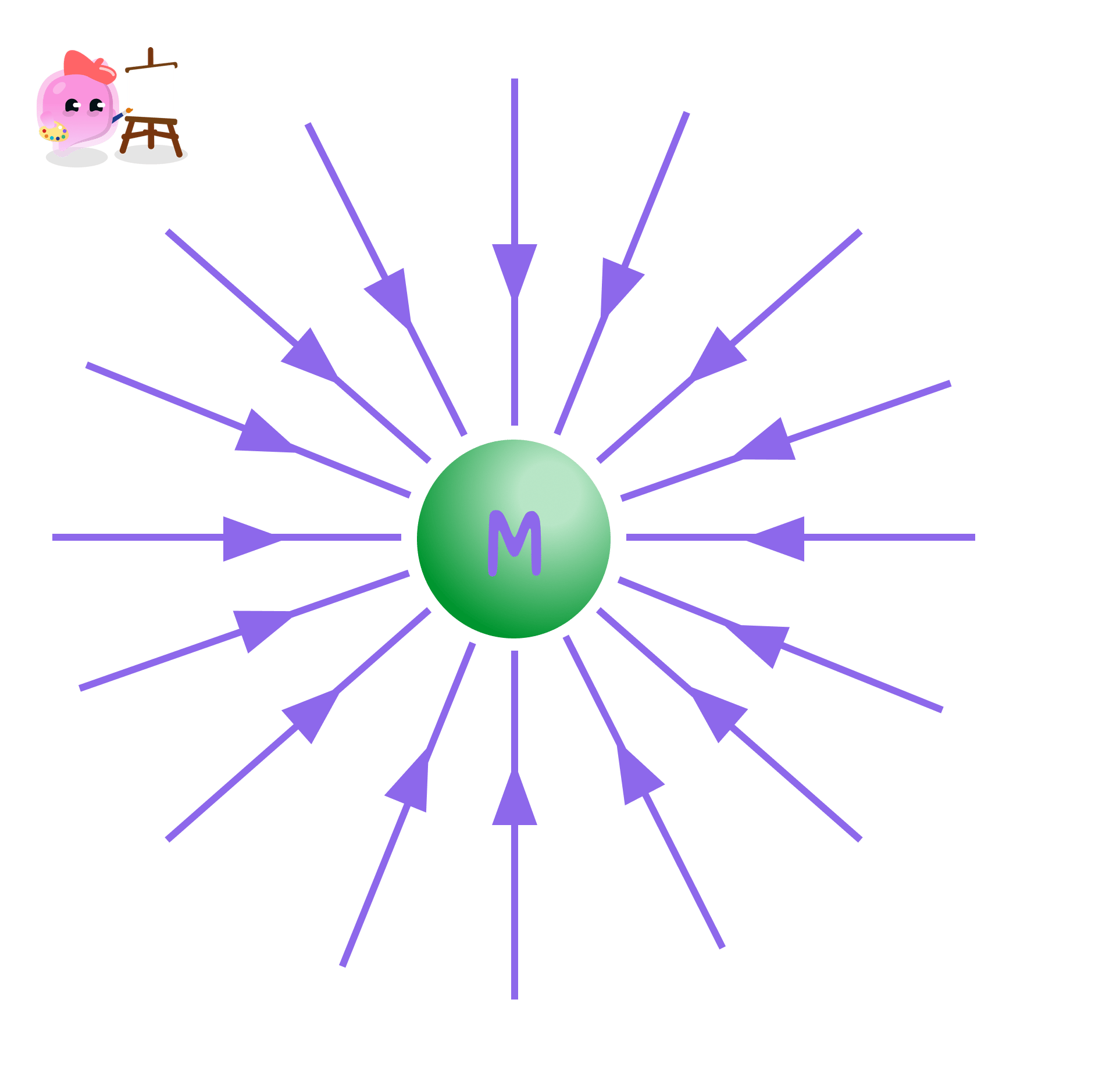
Gravity is an attractive force between objects with mass. Close to the Earth, the force of gravity on an object is caused by the gravitational field around the Earth.

Definition

Weight

Weight is the force acting on an object due to gravity. Its symbol is WWW, and it is measured in newtons, N.

Because weight is a force, it has a direction. Close to the Earth, weight acts downwards, towards the centre of the Earth.

Gravitational fields

A field is a region where an object experiences a force without needing to touch another object. The Earth has a gravitational field around it, so objects near the Earth experience a gravitational force.

Definition

Gravitational field strength

Gravitational field strength, symbol ggg, is the force of gravity on each kilogram of mass at a point in a gravitational field. It is measured in newtons per kilogram, N/kg.

The value of ggg depends on where the object is. Near the surface of the Earth it is about 9.8 N/kg, often rounded to 10 N/kg in GCSE questions. In calculations, the value of ggg will be given.

The diagram shows an object in the Earth’s gravitational field. Its weight acts downwards from its centre of mass.

Object near Earth showing gravitational field lines, weight W acting downwards through the centre of mass, and W = mg

Key Idea

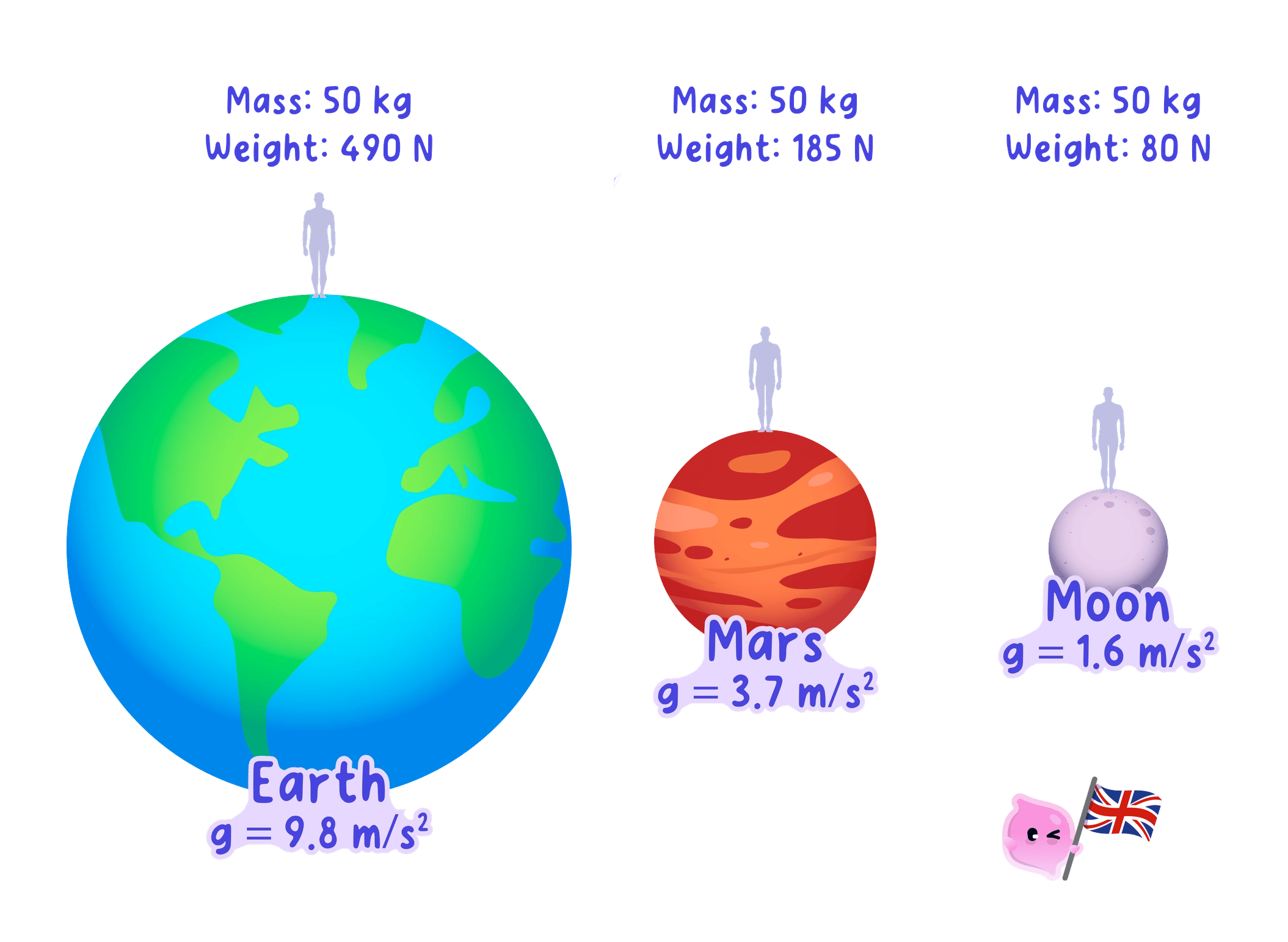
Weight depends on location

For the same object, mass stays the same, but weight changes if the gravitational field strength ggg changes.

Mass and weight are different

Mass is the amount of matter in an object. It is measured in kilograms, symbol kg.

Weight is a force due to gravity. It is measured in newtons, symbol N.

So:

  • mass tells you how much matter the object has
  • weight tells you how strongly gravity pulls on the object
Common Mistake

Kilograms are not newtons

Do not write weight in kg. Kilograms measure mass. Newtons measure force, including weight.

Calculating weight

The equation you need to recall and apply is:

W=mgW = mgW=mg

where:

  • WWW is weight in newtons, N
  • mmm is mass in kilograms, kg
  • ggg is gravitational field strength in newtons per kilogram, N/kg

The units make sense because kilograms multiplied by newtons per kilogram gives newtons.

Tip

Use the given value of g

If the question gives a value for ggg, use that value, even if you know another common value such as 9.8 N/kg or 10 N/kg.

You may also need to rearrange the equation:

m=Wgg=Wm\begin{aligned} m &= \frac{W}{g} \\ g &= \frac{W}{m} \end{aligned}mg​=gW​=mW​​
Example

Calculating weight

An object has a mass of 3.0 kg. The gravitational field strength is 4.0 N/kg. Calculate the object’s weight.

  1. The question asks for weight, so use W=mgW = mgW=mg.

  2. Substitute the mass and gravitational field strength:

    W=3.0 kg×4.0 N/kgW = 3.0\,\text{kg} \times 4.0\,\text{N/kg}W=3.0kg×4.0N/kg
  3. Calculate the answer:

    W=12 NW = 12\,\text{N}W=12N
Example

Comparing weight in different gravitational fields

A student has a mass of 60 kg. On Earth, g=10 N/kgg = 10\,\text{N/kg}g=10N/kg. On the Moon, g=1.6 N/kgg = 1.6\,\text{N/kg}g=1.6N/kg. Compare the student’s mass and weight on Earth and on the Moon.

  1. The mass does not depend on location, so the student’s mass is 60 kg on Earth and 60 kg on the Moon.

  2. Calculate the weight on Earth:

    W=60 kg×10 N/kg=600 NW = 60\,\text{kg} \times 10\,\text{N/kg} = 600\,\text{N}W=60kg×10N/kg=600N
  3. Calculate the weight on the Moon:

    W=60 kg×1.6 N/kg=96 NW = 60\,\text{kg} \times 1.6\,\text{N/kg} = 96\,\text{N}W=60kg×1.6N/kg=96N
  4. The student’s weight is smaller on the Moon because the Moon’s gravitational field strength is smaller.

Centre of mass

The centre of mass is the single point where an object’s weight may be considered to act.

For a simple, uniform object, such as a solid rectangular block, the centre of mass is usually at the geometric centre. For irregular objects, it may not be in the middle.

Definition

Centre of mass

The centre of mass is the point through which the weight of an object can be considered to act.

When drawing a force diagram, draw the weight arrow:

  • starting at the centre of mass
  • pointing vertically downwards near the Earth’s surface
  • labelled as weight or WWW
Example

Drawing weight from the centre of mass

A uniform rectangular block is close to the Earth’s surface. You need to draw its weight on a force diagram.

  1. For a uniform rectangular block, place the centre of mass at the centre of the block.

  2. Since the Earth’s gravitational field pulls objects towards the centre of the Earth, choose a vertically downward direction.

  3. Draw one downward arrow from the centre of mass. This single arrow represents the whole weight of the block.

Weight and mass are directly proportional

In one fixed gravitational field, ggg is constant. That means the equation W=mgW = mgW=mg shows that weight and mass are directly proportional.

Definition

Directly proportional

Two quantities are directly proportional if their ratio stays constant. For weight and mass in a fixed gravitational field, Wm=g\frac{W}{m} = gmW​=g, so W∝mW \propto mW∝m.

If mass doubles, weight doubles. If mass triples, weight triples.

On a graph of weight against mass:

  • the line is straight
  • the line goes through the origin
  • the gradient is the gravitational field strength, ggg

Graph of weight W against mass m showing a straight line through the origin, W proportional to m, with gradient equal to g

Example

Using a weight–mass graph

A weight–mass graph is a straight line through the origin. One point on the line is mass 3 kg, weight 30 N. Find the gravitational field strength and predict the weight of a 5 kg object.

  1. The gradient of a weight–mass graph is the gravitational field strength:

    g=Wm=30 N3 kg=10 N/kg\begin{aligned} g &= \frac{W}{m} \\ &= \frac{30\,\text{N}}{3\,\text{kg}} \\ &= 10\,\text{N/kg} \end{aligned}g​=mW​=3kg30N​=10N/kg​
  2. Use W=mgW = mgW=mg for the 5 kg object:

    W=5 kg×10 N/kgW = 5\,\text{kg} \times 10\,\text{N/kg}W=5kg×10N/kg
  3. Calculate the predicted weight:

    W=50 NW = 50\,\text{N}W=50N
Common Mistake

Same place, same g

The statement W∝mW \propto mW∝m applies when the gravitational field strength is constant. If you compare objects in different places, such as Earth and the Moon, ggg changes too.

Measuring weight

Weight is measured using a calibrated spring-balance, also called a newtonmeter.

Calibrated means the scale has been marked so that it gives reliable readings in the correct units. A newtonmeter measures force, so it reads in newtons, N.

Key Idea

Measuring weight

A newtonmeter measures weight in newtons. A mass balance measures mass in kilograms.

Exam technique

In the exam

  1. Check whether the question asks for mass or weight. Mass is in kg; weight is in N.

  2. For calculations, write W=mgW = mgW=mg, substitute the values with units, and use the value of ggg given in the question.

  3. For diagrams, draw weight as one arrow acting downwards from the centre of mass.

  4. For a graph of weight against mass, look for a straight line through the origin; the gradient is ggg.

Self review

Check yourself

  • What is the difference between mass and weight?

  • An object has a mass of 4 kg where g=6 N/kgg = 6\,\text{N/kg}g=6N/kg. What is its weight?

  • Why does a weight–mass graph go through the origin when ggg is constant?

You've reached the end

Test yourself on this topic, or move on to the next guide.

FlashcardsSelf-test with active recall
Resultant forcesUp next

How was this guide?

Gravity Revision Guide

  1. GCSE
  2. /Physics
  3. /Gravity