1.2.1a Conservation and dissipation of energy
Energy is conserved
Conservation of energy
Energy cannot be created or destroyed; it can only be transferred from one store to another, or transferred between objects.
- In any change, energy is transferred usefully, stored, or dissipated, but the total amount stays the same.
- Energy does not "run out" or "disappear"; it becomes stored in different ways.
- When a battery torch is switched on, energy from the chemical store of the battery is transferred electrically to the lamp, some usefully by light and some to the thermal store of the surroundings.
- A useful energy transfer is the one the device is designed to produce: light for a lamp, heating for a heater, or the kinetic store for a moving car.
The same transfer can be useful or wasted depending on the device: heating is useful in a kettle but wasted in a lamp.
Energy transfers in a closed system
Closed system
A closed system is a system where no energy enters and no energy leaves.
- In a closed system there is no net change to the total energy, because none enters or leaves.
- Energy can move between stores inside the system, but the total stays constant.
- For a ball rolling down a ramp, energy moves from its gravitational potential store to its kinetic store, and friction sends some to thermal stores, yet the total in the closed system is unchanged.
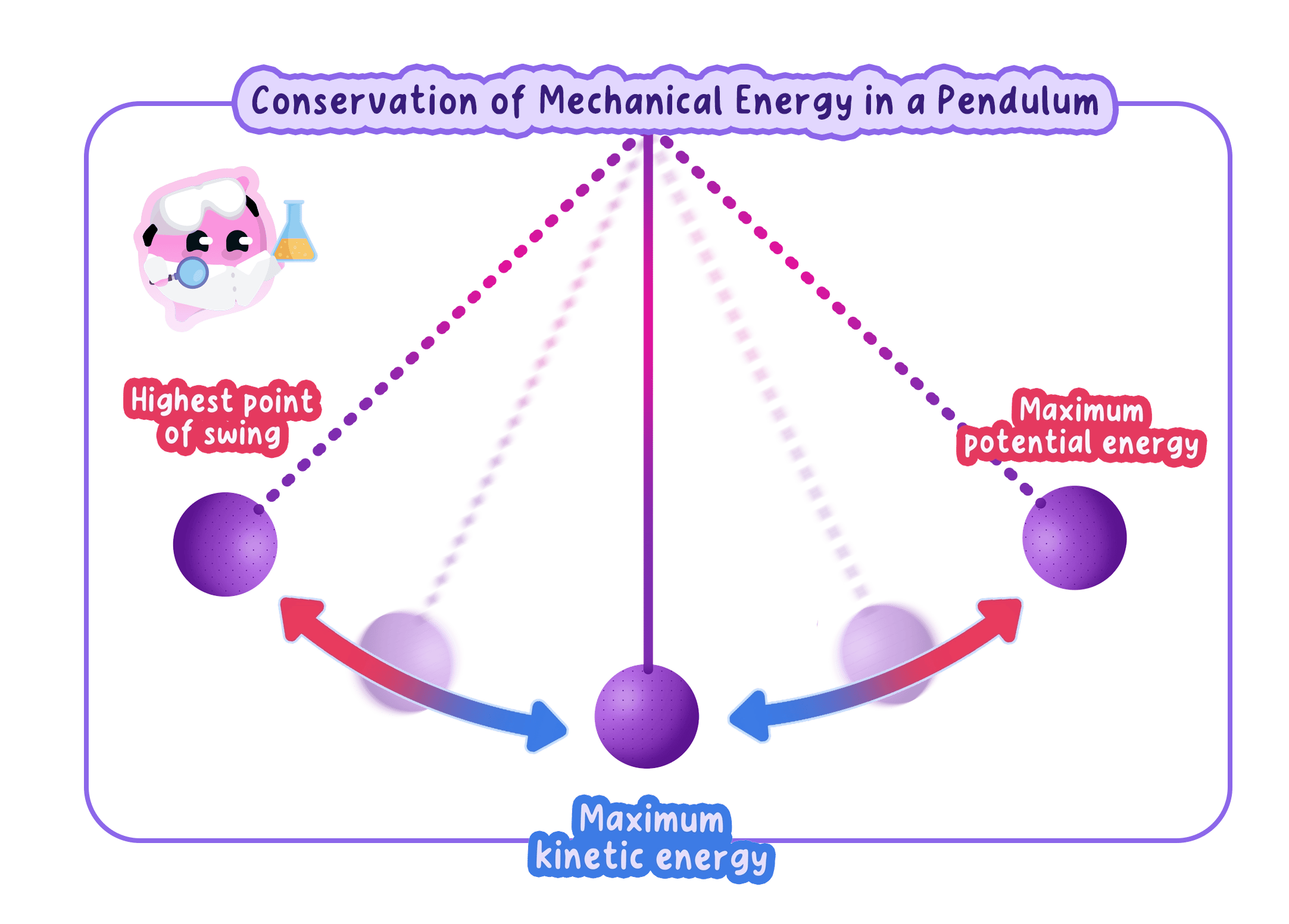
- For a swinging pendulum, energy shifts between the gravitational potential store and the kinetic store each swing, while air resistance and friction gradually transfer some to the thermal store of the surroundings.
Energy is dissipated in system changes
Dissipated energy
Dissipated energy is energy that has been transferred to less useful stores, often to the thermal store of the surroundings.
- In every system change some energy is dissipated, spreading into less useful stores, and this is often called wasted energy even though it is not destroyed.
- When a phone charger is used, some energy is stored usefully in the phone battery's chemical store while some heats the charger and the surroundings.
- That dissipated energy is hard to use again because it is spread thinly through the surroundings.
- In a moving car, energy from the fuel's chemical store fills the kinetic store, but friction in the engine, friction between the tyres and road, air resistance and sound dissipate some of it.
- Do not say energy is "lost" without saying what that means, because energy is never destroyed.
- When you mean "lost", say it is transferred to the surroundings or dissipated to less useful stores, usually thermal stores.
- Use the phrase "energy is transferred to the thermal store of the surroundings" when describing wasted energy.
- Avoid "energy is used up" or "energy disappears", because they do not show conservation of energy.
- A question often gives a device or situation and asks you to describe the energy transfers.
- Name the starting energy store, the useful store or transfer, and the wasted or dissipated store.
- State that the total energy is unchanged in a closed system.
- For an electric drill, say energy is transferred electrically from the battery or mains to the kinetic store of the rotating bit, some is dissipated to thermal stores of the drill and surroundings, some by sound, and the total is conserved.
- State the principle of conservation of energy.
- What is a closed system?
- What does it mean to say energy is dissipated?
- Why is it wrong to say energy is "used up"?
- For an electric drill, name the starting store, the useful store and where energy is wasted.
1.2.1b Reducing unwanted energy transfers and thermal conductivity
Reducing unwanted energy transfers
Unwanted energy transfer
An unwanted energy transfer is an energy transfer that does not contribute to the intended useful outcome of a device or process.
- Unwanted energy transfers often spread energy into the thermal stores of the surroundings, where it becomes less useful because it is dissipated over a large area.
- Lubrication reduces unwanted transfers caused by friction: a lubricant such as oil forms a layer between moving surfaces and lowers the friction, so less energy is wasted heating the parts.
- Thermal insulation reduces the rate at which energy is transferred by heating, so insulating the walls and roof of a building slows the transfer from the warm inside to the cooler surroundings.
Thermal conductivity
- Different materials transfer energy by conduction at different rates.
- The higher the thermal conductivity of a material, the higher the rate of energy transfer by conduction through it, so it is a good thermal conductor.
- Materials with low thermal conductivity conduct energy more slowly, so they make good thermal insulators.
- You are not expected to define thermal conductivity or use an equation for it; you compare materials using the link between thermal conductivity and the rate of conduction.
Cooling through the walls of a building
- The rate at which a building cools depends on both the thermal conductivity and the thickness of its walls.
- A wall of high thermal conductivity conducts energy quickly, so the building cools faster.
- A wall of low thermal conductivity conducts energy slowly, so the building cools more slowly.
- A thicker wall lowers the rate of conduction, so the building cools more slowly, while a thinner wall lets it cool faster.
- The best wall for slowing cooling is therefore thick and made from a material with a low thermal conductivity.
- In an explanation, refer to both the property of the wall and the resulting rate of energy transfer, for example a thicker wall of lower thermal conductivity reduces the rate of conduction so the building cools more slowly.
- Do not just say the wall "keeps heat in": say what happens to the rate of energy transfer.
Investigation: comparing thermal insulators
You measure how fast a beaker of hot water cools when it is lagged with different insulating materials, and then with different thicknesses of the same material, and use cooling curves to compare them.
- Stand a small beaker inside a larger beaker and pack the gap between them with the insulating material you are testing, such as newspaper, corrugated cardboard, bubble wrap, polystyrene balls or cotton wool.
- Boil water in a kettle and pour the same volume, about 80 cm380\ \text{cm}^380 cm3, into the small beaker each time.
- Cover the large beaker with a piece of cardboard that has a hole cut in it, and push the thermometer through so its bulb sits in the hot water.
- Record the starting temperature and start the stopclock together, then record the temperature every 333 minutes for 151515 minutes.
- Repeat with a different insulating material in the gap each time, keeping the same volume of water, the same beakers and the same starting temperature, and run it once with no insulation as a control.
- Plot a cooling curve of temperature against time for each material on the same axes.
- The material whose water cools least, giving the smallest temperature drop and the shallowest curve, is the best insulator.
- To test how thickness matters, wrap layers of one material such as newspaper around a single beaker, hold them with rubber bands, and leave the base uncovered.
- Add the same volume of hot water, fit the lid and thermometer, and record the cooling every 333 minutes for 151515 minutes as before.
- Repeat with more layers each time, for example 2, 4 and 6 layers, using the no-insulation run as the zero-layer result.
- More layers trap more air and cool the water more slowly, showing that a thicker insulating layer reduces the rate of energy transfer.
Comparing the cooling rates
- Compare insulators using the average rate of cooling, average rate of cooling=temperature decreasetime\text{average rate of cooling} = \frac{\text{temperature decrease}}{\text{time}}average rate of cooling=timetemperature decrease.
- The material with the lower rate of cooling is the better insulator.
- A beaker lagged with material A cools by 14 ∘C14\ ^\circ\text{C}14 ∘C in 600 s600\ \text{s}600 s, while one lagged with material B cools by 8 ∘C8\ ^\circ\text{C}8 ∘C in the same time.
- For material A: rate=14600=0.023 ∘C/s\text{rate} = \frac{14}{600} = 0.023\ ^\circ\text{C/s}rate=60014=0.023 ∘C/s.
- For material B: rate=8600=0.013 ∘C/s\text{rate} = \frac{8}{600} = 0.013\ ^\circ\text{C/s}rate=6008=0.013 ∘C/s.
- Material B is the better insulator because it has the lower rate of cooling.
- Energy is not destroyed or "lost": in an unwanted transfer it goes to thermal stores and is dissipated in the surroundings.
- Do not confuse high thermal conductivity with good insulation: a good insulator has a low thermal conductivity.
- A thicker wall also insulates better, but thickness and thermal conductivity are separate factors.
- How does lubrication reduce unwanted energy transfers?
- What happens to the rate of conduction when thermal conductivity increases?
- Why does a thicker wall reduce the rate at which a building cools?
- Which is the better insulator: a material with high or low thermal conductivity?
- In the insulation investigation, which variables must be controlled, and how do you identify the best insulator?
