GCSE Old Maths Grade: Sixth Form Entry Guide
GCSE old maths grade sixth form entry explained: learn when a previous result matters, typical course thresholds, resits and what to do before applying.
A GCSE result can feel strangely permanent. It sits on a certificate, follows you onto application forms and sometimes appears beside a course requirement that looks less like guidance and more like a locked door.
Here is the direct answer to the gcse old maths grade sixth form entry question: sixth forms and colleges do care about your achieved GCSE Maths grade, but the amount of weight they give it depends on their general admissions policy and the course you want to take. A grade below 444 may mean continuing maths alongside your main programme in England. A Level Maths often has a much higher requirement, commonly grade 666 or 777, although every provider sets its own rules.
An older, lower result does not automatically decide your future. A later resit, your other GCSE grades, course availability and the provider's admissions policy can all affect the outcome.
The short admissions checklist
Before worrying about what your grade might mean, check five things:
- Is the grade an achieved result, a predicted grade or a result from an earlier attempt?
- What are the provider's general entry requirements?
- Does your chosen course have a separate GCSE Maths requirement?
- If you have resat maths, which results must you declare?
- Does the provider offer GCSE resit classes or an alternative study programme?
Do not rely on a friend's offer or last year's prospectus. Entry requirements differ between institutions and can change between admissions cycles.
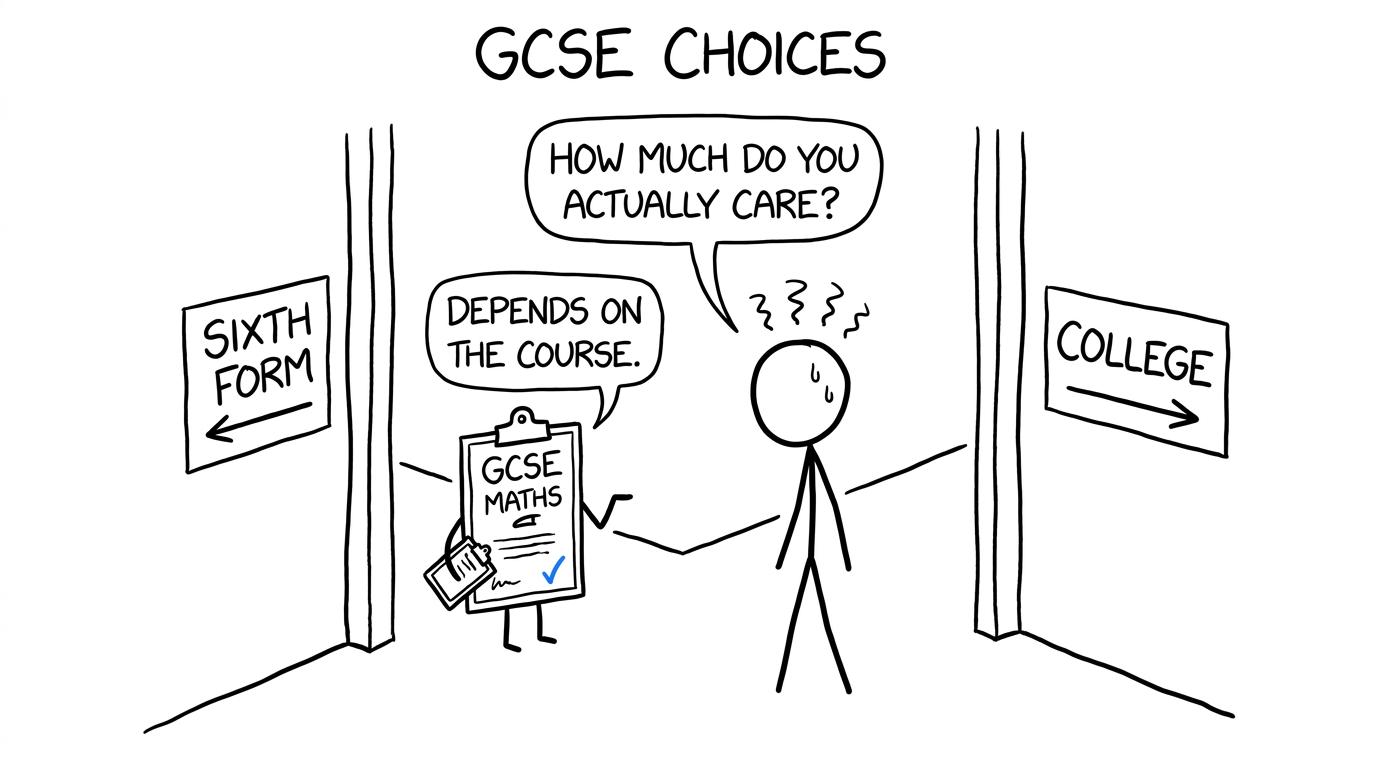 A GCSE Maths certificate acting as an admissions bouncer
How much does your GCSE Maths grade actually matter?
Its importance falls into three broad levels.
| Situation | Likely weight given to GCSE Maths |
|---|---|
| Meeting the provider's general entry criteria | High if a particular maths grade is explicitly required |
| Applying for A Level Maths, Further Maths or a maths-heavy science course | Usually very high because subject-specific thresholds often apply |
| Applying for a less mathematical vocational or A Level course | Often moderate, provided you meet the general admissions requirements |
| Holding a grade below 444 in England | High because continued maths study will normally form part of a qualifying post-161616 programme |
| Having an older lower grade followed by a stronger resit result | The newer result may strengthen your application, but all requested qualifications must be declared accurately |
The central distinction is between general entry and subject-specific entry.
A sixth form might require a collection of GCSEs at grades 999-444 or 999-555, including English and Maths. That determines whether you qualify for its wider Level 333 programme. It may then require grade 777 in GCSE Maths for A Level Maths or grade 888 for Further Maths.
In other words, a grade can be sufficient for admission to the institution while still being insufficient for one particular subject.
Maths requirements also appear beyond A Level Maths. Physics, chemistry, economics, computer science and some psychology courses may set their own numeracy thresholds. These vary considerably, so treat the course page as the authority rather than assuming that one national rule applies.
For a broader grade-by-grade picture, read the GCSE Maths grade meaning for sixth form guide.
What does an “old maths grade” mean?
Students use this phrase in several different ways, and the difference matters.
A grade from an earlier attempt
You may have taken GCSE Maths early, received a result and then entered again. When applying, provide every result the form or admissions team requests. Do not hide an earlier attempt or guess which result they want recorded.
A stronger later grade can demonstrate that you now meet the published threshold. However, providers control their own admissions decisions and may have rules about when qualifications were achieved, whether results should come from one sitting or whether an entrance assessment is needed.
If your latest result was lower than expected, use the GCSE Maths lower grade next-steps guide to organise the conversation with your school and chosen provider.
A predicted grade from an earlier report
A predicted grade is not the same as an awarded GCSE result. Sixth forms may use predictions when making conditional offers, but those offers are commonly confirmed after actual results are available.
If an old report predicted grade 555 and you later achieve grade 777, the achieved result is the formal qualification. If you achieve grade 444 against a course requiring grade 666, the earlier prediction does not normally override the final result. Contact the admissions team because it may offer another subject, an assessment or a different programme.
A legacy letter grade
Some applicants hold an older A*-GGG GCSE rather than a qualification graded 999-111. A legacy grade C broadly aligns with the standard-pass threshold represented by grade 444. It is not sensible to convert every old letter grade into one exact numerical grade because the two scales do not match perfectly across their full ranges.
Ask the provider how it records legacy qualifications. Its admissions team can confirm whether your certificate satisfies the stated requirement.
The national grade 444 threshold is not a universal entry rule
Grade 444 is especially important in England because it is the standard-pass threshold used in current post-161616 maths funding rules. Students on qualifying programmes who do not already hold grade 444 or above in GCSE Maths, or an accepted equivalent, must normally continue studying maths.
For full-time students entering with grade 333, that normally means studying towards GCSE Maths. Students with grade 222 or below may have a broader range of approved routes, which can include GCSE or an appropriate stepping-stone qualification. Individual circumstances and programme types can affect the arrangement.
This funding condition is a study requirement for institutions. It is not a national guarantee that every sixth form must admit every student with grade 444, nor does it mean that every student below grade 444 will be refused a college place.
That distinction is easy to miss:
- National threshold: influences whether you must continue maths in England.
- Provider requirement: determines whether you meet that institution's admissions criteria.
- Course requirement: determines whether you can start a particular subject.
Arrangements differ across England, Wales and Northern Ireland, and Scottish qualifications follow a different system. Always check the rules applying where you live.
What grades are usually expected for different routes?
There is no single UK-wide admissions table, but published sixth-form policies reveal some recurring patterns.
A Level Maths and Further Maths
A Level Maths requires confident algebra, graphs, trigonometry and problem-solving. Many providers therefore ask for grade 777, while some accept grade 666 or impose an additional assessment. Further Maths commonly has a higher threshold, often grade 777 or 888, and requires A Level Maths to be studied alongside it.
These are patterns, not guarantees. The exact prospectus for your intended year of entry is what matters.
If you meet the requirement and plan to continue, you can see the style of later assessment through the Edexcel A Level Maths past papers. This is not a reason to rush ahead before GCSE. It is simply a useful view of why secure GCSE algebra matters.
Other A Levels
Science and economics courses may request a grade above the provider's general maths threshold because the subjects involve calculations, graphs and quantitative reasoning. Humanities and arts courses may rely mainly on the general requirement, although they can have separate English or subject-grade conditions.
Vocational and mixed programmes
Further education colleges often offer a wider range of Level 222 and Level 333 pathways. A student who misses an A Level entry requirement may still have suitable vocational, technical or mixed options, sometimes with maths resit support built into the timetable.
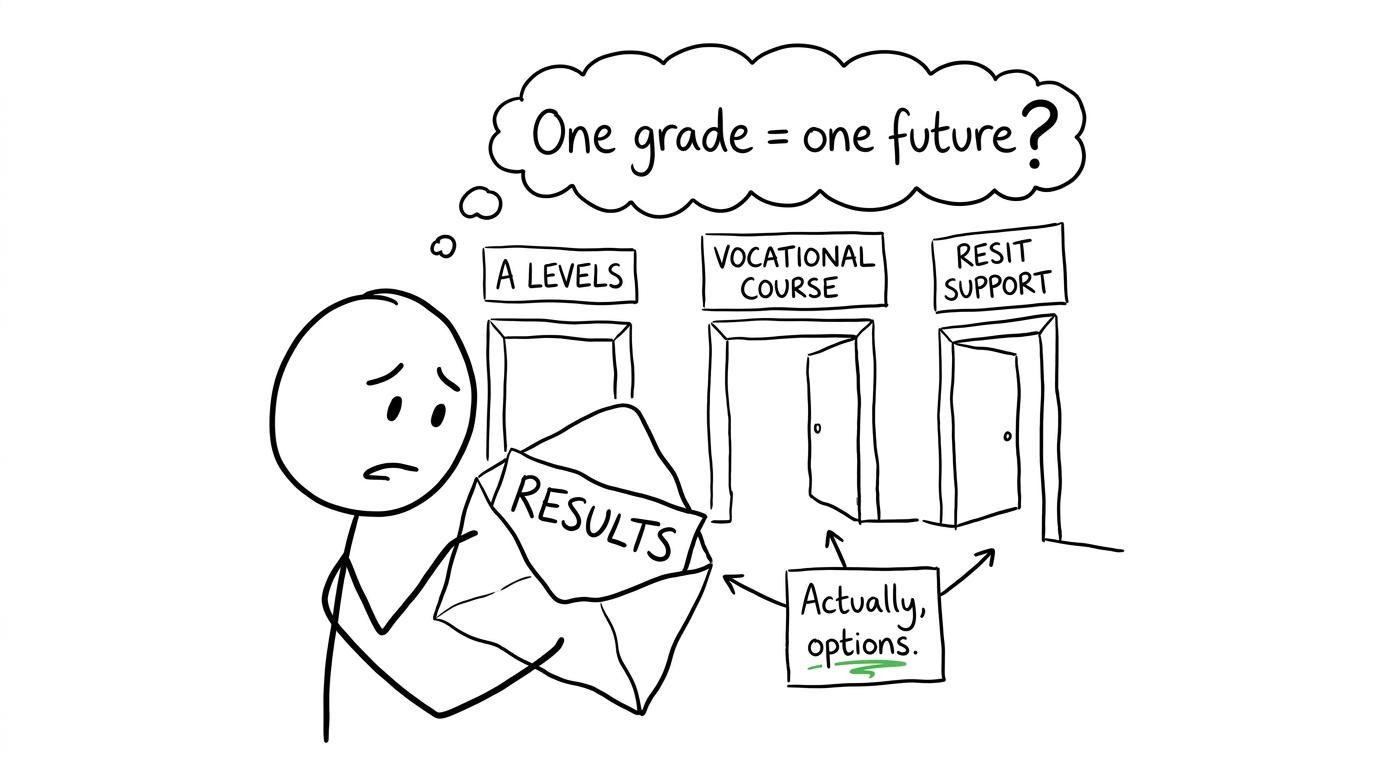 An exam result revealing several possible routes
What happens if you are one grade short?
Being one grade short is a reason to contact the provider, not a reason to disappear from the conversation.
On results day, speak to the admissions team promptly. Ask focused questions:
- Is the published grade an absolute requirement?
- Will the department consider your marks, other GCSE results or teacher evidence?
- Is there an entrance assessment?
- Can you choose a related subject or different programme?
- Can you resit GCSE Maths alongside the course?
Do not assume an exception will be made. Equally, do not reject yourself before the provider has considered your actual results and available places.
If a result appears inconsistent with your work, ask your school for the mark, grade boundary information and advice about accessing the script. A review of marking should be considered only where there is evidence that something may have been missed. Marks can stay the same, rise or fall.
How to strengthen your grade before applying
The most useful response to an entry requirement is not repeated worry. It is evidence-producing revision.
Start at the GCSE Maths revision hub, select your exam board, including Edexcel, AQA, OCR or Eduqas, and make sure you are using the correct foundation or higher-tier material.
Then follow a short cycle:
- Complete a diagnostic paper or mini test.
- Mark it with the official mark scheme.
- Record the exact topics responsible for lost marks.
- Use a revision lesson to rebuild each method.
- Answer focused practice questions without notes.
- Retest the skill several days later.
The GCSE past paper library lets you practise with real papers and mark schemes. Nearer the exam, Edexcel GCSE Maths predicted papers can provide fresh exam-style practice, but they should supplement rather than replace official past papers.
If your result is already known and you are preparing to sit maths again, follow the GCSE Maths resit revision plan. A manageable GCSE Maths revision timetable can also turn an uncertain target into weekly actions.
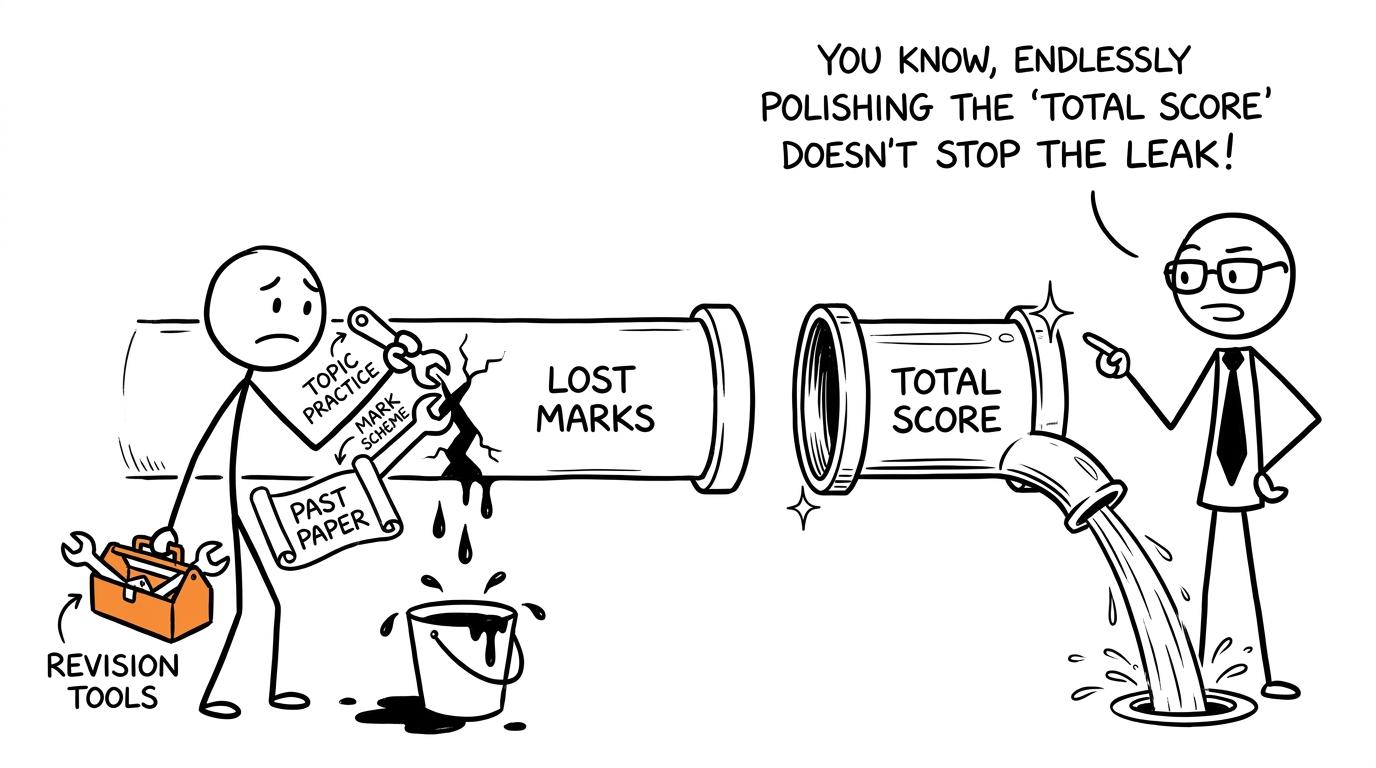 A student repairing leaks called lost marks
Common mistakes when judging your entry chances
Treating grade 444 as automatic sixth-form admission
Grade 444 is an important threshold, but providers can set higher general or subject-specific requirements.
Looking only at the general admissions page
You may qualify for the sixth form but not for A Level Maths, physics or another course with a separate maths condition.
Assuming every college follows the same policy
Admissions criteria, available courses and resit arrangements vary. Check each provider separately.
Confusing predictions with achieved grades
Predictions can support a conditional offer, but achieved results are normally used to confirm whether its conditions have been met.
Hiding an older result
Give complete and accurate information whenever an application asks for all qualifications or attempts. If the wording is unclear, ask admissions staff what to include.
Revising the topics you already enjoy
Comfortable practice feels productive, but your greatest gains usually sit inside the questions that cost you marks. Use papers, mark schemes and video solutions to locate those gaps.
Your grade matters, but context decides how much
A GCSE Maths result can carry substantial weight. It may determine whether you meet a general admissions threshold, whether continued maths is included in your programme or whether you can begin A Level Maths and other quantitative subjects.
But it is not a universal verdict. Sixth forms and colleges consider grades through their own published policies, and different routes have different demands. The practical response is to check the current requirements, declare results accurately, contact admissions if you are close to a threshold and keep improving the parts still within your control.
MathsGenie gives you a free place to do that work: revision lessons for understanding, practice questions for fluency, mini tests for diagnosis, and past papers, predicted papers, mark schemes and video solutions for exam readiness. Open the GCSE revision hub, identify the first topic leaking marks and begin there.