GCSE Maths Lower Grade Than Expected: Next Steps
GCSE maths lower grade than expected? Learn how to check marks, request a review, protect college plans and build a focused maths resit strategy today.
Opening a results envelope can make months of effort feel as though they have been reduced to one small number. If you received a GCSE maths lower grade than expected, pause before deciding what it means. Your immediate next steps are to check whether the grade affects your college place, ask your school about your marks and script, consider a review only where there is evidence of a marking error, and discuss resitting if the grade still stands.
A disappointing result matters, but it is information rather than a verdict. The most useful response is not panic. It is a calm sequence of decisions.
 A student discovering that one grade is data rather than destiny
Your GCSE maths results day checklist
Before leaving school or college, try to complete these actions:
- Confirm your final grade and exam board.
- Ask how many marks you achieved and where the grade boundaries were.
- Tell your chosen college, sixth form or training provider if the result affects your offer.
- Ask a maths teacher whether your performance looks unusual compared with your previous work.
- Find out your centre’s deadline and possible fee for a clerical re-check or review of marking.
- Discuss resit arrangements rather than assuming you must organise everything alone.
- Keep your statement of results and any emails about your next course.
Do not make a rushed decision based only on how close you were to a boundary. Being one or two marks away does not itself prove that marking was wrong.
Check what the lower grade changes
Different grades create different decisions. A grade below your prediction may feel frustrating without affecting your next step. In other cases, a required grade may be part of a sixth-form, apprenticeship or A Level entry offer.
Contact the provider directly. Explain the result accurately and ask whether it will still confirm your place, offer an alternative course or require a resit. Entry requirements belong to individual providers, so do not rely on rumours from other students.
In England, students on relevant post-161616 programmes who have not achieved grade 444 or above in GCSE maths are normally required to continue studying an approved maths qualification. Full-time students with grade 333 must generally study GCSE maths. The exact programme offered can depend on your grade and provider, while arrangements elsewhere in the UK differ. Your school or college can explain the rules applying to you.
Ask for evidence before requesting a review
A GCSE maths disappointing result can come from several causes: an unexpectedly difficult paper, avoidable errors, unanswered questions or, less commonly, a problem in marking or administration. These possibilities require different responses.
Ask your exams officer or maths department about access to your marked scripts. A teacher may be able to compare your answers with the mark scheme and identify whether a clerical re-check or review of marking is sensible.
A clerical re-check checks matters such as whether all questions were marked and whether marks were totalled and recorded correctly. A review of marking checks whether the mark scheme was applied correctly. It is not a fresh attempt by a new examiner to award extra marks simply because you are near a boundary.
Your school or college normally submits the request to the exam board. You must be told that your mark and grade can go down, stay unchanged or go up, and your written consent is required for an individual review. Ask about fees before agreeing.
For the June 2026 series, GCSE results are released on 20 August 2026 and the JCQ deadline for standard reviews of results is 24 September 2026. Your centre may set an earlier internal deadline, so speak to it promptly rather than waiting.
Decide whether a GCSE maths resit is right
If the grade stands, a resit may be the clearest GCSE maths next step. GCSE English language and maths examinations are available in November for eligible students who were aged 161616 or over on 31 August of that year. Availability, entry arrangements and suitability should be confirmed with your school, college or exam centre. A later summer entry may offer more preparation time.
A November resit can suit a student who was close to the required grade and can begin focused revision quickly. Waiting may be wiser if substantial parts of the specification need rebuilding. Discuss your tier as well. Foundation tier and higher tier have different available grade ranges, so the right entry should reflect your target and current understanding, not pride.
MathsGenie’s guide to what happens if you do not pass GCSE maths explains the wider resit route. You can then open the GCSE Maths revision hub and select Edexcel, AQA, OCR, Eduqas or your relevant board.
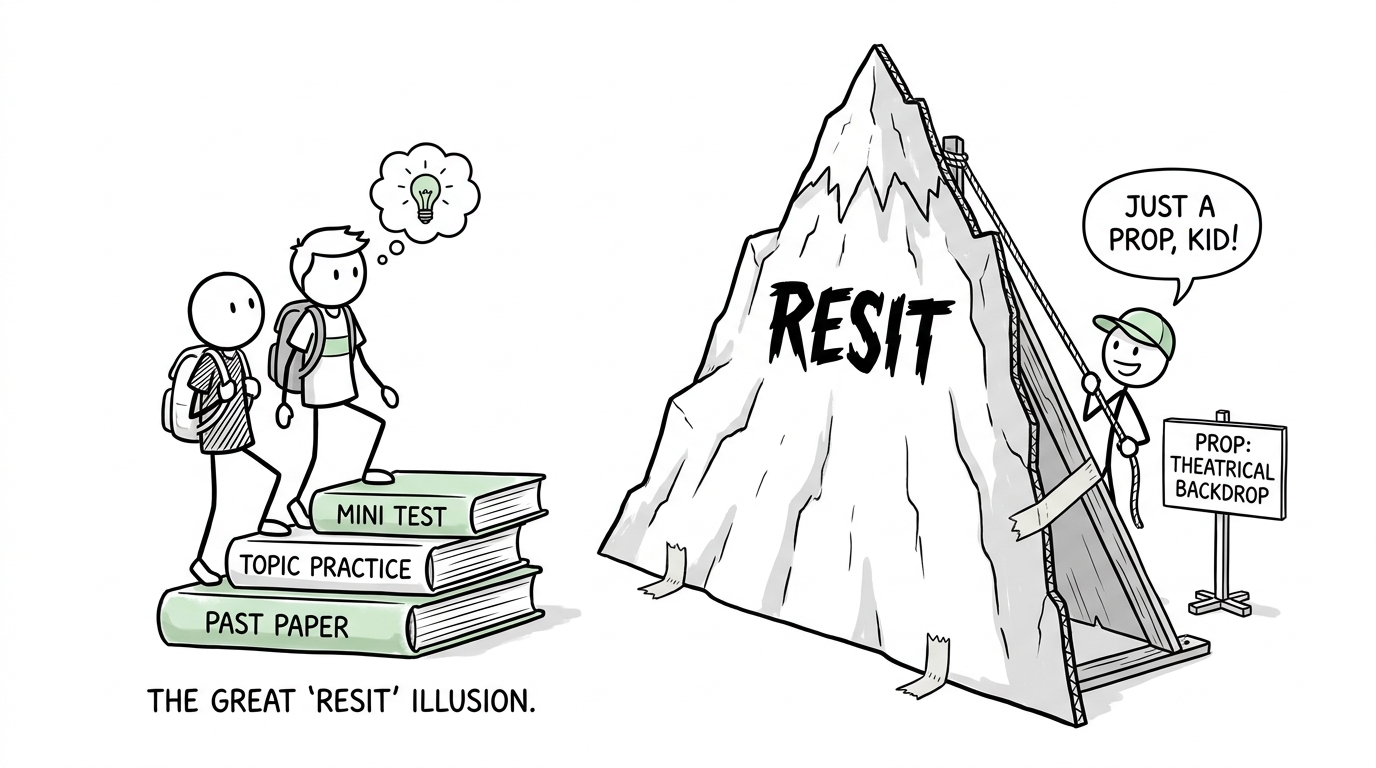 A resit mountain turning out to be manageable revision steps
Build a resit plan from lost marks
Resit revision should not mean repeating Year 111111 in exactly the same way. Start with diagnosis.
Complete a short assessment at the correct tier, mark it honestly and classify each lost mark as a knowledge gap, calculation error, misread question or time-management problem. The GCSE maths mini tests and target grade tests can reveal weaknesses without requiring a full paper immediately.
Turn the results into a simple revision planner:
- Choose three precise weak topics.
- Use a revision lesson or video solution to rebuild each method.
- Complete practice questions without looking at the solution.
- Mark the work and record why each mark was lost.
- Retest the same skill several days later.
- Add timed papers once your core methods are reliable.
For Edexcel, use the GCSE maths revision pathway, followed by Edexcel past papers and mark schemes. OCR students can use the OCR GCSE maths paper collection. Nearer the examination, GCSE predicted papers can provide an additional rehearsal, but they should complement rather than replace past papers.
Common mistakes after a disappointing result
Assuming a review automatically improves the grade
Marks can decrease, remain unchanged or increase. Request a review because a teacher sees a credible marking issue, not simply because the next boundary is close.
Missing the centre’s deadline
Official deadlines are not always the same as school deadlines. Centres need time to collect consent, payment and supporting information.
Avoiding your college or sixth form
Silence reduces your options. Contact the provider quickly, even if the conversation feels uncomfortable.
Revising everything equally for a resit
Your script, past-paper errors and mini-test results should decide what receives the most time. A vague plan to “do more maths” is less useful than a short list of specific marks to recover.
Treating the result as proof of your ability
A result records performance across particular papers on particular days. It can influence the next administrative step, but it does not define the limit of what you can learn.
Turn the result into a practical next step
The day may not have unfolded as you hoped. That cannot be changed. What can change is what happens next: checking the evidence, protecting your course options and preparing differently if a resit is needed.
Start with MathsGenie’s free GCSE Maths revision resources. Use revision lessons to rebuild uncertain topics, practice questions and mini tests to expose gaps, then past papers, predicted papers, mark schemes and video solutions to prepare under exam conditions. One grade is the end of an exam series, not the end of your progress.