

GCSE Maths Grade Meaning for Sixth Form
GCSE maths grade sixth form guide: understand grades 9-1, typical college entry expectations, resits and what you may need for A Level Maths next.
The results envelope feels heavier than paper should. That is because a GCSE maths grade can affect sixth-form choices, course entry and whether maths remains on your timetable.
Here is the short answer to the GCSE maths grade sixth form question: a grade 444 is the key national threshold for continuing maths after age 161616, but individual sixth forms set their own entry requirements. For A Level Maths, many providers ask for grade 777, although some accept grade 666 and others set higher requirements. Always check the published criteria for your chosen school or college.
Your grade is a doorway, not a judgement. It tells providers what mathematical preparation you have demonstrated on those papers, and suggests what your next step should be.
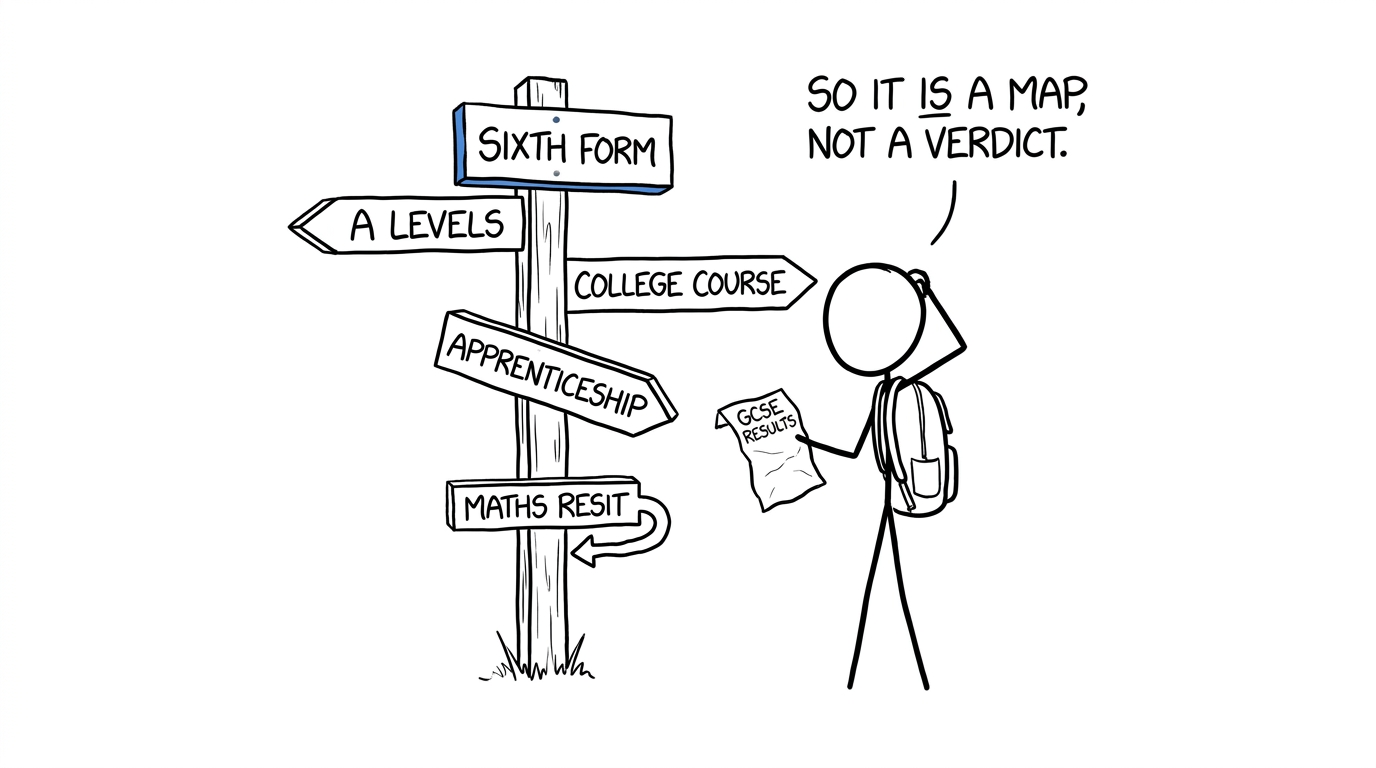 A student treats their GCSE result as a map rather than a verdict
GCSE maths grade meaning at a glance
Before looking grade by grade, remember four points:
- GCSEs in England use grades 999 to 111, with 999 the highest.
- Grade 444 is commonly described as a standard pass; grade 555 is a strong pass.
- Students without grade 444 or above must normally continue studying an approved maths qualification in a qualifying post-161616 programme.
- There is no single national entry grade for A Level Maths. Each provider publishes its own requirements.
The Foundation tier offers grades 111 to 555. The Higher tier targets grades 444 to 999, with a narrow grade 333 safety net. A grade 555 has the same value whichever tier produced it, but students intending to take A Level Maths will usually need Higher-tier knowledge.
Grade-by-grade sixth-form expectations
| GCSE maths grade | What it usually means for sixth form |
|---|---|
| Grade 999 | Exceptional GCSE performance and a strong basis for A Level Maths or Further Maths. Some highly selective Further Maths courses ask for grade 999. |
| Grade 888 | Very strong preparation for A Level Maths. Grade 888 commonly meets published Further Maths requirements, although some providers ask for grade 999. |
| Grade 777 | A common minimum requirement for A Level Maths. It indicates secure Higher-tier algebra, graphs, geometry and problem-solving skills. |
| Grade 666 | A strong result that may meet A Level Maths entry requirements at some providers, sometimes subject to teacher advice or other GCSE results. Many sixth forms still require grade 777. |
| Grade 555 | A strong pass and the highest Foundation-tier grade. It supports entry to many post-161616 programmes, but usually falls below the requirement for A Level Maths. Core Maths may be available. |
| Grade 444 | A standard pass. It normally satisfies the national post-161616 maths threshold, so compulsory continued maths study is not generally required. Course-specific requirements can still be higher. |
| Grade 333 | Below the level 222 pass threshold. You will normally continue studying maths after GCSE, often towards a GCSE resit alongside your main programme. |
| Grade 222 | Shows some mathematical understanding, but more development is needed. Your provider may offer GCSE maths, Functional Skills or another approved stepping-stone route, depending on your programme and prior attainment. |
| Grade 111 | Recognises achievement within the GCSE course, but remains below the post-161616 threshold. Expect structured continued maths support. |
| Grade U | The qualification was ungraded. Your school or college should help identify an appropriate route for rebuilding core skills and progressing towards level 222. |
Use this table as a guide, not an admissions contract. Sixth forms may also require a certain number of GCSEs at grades 555 or 666, alongside subject-specific criteria. Read the current prospectus and ask what happens if you miss an offer by one grade.
Progressing to A Level Maths
Progressing to A Level Maths is less about possessing a particular number and more about what that number represents. The course develops algebra, functions, trigonometry, calculus, statistics and mechanics at a faster pace. GCSE techniques are assumed rather than slowly retaught.
That is why grade 777 is a common threshold: providers want evidence that Higher-tier algebra and multi-step reasoning are secure. Grade 666 students should not automatically rule themselves out, but they should speak to the department and examine the precise entry policy.
If A Level Maths is your aim, explore the free A Level Maths revision hub. Seeing the next course early gives you a more useful question than “Am I clever enough?” Ask instead: “Which GCSE skills must become automatic?”
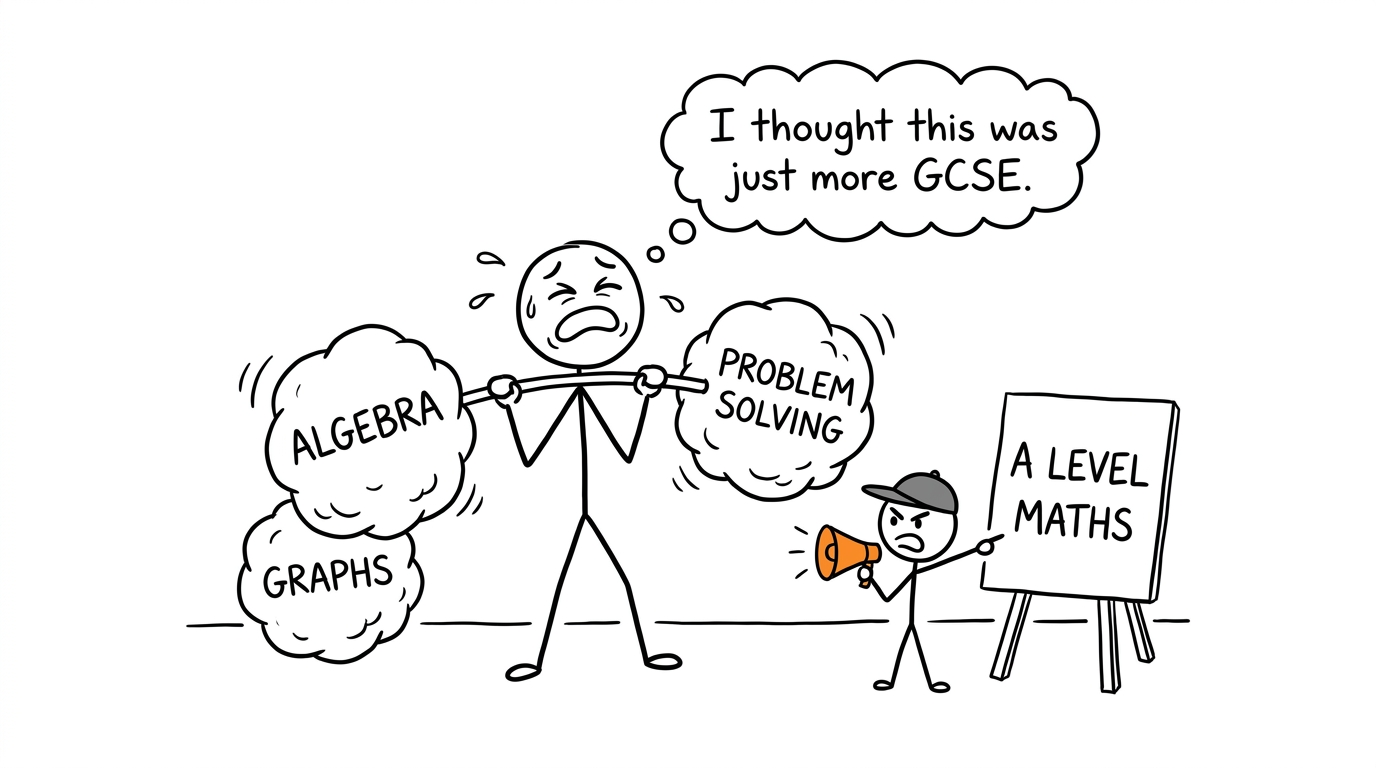 A student discovers that A Level Maths is a serious mathematical workout
What to do before results day
Start with the entry requirements for every course you are considering. Separate the provider’s general sixth-form requirement from the requirement for Mathematics, Further Mathematics, Physics, Economics or another individual subject.
Then turn your latest mock into a plan:
- Use the GCSE Maths revision hub to choose your exam board and tier.
- Diagnose gaps with topic questions and revision lessons.
- Complete timed papers and mark them carefully using official-style mark schemes.
- Use GCSE predicted papers near the exams, after building topic knowledge.
- Break full papers into manageable tests using the MathsGenie revision resources.
AQA students can find board-specific lessons, questions and papers in the AQA GCSE Maths revision area. If revision feels stuck around the pass threshold, use the practical routine in GCSE Maths revision when you are stuck at a pass grade.
Common mistakes when interpreting your grade
Treating grade 444 as entry to every course
Grade 444 meets an important national threshold, but a sixth form can require higher grades for admission or particular subjects.
Assuming every A Level Maths course asks for grade 777
Grade 777 is common, not universal. Requirements vary, so check the current policy rather than relying on a friend’s offer.
Thinking a Foundation grade 555 is worth less
It is not. Grade 555 has the same qualification value on either tier. The limitation is that Foundation tier cannot award above grade 555 and does not cover the full Higher-tier preparation expected for A Level Maths.
Revising only by completing papers
Papers reveal weaknesses; they do not automatically repair them. Use a paper to identify gaps, return to revision lessons and practice questions, then retest. A structured GCSE maths revision timetable can keep that cycle moving.
Your grade is information, not your identity
A GCSE result matters, but its meaning is practical rather than personal. It helps decide whether you can enter a course immediately, need a conversation with the department or should continue building towards grade 444.
Check your sixth form’s requirements now. Then use MathsGenie to close the distance between your current grade and your next doorway: revise with free lessons, practise exam questions, complete past papers, review video solutions and mark schemes, and sharpen your preparation with mini tests and predicted papers. If A Level Maths is realistic for you, make the MathsGenie A Level Maths page your first look at what comes next.











