GCSE Old Maths With No Revision Time? Survival Guide
GCSE old maths busy schedule? Build a realistic plan using short practice, weak-topic triage, past papers and calm routines that protect your sleep.
Some GCSE maths topics feel old long before the exam arrives. You understood percentages in autumn, met simultaneous equations after Christmas, then sport, a weekend job and every other subject filled the calendar. Now the methods seem distant.
If you searched for gcse old maths busy schedule, the useful answer is simple: do not attempt to revise everything equally. Identify where marks are leaking, use short question-based sessions to repair one weakness at a time, and revisit each repaired topic before it fades again.
You do not need empty evenings. You need a small system that survives full ones.
Your survival checklist
When time is tight, use this order:
- Confirm your exam board and tier.
- Diagnose weaknesses with a short mixed test or paper section.
- Choose one precise skill, not a whole subject area.
- Review the method briefly, then answer questions without notes.
- Mark immediately and record the reason for each lost mark.
- Revisit the skill within a few days.
- Use occasional timed papers to test whether the repair holds.
- Protect sleep rather than turning revision into a midnight contest.
Start from the GCSE Maths Revision hub, where you can choose resources for Edexcel, AQA, OCR or Eduqas and check that your work matches the correct foundation or higher tier specification.
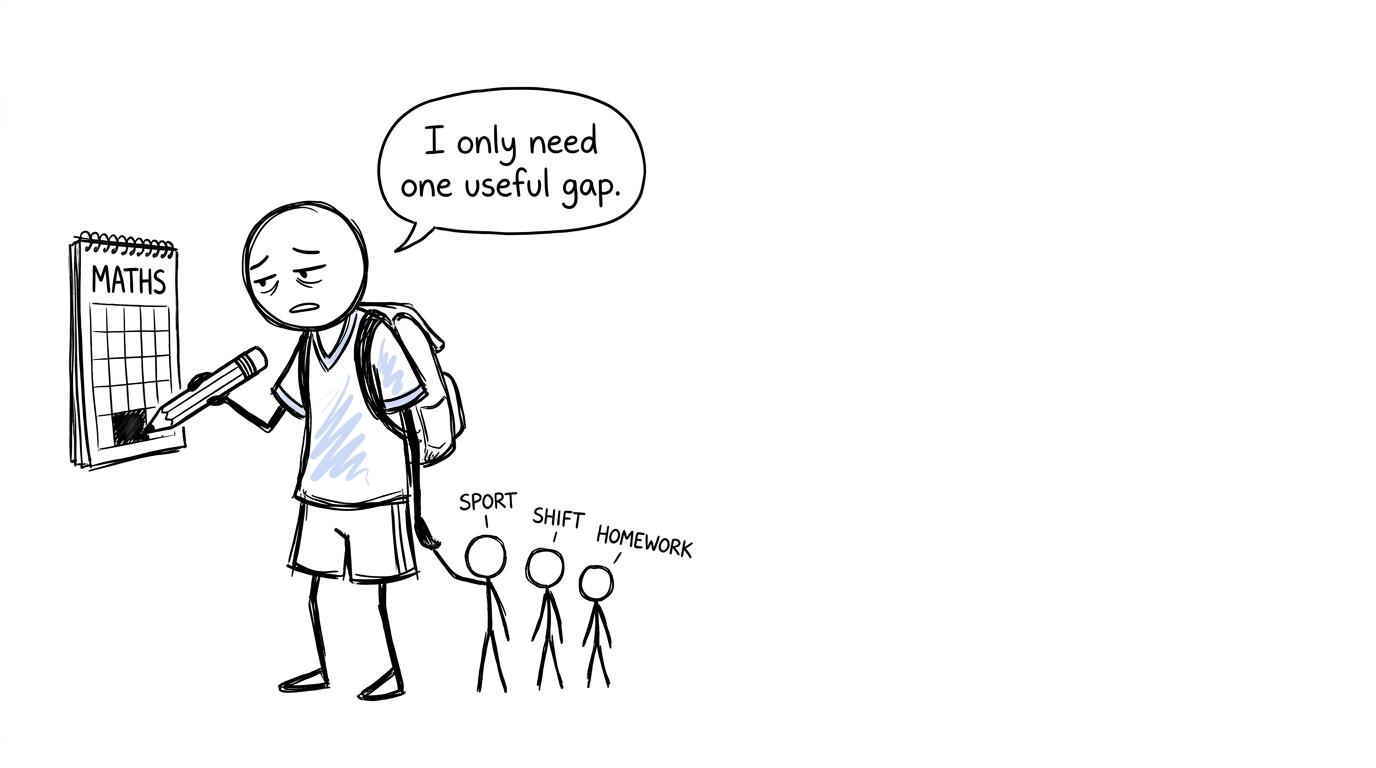 A busy student finds one useful gap for maths revision
What “old maths” really means
Old maths is usually not lost maths. It is knowledge that has become difficult to retrieve.
Recognising a method when a teacher demonstrates it can create a comforting feeling of familiarity. An exam asks for something harder: you must recognise the topic, select a method and carry it out without being prompted. That is why rereading notes may feel productive while leaving you unable to begin a question.
Research on learning consistently supports active retrieval and spaced practice over relying on passive rereading or one large cramming session. For GCSE maths, this means attempting questions from memory, checking the result and returning to the topic after a gap.
The important distinction is this:
- Review reminds you what the method looks like.
- Practice makes you perform the method.
- Retrieval later checks whether you can still perform it.
A short session containing all three is more useful than a long session spent making attractive notes.
Build a plan around your real week
A revision plan fails when it is designed for an imaginary student with unlimited evenings. Begin with what cannot move: school, travel, training, matches, shifts, meals, homework and sleep.
Then look for three kinds of space.
Anchor sessions
An anchor session is a reliable block that happens most weeks. It might be after school on Tuesday, before a Saturday shift or on Sunday morning. Use it for work requiring concentration, such as a mini test, a paper section or careful correction.
One dependable block is worth more than five ambitious sessions that are repeatedly cancelled.
Pocket sessions
A pocket session lasts roughly 101010 to 202020 minutes. It can fit before training, during a quiet journey or between homework tasks. Use it for one narrow action:
- answer several questions on one skill;
- redo yesterday's mistakes;
- recall key facts or methods;
- watch one video solution and summarise the missing step;
- mark a short question set.
Do not waste half the pocket deciding what to revise. Choose the task in advance.
Rescue sessions
Some days collapse. A shift runs late, training overruns or another subject has an urgent deadline. Your rescue session is the smallest version of revision that keeps the chain alive: one question, one correction or five minutes reviewing your marks-leak list.
This is not the ideal session. It is protection against doing nothing for a week because one evening went wrong.
Triage topics instead of covering everything
A busy schedule forces prioritisation. That can be useful. It stops revision becoming a tour of comfortable topics.
Use a short mixed assessment from the MathsGenie AQA GCSE Maths revision area, the relevant board section, or part of a past paper. Mark it and place each mistake into one of three categories:
- Knowledge gap: you did not know the method or fact.
- Execution error: you knew the method but made an algebraic, arithmetic or calculator error.
- Interpretation error: you misunderstood the wording, diagram, units or required form.
Now name the topic precisely. “Algebra” is too broad. “Expanding two brackets”, “rearranging formulae with the subject on both sides” or “forming an equation from a ratio” gives you a usable next action.
For a fuller diagnostic routine, follow MathsGenie's guide to finding your weakest GCSE maths topics.
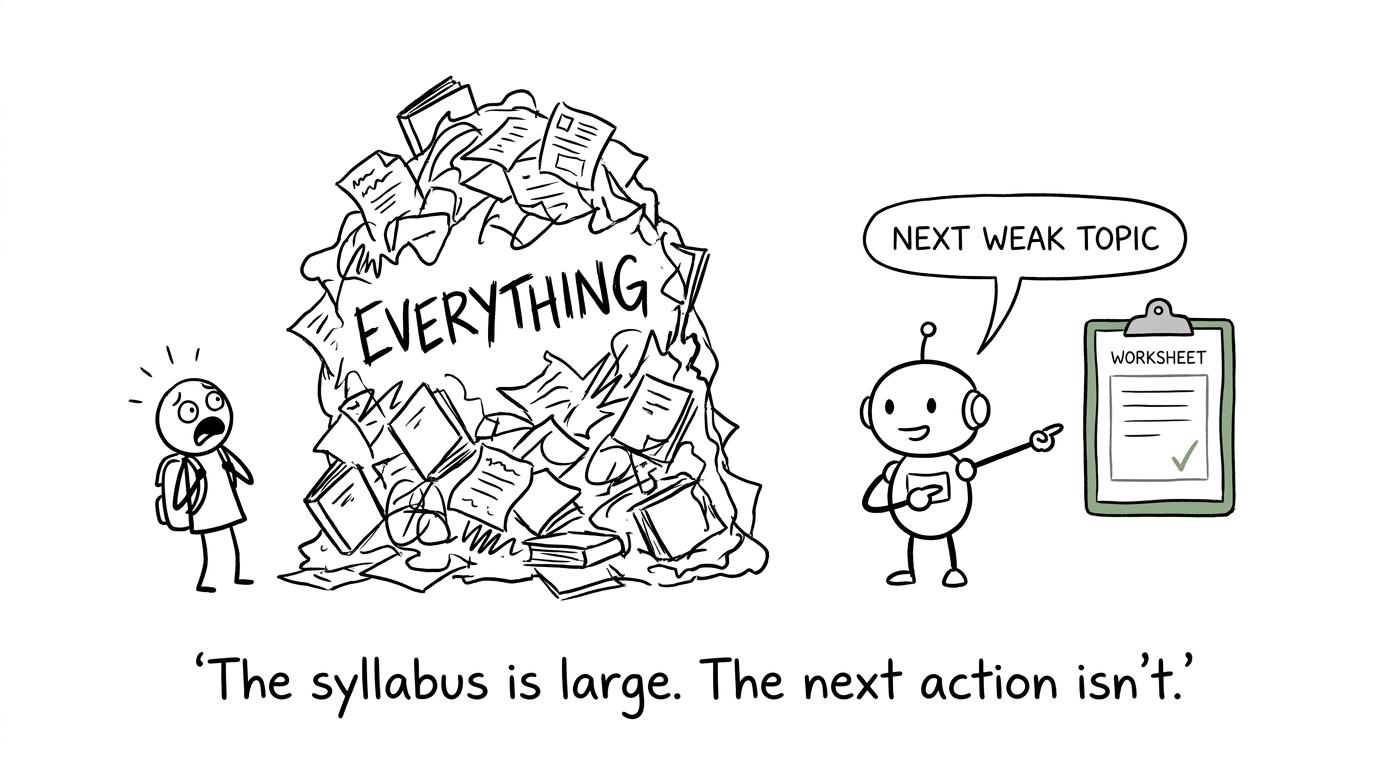 A student chooses the next weak topic instead of fighting the whole syllabus
Use the learn, practise, mark, return loop
Once you know the weakness, give each session a fixed shape.
Learn only what you need
Use a revision lesson or video to recover the method. Keep this stage brief. Your aim is not to consume every explanation available; it is to become ready to attempt a question independently.
If you can already explain the first step, move to questions. Watching more videos may feel safer, but the exam rewards performance rather than recognition.
Practise without support
Close the notes and answer a small set of questions. Writing full working matters because it reveals where the method breaks down and helps you practise communicating reasoning that may earn method marks.
If the first question is impossible, return to the explanation. If it is merely uncomfortable, stay with it. Productive revision often feels less fluent than rereading because your memory is doing more work.
Mark while the thinking is fresh
Immediate feedback connects the error to the decision that caused it. Use the mark scheme and, where available, a video solution. Do not write only “careless”. Record a specific instruction:
- substitute using brackets;
- keep exact values until the final step;
- check whether the question requires units;
- reverse an inequality sign after multiplying or dividing by a negative value;
- distinguish radius from diameter.
The guide to using GCSE mark schemes to improve maths marks explains how to turn marking into future action rather than just a score.
Return after a gap
Reattempt one or two related questions after a few days. A correct answer immediately after watching a solution may reflect short-term memory. A correct answer later is stronger evidence that the method is becoming available under exam conditions.
Fit past papers around sport, work and other subjects
A full paper is valuable, but it is not the only legitimate form of exam practice. On busy weeks, complete a timed section or a cluster of questions, then mark it properly. Saving time by skipping the marking removes the most informative part.
When you have a longer anchor session, use the correct board and tier. For example, Edexcel GCSE Maths past papers include papers and mark schemes for realistic practice. Students following another specification should select their board from the main GCSE hub.
Use papers in three modes:
- Diagnostic mode: identify weak topics without worrying about the total mark.
- Training mode: complete a timed section and practise moving on when stuck.
- Rehearsal mode: sit a full paper under exam conditions when time allows.
Predicted papers can add fresh mixed practice near the exam, but they are not promises about what will appear. Use them to reveal gaps, then return to topic practice. MathsGenie's guide on when to start GCSE past papers helps you choose the right mode for your stage.
Make your job or sport part of the plan
Sport and paid work are not evidence that you are unserious about GCSEs. They simply create constraints. Good planning respects those constraints.
After training, fatigue may make a demanding new topic inefficient. Use that evening for corrections, recall or familiar skills. Put harder learning before training, on a non-training day or in a weekend anchor session.
After a late shift, avoid starting a full paper simply because it was written on a timetable. A short repair task followed by sleep is usually a more sensible decision. The goal is not to win one evening. It is to arrive at the exam able to think clearly.
If exams are very close, the GCSE maths exam week checklist offers a calm structure for timed practice, corrections and preparation.
Common mistakes when revision time is limited
Revising only favourite topics
Comfortable questions produce reassuring marks but little new information. Begin with your weakest important skill, then finish with something more secure if you need confidence.
Making a timetable with no spare capacity
A plan that uses every available minute has no way to absorb an extra shift, match, illness or homework deadline. Leave at least one catch-up space each week.
Treating missed sessions as failure
Do not attempt to repay every missed minute. Resume at the next available slot and complete the highest-priority task. Revision is a repeated process, not a perfect attendance record.
Completing papers without analysing errors
A paper score tells you where you are. Corrections help change where you are going. Keep a short marks-leak list and look for repeated patterns in signs, units, rounding, calculator use and question interpretation.
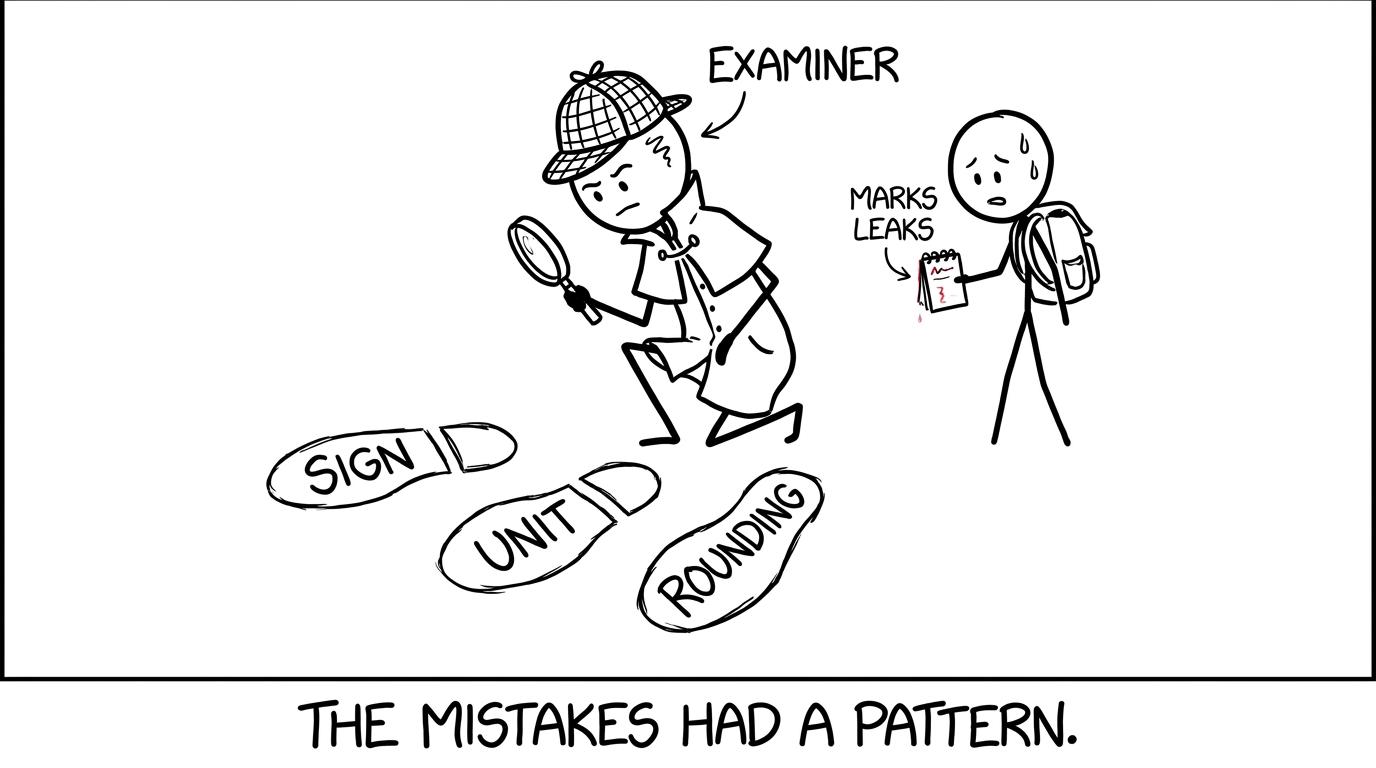 A detective discovers that lost maths marks have a pattern
Ignoring your tier or exam board
Foundation and higher tier papers assess overlapping content but have different demands and grade ranges. Edexcel, AQA, OCR and Eduqas also present specifications and papers in their own formats. Confirm both details with your teacher before choosing resources.
Confusing predicted papers with predictions you can trust blindly
No predicted paper can guarantee the questions on your real examination. Treat it as high-quality practice, not permission to ignore the rest of the specification.
A sustainable weekly rhythm
Your exact week will differ, but a useful pattern contains:
- two or three pocket sessions for targeted questions;
- one anchor session for a mini test or paper section;
- immediate marking after each task;
- one short return to an earlier weakness;
- one flexible slot that can absorb disruption.
If you have a month available, adapt the GCSE one-month maths revision plan rather than creating an elaborate timetable from scratch. If only one evening remains, use the GCSE maths night-before plan and focus on calm, targeted preparation.
Small sessions can still change the exam
A busy student rarely needs another lecture about working harder. The more useful question is how to make limited time produce evidence: a completed question, a corrected method, a weakness identified and a skill successfully retrieved later.
Start with one short diagnostic. Choose one marks leak. Use a MathsGenie revision lesson to recover the method, practise it with exam questions, check the mark scheme or video solution, and return to it after a gap. As the exam approaches, add mini tests, past papers and predicted papers that match your board and tier.
Open the free MathsGenie GCSE Maths Revision hub and choose your first manageable task now. The whole syllabus may not fit into tonight. One useful next step can.