GCSE Media Studies Study Group That Actually Works
GCSE media studies study group guide: choose the right people, plan focused sessions, practise exam responses and stop the group chat taking over.

A study group often begins with good intentions and ends with dozens of messages about when everyone might be free. Nothing is revised. Nobody wants to make the first decision.
A GCSE media studies study group works differently. Keep it small, meet at a fixed time, choose one precise outcome and make everyone retrieve, analyse or write something. The group should produce visible evidence of learning, not simply create a pleasant place to talk about revision.
That distinction matters whether Media Studies is your main concern or you are balancing it with GCSE maths. A productive group reduces decisions, exposes weak knowledge and makes each student accountable for doing the work.
The study group checklist
Before the first meeting, agree on these essentials:
- Invite between three and five reliable students.
- Check that everyone follows the same exam board and current specification.
- Meet for about 454545 to 606060 minutes at a regular time.
- Publish one specific objective before each session.
- Ask every member to prepare something independently.
- Use closed-book recall before opening notes.
- Include individual exam writing in every meeting.
- Check answers against class materials or official mark schemes.
- Finish by assigning the next topic, chair and deadline.
The principle is simple: a group needs a system before it needs enthusiasm.
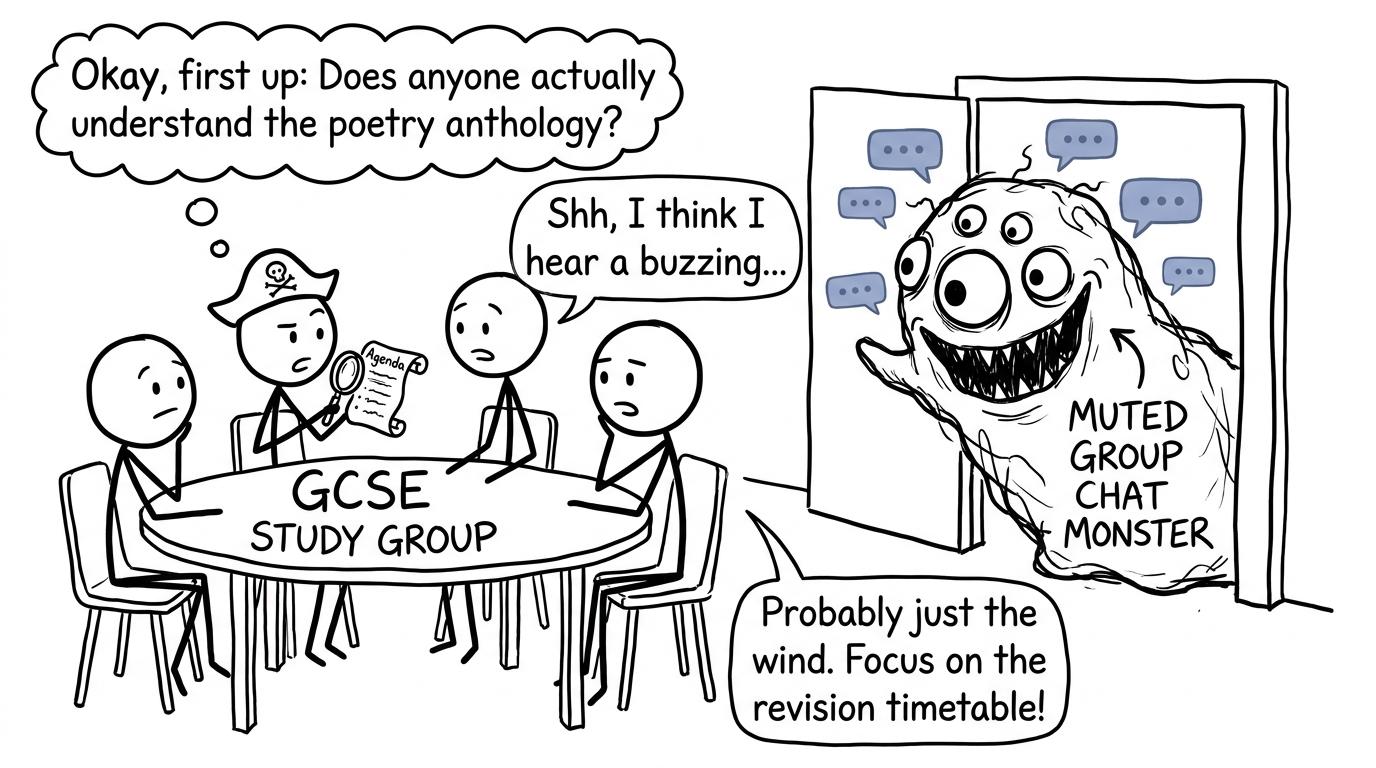 A focused study group ignores the group-chat monster
Choose people who will do the work
The best members are not necessarily your closest friends or the students with the highest grades. Look for people who arrive when they say they will, complete small tasks and can disagree without turning every discussion into an argument.
Three to five members usually gives everyone enough airtime while allowing the meeting to continue if one person is absent. Larger groups make hiding easier. One student explains everything, two listen and everyone else quietly checks their phone.
Before creating the chat, send a clear invitation. State the exam board, proposed meeting time, session length and first topic. Ask people to join only if they can prepare and attend regularly.
Set a short trial period of two or three meetings. If someone repeatedly arrives unprepared, address it calmly. A study group is a voluntary agreement, not an obligation to carry somebody through the course.
Build the group around your specification
GCSE Media Studies is not one identical course everywhere. AQA, OCR, Eduqas and Pearson Edexcel use different set products, component structures and assessment arrangements. Set products or briefs can also change between examination years.
At the first meeting, confirm your board, specification and examination series with your teacher. Use the current information supplied by your school rather than a revision list found in an old group chat.
Across GCSE Media Studies specifications, the assessment objectives broadly require students to:
- demonstrate knowledge and understanding of the theoretical framework and relevant contexts;
- analyse media products, make judgements and draw conclusions;
- create a media product for an intended audience through non-exam assessment.
The familiar framework covers media language, representations, industries and audiences. Your group therefore needs more than fact-sharing. It must practise moving from accurate knowledge to analysis, comparison and justified conclusions.
Non-exam assessment deserves particular care. You may revise concepts together, but assessed production must follow your board's rules and your teacher's instructions. Do not exchange material, rewrite one another's assessed work or treat collaboration as permission to produce a shared response. If anything is unclear, ask your teacher before proceeding.
Give every meeting one measurable outcome
“Revise advertising” is too vague. Nobody knows when the task is complete.
A useful objective names the material, skill and final product. For example, a session might aim to recall key contextual knowledge for one set product, compare two representations or plan an extended response under timed conditions.
The finished evidence could be:
- a checked retrieval sheet;
- an annotated unseen product;
- an individual paragraph from every member;
- a comparison grid;
- a marked response with one improvement target each.
Do not attempt an entire unit in one meeting. Narrow objectives create depth and make preparation realistic. They also stop the confident person from steering the conversation towards whichever topic they already know best.
This approach transfers neatly to maths revision. Instead of promising to “do algebra”, a student can identify one weak skill through the GCSE maths revision hub, complete its revision lesson and practise the associated questions.
Use a repeatable session structure
A reliable routine prevents the first 202020 minutes disappearing into decisions.
Opening recall
Spend the first 888 to 101010 minutes working independently and without notes. Everyone could write definitions, list contextual facts, sketch the structure of an argument or answer short questions prepared by the chair.
Retrieval practice means bringing information to mind rather than merely reading it again. Research consistently supports active retrieval and spaced review as effective ways to strengthen long-term learning. Feedback is essential, however. Recalling an incorrect fact repeatedly does not make it useful.
Comparison and correction
Open your notes and compare answers. Resolve disagreements using trusted class resources, the current specification or an official mark scheme. Maintain a shared correction log containing the claim, the corrected version and its source.
Avoid majority voting. Three people remembering the same inaccurate detail does not make it true.
Application
Move from knowing to using. Analyse an unseen image, discuss how a set product addresses its audience or plan how evidence would support a judgement. Ask follow-up questions such as:
- Which detail supports that interpretation?
- Is this analysis or description?
- How does context affect the meaning?
- What alternative interpretation could be justified?
- Which assessment objective is being demonstrated?
Discussion should prepare students to write, not replace writing.
Individual exam practice
Everyone now produces a short response independently. Keep phones and shared notes away. Afterwards, use the relevant mark scheme, teacher guidance or model material to identify what earned credit and what remained unsupported.
The same learn-practise-check cycle underpins effective maths revision. MathsGenie's free GCSE revision resources bring together short tests, papers and supporting material, while the guide to using GCSE past papers effectively explains how to turn completed questions into future action.
Exit ticket
End with two sentences from each member:
- “I can now...”
- “Before the next meeting, I need to...”
Record the next chair, topic and preparation task before anyone leaves.
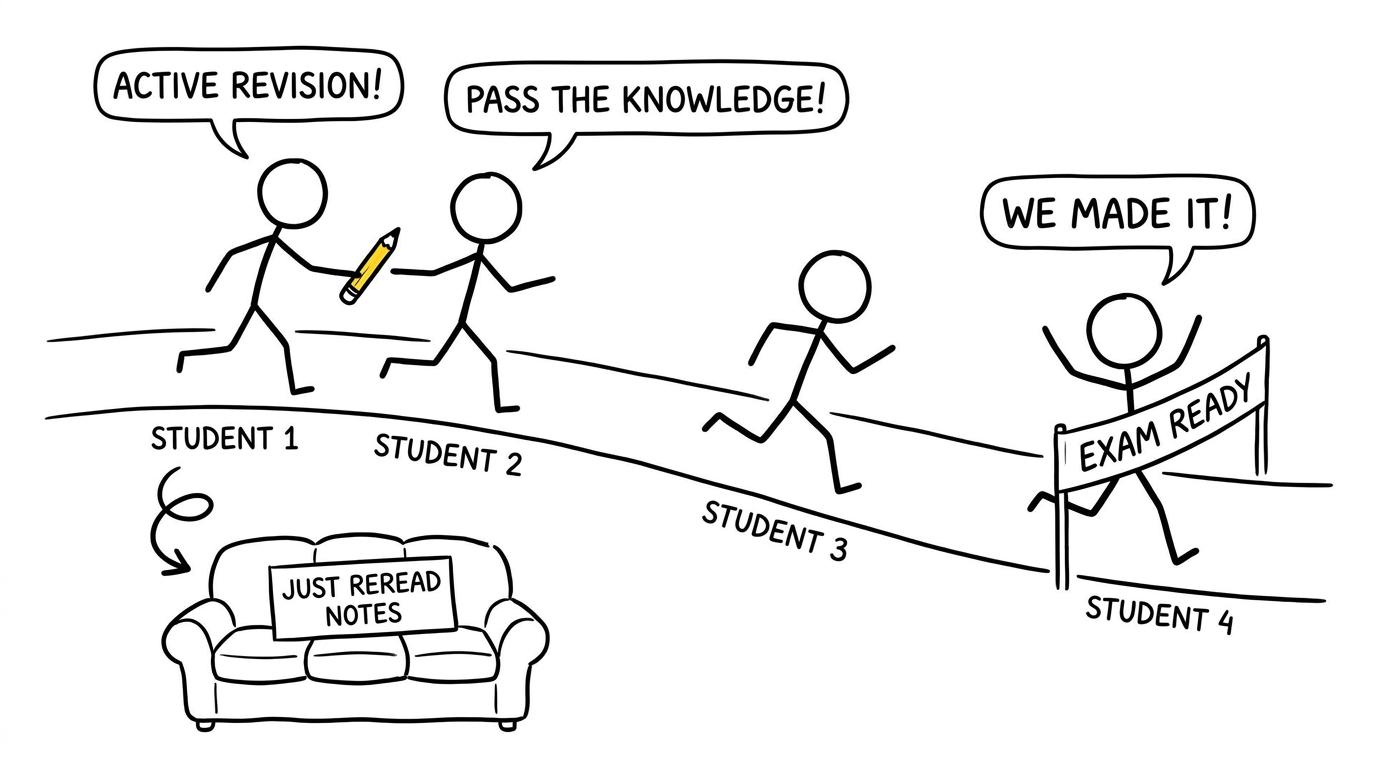 Students pass a pencil in an active-revision relay
Assign roles without creating a hierarchy
Roles make responsibility visible, but they should rotate.
The chair publishes the objective and keeps the session moving. The question writer prepares a short recall activity. The evidence checker brings the correct specification material or mark scheme. The timekeeper protects the writing phase. The recorder notes corrections and next actions.
Rotating these jobs prevents one organised student from becoming an unpaid teacher. It also makes everyone explain ideas, prepare questions and evaluate evidence, useful forms of revision in themselves.
Explaining can reveal gaps, but an explanation is only valuable if it is accurate. The evidence checker should pause confident claims that cannot be supported. “I think our teacher said...” is a prompt to verify, not a source.
Control the group chat before it controls the group
The chat should handle logistics, not become the study group itself.
Pin one message containing the meeting time, location, objective, preparation and current roles. Keep availability polls rare. A recurring slot is better than renegotiating every week.
Use a simple rule: messages require either a decision, a resource or a question. Memes and encouragement are harmless in moderation, but endless notifications can create the feeling of work without the substance of it.
During meetings, put phones face down or in a shared “phone car park” unless they are needed for a timed task or approved resource. A device is not automatically a distraction, but an unplanned device usually becomes one.
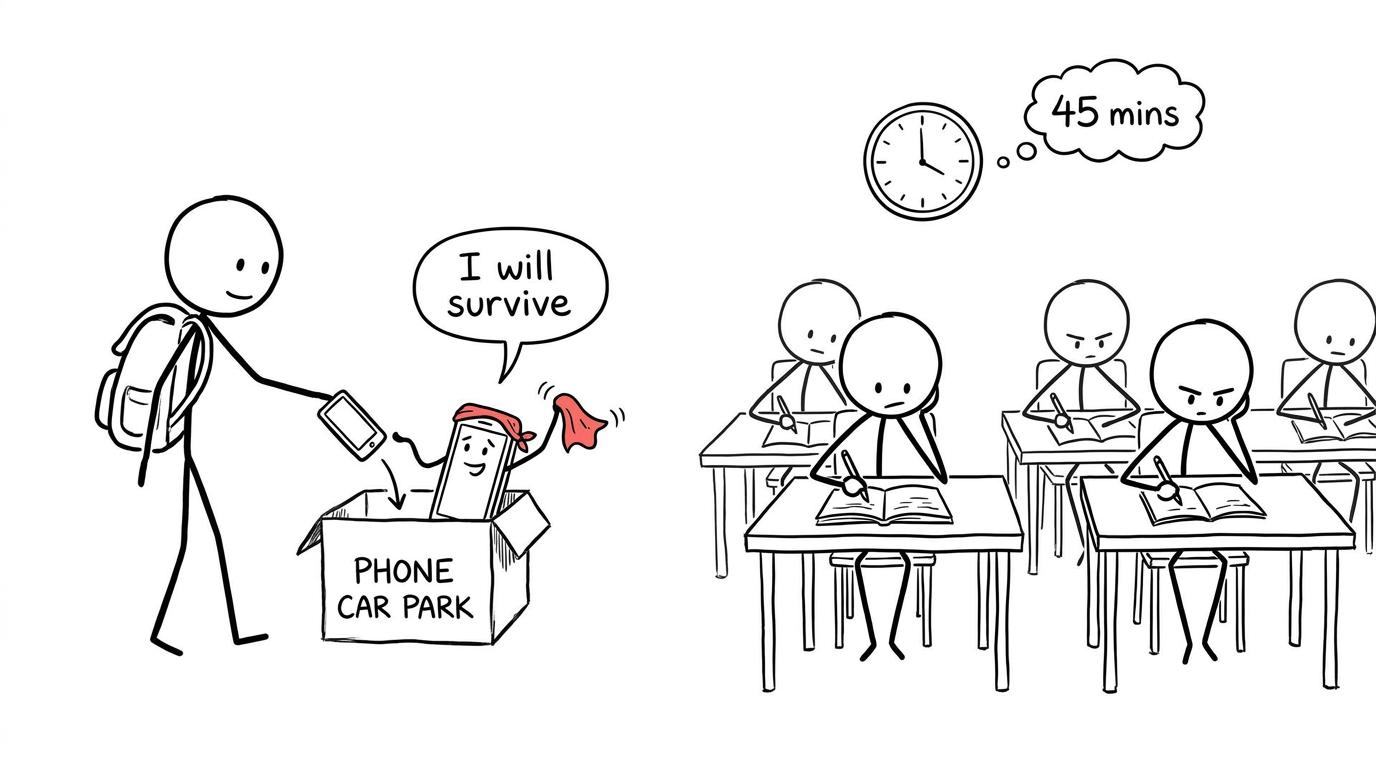 A dramatic phone enters the revision phone car park
Make the group useful for maths revision too
If your audience is preparing for maths exams as well as Media Studies, retain the same group structure but change the task. Maths requires independent problem-solving before discussion; watching another student calculate can feel fluent without proving that you can reproduce the method.
Begin by identifying individual gaps. The GCSE maths topics by board and tier guide helps students organise revision for Edexcel, AQA, OCR or Eduqas and distinguish foundation from higher-tier preparation.
Then use this cycle:
- attempt questions independently;
- compare methods rather than copying answers;
- mark against the scheme;
- classify each error;
- revisit the relevant revision lesson;
- retest the skill at a later meeting.
As examinations approach, groups can use MathsGenie's predicted-topic revision guidance alongside official past papers. Predicted papers are useful for fresh practice, but they should supplement rather than replace specification coverage and official papers.
Students who want a stable weekly structure can also adapt the GCSE maths revision timetable. The important point is that every student attempts the maths. One person performing at the whiteboard while everyone nods is a demonstration, not group practice.
Common study-group mistakes
Meeting without preparation
If nobody brings questions, materials or prior knowledge, the session becomes an improvised lesson. Send the preparation task several days ahead and keep it small enough to complete.
Confusing conversation with revision
An energetic debate can be useful, but examinations require individual retrieval and writing. Protect time for silent work in every session.
Letting one person dominate
Use rotating roles and round-robin contributions. Ask everyone to write before anyone answers aloud, so quick speakers do not remove the thinking opportunity from others.
Trusting polished but unsupported claims
Media analysis permits interpretation, not invention. Require precise evidence from the product and verify factual contextual claims.
Avoiding difficult topics
Students naturally return to material they enjoy. Use retrieval results, marked answers and teacher feedback to choose the next focus. Weakness should set the agenda.
Trying to repair every weakness at once
A long list creates paralysis. Choose one or two priorities per meeting. Maths students can follow the same principle in MathsGenie's guide to using Edexcel GCSE maths past papers properly: mark, diagnose, repair and reattempt.
Turn the next message into a real meeting
A productive group is not built by finding endlessly motivated people. It is built by making the useful action easier than the distracting one.
Choose three to five students. Fix the time. Publish one outcome. Begin with recall, verify errors, apply the knowledge and finish with individual exam practice. Then repeat the process before momentum has time to disappear.
For your maths preparation, make MathsGenie the group's free revision base. Use revision lessons and practice questions to repair weak topics, mini tests to check recall, and past papers or predicted papers to build exam confidence. Mark carefully with the available mark schemes and use video solutions when a method still does not make sense.
The best first step is small: send one message containing a date, a topic and a preparation task. That is how a group chat becomes a study group.