

GCSE Maths Paper 1: What to Actually Expect
GCSE Maths Paper 1 explained: calculator rules, timings, likely question styles, common mistakes and a practical revision plan for exam day.
The calculator is packed away. Suddenly, arithmetic that normally takes three button presses feels exposed.
That is the anxiety behind most searches for GCSE maths paper 1. The practical answer is reassuring: for Edexcel and AQA, Paper 1 is a non-calculator examination lasting 111 hour 303030 minutes. However, Paper 1 is not automatically non-calculator for every board; OCR students use a calculator on the paper called Paper 1, while Eduqas calls its non-calculator examination Component 1.
More importantly, a non-calculator paper does not contain a secret, restricted list of topics. Any specification content can be assessed. What changes is how questions are designed: numbers are usually chosen to support exact calculation, estimation, written methods and mathematical reasoning without relying on calculator output.
GCSE maths Paper 1 at a glance
Before revising, confirm your exam board and tier. The name printed on the front matters more than what friends at another school call it.
| Exam board | What is Paper 1? | Time | Marks | Weighting |
|---|---|---|---|---|
| Edexcel | Non-calculator, Foundation or Higher | 111 hour 303030 minutes | 808080 | 3313%33\frac{1}{3}\%3331% |
| AQA | Non-calculator, Foundation or Higher | 111 hour 303030 minutes | 808080 | 3313%33\frac{1}{3}\%3331% |
| OCR | Calculator Paper 1 at Foundation; Higher begins with Paper 4 | 111 hour 303030 minutes | 100100100 | 3313%33\frac{1}{3}\%3331% |
| Eduqas | Component 1 is non-calculator | 222 hours 151515 minutes | 120120120 | 50%50\%50% |
For OCR, the non-calculator assessment is Paper 2 at Foundation tier and Paper 5 at Higher tier. This is the exception students most need to notice.
The quickest checklist is:
- confirm Edexcel, AQA, OCR or Eduqas;
- confirm Foundation or Higher tier;
- identify whether your named paper permits a calculator;
- practise using the correct time limit and equipment;
- revise the whole specification rather than gambling on predicted topics;
- mark your practice and repair the reasons behind lost marks.
You can check your course coverage through the GCSE Maths topics by exam board and tier, then choose the matching resources from the GCSE Maths revision hub.
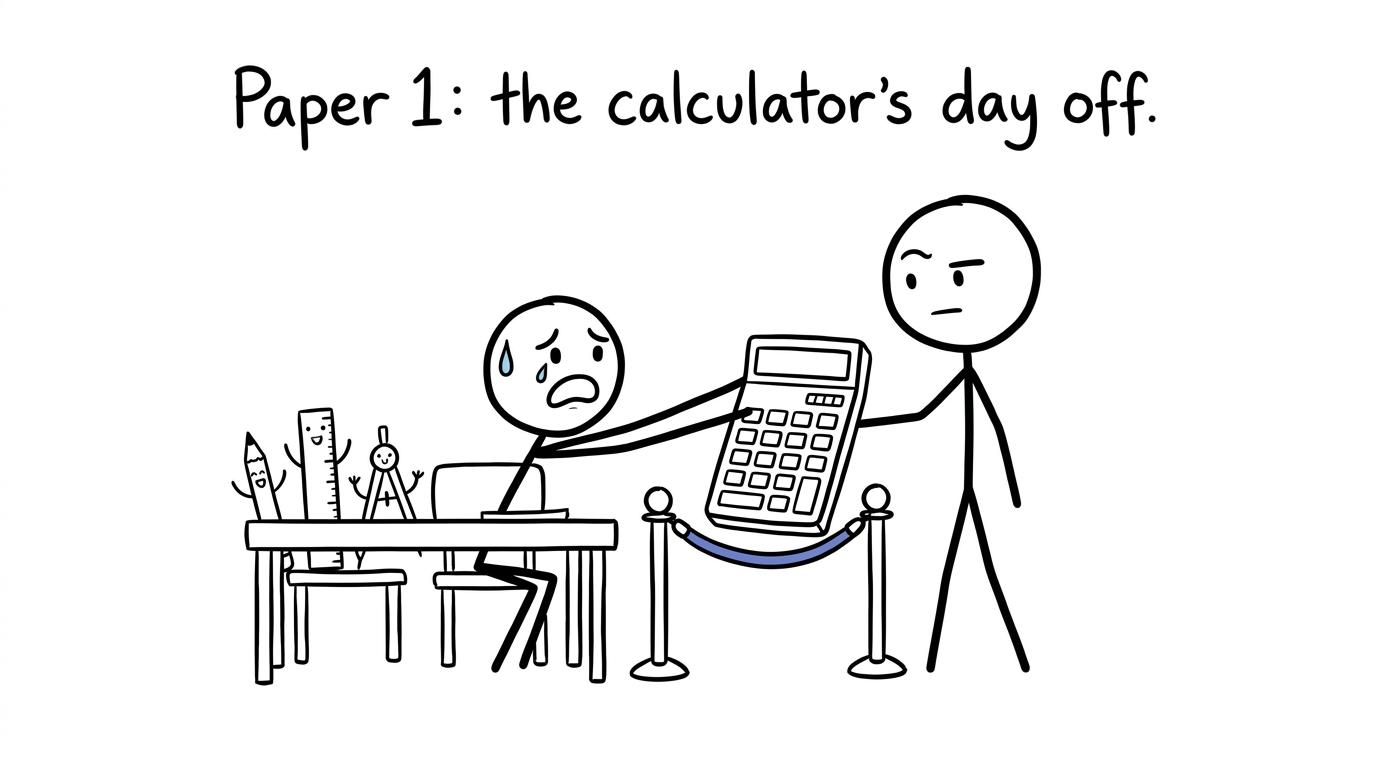 A student saying goodbye to a calculator before Paper 1
What is actually different about a non-calculator paper?
The curriculum does not split neatly into “Paper 1 topics” and “calculator topics”. AQA explicitly states that content from any part of its specification may be assessed on any paper, and the same broad principle applies across the major boards.
So why do past papers feel different?
Without a calculator, examiners need questions that can reasonably be completed by hand. That often makes the following skills especially visible:
- arithmetic with integers, decimals and negative numbers;
- fractions, percentages and ratio;
- factors, multiples, primes, powers and roots;
- exact values involving fractions, surds or π\piπ;
- simplifying and manipulating algebra;
- solving equations and inequalities;
- angle facts and geometric reasoning;
- estimation and checking whether an answer is sensible;
- interpreting diagrams, tables, graphs and written information.
This is a tendency, not a prediction. Probability, statistics, transformations, constructions, sequences, graphs and multi-step geometry can all appear. Higher-tier students should also be ready for algebraic proof, quadratics, trigonometry and exact calculations where appropriate.
The better question is not “What always comes up?” It is “Which skills become harder when I cannot outsource arithmetic to a machine?” Those are the skills to practise first.
What the questions tend to feel like
Most papers begin with relatively accessible questions and become more demanding overall, although difficulty does not rise perfectly from one page to the next. A hard-looking diagram can lead to a short method. A harmless-looking worded problem can conceal several decisions.
Short technique questions
These check whether you can recall and apply a standard method. They may be worth only one or two marks, but together they form an important part of the paper. Accuracy matters: a sign error or an incorrectly simplified fraction can lose an otherwise reachable mark.
Multi-step problems
Longer questions may connect several areas of maths. You might need to extract information, choose a method, complete accurate arithmetic and interpret the result in context. The challenge is often deciding what to do before carrying it out.
Reasoning and communication
Commands such as show, prove, explain, give a reason and show that require visible reasoning. An unsupported answer is not a complete response when the question asks for justification.
This is why working matters. Mark schemes commonly separate method marks from accuracy marks. A correct approach can still earn credit after an arithmetic slip, but only when the examiner can see it.
Timing without rushing
Edexcel and AQA give 909090 minutes for 808080 marks. That is an average of
9080=1.125\frac{90}{80}=1.1258090=1.125minutes per mark. Eduqas has the same average because
135120=1.125.\frac{135}{120}=1.125.120135=1.125.OCR papers offer 909090 minutes for 100100100 marks, an average of
90100=0.9\frac{90}{100}=0.910090=0.9minutes per mark.
These are guides, not schedules for every question. A one-mark fact may take seconds, leaving time for a demanding multi-step problem.
A sensible approach is to move through the paper in passes:
- answer questions you can begin confidently;
- mark anything that needs more thought and move on;
- return to incomplete questions with the remaining time;
- use the final minutes to check arithmetic, units and unanswered pages.
Being stuck is expensive because it consumes both time and confidence. Moving on is not surrender. It is mark management.
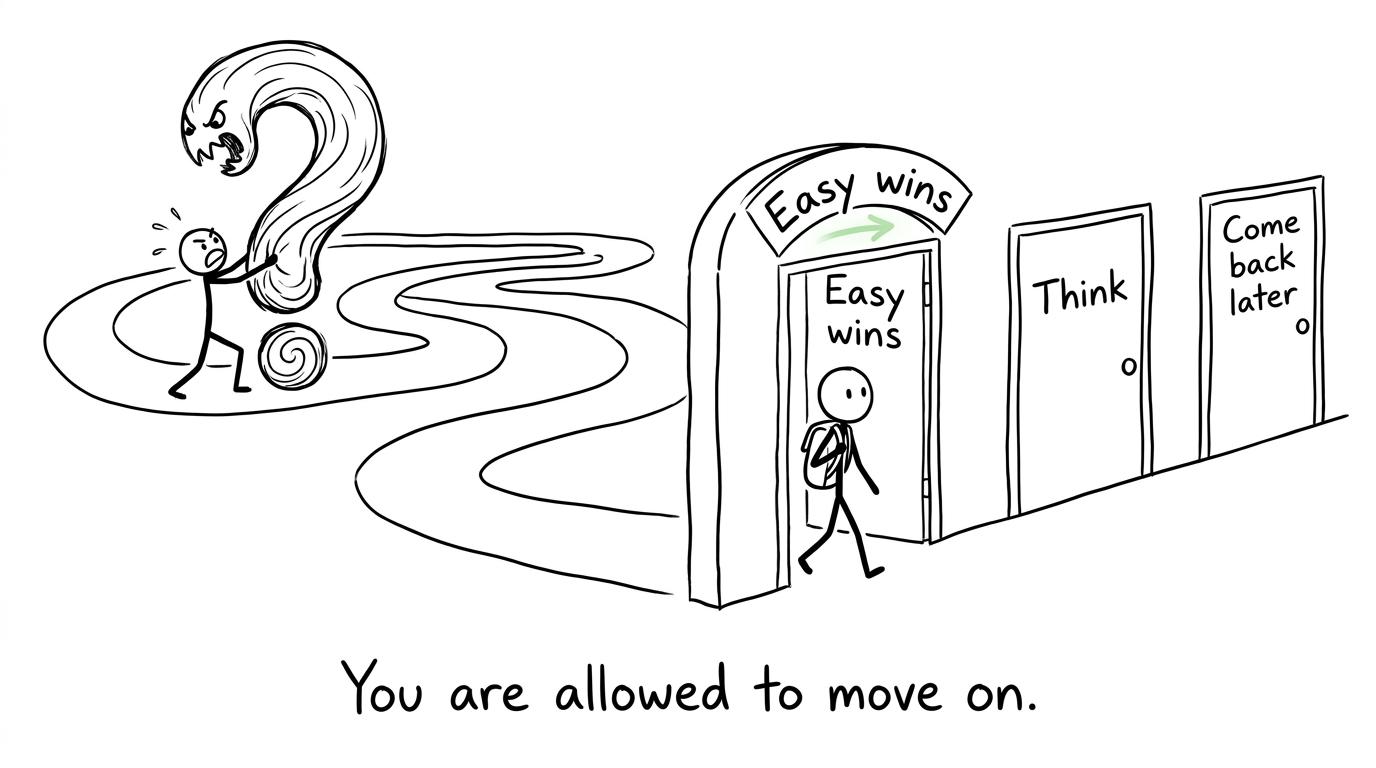 A student choosing to return to a difficult question later
How Foundation and Higher papers differ
Both tiers assess mathematical fluency, reasoning and problem solving, but their content and demand differ.
Foundation tier targets grades 111 to 555. Its early questions are generally more accessible, yet later questions can involve unfamiliar contexts and linked methods. Secure number skills, ratio, percentages, basic algebra and geometry are especially important because weaknesses there can affect many questions.
Higher tier targets grades 444 to 999. It includes additional content and places greater demand on algebraic manipulation, exact answers, proof and multi-step reasoning. The opening should not be treated casually: accurate marks from accessible questions create the platform for the harder final section.
On either tier, do not judge a question by how advanced its topic sounds. The marks depend on the particular task, not the topic label.
Formula sheets and equipment
Formula support has been confirmed for GCSE Maths examinations in 202620262026 and 202720272027. The exact presentation varies by board, so practise with the formula material issued for your specification and tier.
A formula sheet reduces memory pressure, but it does not choose the formula, substitute values or complete the arithmetic. You still need to understand what each symbol represents and recognise when a relationship is relevant.
For a non-calculator examination, bring the equipment specified by your school and paper instructions. This will normally include black pens, pencils for diagrams, a ruler and appropriate mathematical instruments such as compasses and a protractor. Do not assume diagrams are drawn accurately unless the paper says so.
The most useful Paper 1 revision method
Reading notes can make a method feel familiar without making it usable. Paper 1 preparation needs retrieval and written calculation.
Start with one correctly timed paper for your board and tier. Edexcel students can use the Edexcel GCSE Maths past papers, while the main revision hub provides routes to other boards.
Then classify every lost mark:
- knowledge gap: you did not know the rule or method;
- arithmetic error: the approach was sound but the calculation failed;
- interpretation error: you misunderstood the wording, diagram or data;
- communication error: working, units or justification were missing;
- timing error: you could do it, but not within the paper.
Fix the cause rather than merely reading the answer. Use a MathsGenie revision lesson, complete targeted practice questions, check the mark scheme or video solution, and retest the skill later. The guide to using Edexcel past papers properly explains this learn, practise, mark, fix cycle in more detail.
Once older papers feel manageable, use Edexcel predicted papers or fresh mixed practice to test whether your improvement transfers to unseen questions. Predicted papers are useful practice, not promises about what will appear.
If revision feels scattered, build paper practice into a realistic GCSE Maths revision timetable. Mini tests can diagnose a small weakness; full papers build stamina and decision-making.
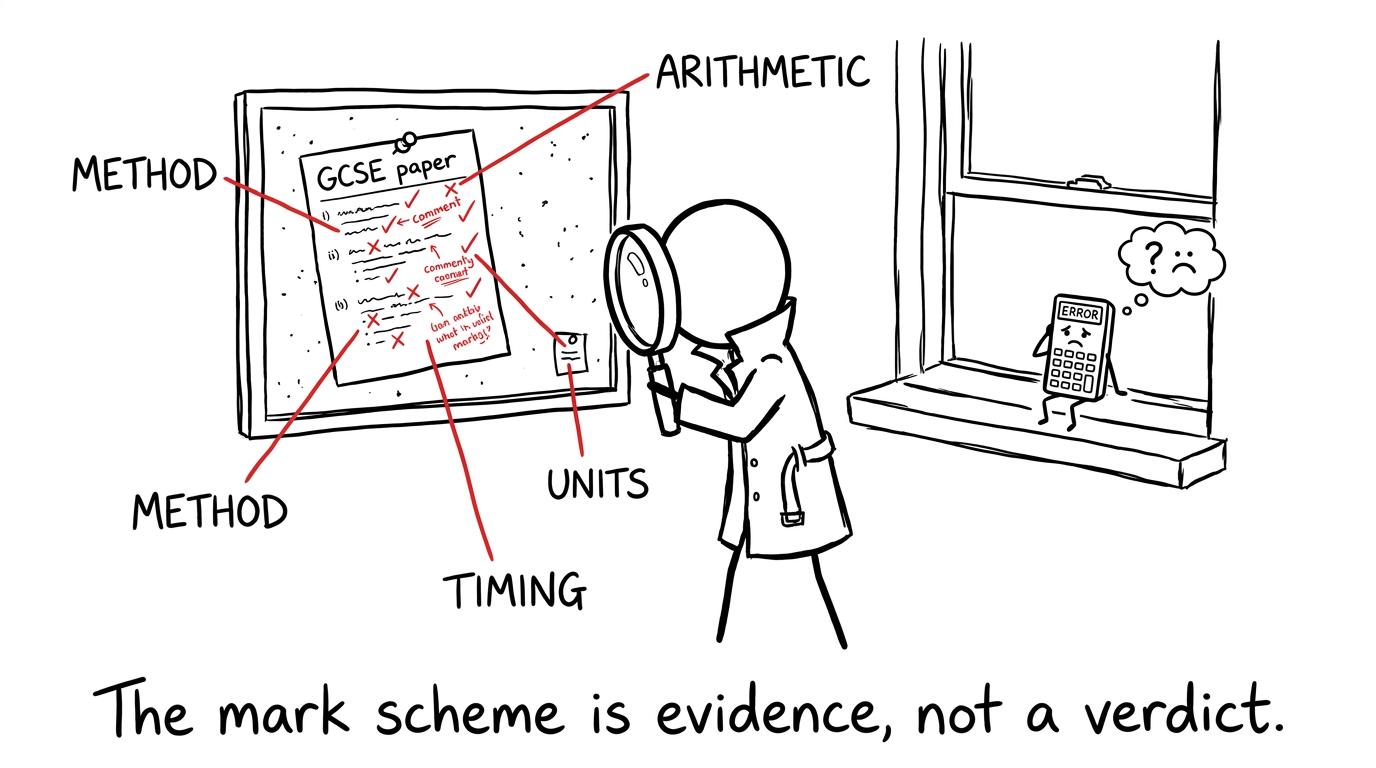 A student investigating lost marks like a detective
Common mistakes on GCSE maths Paper 1
Assuming every Paper 1 is non-calculator
This is false for OCR. Check the paper code and official instructions for your board and tier.
Revising only “non-calculator topics”
Any specification area may be assessed. Prioritise hand-calculation skills, but maintain full curriculum coverage.
Doing arithmetic mentally when marks are available for method
Write enough working to make your approach clear. It supports checking and may protect method marks if the final calculation is wrong.
Turning exact answers into rough decimals
If a question asks for an exact value, retain forms involving fractions, surds or π\piπ rather than estimating unnecessarily.
Using the diagram as a measuring tool
Unless told otherwise, diagrams may not be accurately drawn. Use the stated lengths, angles and mathematical facts.
Spending too long on one question
A blank final page can cost more marks than temporarily leaving one difficult problem. Circle it, move on and return later.
Marking a paper without acting on it
A score measures one attempt. Improvement comes from identifying the error, revising the underlying skill and trying it again.
For the final evening, follow a calm GCSE Maths night-before plan rather than attempting to relearn the entire course.
Go into the paper knowing what it is
Paper 1 is not designed to catch you without a calculator. It is designed to see whether your number sense, written methods and reasoning are dependable when every mathematical decision is visible.
Confirm your board. Practise under the right conditions. Show your method. Move on when necessary. Most importantly, let every marked paper tell you what to do next.
Start at the MathsGenie GCSE Maths revision hub. Use the free revision lessons and practice questions to repair weak topics, mini tests to check recall, and past papers, predicted papers, mark schemes and video solutions to make the real examination feel familiar rather than mysterious.











