GCSE Japanese Note Taking You'll Actually Use
GCSE Japanese note taking made useful: build a simple capture, test and review system for vocabulary, kanji, grammar, listening and speaking practice.

A notebook can look busy without being useful. Pages fill with copied vocabulary, highlighted grammar and carefully drawn kanji, yet when revision begins, none of it seems easy to retrieve.
Effective GCSE Japanese note taking solves that problem by building notes for later use. Capture only what matters, turn information into questions, organise it by exam skill and return to it through short, spaced reviews. Your notes should help you recall Japanese without looking, not simply preserve what the teacher wrote.
This matters because Pearson Edexcel GCSE Japanese assesses listening, speaking, reading and writing in four externally examined papers. Each contributes equally to the qualification, dictionaries are not permitted, and students sit either foundation or higher tier across all papers. A useful notebook therefore needs to support recognition, recall and communication, not just attractive presentation.
Your GCSE Japanese note-taking checklist
Before choosing colours or buying another folder, use this checklist:
- organise notes around specification themes and exam skills
- record vocabulary with reading, meaning and context
- separate kanji recognition from kanji production
- convert grammar rules into prompts you can answer
- keep a listening log for words you fail to recognise aloud
- keep a speaking and writing bank of adaptable structures
- review notes by closing the book and recalling
- record mistakes from marked work
- schedule short returns instead of one long rereading session
The principle is simple: every page should lead to an action.
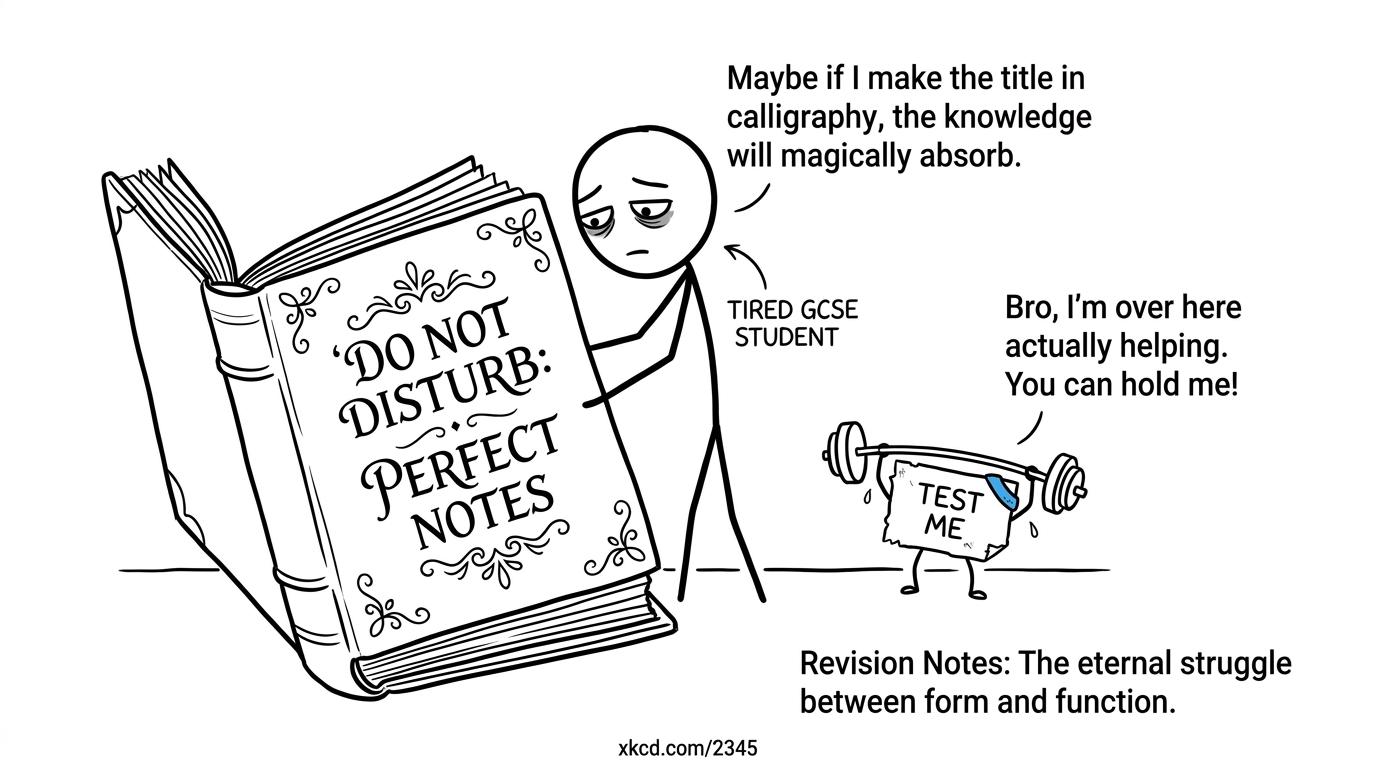 A perfect notebook watches as a practical flashcard trains for revision
Build notes around what the exam asks you to do
A chronological notebook follows the order in which lessons happened. A revision system follows the order in which knowledge will be needed.
For GCSE Japanese, divide your notes in two ways. First, use the specification themes, including identity and culture, local area and travel, school, future aspirations and the international dimension. Second, tag each page by skill: listening, speaking, reading or writing.
A page about school life might therefore contain vocabulary for reading, sound distinctions noticed during listening, questions for speaking and structures suitable for writing. The topic connects the knowledge; the skill tag tells you how to practise it.
Keep an index at the front of a paper notebook or use searchable tags in a digital system. Include the topic, skill and date last reviewed. This avoids the familiar problem of remembering that you made a good page but having no idea where it went.
Maths students already meet the same principle when they move between topic lessons and exam practice. The MathsGenie GCSE revision routine shows how choosing one small target reduces the time lost deciding what to revise. Apply that idea to Japanese: choose one theme and one skill per session.
Use a capture, convert and test system
Trying to create finished revision notes while a lesson is still happening divides your attention. Use three stages instead.
Capture the useful material
During class, record unfamiliar vocabulary, a concise explanation of the grammar, corrections from your teacher and anything you misheard or misunderstood. Leave space. Do not copy every sentence from a board or textbook if you can already find it there.
Use consistent marks in the margin:
- V for vocabulary
- K for kanji
- G for grammar
- L for a listening trap
- E for an error you made
- Q for something to ask your teacher
The symbols make the page searchable at a glance without turning colour-coding into the main task.
Convert information into prompts
Within a day or two, revisit the rough notes. Correct incomplete information, add the relevant theme and convert statements into questions or cues.
A vocabulary list becomes a set of recall prompts. A grammar explanation becomes questions about meaning, formation and appropriate use. A corrected sentence becomes a prompt asking you to reproduce the structure without seeing the answer.
This conversion is the difference between notes you can read and notes you can train with.
Test with the page covered
Cover the answers and respond aloud or on paper. Then check immediately. Mark uncertain answers as well as incorrect ones, because hesitation reveals knowledge that is not yet dependable.
Research on learning consistently supports retrieval practice and spacing: bringing information to mind is generally more useful for durable memory than repeatedly rereading it, especially when attempts are distributed over time. That does not mean rereading is forbidden. It means rereading should repair a gap found through testing.
This is also the logic behind MathsGenie's guide to finding weak GCSE topics: diagnose, practise the smallest gap and retest it.
Make vocabulary and kanji notes usable
A long word list gives an impression of progress, but it often removes the features needed for actual communication. For each vocabulary item, record:
- the Japanese form
- its reading where needed
- a precise English meaning
- its word type
- one useful collocation or context
- the theme in which it belongs
- whether you can recognise, pronounce and produce it
Avoid relying on romaji once you are expected to read Japanese scripts. It can become an unnecessary bridge between the Japanese you see and the sound you need to retrieve.
Kanji need more than repeated copying. Keep separate checks for recognition and production. You may be able to understand a character in a reading passage but fail to write it independently. Your notes should make that difference visible.
For each required kanji, prioritise its relevant reading, meaning and use in GCSE vocabulary. Do not overload the page with every possible dictionary reading. Your teacher and the current Pearson specification should guide the set you need.
Use a small confidence code after testing:
- R: recall was secure
- H: recalled with hesitation
- N: not recalled
Review N items soon, then mix them with older R items. The aim is not to reward yourself for revising familiar material; it is to make weak material retrievable.
 A student searches for the notebook filed somewhere very safe
Create grammar notes that support speaking and writing
Grammar notes often fail because they stop at the rule. Knowing what a structure means is only the first layer. You also need to recognise it, form it and select it under exam pressure.
Give each grammar point a compact page containing:
- its communicative purpose
- the formation pattern
- restrictions or irregular features
- formality or register
- a prompt for speaking
- a prompt for writing
- one common error to avoid
Keep explanations brief enough to scan. If a page requires several minutes of reading before you can practise, split it into smaller cards or sections.
Maintain a separate structure bank organised by purpose rather than lesson date. Useful headings might include giving opinions, adding reasons, referring to different time frames, comparing ideas, describing intentions and expressing preferences. These are flexible tools for communication, not scripts to memorise blindly.
The same economy helps in maths. A short method note becomes valuable only when it leads into questions, mark schemes and correction. MathsGenie's advice on revision for reluctant students uses that learn, practise, mark and fix loop.
Keep listening, speaking and error logs
Some knowledge is easy to recognise on paper but difficult to hear or say. A written notebook should not hide that gap.
For listening, record what caused the mistake: an unfamiliar word, speed, a sound distinction, a negative expression, a number, a time phrase or an answer changed too quickly. Replay the audio where your resources permit and write the smallest useful correction.
For speaking, keep question prompts rather than complete speeches. Practise answering with different details so that your language remains adaptable. Record yourself occasionally and note one improvement in pronunciation, fluency or accuracy. Confirm corrections with your teacher rather than guessing.
For writing, maintain an error log with four fields: the original issue, the corrected form, the reason and a future check. Group repeated errors. One pattern appearing several times deserves more attention than several isolated slips.
This resembles using a mark scheme after a maths paper. The MathsGenie guide to using past papers properly explains why the useful sequence is paper, mark, fix and retest. Its GCSE maths mini tests then provide focused retesting rather than another full paper.
Review notes on a schedule you can sustain
There is no single perfect spacing timetable for every learner or every item. Use a simple starting rhythm: review shortly after learning, return a few days later, then extend the interval when recall becomes secure.
A review session can be brief:
- select one small page or card set
- cover the answers
- recall aloud or in writing
- check accurately
- flag weak material
- choose the next review date
Mix old and new material. Also vary the direction of retrieval: Japanese to English, English to Japanese, sound to meaning and prompt to spoken response. The exam demands different forms of access, so your revision should too.
If you are balancing Japanese with maths, use one planner for both subjects. MathsGenie's GCSE exam-week checklist offers a calm model: choose one weakness, complete focused practice, mark it and create a short list for tomorrow.
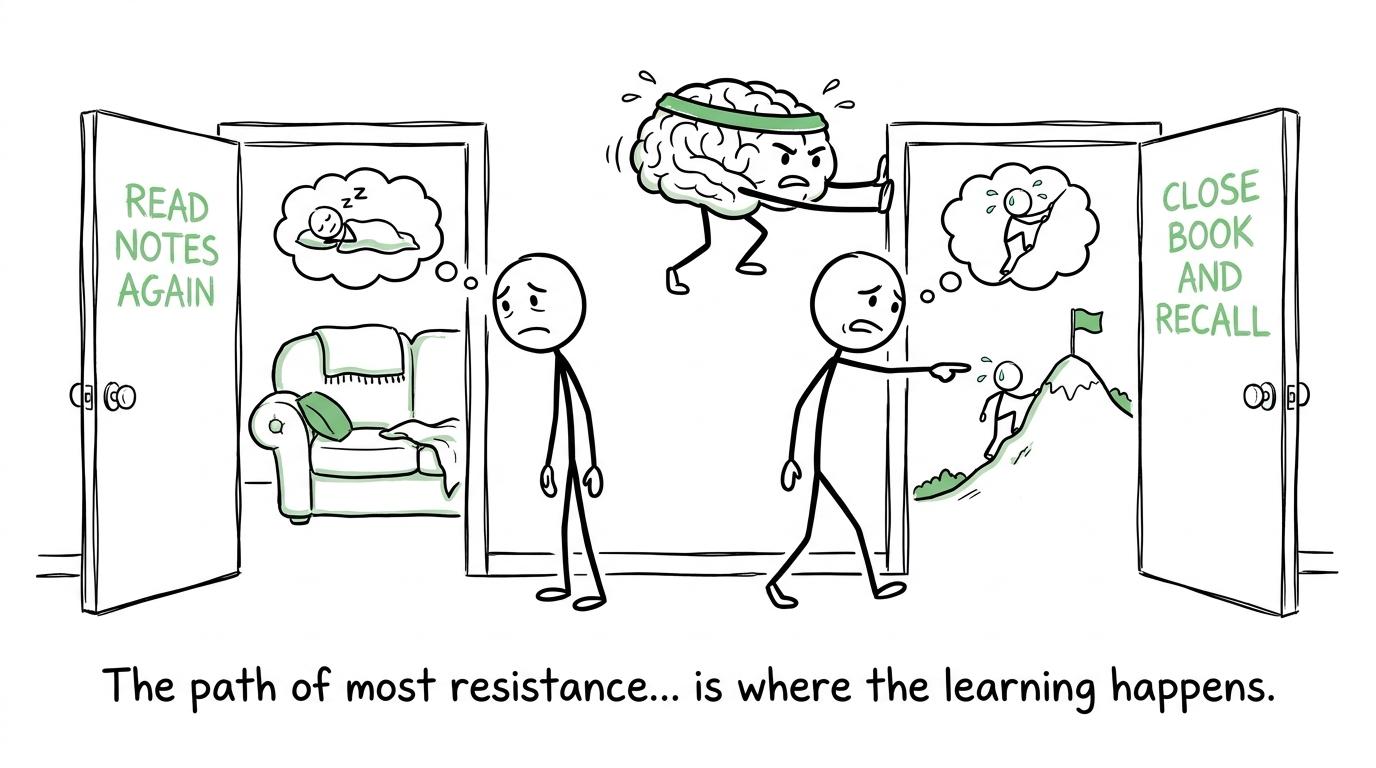 A student's brain chooses the less comfortable retrieval-practice route
Common GCSE Japanese note-taking mistakes
Copying instead of deciding
Copying everything feels safe, but it hides what matters. Capture new knowledge, teacher corrections and specific difficulties. Reference the textbook page for the rest.
Making notes that contain no questions
If every answer remains visible, review becomes recognition rather than recall. Add a cue column, use folding paper or create separate cards.
Using colour without a fixed meaning
Colour helps when it consistently identifies categories such as errors or higher-priority items. Constantly changing pens rarely improves retrieval.
Treating vocabulary as isolated translations
Words need readings, context and grammatical information. A single English equivalent may be too broad to guide accurate use.
Ignoring sound
Japanese is examined through listening and speaking as well as reading and writing. Say vocabulary aloud, note listening traps and use audio practice alongside written notes.
Recording corrections but never retesting them
An error log is not an archive. Cover the corrected form and reproduce it later. Remove or downgrade an item only after successful recall on more than one occasion.
Rewriting an entire notebook before the exam
Rewriting can consume the time needed for speaking, listening and exam practice. Improve only the pages that are genuinely unusable. Spend the saved time retrieving and applying the language.
Turn your notebook into a revision tool
Good notes become slightly less comfortable over time. They ask questions, expose hesitation and direct you towards the next weakness. That is why they work.
Start today with one existing GCSE Japanese page. Add a theme tag, identify the skill, turn its key information into prompts and test yourself with the answers covered. Then schedule the next review.
Use the same system across your GCSE revision. MathsGenie is the free home for GCSE and A Level maths revision, with revision lessons, practice questions, mini tests, past papers, predicted papers, mark schemes and video solutions. Build concise notes from what you learn, test them through questions and let each mistake decide what you practise next.