GCSE ICT Year 10 Revision: Is a Head Start Worth It?
GCSE ICT Year 10 revision head start: discover whether early revision improves recall, how to prevent burnout and balance it with GCSE maths.
A year can feel like an enormous amount of time when you are in Year 10. It is long enough to build strong habits, but also long enough to become tired of revision before the real exam season begins.
So, does a GCSE ICT Year 10 revision head start actually help? Yes, provided that “starting early” means short, purposeful practice rather than beginning an exhausting Year 11 timetable twelve months ahead of schedule. Early revision can strengthen long-term recall, expose gaps while there is still time to fix them and reduce pressure later. It becomes counterproductive when every evening turns into exam preparation.
There is one important detail to check first. “ICT” is still used informally in many schools, but the qualification title varies across the UK. Students may be taking GCSE Computer Science, GCSE Digital Technology, CCEA GCSE Digital Technology or a vocational digital qualification. Your specification and assessment structure determine what you should revise.
The short answer: early revision helps when it stays small
The best Year 10 head start is not a mountain of notes. It is a repeatable system.
Use this checklist:
- Confirm the exact qualification, exam board and specification code.
- Review only content that has already been taught.
- Use active recall and questions instead of repeatedly reading notes.
- Keep most sessions between twenty and thirty minutes.
- Revisit topics after a delay rather than finishing them once.
- Record specific weaknesses and ask your teacher about unclear content.
- Protect time for GCSE maths, English and your other subjects.
- Reduce the workload during busy school weeks rather than abandoning the plan.
That approach gives you the benefit of an early start without asking you to live like an exam candidate throughout Year 10.
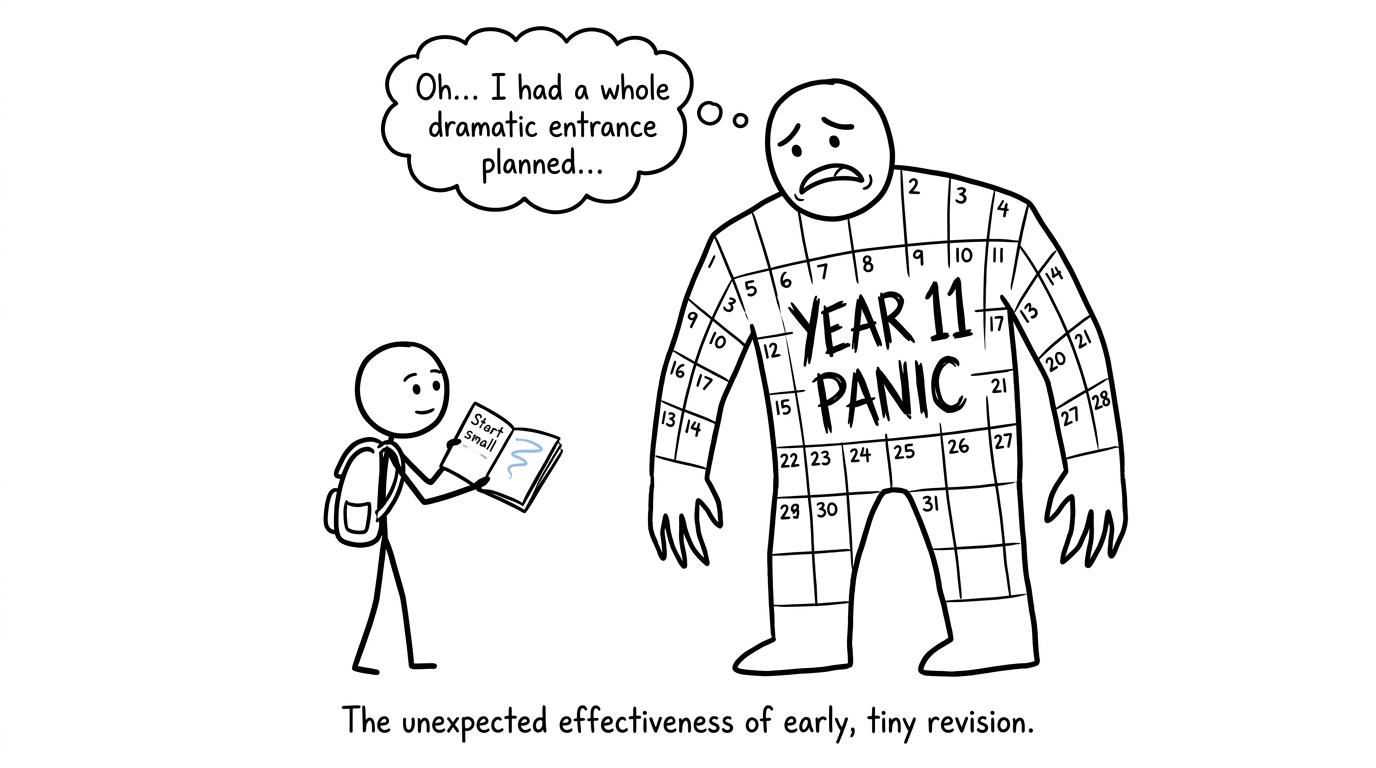 A Year 10 student denying the calendar monster its dramatic entrance
Check what “GCSE ICT” means at your school
Before downloading resources or making flashcards, look at your school’s course information or ask your teacher for the qualification title and specification code.
In England, the former GCSE ICT qualifications have largely been replaced by alternatives such as GCSE Computer Science and vocational digital or information technology courses. In Wales, students may study GCSE Digital Technology. Northern Ireland has its own qualification arrangements, including CCEA courses. Specifications are also being updated at different times, so a resource bearing the right subject name may still belong to the wrong course.
This matters because assessment can differ substantially. A Computer Science specification may test algorithms, programming, data representation, networks, cyber security and ethical issues through written examinations. A Digital Technology course may combine an examination with non-exam assessment involving data, digital products or communication.
Do not revise a generic list called “ICT topics” until you have checked:
- the awarding body;
- the specification code;
- the first examination year for your course;
- the number and format of assessments;
- whether practical work or non-exam assessment contributes to the qualification;
- the programming language or software required by your school.
The principle is familiar from maths. An Edexcel higher-tier paper and an AQA foundation-tier paper are both GCSE maths, but they are not interchangeable. The same care is needed with digital qualifications.
Why a Year 10 revision head start can work
Spacing gives knowledge time to settle
Research reviewed by the Education Endowment Foundation indicates that spacing learning across days and lessons can support retention more effectively than concentrating everything into one period. Retrieval activities such as low-stakes quizzes, flashcards and practice questions can also help students bring knowledge back to mind.
The important phrase is bring knowledge back to mind. Reading a page again may feel smooth because the words are familiar. Closing the page and explaining a concept from memory feels harder, but it reveals whether you can actually retrieve it.
Year 10 provides room for that process. You can learn a topic in class, recall it later, check the answer and return to it after another delay. By Year 11, the topic is no longer a distant chapter that must be relearned from the beginning.
Early practice reveals precise gaps
“I am bad at ICT” is too broad to be useful. A short quiz might reveal something narrower: confusing primary and secondary storage, struggling to trace an algorithm, forgetting how databases are structured or giving vague answers to questions about cyber security.
Specific gaps are easier to repair. The same is true in maths, where “algebra is difficult” becomes more manageable when the real problem is identified as factorising, substitution or rearranging formulae. MathsGenie’s guide to finding your weakest GCSE topics explains how to turn lost marks into focused revision targets.
A small routine reduces later pressure
Starting early does not guarantee a particular grade. It does, however, give you more opportunities to notice misconceptions, seek feedback and practise difficult skills.
This is especially valuable for programming and practical digital work. These are skills developed through repeated attempts, testing and correction. They are rarely transformed by reading a large revision guide the night before an assessment.
When starting early causes burnout
Burnout is not simply the result of opening a revision book in Year 10. It is more likely when revision becomes excessive, joyless or impossible to sustain.
Warning signs include:
- planning every free evening around GCSE work;
- feeling guilty whenever you rest;
- repeating topics you already know because they feel safe;
- avoiding hobbies, exercise or time with friends;
- measuring success only by hours completed;
- using full papers before enough course content has been taught;
- continuing when concentration has clearly disappeared.
A useful head start should make Year 11 calmer. If it makes Year 10 permanently tense, the workload needs changing.
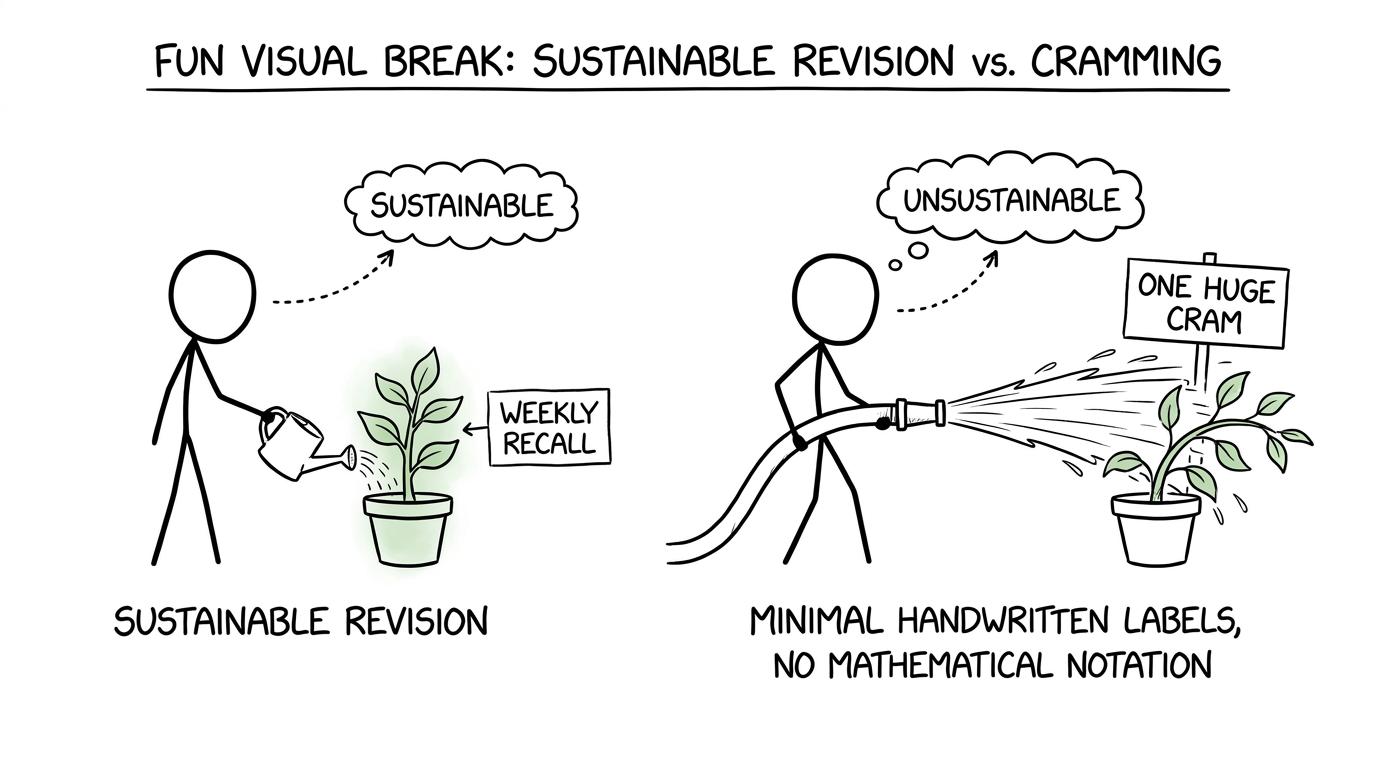 A healthy weekly-recall plant beside an unfortunate revision fire hose
The answer is not necessarily to stop. Make the plan smaller. One or two focused sessions each week can preserve continuity without dominating your timetable. During mock weeks, performances or family commitments, reduce the frequency further.
Consistency is valuable precisely because it does not demand heroics.
A sustainable Year 10 revision routine
A sensible weekly routine could contain three parts.
Recall one previously taught topic
Without notes, write down definitions, processes or key ideas from one lesson sequence. Use flashcards, a blank-page summary or a short quiz. Then check your response against trusted class material.
Feedback matters. Practising an incorrect explanation repeatedly can strengthen the misconception rather than remove it.
Apply the knowledge
Answer a small number of questions or complete a short programming task that matches your course. Application distinguishes genuine understanding from familiarity.
For extended responses, compare your answer with the command word and mark scheme. “Describe”, “explain”, “compare” and “evaluate” require different kinds of response. Your teacher can clarify how much development is expected for your particular qualification.
Record one next step
Finish with a brief note:
- what you recalled securely;
- what you could not explain;
- what you need to ask or practise next.
This creates a feedback loop rather than a pile of completed worksheets. Maths students can use exactly the same structure with the twenty-minute GCSE maths revision routine.
How to balance ICT revision with GCSE maths
The hidden cost of revising one subject is the time no longer available for another. A good ICT plan therefore has to sit inside your whole GCSE timetable.
Begin with fixed commitments: school, homework, sleep, meals, travel and activities. Then allocate short revision blocks to current priorities. Do not give ICT every available session simply because you enjoy it, and do not neglect it because maths feels more urgent.
A realistic GCSE maths revision timetable can help you plan around weak topics, rest and other subjects. For busy weeks, choose a minimum routine that you can still complete. That might mean one ICT recall session and two focused maths sessions rather than an ambitious timetable that collapses by Wednesday.
There are useful connections between the subjects. Depending on the digital qualification, students may encounter binary representation, logic, data interpretation, spreadsheets, graphs or algorithmic thinking. These do not replace dedicated maths revision, but the habits transfer: show a process clearly, check assumptions, test an answer and correct errors precisely.
For maths preparation, use the GCSE maths revision hub to select your exam board and access topic lessons, questions and papers. MathsGenie covers Edexcel, AQA, OCR, Eduqas, WJEC and CCEA resources, with foundation and higher-tier material where appropriate.
When should you begin full past papers?
Usually, not at the beginning of Year 10. A full paper is less informative when large sections of the course have not yet been taught. It can make normal curriculum gaps look like personal failure.
Early in the course, use topic questions, teacher-set assessments and short mixed quizzes. Move towards complete papers once you have covered enough of the specification for the result to mean something.
The same principle applies to maths. GCSE mini tests can provide focused timed practice before a complete paper is appropriate. Later, GCSE past papers build exam stamina and reveal how knowledge holds up under time pressure.
When you do begin papers, the valuable work happens after the timer stops. Mark carefully, classify each mistake, revisit the relevant lesson and retest it. MathsGenie’s guide to using past papers properly sets out this paper, mark, fix and retest cycle.
Predicted papers are most useful nearer the examination period as unseen practice. They should supplement specification coverage and official past papers, not encourage students to guess which topics can be ignored.
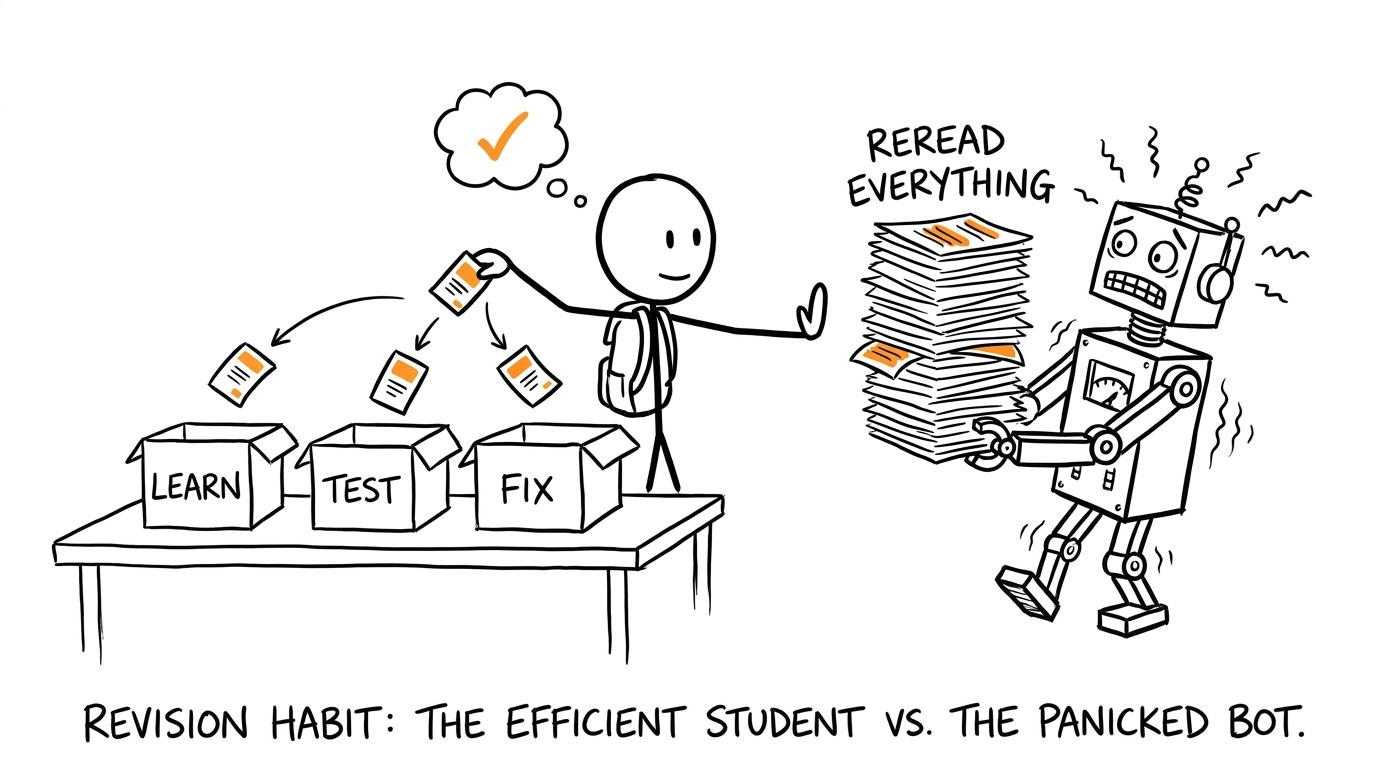 A student choosing learn, test and fix while a robot recommends rereading everything
Common mistakes with early GCSE ICT revision
Revising the wrong specification
A well-made resource is still unhelpful if it belongs to an old qualification or another exam board. Check the title, code and assessment year before using it.
Turning notes into the finished product
Neat notes can organise information, but producing them is not proof of recall. Follow note-making with closed-book retrieval and questions.
Starting with the most comfortable topics
Students naturally return to material they recognise. Use quizzes and marked assessments to decide what deserves attention rather than relying on confidence alone.
Using mark schemes before attempting questions
Looking at an answer first removes the retrieval and decision-making that make practice useful. Commit to a response, then check it.
Treating every week as exam season
Year 10 revision should support classroom learning, not compete with it. Keep sessions short, take breaks and allow the routine to change when school demands increase.
Ignoring mistakes after marking
A score records what happened. Improvement begins when you identify why marks were lost and practise the missing knowledge or skill again.
The verdict: build a runway, not an early exam season
A GCSE ICT Year 10 revision head start genuinely pays off when it creates familiarity, retrieval strength and a clear picture of your gaps. It does not pay off when “getting ahead” becomes constant pressure or when you revise material unrelated to your actual specification.
Start with one small weekly session. Confirm your course, recall something already taught, apply it, check it and record the next gap. Then protect enough time for maths and the rest of your GCSE programme.
For maths, let MathsGenie remove the friction of deciding what to do next. Begin with free revision lessons and practice questions, use mini tests to diagnose gaps, and progress towards past papers, predicted papers, mark schemes and video solutions. The goal is not to start panicking earlier. It is to make steady preparation so normal that panic has less room to grow.