

GCSE ICT vs Computer Science: What Employers Notice
GCSE ICT vs Computer Science: employers value relevant skills, strong grades and later qualifications. Learn what UK colleges and workplaces notice.
A subject-choice form can make one GCSE feel like a permanent career decision. It is not. In the GCSE ICT vs Computer Science employers debate, the short answer is that Computer Science is usually the clearer signal for technical pathways, while ICT demonstrates useful applied digital skills. Yet most employers and colleges care more about your overall grades, English and maths, relevant experience, and what you study next.
That distinction matters. A GCSE can open a door, but it rarely decides the whole journey. The better choice is the course that fits your interests, is genuinely available at your school and helps you build skills you can later prove.
The quick answer
Use this checklist before choosing or describing either qualification:
- For programming, software development or technical computing: GCSE Computer Science is more directly relevant.
- For using digital systems in business and workplace contexts: ICT or a current digital qualification can be relevant.
- For most ordinary part-time jobs: neither subject is likely to outweigh English, maths, reliability and communication.
- For apprenticeships: requirements differ, but many advanced routes ask for several GCSEs at grades 999 to 444, commonly including English and maths.
- For sixth form: some colleges require GCSE Computer Science, but many accept students without it if their maths grade or programming evidence is strong enough.
- For university later: GCSE subject choice is only one part of the picture. A Level choices and grades normally become much more important.
- Before comparing names: check the exact qualification title, level, awarding organisation and specification.
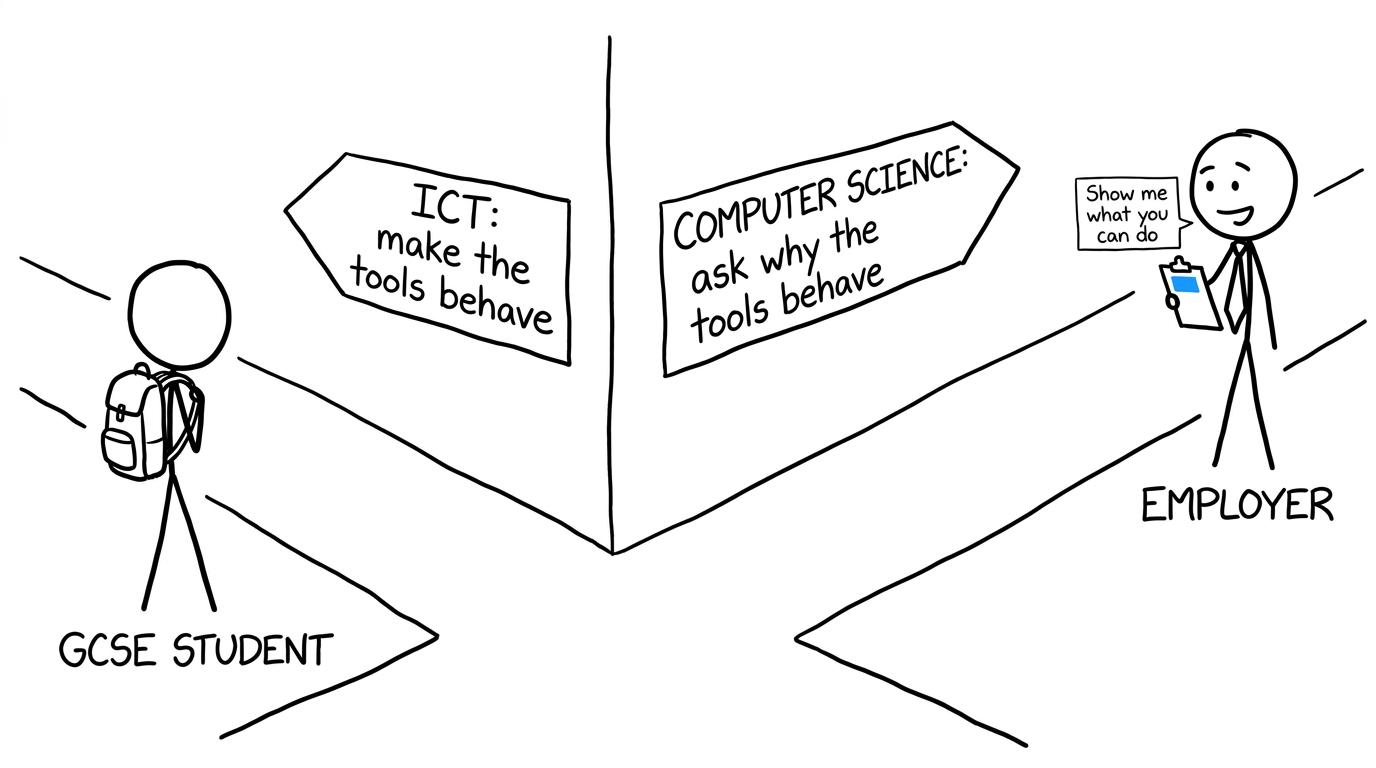 A student choosing between ICT and Computer Science while an employer asks for evidence of skills
ICT and Computer Science are not interchangeable
The names sound close because both involve computers. The thinking behind them is different.
What GCSE Computer Science teaches
Current GCSE Computer Science specifications from boards such as AQA, Pearson Edexcel, OCR and Eduqas commonly cover:
- computational thinking and problem-solving;
- algorithms and programming;
- data representation, including binary;
- computer hardware and software;
- networks and cyber security;
- Boolean logic;
- databases on some specifications;
- the ethical, legal and environmental effects of technology.
The course asks how computer systems work and how instructions can be designed, tested and improved. It therefore provides a recognisable foundation for later study in computing, software development and related technical subjects.
It is not simply a course in learning to code. Theory, written explanations and careful logical reasoning form a substantial part of the assessment.
What GCSE ICT represented
Traditional GCSE ICT concentrated more on applying digital tools, managing information and using technology in practical or organisational settings. Depending on the specification, students might have worked with documents, spreadsheets, databases, presentations and digital project planning.
In England, GCSE ICT was discontinued rather than reformed alongside the current GCSE Computer Science qualification. Someone who previously earned GCSE ICT still holds a valid qualification, but students choosing subjects today may instead encounter a vocational digital, information technology or creative media award.
This is why the label on an options sheet matters. A course casually called “ICT” may not officially be a GCSE. Across England, Wales and Northern Ireland, qualification systems and available courses can also differ. Ask for the full title and awarding organisation rather than relying on the classroom nickname.
England has announced plans for a broader computing GCSE for first teaching from September 202820282028. Final content and local availability should be checked closer to the time, especially if you are currently making options for a future cohort.
Which qualification do employers actually notice?
There is no universal employer ranking that says every GCSE Computer Science grade beats every ICT qualification. Employers recruit for different work.
For a software development apprenticeship, Computer Science is the more immediately relevant title because it suggests exposure to programming, algorithms and computational thinking. For an administrative or business role, applied experience with spreadsheets, databases and digital communication may be more directly useful.
The qualification title may help an application reach the right category. After that, employers can look for stronger evidence:
- the grade achieved;
- English and maths results;
- the relevance of later qualifications;
- projects or a portfolio;
- work experience and extracurricular activity;
- communication, teamwork and reliability;
- evidence that the applicant can learn unfamiliar systems.
A GCSE student should therefore avoid treating the choice as a contest in prestige. Computer Science usually carries the clearer technical meaning, but a title alone cannot demonstrate that you can write reliable code, analyse data or explain a decision.
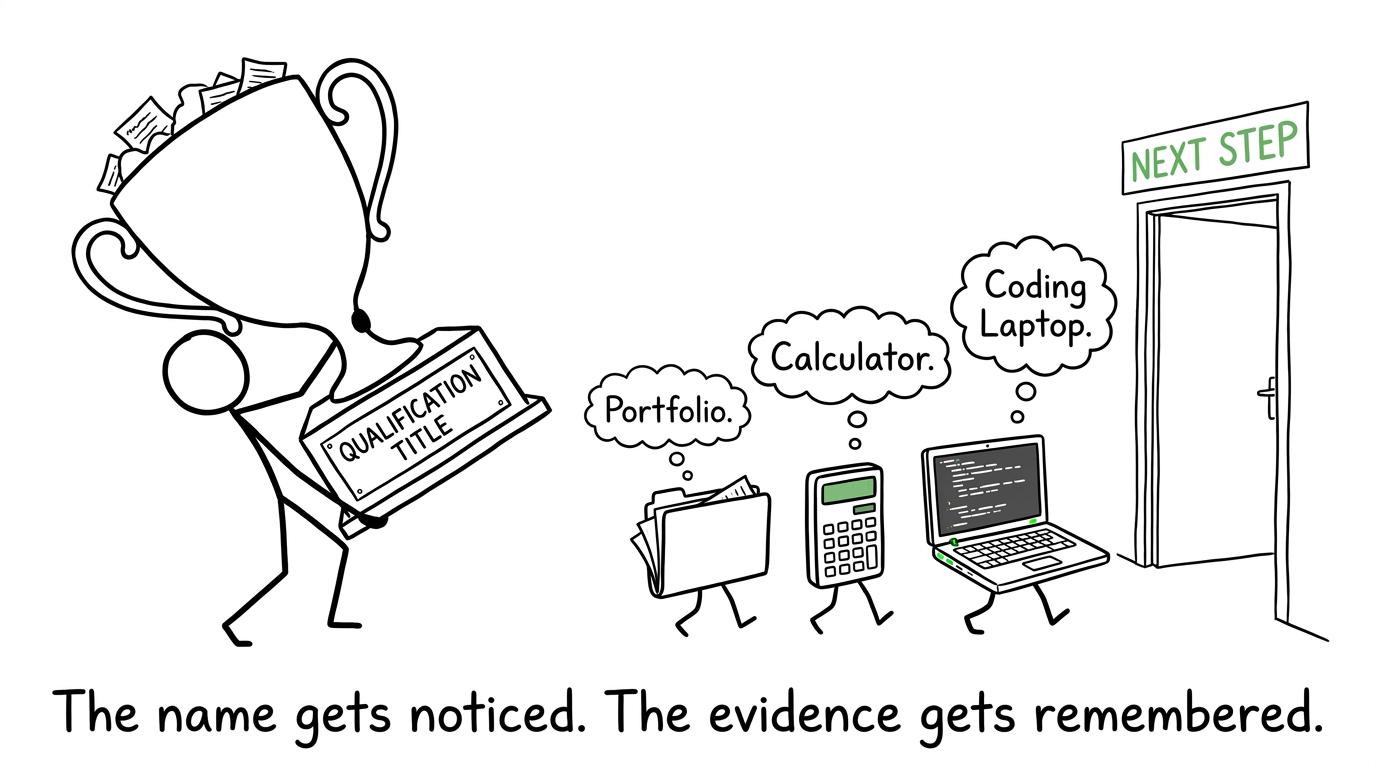 A giant qualification trophy loses a race to practical evidence, a calculator and a coding laptop
Do colleges care more about ICT or Computer Science?
Colleges care about suitability for the course you want to enter. Their published entry requirements vary considerably, so there is no national GCSE rule for admission to A Level Computer Science.
Some sixth forms ask for a particular GCSE Computer Science grade when the subject was taken. Others do not require the GCSE at all, provided that the student has a strong maths result, suitable programming experience or another relevant science grade. A college may also set general entry requirements covering English and maths.
That creates three sensible actions:
- read the current requirements for each college rather than assuming;
- ask how applicants without GCSE Computer Science are assessed;
- keep evidence of coding, logical problem-solving or digital projects if relevant.
MathsGenie’s guide to progression after GCSE Computer Science explains why local entry policies must be checked carefully.
For university, the pattern changes again. The most selective Computer Science degrees frequently place considerable weight on A Level Mathematics, and some expect Further Mathematics when a school offers it. GCSE ICT or Computer Science is not normally the central requirement by that stage. Course requirements vary, so students should always check current university pages before selecting A Levels.
Why your GCSE maths grade may matter more
Students sometimes focus on the word “computer” and overlook the quieter qualification beside it: maths.
Computer Science relies on structured reasoning. Variables, functions, logic, coordinates, powers, probability and interpreting data all develop habits that transfer into computing. Digital careers also extend well beyond programming into data analysis, engineering, cyber security, finance and technical research.
That does not mean every technology job requires exceptional mathematics. It means that a secure GCSE maths grade keeps more routes available. Colleges and apprenticeships frequently specify maths because it is a standard, comparable indication of quantitative readiness.
If technical computing interests you, strengthen these areas:
- algebra and rearranging relationships;
- powers and standard form revision;
- ratio and rates;
- graphs and interpreting trends;
- probability revision;
- multi-step problem-solving;
- checking whether an answer is reasonable.
Start from the GCSE Maths revision hub, or choose board-specific material for AQA GCSE Maths and OCR GCSE Maths. Matching your exam board and foundation or higher tier keeps your practice aligned with the correct specification.
How to choose the right course for you
The strongest choice is not automatically the qualification that sounds most impressive. It is the one that connects your interests, likely performance and intended next step.
Choose Computer Science if you enjoy
- solving logical problems;
- understanding what happens inside a computer;
- writing, tracing and debugging programs;
- algorithms and precise instructions;
- theoretical explanations as well as practical coding.
Consider an ICT or digital qualification if you enjoy
- applying software to realistic tasks;
- organising and presenting information;
- creating digital products;
- thinking about how organisations use technology;
- practical project work.
Assessment style matters too. Read the specification and sample assessments. Ask how much programming, written theory, coursework or controlled assessment is involved. A course can be useful and still be the wrong fit for the way you prefer to learn.
Then examine your wider workload. A balanced set of strong GCSE results is usually more useful than choosing a fashionable subject and allowing several grades to fall.
Turn either qualification into evidence
Employers notice evidence because it reduces uncertainty. You do not need to build a complicated application or claim professional expertise. A small, well-explained project can show more than a vague list of interests.
Useful evidence might include:
- a short program with clear documentation;
- a spreadsheet model designed for a genuine purpose;
- a database or data visualisation project;
- participation in a coding club or digital competition;
- a brief explanation of how you tested and improved a project;
- relevant work experience or volunteering.
Be honest about what you completed yourself. Explain the problem, your decisions, the obstacles and what you would change. That combination demonstrates technical curiosity and communication.
The same principle applies to maths revision. One completed paper, carefully marked and corrected, tells you more than several hours of passive reading. MathsGenie’s guide to finding weak GCSE topics shows how to turn lost marks into a focused practice list.
Common mistakes when comparing ICT and Computer Science
Assuming ICT is still a current GCSE everywhere
In England, the traditional GCSE was discontinued. Confirm whether the available course is a GCSE, Technical Award, BTEC or another Level 111 or Level 222 qualification.
Believing Computer Science guarantees a technology career
It is a useful foundation, not a job guarantee. Later qualifications, practical skills, grades and experience carry increasing weight.
Ignoring maths and English
These subjects are commonly included in college, apprenticeship and employment requirements. A technical GCSE does not replace them.
Choosing by reputation rather than content
Computer Science includes substantial theory and written assessment. ICT-style qualifications are not merely “easy computer use”. Read the actual specification and assessment structure.
Treating one college’s rule as a national rule
One sixth form may require GCSE Computer Science; another may accept strong maths and evidence of programming. Requirements can change between application cycles.
Revising only the subject connected to your future career
Your complete GCSE profile matters. Build a realistic schedule using the GCSE one-month maths revision plan, then introduce past papers at the right stage.
The qualification opens the conversation
So, which do employers and colleges care about more? Computer Science is generally the more recognisable preparation for technical computing. ICT and current digital qualifications can still demonstrate valuable applied skills, particularly when they match the role. Neither operates in isolation.
Your next step matters more than winning an argument over subject names. Check the exact course, protect your English and maths grades, investigate local entry requirements and create evidence of what you can do.
MathsGenie can help you strengthen the part of that plan that repeatedly appears in college and apprenticeship requirements. Begin with free revision lessons, practise with topic questions, check your reasoning against mark schemes and video solutions, then build confidence through mini tests, past papers and predicted papers. Choose one weak maths topic today and make the next application stronger than the last.











