A-Level After GCSE Computer Science: What Next?
A-level after GCSE Computer Science: compare entry grades, course content and subject combinations to make a confident, informed sixth-form choice.

Results day can make a carefully considered plan feel surprisingly fragile. One grade appears on the screen or page, and suddenly you are asking whether your next step is still possible.
If you are choosing an A-level after GCSE Computer Science, the short answer is this: A Level Computer Science is the most direct progression, but it is not automatically the best choice for everyone. Check your sixth form's entry grades, consider how much you enjoy programming and problem-solving, and think carefully about whether A Level Maths belongs in your combination.
Your result is useful evidence. It is not the whole decision.
Your results-day checklist
Before changing or confirming your options, check:
- the exact entry requirements published by your school or college
- your grades in GCSE Computer Science and Maths
- whether you enjoyed programming as well as computer theory
- which exam board and programming language the sixth form uses
- how the course is assessed, including any programming project
- whether possible university courses require A Level Maths
- whether your complete subject combination is realistic and enjoyable
Start by comparing your result with the GCSE grade boundaries, but remember that boundaries describe past exam series. Your awarded grade, not a previous boundary, is what matters for admission.
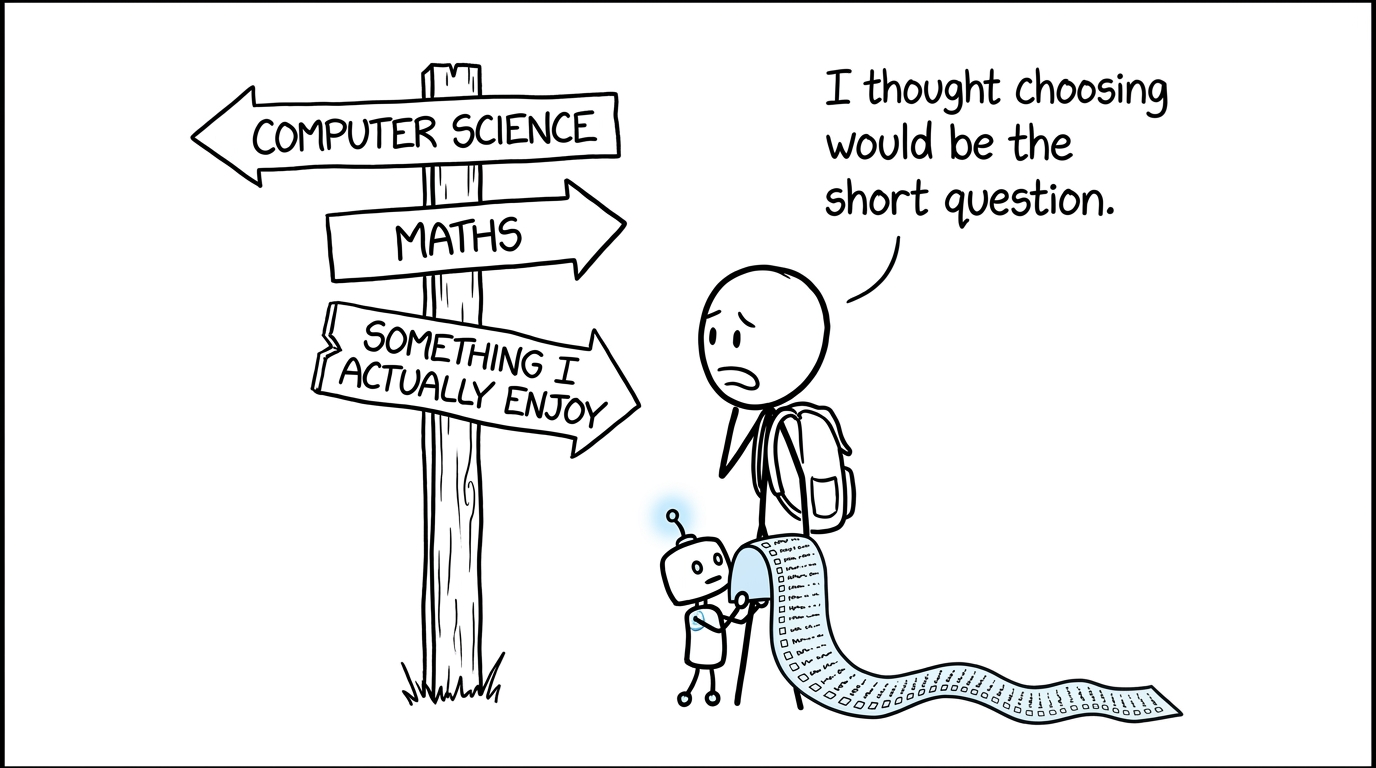 A student discovers that choosing A-levels is not the short question
What grades do you need for A Level Computer Science?
There is no single national GCSE threshold. AQA states that its A Level Computer Science specification has no formal previous-learning requirement, while OCR also sets no prior qualification requirement. Schools and colleges decide their own admissions rules.
Current sixth-form requirements vary considerably. Some ask for grade 555 in GCSE Computer Science and Maths, many ask for grade 666, and more selective courses may set a higher threshold. Some accept students who did not take GCSE Computer Science if they can demonstrate suitable mathematical, logical or programming skills.
Use these as decision-support bands rather than national rules:
| GCSE position | Sensible next action |
|---|---|
| Grade 666 or above in Computer Science and Maths | You are likely to meet many published subject requirements, but verify your chosen provider's rules. |
| Grade 555 in one or both subjects | Some providers will accept this; others require grade 666 or above. Ask before changing your options. |
| Below grade 555 | Speak to the course leader about flexibility, resits or an alternative Level 333 route. |
| No GCSE Computer Science | You may still be eligible because the exam specifications do not require it, but local entry rules apply. |
If Maths is the grade causing uncertainty, use the GCSE Maths revision hub to identify gaps rather than treating the grade as a judgement on your potential.
What changes from GCSE Computer Science to A Level?
Moving from GCSE Computer Science to A Level means going deeper, not merely learning more syntax.
A Level specifications cover programming, data structures, algorithms, computer architecture, networks, databases, data representation and the legal, moral and ethical effects of technology. You will be expected to analyse unfamiliar problems, justify decisions and evaluate solutions. Programming requires greater independence, while theory answers demand accurate terminology and developed reasoning.
The official subject content also requires at least 10%10\%10% of assessment to test mathematical skills. These include Boolean algebra, number bases and, at A Level, comparisons of algorithmic complexity. MathsGenie's A Level Computer Science mathematical skills guide gives you a useful preview.
For a broader picture of lessons and topics, explore the AQA A Level Computer Science overview. If your prospective sixth form follows OCR, the OCR A Level Computer Science past papers show the style and depth of assessment you are moving towards.
Should you choose A Level Maths as well?
Computer Science and Maths are a strong combination because both reward abstraction, logic and systematic problem-solving. However, A Level Maths is not universally required for A Level Computer Science. Your sixth form may recommend it, require it or allow Computer Science without it.
The longer-term question matters more. University entry requirements vary, but theoretical and highly selective Computer Science degrees often require A Level Maths. A Level Computer Science itself is less commonly an essential university requirement. If a computing degree is a serious possibility, examine several current university course pages before finalising your subjects.
Choose A Level Maths only if you meet the local threshold and are prepared for the step up in algebra, functions, trigonometry, calculus, statistics and mechanics. You can inspect that progression through the A Level Maths revision hub.
A balanced combination might include Computer Science, Maths and a subject you genuinely enjoy. Physics can complement mathematical modelling; Business or Economics can support commercial interests; a humanities subject can strengthen extended writing and evaluation. There is no universally perfect trio.
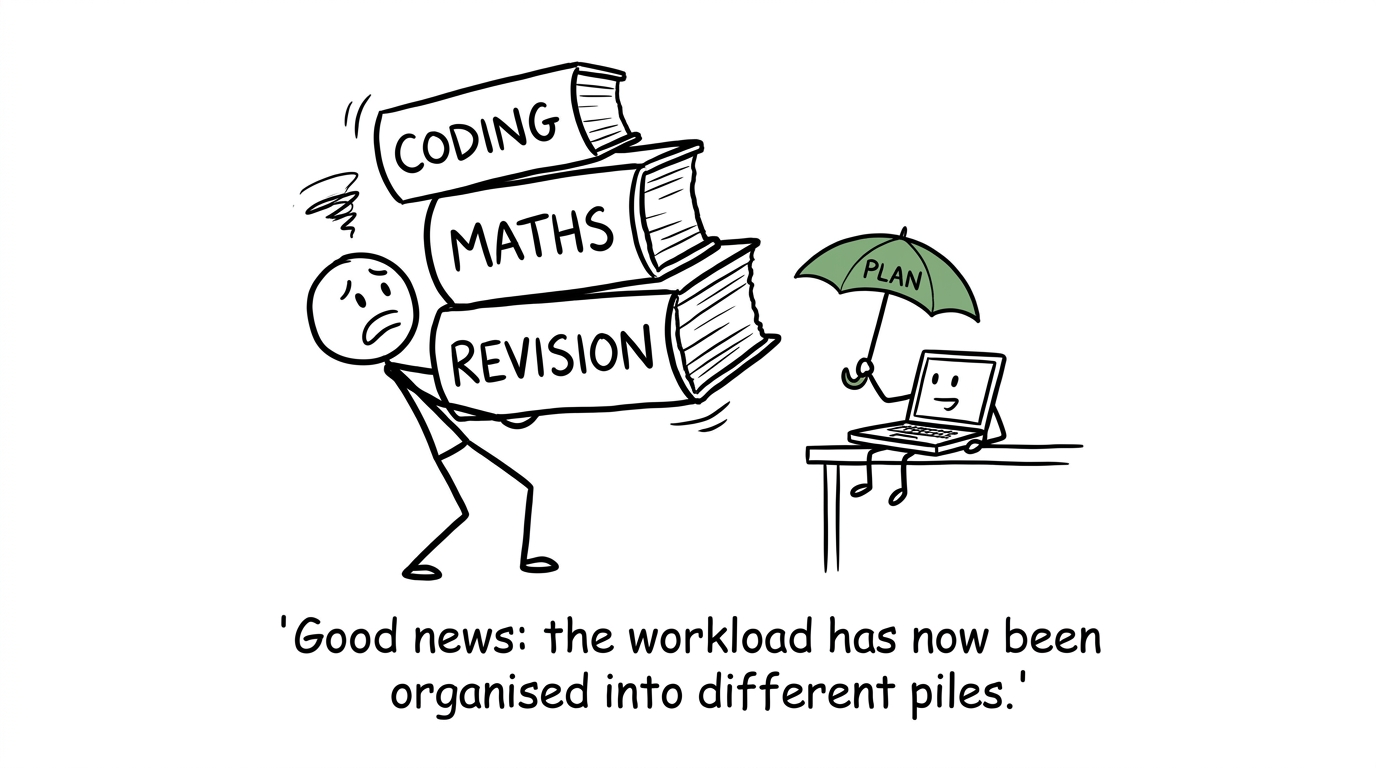 A student's carefully organised piles of coding, maths and revision
Is choosing A Level Computer Science right for you?
Choose it because you enjoy the underlying work, not simply because technology sounds employable.
A good sign is that you like tracing algorithms, debugging programs, understanding why systems behave as they do and persisting when a solution fails initially. You do not need to be an expert programmer on day one. You do need to be willing to practise regularly.
Before enrolling, review the programming and computational-thinking topics on the OCR GCSE Computer Science revision page. Then preview an A Level topic such as the processor structure revision guide. The difference in depth is more informative than the course title.
Common mistakes when choosing your A-levels
Assuming one national grade threshold applies
Exam boards define course content, but schools and colleges set entry requirements. Always check the provider's current prospectus and speak to its admissions team.
Choosing Computer Science because you enjoy using computers
Using software and studying computer science are different experiences. The A Level involves programming, abstraction, technical theory and sustained problem-solving.
Ignoring A Level Maths requirements for university
Some Computer Science degrees require Maths even when they do not require Computer Science. Researching this after starting Year 131313 may be too late to change your combination.
Building an impressive but unmanageable timetable
Computer Science, Maths, Further Maths and Physics can be coherent, but coherence does not guarantee balance. Three well-chosen subjects usually serve you better than an overloaded programme.
Treating a disappointing result as a final verdict
A grade may affect immediate entry, but alternatives can include discussing flexibility, improving programming evidence, resitting a required GCSE or taking another suitable Level 333 qualification.
Make the next decision from evidence
Results day feels decisive because it compresses years of work into a few symbols. Yet choosing A Level Computer Science is not a reward for one grade. It is a commitment to the kind of problems you want to keep solving.
Check the threshold. Preview the content. Research future requirements. Then choose the combination you can sustain.
Start with MathsGenie's AQA A Level Computer Science overview, then use the free revision lessons, practice questions, past papers, mark schemes and video solutions to see what the course genuinely involves. If Maths is part of your plan, predicted papers, mini tests and structured revision resources can help turn today's uncertainty into a practical next step.