GCSE ICT Time Pressure Mistakes to Avoid
GCSE ICT time pressure mistakes explained: avoid misreading questions, weak working and rushed checks when completing timed GCSE maths papers.
The clock changes how a question feels. A calculation you could complete comfortably at home suddenly looks unfamiliar. You hurry, skip a line and discover too late that the question asked for a percentage rather than an amount.
The most damaging GCSE ICT time pressure mistakes are rarely dramatic. They are small leaks: misreading an instruction, spending too long on one question, hiding useful working or checking only the hardest answers. Although GCSE ICT was discontinued in England, students still use the name informally for Computer Science, digital and vocational IT qualifications. More importantly, the exam habits behind these mistakes transfer directly to GCSE maths.
This guide explains how to protect easy marks when the clock is running, whether you take foundation or higher tier with Edexcel, AQA, OCR or Eduqas.
Your quick time-pressure checklist
Before looking at each mistake in detail, remember this short routine:
- Read the command word and the final instruction.
- Use the number of marks to judge the likely depth required.
- Write enough working for another person to follow.
- If you cannot make progress, leave space and return later.
- Keep exact values until the final stage unless told otherwise.
- Check units, rounding, signs and the required form.
- Attempt every question you reasonably can.
- Practise these habits with a visible timer before the real exam.
The purpose is not to move frantically. It is to make fewer poor decisions per minute.
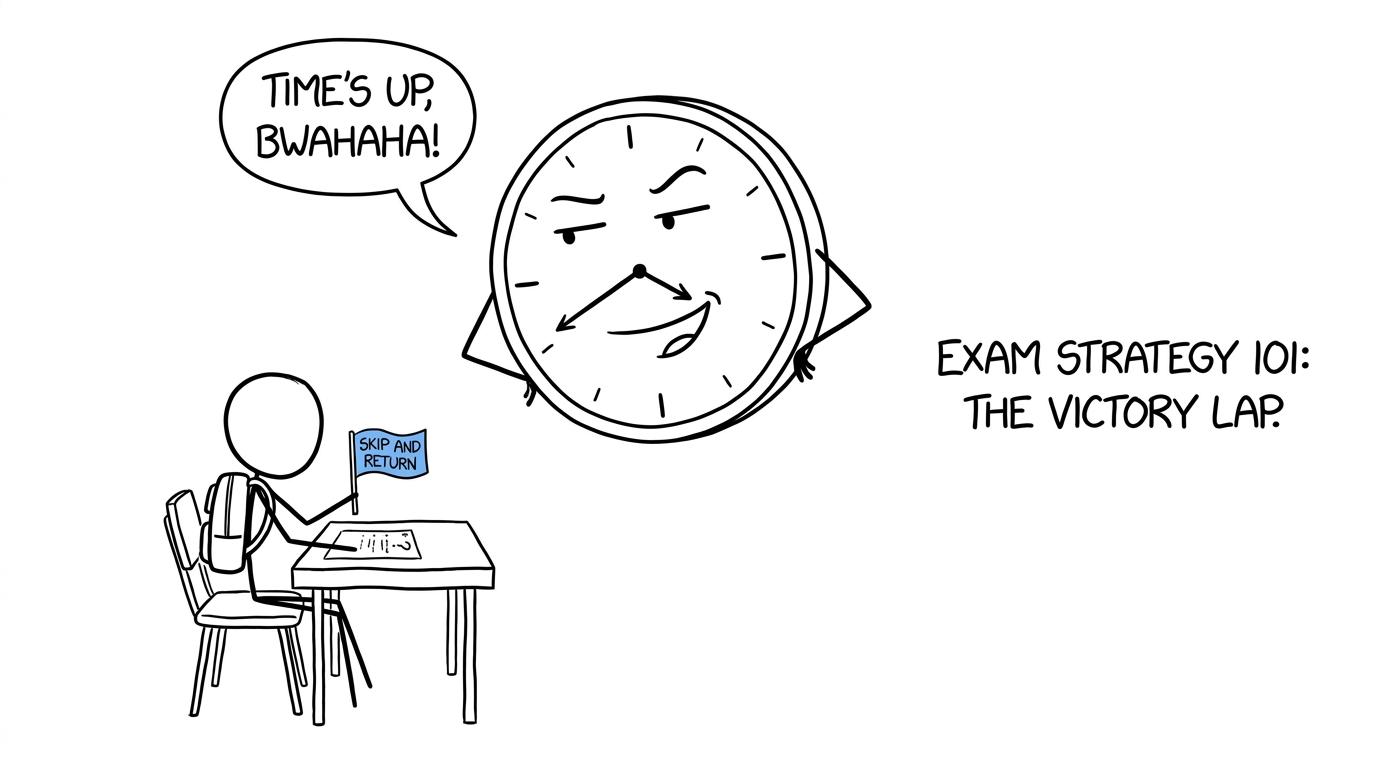 A student calmly using skip and return while racing an exam clock
Why time pressure causes avoidable mistakes
Knowing maths and displaying maths are different skills. Revision builds knowledge; timed practice trains retrieval, selection and communication while attention is limited.
Under pressure, students often narrow their focus. They see a familiar diagram and begin the method they expected before reading the final sentence. Others become trapped by one difficult question because leaving it feels like giving up. In reality, moving on is often an intelligent allocation of limited time.
Official GCSE papers also contain different command words and answer requirements. Calculate, show that, estimate, prove and write down do not ask for identical responses. The whole question matters, not merely the topic it resembles.
This is why the MathsGenie guide to using past papers properly recommends a cycle of completing, marking, diagnosing, repairing and retesting. A timed paper becomes valuable when it changes what you do next.
Common mistakes students make when the clock is running
Answering the question they expected
A student recognises a circle, ratio or quadratic and immediately begins a familiar procedure. The method may be flawless but irrelevant because the question requested something slightly different.
Protect yourself by underlining or mentally isolating three things:
- the command word;
- the object you must find;
- the required form of the answer.
For example, a question might require an exact value rather than a decimal, a probability rather than a frequency, or the size of an exterior angle rather than the interior angle shown most prominently.
After calculating, reread the final sentence. This takes seconds and can save an entire chain of marks.
Spending too long on one difficult question
Persistence is useful in revision. In an exam, persistence without a stopping rule can become expensive.
If you have made no meaningful progress after a short attempt, circle the question number, leave usable working and move on. Return after banking more accessible marks. This is particularly important near the end of a higher-tier paper, where one demanding problem can absorb time that could secure several marks elsewhere.
Do not abandon a question at the first sign of difficulty. Write a relevant formula, label a diagram, substitute known values or state an intermediate result if appropriate. Then make a deliberate decision.
Short timed practice, such as the Edexcel GCSE maths mini tests, helps you learn when to continue and when to return later.
Writing only the final answer
A correct answer is welcome, but visible working can matter when an error appears later in a multi-stage solution. If your page contains only calculator output, there may be little evidence of a valid method.
Write the structural steps: the formula, substitution, rearrangement and conclusion. Avoid filling the page with disconnected arithmetic, but do not make the examiner guess what you did.
For instance, if a method depends on percentage change, the relationship should be visible:
percentage change=changeoriginal amount×100\text{percentage change}=\frac{\text{change}}{\text{original amount}}\times 100percentage change=original amountchange×100That is not about making an answer longer. It is about making the reasoning inspectable.
Rounding before the calculation is finished
Early rounding creates errors that grow through later steps. Keep full calculator values during intermediate stages and round once at the end, unless the question explicitly instructs you otherwise.
If a value is exact, keep it exact where possible. Expressions involving π\piπ, roots or fractions often lose accuracy when converted prematurely. A final instruction such as “give your answer to three significant figures” belongs at the end of the process.
Your last line should also show the requested accuracy clearly. Writing 4.704.704.70 can communicate something different from writing 4.74.74.7 when a specified number of decimal places is required.
Forgetting units or using the wrong units
Time pressure makes units seem decorative. They are not.
Check whether the question involves length, area, volume, speed, density or money. Area units are squared, such as cm2\text{cm}^2cm2, while volume units are cubed, such as m3\text{m}^3m3. If measurements use different units, convert them before applying a formula.
A quick dimensional check can also reveal an implausible method. Multiplying two lengths should produce an area, not another length.
Trusting calculator input without checking it
A calculator follows the keys pressed, not the method intended. Missing brackets, an incorrect negative sign or a mistyped power can turn sound reasoning into a wrong answer.
Before moving on, compare the result with a rough estimate. If the calculation is
19.8×5.12.02,\frac{19.8\times 5.1}{2.02},2.0219.8×5.1,you do not need an exact parallel calculation to notice that the result should be near
20×52=50.\frac{20\times 5}{2}=50.220×5=50.This is a reasonableness check, not a full worked solution. It tells you whether to inspect the calculator entry again.
Leaving long questions until the final seconds
Some students complete every short question slowly, then reach an extended problem with almost no time remaining. Others begin with the longest question and lose confidence immediately.
A better approach is to scan naturally as you progress and notice where the larger-mark questions sit. Your exam board’s structure should not be a surprise. Practise with papers matching your specification, tier and calculator rules.
Use the Edexcel GCSE maths past papers or OCR GCSE maths past papers to rehearse complete-paper pacing. The GCSE maths revision hub also lets you select resources for your board rather than practising against an unfamiliar format.
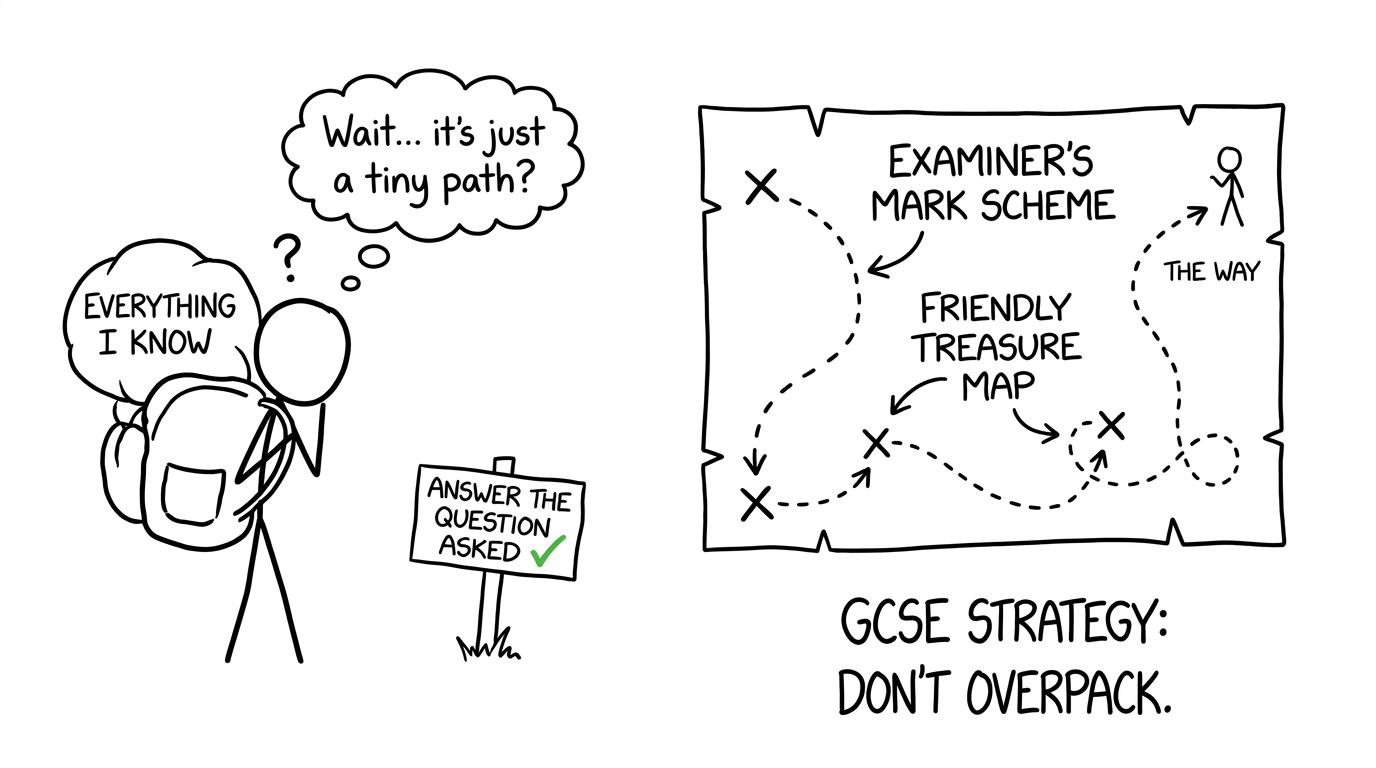 A mark scheme treasure map pointing towards the question actually asked
Checking difficult answers but ignoring easy ones
When students have spare time, they often return to the hardest problem. That can be worthwhile, but easy questions are where rushed transcription errors, missing units and sign mistakes frequently hide.
Use a layered check:
- confirm that every question has been seen;
- inspect answer boxes, units and rounding;
- check negative signs, copied values and calculator entries;
- revisit flagged questions;
- attempt any remaining unfinished work.
A short check of accessible questions may protect more marks than another long attack on a problem that still has no clear route.
Letting one mistake affect the next question
Realising that an earlier answer may be wrong can consume attention long after you have turned the page. The paper then charges you twice: once for the original error and again through lost concentration.
Mark the question for review and reset. Each new question is a fresh opportunity. You can return if time allows, but you cannot recover minutes spent replaying the mistake internally.
How to train accuracy under time pressure
Timing improves through controlled exposure, not by doing every revision task as quickly as possible.
Begin with untimed topic practice so that the method is secure. Next, complete a short timed set. Finally, progress to full papers under the correct conditions. The MathsGenie twenty-minute revision routine is useful when a complete paper would be too large a starting point.
After each timed attempt, separate mistakes into categories:
- Knowledge: you did not know the required method.
- Selection: you chose the wrong method.
- Accuracy: the approach was right but the execution failed.
- Communication: working, units or justification were insufficient.
- Timing: you rushed, became stuck or did not reach the question.
Then fix the cause. A knowledge gap needs a revision lesson and targeted practice questions. A timing problem needs another timed set with a clear stopping rule. A communication problem needs comparison with the mark scheme or video solution.
The guide to finding your weakest GCSE topics can help turn a marked paper into a manageable revision list.
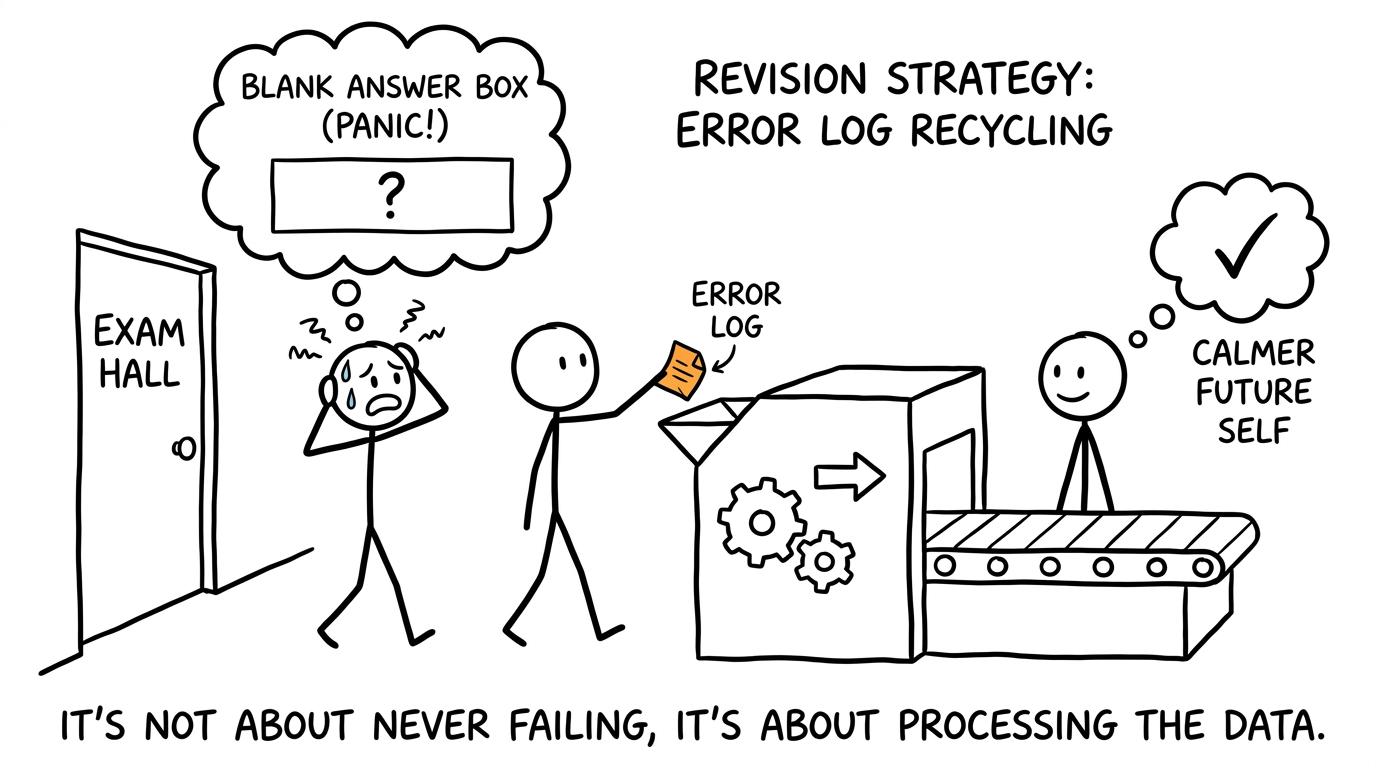 An error log recycling an exam mistake into a calmer future student
Build a calm paper routine before exam day
A reliable routine removes decisions when stress is highest.
Before the exam, confirm your board, tier and paper type. Follow the current instructions from your school and the front of the paper. During revision, use the same permitted equipment and complete papers without pausing the timer.
Nearer the examination, GCSE predicted papers can provide fresh rehearsal, but they should complement official past papers rather than replace them. Mark every attempt. Record why marks were lost, revise the relevant topic and test it again.
You can organise that work with the MathsGenie GCSE revision timetable guide, which combines topic learning with gradually increasing timed practice.
Turn pressure into a familiar condition
The clock does not create every weakness. It reveals which habits are not yet automatic.
Your aim is not to become a faster version of a panicked student. It is to become a calmer decision-maker: read fully, show the method, move on deliberately and check what is easiest to lose.
Start on MathsGenie with a free revision lesson for one weak topic. Complete the practice questions, then use mini tests to build pace. When the method feels secure, sit past papers and predicted papers under timed conditions, marking them with the available mark schemes and video solutions.
The next paper should not merely test you. It should teach you where your easiest marks are escaping and what to do before they escape again.