GCSE History Spec Changes: What Is Different Now?
GCSE history spec changes explained: discover what shifted in recent years, what changed for 2025 and 2026, and whether your older resources still work.
A revision guide can look perfectly useful until you notice the publication date. The facts may still be accurate. The exam advice may not be.
That is the practical issue behind GCSE history spec changes. The reformed GCSE introduced new course structures and grades 999 to 111, with current History qualifications generally taught from 2016 and first awarded in 2018. Since then, exam boards have updated terminology, assessment details, specified historic environments and, in Edexcel's case, parts of the assessment model and content.
The short answer is simple: older resources are not automatically useless, but they must be checked against your current exam board specification. A textbook can teach sound history while preparing you for the wrong question structure, topic boundary or historic site.
Your quick specification checklist
Before using any History revision resource, confirm:
- your exam board: AQA, Pearson Edexcel, OCR or Eduqas
- the exact specification and option codes studied by your school
- your exam year
- the topics included in each paper
- the current question wording, marks and timings
- whether your course includes a specified historic environment or site
- whether the resource reflects permanent rules rather than temporary pandemic arrangements
This is the same habit that protects your maths revision. A Foundation paper, a Higher paper and an old-spec paper may all contain algebra, but they do not prepare you for the same assessment. MathsGenie's GCSE maths revision hub lets you choose current resources by board and level rather than revising from an unidentified worksheet.
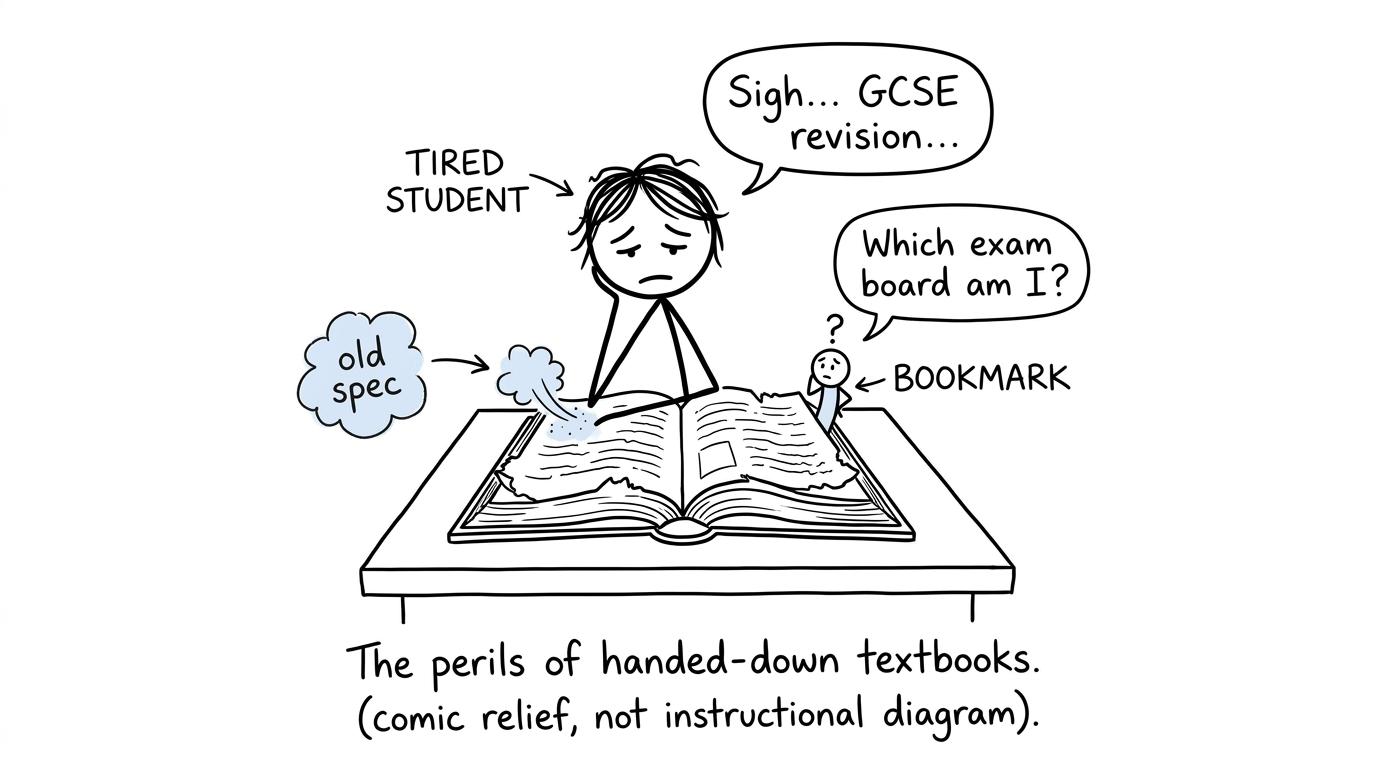 A student discovers that an old-spec revision book has forgotten which exam board it belongs to
The biggest change happened with GCSE reform
A resource from the early 2010s may belong to the previous GCSE, not merely an earlier edition of today's course. That distinction matters.
In England, reformed GCSE History courses were introduced for first teaching in 2016 and first awarded in 2018. They use grades 999 to 111 rather than the former letter grades. The qualifications are linear, so assessment takes place at the end of the course rather than through modular examinations taken along the way.
The national subject content expects substantial chronological range and several kinds of study. Depending on the board's structure, students encounter combinations of:
- a thematic study covering change over a long period
- a period study
- a British depth study
- a non-British or wider-world depth study
- a study connected with the historic environment
Exam boards package these requirements differently. AQA, for example, currently assesses two equally weighted papers: Understanding the Modern World and Shaping the Nation. Its course includes a period study, a wider-world depth study, a thematic study and a British depth study incorporating the historic environment.
This means an old textbook headed simply “GCSE History” is not specific enough. Its subject may overlap with your course, but its breadth, depth and assessment guidance may belong to another qualification.
What has changed since the reformed course began?
Not every board has replaced its entire specification. Recent change has more often involved targeted amendments: clearer wording, revised assessment instructions, updated historic sites or adjustments to particular questions.
Edexcel changes for 2025 and 2026
Pearson Edexcel has made the most visible recent sequence of changes.
For examinations from summer 2025, it introduced assessment-model amendments. Pearson's summary guidance records longer papers: Paper 1 increased from 111 hour 151515 minutes to 111 hour 202020 minutes, Paper 2 from 111 hour 454545 minutes to 111 hour 505050 minutes, and Paper 3 from 111 hour 202020 minutes to 111 hour 303030 minutes. Students using an old timing plan could therefore practise at the wrong pace.
Edexcel also revised some language from 2025 to replace outdated or problematic terminology. Pearson states that these language amendments did not change the historical content, but students should still learn and use the terminology expected by the current specification and their teachers.
For first assessment in summer 2026, Edexcel introduced minor content amendments across many options. Pearson describes three broad kinds of change:
- rewording content to clarify its intended focus
- moving content to create a more logical sequence
- simplifying content by removing unnecessary detail
Pearson also states that no new content was added and that published resources were not made obsolete. That is reassuring, but it is not permission to ignore the update. A resource can remain broadly useful while containing detail that is no longer required or organising a topic differently from the live specification.
Historic environments can change by exam year
Some boards prescribe a historic environment or site for particular examination years. AQA publishes designated sites for its British depth studies, while Eduqas updates historic site studies for specified assessment periods.
The underlying thematic knowledge may remain stable, but the place through which it is examined can change. Notes on a previous site can help you understand the broad theme; they cannot replace revision of the site named for your own exam series.
Eduqas has also updated guidance and sample materials connected with its thematic-study historic-site questions. Its recent guidance allows greater flexibility in question setting, making it risky to depend on memorised answers built around one old wording.
Temporary arrangements were not permanent reforms
Students also encounter papers and videos produced around the pandemic. Examinations were cancelled in 2020 and 2021, while exceptional support and assessment arrangements applied in later series, including advance information in 2022.
Those arrangements should not be assumed to apply now. A video promising advance notice of topics may be accurate for the year shown and completely wrong for your exam. Always distinguish a temporary exam-year arrangement from a permanent specification amendment.
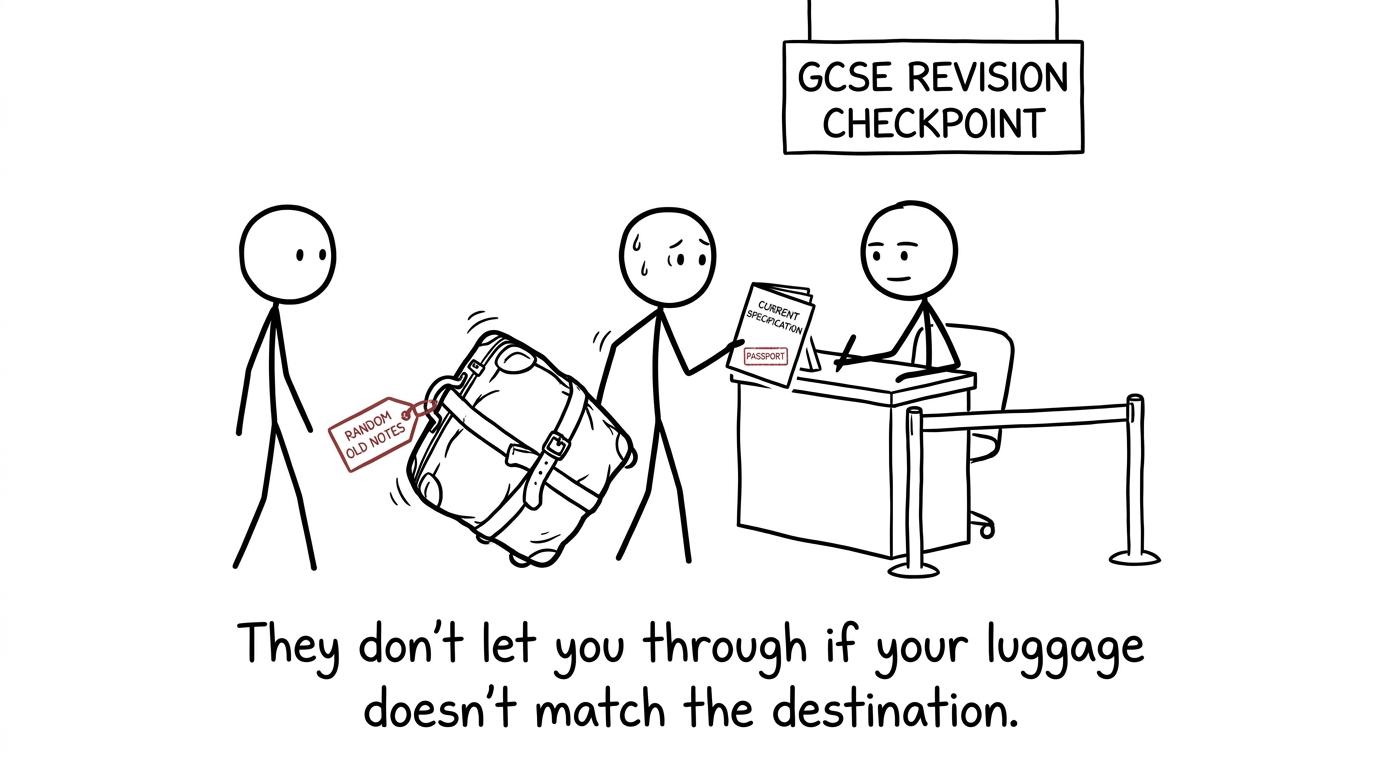 Revision folders pass through a checkpoint where the current specification acts as a passport
Why older History resources can still be valuable
Specifications change faster than many historical facts. A clear explanation of the causes of the First World War does not suddenly become false because a paper gains extra time. Older resources can still support:
- factual knowledge that remains within the current topic
- chronology and connections between events
- interpretations and source-analysis practice
- retrieval questions on content that is still required
- wider context that makes the specified material easier to understand
The danger lies in treating the resource as a complete map. It may omit a current subtopic, include removed detail, use superseded terminology or teach an outdated answer structure.
A useful rule is to separate knowledge resources from assessment resources. Older books may remain strong for knowledge. For question types, timings, command words and mark-scheme expectations, prioritise current specifications, specimen materials and recent official papers.
Maths students already face the same choice. An old worksheet can provide extra practice, but current GCSE past-paper guidance explains why board-matched, timed work should become more important as exams approach.
How to audit an older revision guide
Start with the current specification rather than the guide. Your teacher or school should confirm the board, options and examination year.
Check the cover and contents
Look for the board name, specification code, publication date and stated examination years. “Suitable for GCSE” is not enough. Schools choose different options even when they use the same board.
Compare every chapter with the current specification. Mark each section:
- current: directly required
- useful context: relevant but beyond the stated content
- outdated: linked to an old question or topic arrangement
- missing: required now but absent from the resource
Check assessment advice separately
Examine any claims about paper length, marks, compulsory questions, source booklets and recommended answer structures. Verify them using the live specification and current sample assessment materials.
Do not assume that a model answer's paragraph count is an official rule. Mark schemes reward demonstrated knowledge, analysis and judgement according to the question; they rarely reward a formula merely because it has a memorable name.
Add a visible warning to old materials
Write the exam year and any limitations on the front. A note such as “knowledge only; check 2026 question format” prevents a useful resource from quietly becoming your main source of exam advice.
This kind of organisation is valuable across subjects. MathsGenie's one-month GCSE revision plan shows how diagnosis, topic practice and current papers can work together, while the GCSE maths revision timetable helps turn those checks into a repeatable weekly routine.
Build revision around the live course
The specification is a boundary, not a revision method. Once you know what belongs inside it, use a simple cycle:
- retrieve a small section from memory
- compare your recall with reliable notes
- answer a current exam-style question
- mark it using the relevant mark scheme
- record the exact knowledge or reasoning you missed
- return to that weakness after a gap
Do not spend the whole session rewriting content because an older textbook contains more pages. More detail can feel safer, but unselected detail consumes time that could be spent practising analysis and judgement.
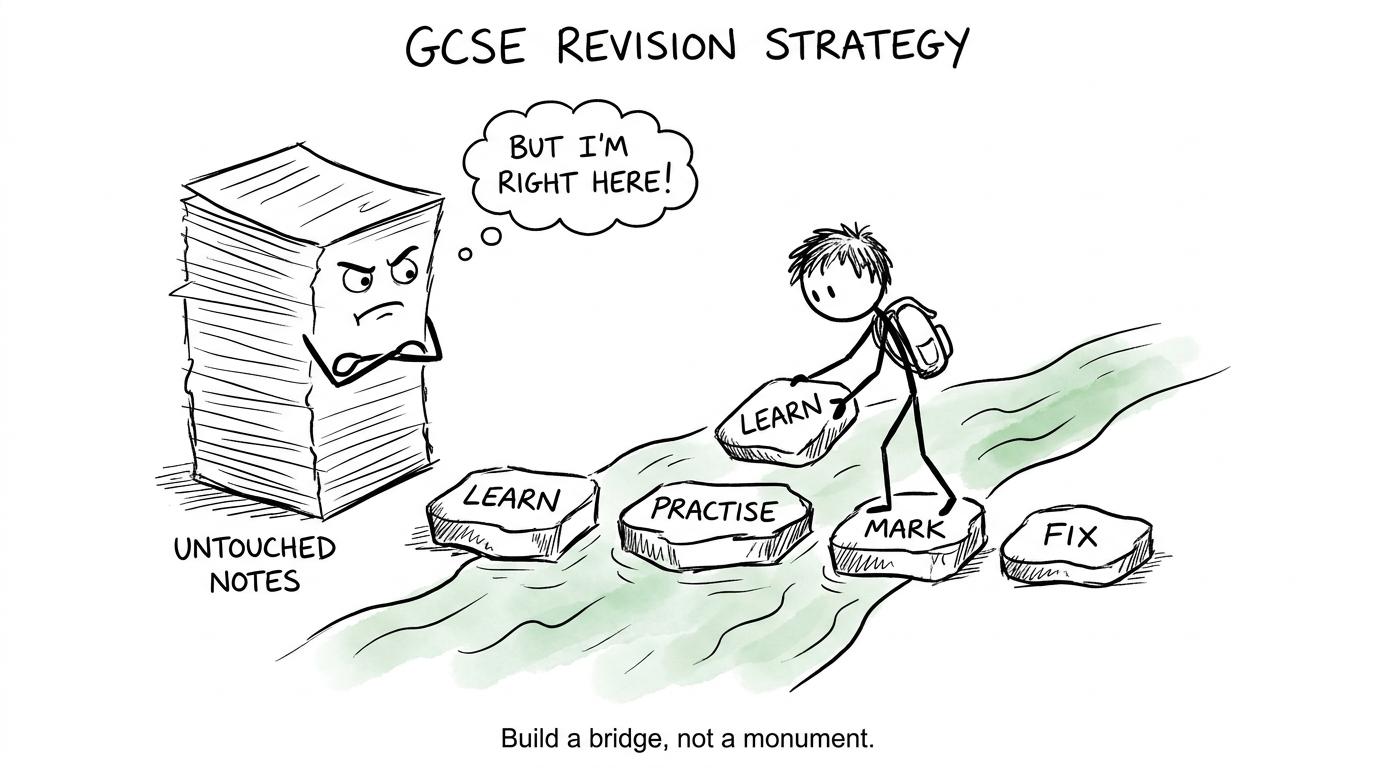 A practical revision bridge defeats an enormous but untouched stack of notes
For maths, the same learn, practise, mark, and fix loop is built into MathsGenie's free lessons and questions. If time is short, use the one-week GCSE maths revision plan rather than opening resources at random. The night-before GCSE maths plan is designed for calm checking, not an unrealistic attempt to relearn an entire course.
Common mistakes when using older resources
Assuming the title guarantees a match
The same historical period can appear on different boards with different date ranges, content statements and question types. Match the exact board and option.
Revising a previous historic site
A former site may provide context, but it is not a substitute for the site specified for your examination year.
Learning obsolete timings
This is particularly important for Edexcel students because paper timings changed from summer 2025. Build timed practice around the current papers.
Treating pandemic support as a normal feature
Advance information and other exceptional arrangements were tied to particular series. Check current instructions rather than relying on an old video title.
Throwing away every old book
This wastes sound explanations and useful retrieval material. Audit old resources; do not trust or reject them solely because of age.
Using unofficial predictions as the specification
Predictions can provide fresh practice, but they cannot change what the board is permitted to assess. In maths, MathsGenie's predicted resources are best used alongside official past papers, mark schemes and topic revision; never as a replacement for full-course preparation.
Make the specification work for you
Specification changes matter because revision time is limited. The goal is not to own the newest-looking book. It is to know that every session prepares you for the course and paper you will actually sit.
Confirm your board, options and exam year. Keep older explanations where they still match. Replace outdated timings and question advice. Then practise with current assessment materials until the format feels familiar.
For your maths exams, begin at the MathsGenie home page or open the free GCSE maths revision hub. Use revision lessons and practice questions to repair weak topics, mini tests to check recall, and past papers, predicted papers, mark schemes and video solutions to sharpen exam technique. A current map does not do the walking for you, but it stops you spending valuable time on the wrong road.