

GCSE History Predicted Grades Accuracy Explained
GCSE history predicted grades accuracy explained: discover how reliable forecasts are, why final results differ and what you can control before exams.
A predicted grade can feel strangely permanent. It appears on a report, sits beside your name and quietly begins to look like a verdict. Yet GCSE history predicted grades accuracy is more limited than that impression suggests. A predicted grade is an informed estimate based on the evidence available at the time. It is not a result, a ceiling or a guarantee.
Research into GCSE forecasts across subjects suggests that teachers often identify a student's general level reasonably well, but exact grades are much harder to predict. An Ofqual literature review reported that approximately 43%43\%43% of OCR GCSE forecast grades in a 2014 study were exactly correct, while 87%87\%87% were within one grade. That is useful accuracy for planning, but not enough to tell an individual student precisely what will happen on results day.
For a maths student who is worried about predicted grades in any subject, the practical lesson is reassuring: treat the prediction as evidence, then build better evidence.
GCSE predicted grades at a glance
- A predicted grade is an estimate of likely future performance, not an awarded GCSE result.
- Schools may use mock exams, class assessments, homework and teacher judgement, but their methods can differ.
- Exact predictions are difficult because exam performance, revision and grade boundaries can change.
- Research across GCSE subjects suggests forecasts are often within one grade, but this does not guarantee accuracy for History or for an individual student.
- History can be particularly sensitive to question choice, written analysis, source evaluation and timing.
- The most productive response is to identify the marks currently being lost and practise the skills responsible for them.
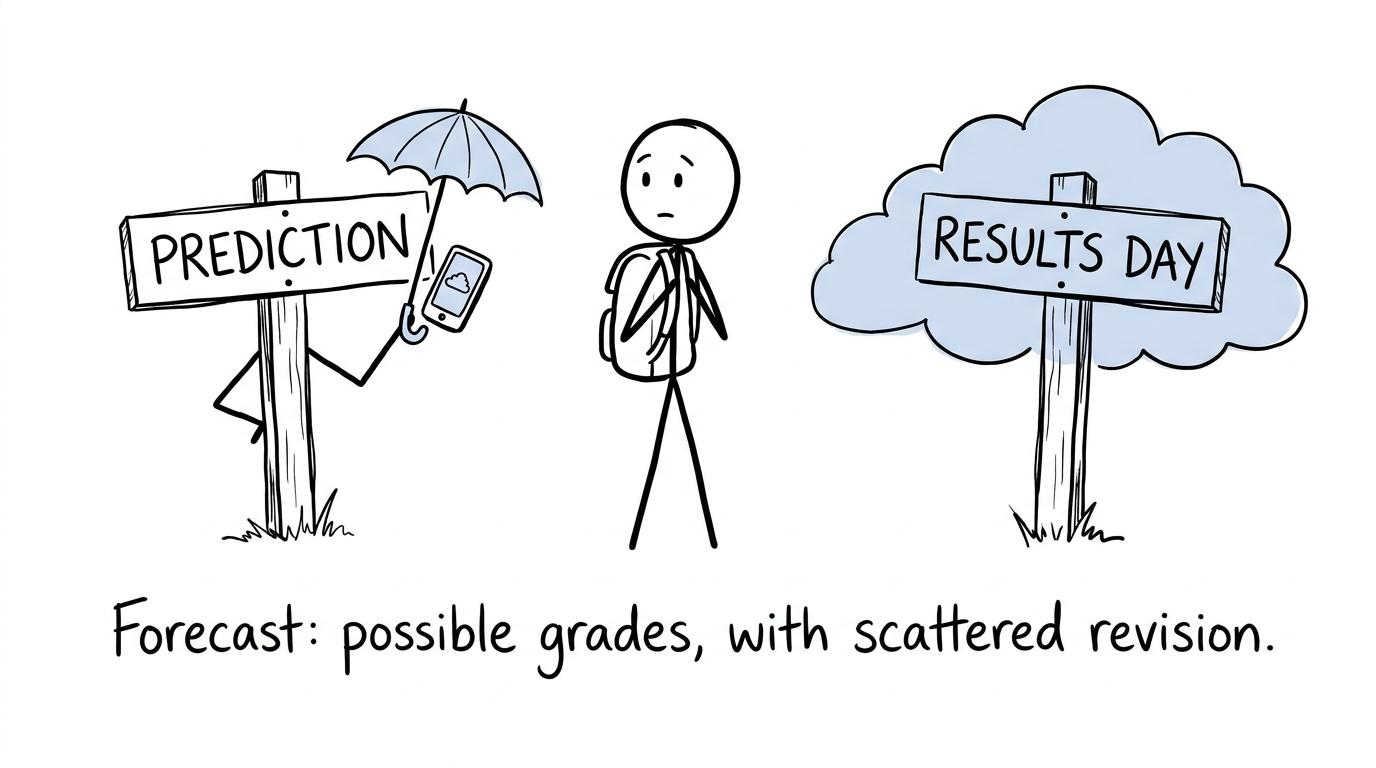 A student watches a predicted-grade weather forecast
How reliable are GCSE History predicted grades?
The honest answer is: useful, but uncertain.
There does not appear to be a recent, nationally representative figure that isolates the exact accuracy of current GCSE History predictions across AQA, Edexcel, OCR and Eduqas. It would therefore be misleading to claim that a particular percentage of History predictions will match final results.
The broader evidence gives us a more careful conclusion. Ofqual's review of prediction research found exact accuracy commonly ranging from about 42%42\%42% to 52%52\%52% in studies of individual grades. When a tolerance of one grade was allowed, accuracy was at least 85%85\%85% in the literature reviewed. The OCR GCSE study mentioned earlier found 43%43\%43% exact accuracy and 87%87\%87% accuracy within one grade across subjects.
Those figures come from older forecast-grade evidence and should not be treated as a current History-specific success rate. They do, however, reveal the central pattern: teachers can often estimate the neighbourhood of a result, while identifying the exact house is much harder.
Predictions also tend to be more generous than final outcomes when they are wrong. Ofqual's review found a broad tendency towards overprediction, although accuracy varies by subject, attainment level and the evidence used.
What does a predicted grade actually mean?
Students often confuse three different ideas:
| Term | What it usually means |
|---|---|
| Target grade | An aspirational or data-informed goal, sometimes based partly on prior attainment |
| Predicted grade | The grade a school currently believes a student is likely to achieve |
| Final grade | The grade awarded after the examined work has been marked and boundaries applied |
Schools do not all calculate predictions in exactly the same way. One school may place substantial weight on a timed mock. Another may consider several assessments alongside classwork, attendance, recent improvement and professional judgement. If your report does not explain the method, ask your History teacher what evidence produced the grade.
That question is more useful than asking whether the prediction is “fair”. It turns a label into information: Was factual knowledge the problem? Were answers insufficiently analytical? Did source questions lack evaluation? Was timing responsible for unfinished responses?
Why GCSE History results can be lower than predicted
The prediction may include optimistic assumptions
A forecast may represent what a teacher expects under positive circumstances: continued effort, completed revision and a reasonable performance on the day. If those assumptions do not hold, the final result can be lower.
This helps explain why prediction research frequently finds more overprediction than underprediction. Optimism is not necessarily carelessness. Teachers are estimating future performance, and future performance depends partly on work that has not happened yet.
Mock conditions may not match the final examination
A mock might cover fewer topics, use a familiar question style or take place before all content has been revised. Equally, some mocks are deliberately marked cautiously. The relationship between a mock and a final grade depends on the paper, boundaries and school policy.
History courses also differ by exam board and option route. A student's preparation must match the correct AQA, Edexcel, OCR or Eduqas specification rather than a generic collection of historical facts.
Knowledge alone does not secure every mark
GCSE History assesses more than recall. Across specifications, students are expected to demonstrate knowledge and understanding, explain and analyse events, and evaluate historical sources or interpretations where required.
A student may know the course well but lose marks by describing rather than explaining, making unsupported judgements or failing to address the precise command word. Small weaknesses repeated across several extended responses can produce a meaningful difference in the final total.
Grade boundaries are not known in advance
Exam boards set final subject-level boundaries after the papers have been sat and marked. Previous boundaries can help teachers form cautious estimates, but they cannot reveal the exact thresholds for a future series.
Individual paper boundaries published by boards may be notional rather than official component grades. The final GCSE is awarded from the qualification's overall mark according to the specification. This is one reason a school cannot convert every mock mark into a certain future grade.
Why a final result can be higher than predicted
Predictions can miss improvement because learning is not always linear. A student may spend months appearing stuck, then improve quickly once factual recall, essay structure and timing begin to work together.
A higher result can follow from:
- focused revision after the prediction was issued;
- stronger performance on the topics selected in the examination;
- improved use of evidence and historical detail;
- better understanding of command words;
- completing every response within the time available;
- learning from mark schemes rather than merely rereading notes;
- a prediction based on limited or outdated assessment evidence.
This is why an underprediction should not become an identity. It is a snapshot taken before the journey is finished.
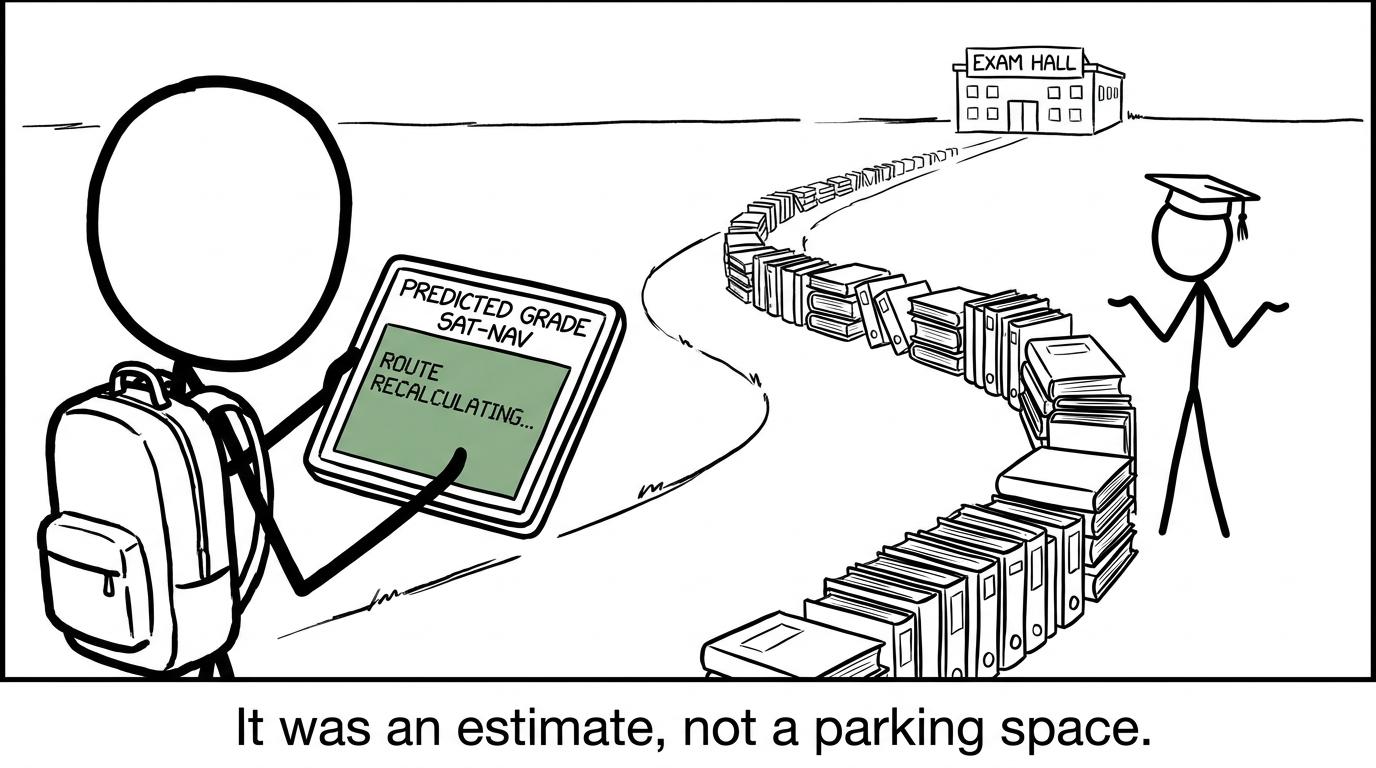 A predicted grade sat-nav recalculates the route to an exam
How to judge your own predicted grade more sensibly
Do not rely on one number. Look for a pattern across several pieces of comparable evidence.
Check the quality of the evidence
A closed-book, timed mock marked with an appropriate mark scheme tells you more about current exam performance than an untimed answer completed with notes. Several assessments tell you more than one unusually good or bad afternoon.
Ask whether the evidence:
- covered enough of the specification;
- used the correct exam-board format;
- was completed under realistic conditions;
- was marked consistently;
- included both knowledge and analytical skills;
- reflects your recent work rather than performance from months ago.
Think in a range, not a single grade
A sensible forecast is better understood as a likely region. If broader GCSE evidence shows that many forecasts fall within one grade of the outcome, a prediction of one grade should not be interpreted as mathematical certainty.
The uncertainty works in both directions. A predicted grade 666 does not secretly mean a guaranteed grade 555, 666 or 777; it means the available evidence currently points towards grade 666, with real scope for variation.
Turn the forecast into actions
The strongest response to any predicted grade is a short diagnostic cycle:
- complete an exam-style assessment under timed conditions;
- mark it carefully;
- record why each mark was lost;
- group errors into knowledge, analysis, evidence, interpretation and timing;
- practise the two most costly weaknesses;
- test them again using a different question.
Maths students can use exactly the same evidence-led process. Start with the free GCSE Maths revision hub, or follow MathsGenie's guide to finding your weakest GCSE topics. A grade becomes less intimidating when it is translated into specific skills.
What this means for your GCSE maths revision
History predictions and maths predictions are not directly interchangeable. History relies heavily on extended written responses and the quality of historical analysis, while GCSE Maths awards marks through mathematical methods, accuracy and reasoning. Maths also has foundation and higher tiers, which affect the grades available and the paper content.
The underlying principle is the same, however: the best forecast comes from repeated, relevant evidence.
Use Edexcel GCSE Maths past papers, or choose the appropriate board through the wider revision hub. Sit a paper under proper conditions, use the mark scheme and investigate every lost mark. MathsGenie's guide to using Edexcel past papers properly explains how to turn a paper into targeted practice rather than merely collecting a score.
If full papers feel premature, use revision lessons, practice questions and mini tests first. The one-month GCSE maths revision plan offers a structured route, while the guide to when to start GCSE past papers helps you introduce timed work gradually.
Predicted papers are useful for unfamiliar exam-style practice, but they cannot predict the exact questions or your final grade. Use them alongside official past papers, not instead of them.
Common mistakes when interpreting predicted grades
Treating the prediction as a maximum
A predicted grade describes what currently looks likely. It does not limit what an exam board can award.
Assuming one mock proves the prediction
One assessment can be distorted by illness, anxiety, topic coverage or unusually favourable questions. Look for repeated evidence.
Comparing raw marks from unrelated papers
Different boards, option routes and exam series can have different totals and boundaries. Compare like with like and use the relevant specification and mark scheme.
Revising only content
In History, facts must be selected and used to answer the question. In maths, recognising the method and communicating working matter alongside remembering formulae.
Chasing the grade instead of the lost marks
The grade is an output. Your errors are the inputs you can change. A calm review of lost marks usually gives you a better revision plan than repeatedly estimating boundaries.
A prediction is a compass, not a destination
GCSE History predicted grades are often close enough to guide decisions, but not accurate enough to define an individual student's result. Exact forecasts are difficult, History performance can shift with the questions and boundaries, and meaningful improvement can happen after the prediction is made.
Use the grade as a prompt to collect better evidence. Ask what it was based on. Practise under realistic conditions. Learn from mark schemes. Then retest the weaknesses that cost you marks.
For your maths preparation, make MathsGenie's GCSE revision resources your next step. Use free revision lessons and practice questions to rebuild weak topics, mini tests to check progress, and past papers, predicted papers, mark schemes and video solutions to prepare for the real examination. Your report contains a forecast. Your revision still influences what happens next.










