GCSE History November Resit: Is It Available?
GCSE history November resit options explained: check availability, when to retake History, and what GCSE or International GCSE students should do next.

A disappointing History result can create an urgent feeling: fix it now, before the knowledge fades. But if you are searching for a GCSE history November resit, the short answer is usually no. For standard GCSE History in England, the November series is for GCSE Mathematics and English Language, not History. AQA, Pearson Edexcel, OCR and Eduqas History candidates normally need to wait for the next summer examination series.
There is one important source of confusion. Some International GCSE History qualifications do have a November series. That does not make November available to a student entered for an ordinary GCSE History specification. The qualification, specification code and available examination centre all have to match.
This guide explains what is genuinely available, who a November History entry may be realistic for, and how to plan the months ahead without letting maths revision slip.
The GCSE History resit checklist
Before making any plans, confirm these details:
- Is your qualification a standard GCSE or an International GCSE?
- Which exam board and specification code appear on your results statement?
- Does that exact specification run in November?
- Will your former school accept you as a resit candidate?
- If not, can an approved centre enter you as a private candidate?
- Must you retake every written paper?
- Does your college, sixth form or future course actually require a higher History grade?
- Are you also resitting GCSE Maths or English Language?
The first three questions matter most. A timetable for a similarly named qualification is not evidence that your own course is available.
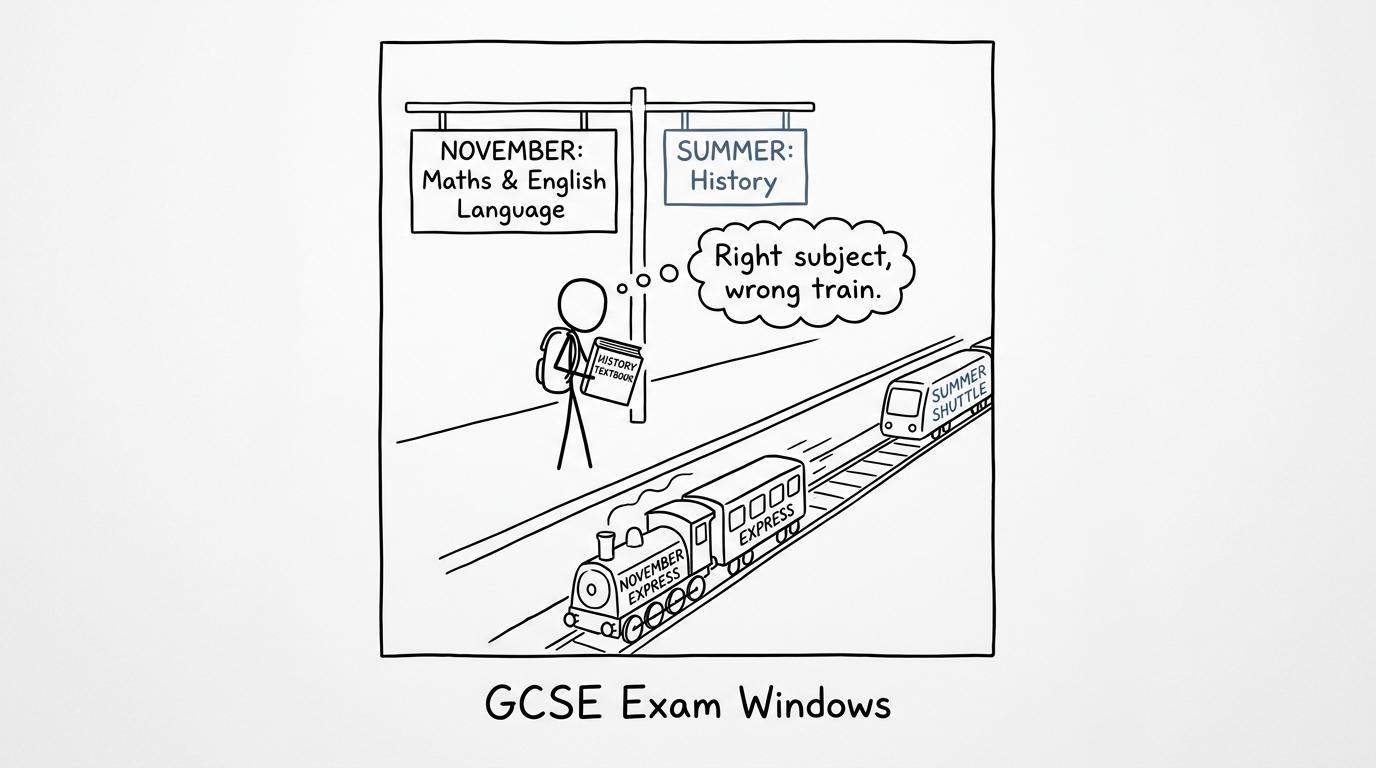 A student discovers that History and the November resit series are on different routes
Can you resit GCSE History in November?
For a standard GCSE regulated in England, History is not normally offered in the November GCSE series. Current November timetables from the main boards focus on GCSE Mathematics and GCSE English Language. History assessments run in the summer series.
That means a student who completed AQA GCSE History, Pearson Edexcel GCSE History, OCR GCSE History or Eduqas GCSE History in summer 2026 would ordinarily look towards the summer 2027 series for a retake. Exact dates, entry options and deadlines must be checked against the relevant board and confirmed by the centre making the entry.
This is different from asking whether History can be resat at all. It can. The limitation concerns the examination window, not your right to retake the qualification.
If you also need to retake maths, November may still be significant. The November GCSE resits guide explains the current Mathematics and English Language arrangements, including the age restriction and the need to enter through a school, college or approved examination centre.
Why students sometimes see a November History timetable
Search results can place GCSE and International GCSE information beside each other. Their names look similar, but their specifications and examination series are not interchangeable.
Pearson Edexcel International GCSE History is available in the November 2026 series. Its linear route includes History papers in that examination window. This is a genuine November History option, but it is International GCSE History, not Pearson Edexcel GCSE History.
A student cannot casually switch qualifications to obtain an earlier date. The content choices, paper structure, assessment objectives and entry codes may differ. You would also need an approved centre willing to offer the correct International GCSE papers.
A November International GCSE entry is most realistic when:
- you have already followed that exact International GCSE specification;
- your school routinely enters candidates for its November series;
- you can prepare every required component in time;
- an approved centre has confirmed the entry in writing; and
- the resulting qualification meets the requirement you are trying to satisfy.
It is much less realistic if you studied an ordinary GCSE and have only found the International GCSE timetable after results day. In that situation, changing course may create more work and uncertainty than waiting for the standard summer resit.
Who should realistically resit History?
A resit is a practical decision, not an automatic response to disappointment. Begin with the destination.
A higher History grade may be worthwhile if it is required for a particular sixth-form course, college programme, apprenticeship or future application. It may also make sense if your performance was clearly below your usual standard and you are prepared to revisit the complete specification.
However, History is not subject to the same post-161616 resit expectations as GCSE Mathematics and English. In England, students on relevant post-161616 programmes who have not secured the required grade in maths or English may have to continue studying those subjects. There is no equivalent general requirement to keep resitting History.
Ask the institution concerned what it actually needs. A broad offer based on several GCSE grades may respond differently from a course that names History specifically. Do not commit months of time or private-candidate fees to repairing a grade that does not affect your next step.
The guide to GCSE resits can help you separate compulsory next steps from optional grade improvement.
What a summer GCSE History retake involves
Modern GCSE History qualifications are linear. In practice, resitting generally means entering the qualification again and completing all required written assessments in the same examination series. You should not assume that a strong mark from one previous paper can simply be combined with a new result from another.
Your exact papers depend on the board and the options originally studied. For example, schools can choose different depth studies, period studies or thematic topics within the same board. This is why the specification code and option combination matter.
Ask your former school first
Contact the exams officer rather than relying only on a subject teacher. Ask whether the school:
- accepts former students for History resits;
- can enter your original board and options;
- provides lessons or expects independent preparation;
- has internal entry deadlines;
- charges an entry or administration fee; and
- can support previously approved access arrangements.
Schools are not required to accept every former student as a resit candidate. An early, clear enquiry gives you time to find another centre if necessary.
Entering as a private candidate
If your school cannot enter you, you may need an approved private-candidate centre. The centre makes the examination entry; you cannot book a regulated GCSE directly with the exam board.
Confirm the board, specification code, option codes, papers, centre fees and deadline before paying. If you previously received extra time, rest breaks or another access arrangement, raise this immediately. A new centre needs time and appropriate evidence to establish any arrangement.
 A student defeats assumptions by organising exam-board and exam-centre details
Should you request a review before deciding to resit?
If the result was close to a grade boundary, ask your school about your marks and the post-results options. A review of marking is not a speculative way to request extra marks. Marks can remain unchanged, rise or fall, and the request normally has to be made through your centre with your consent.
A teacher may be able to examine available evidence and advise whether the marking appears inconsistent with the mark scheme. Pay attention to the official deadline. Waiting until a History resit entry is being discussed may be too late for a summer post-results service.
The same calm approach applies to maths. If that grade was also lower than expected, follow the practical steps in GCSE Maths lower grade than expected before deciding between a review and a retake.
Planning History and maths revision together
Waiting for summer gives you more preparation time, but time only helps when it is given a job. Start by obtaining your paper marks, teacher feedback or script information where available. Identify whether the main weakness was knowledge, source evaluation, interpretation, judgement, timing or response structure.
Build a weekly plan around specific tasks. A useful History session should produce something that can be checked: a timed paragraph, an essay plan, recalled evidence or a response marked against the relevant criteria. Passive rereading can feel fluent without proving that you can construct an answer under pressure.
If you are taking GCSE Maths in November, prioritise its nearer deadline while keeping History alive through shorter weekly sessions. The GCSE Maths revision hub provides free board-specific lessons, practice questions, mini tests and papers. The GCSE Maths resit revision plan shows how to move from diagnosis to focused practice.
Once the November exams are over, you can gradually increase History preparation while maintaining maths if another attempt is needed. A structured one-month GCSE maths revision plan can also help when a formal examination period approaches.
Common mistakes when arranging a History resit
Confusing GCSE with International GCSE
A November International GCSE History timetable does not apply to an ordinary GCSE entry. Check the full qualification title and specification code.
Assuming every subject has a November resit
The familiar November route exists for GCSE Mathematics and English Language. Other standard GCSE subjects, including History, normally return in summer.
Revising before confirming the options
Two students on the same exam board may have studied different historical periods. Secure the correct specification and option combination before buying resources or building a plan.
Expecting to retake one paper
Linear GCSE retakes generally require all written assessments for the qualification. Confirm the complete entry with the exams officer.
Leaving centre arrangements too late
Private centres have their own capacity, fees and internal deadlines. Finding a willing centre can take longer than expected, particularly where a less common option combination is involved.
Letting an optional History resit displace compulsory maths
If you need both subjects, their urgency may differ. November maths has a short preparation window, while standard GCSE History normally waits until summer. Plan by confirmed dates, not by which result feels most disappointing.
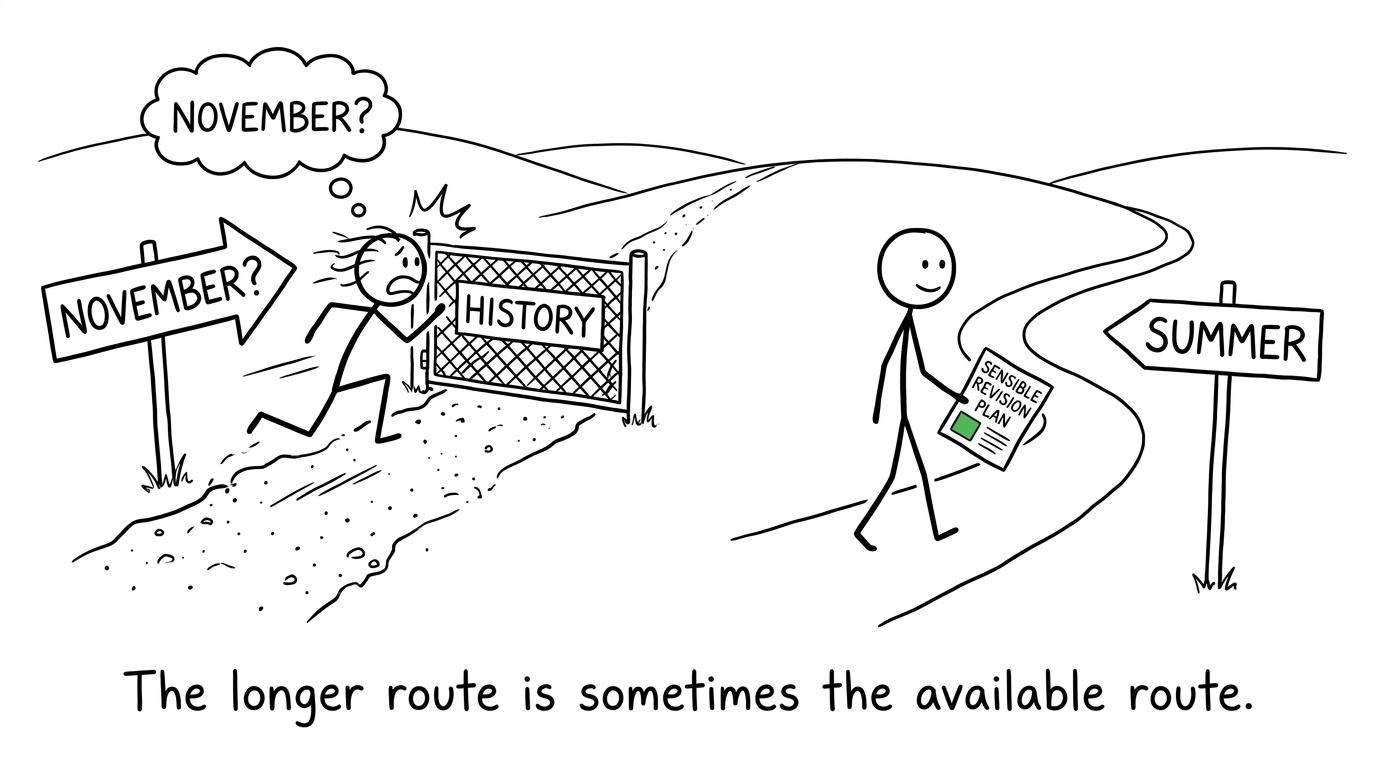 One student rushes towards a closed November History gate while another follows a summer revision plan
Make the available route work
The absence of a standard GCSE History November resit can feel like an unnecessary delay. Yet a later examination window offers something valuable: enough time to diagnose why marks were lost, rebuild precise knowledge and practise the type of writing the assessment rewards.
Confirm your qualification before doing anything else. If it is a standard GCSE History course, plan for the next summer series. If it is an International GCSE, ask your school or centre whether the exact specification is available in November and whether that timetable is realistic for you.
Meanwhile, keep the subjects with nearer deadlines moving. Start with MathsGenie's free GCSE Maths resources, then use revision lessons and practice questions to repair weaknesses. Progress to mini tests, past papers, predicted papers, mark schemes and video solutions when you are ready for timed work. If you take Edexcel, the Edexcel GCSE Maths past papers provide a clear place to begin.
You may not control the examination window. You can control how prepared you are when it arrives.