GCSE History Half-Term Revision That Gets Done
GCSE history half term revision made manageable: build a focused plan, use active recall, practise exam questions and still protect your break.
Half-term revision often fails before it begins. You imagine long, impressive days at a desk, decide you will cover the entire course and then avoid starting because the plan feels enormous.
Effective GCSE history half term revision is smaller and more practical. Choose a few weak areas, schedule short sessions, retrieve knowledge without notes, answer exam questions and review your work. A focused hour completed is worth more than an imaginary day of perfect revision.
You should still have a half-term. Rest, sleep and time away from school are not rewards you earn after revising everything. The aim is to protect most of the break while completing enough deliberate work to return feeling clearer and more prepared.
Your half-term revision checklist
Before planning individual sessions, make these decisions:
- Confirm your exam board and the exact History options taught by your school.
- List the papers, units and question types you need to prepare for.
- Identify three weak areas rather than attempting the entire specification.
- Schedule revision blocks in advance, including a definite finishing time.
- Combine knowledge recall with source, interpretation and essay practice.
- Mark or review every exam response.
- Revisit mistakes later in the week.
- Reserve days or substantial parts of days for a genuine break.
If several GCSE subjects need attention, use one central plan. The principles in MathsGenie's one-week GCSE revision plan can help you divide the week into diagnosis, focused practice and review rather than treating every subject as equally urgent.
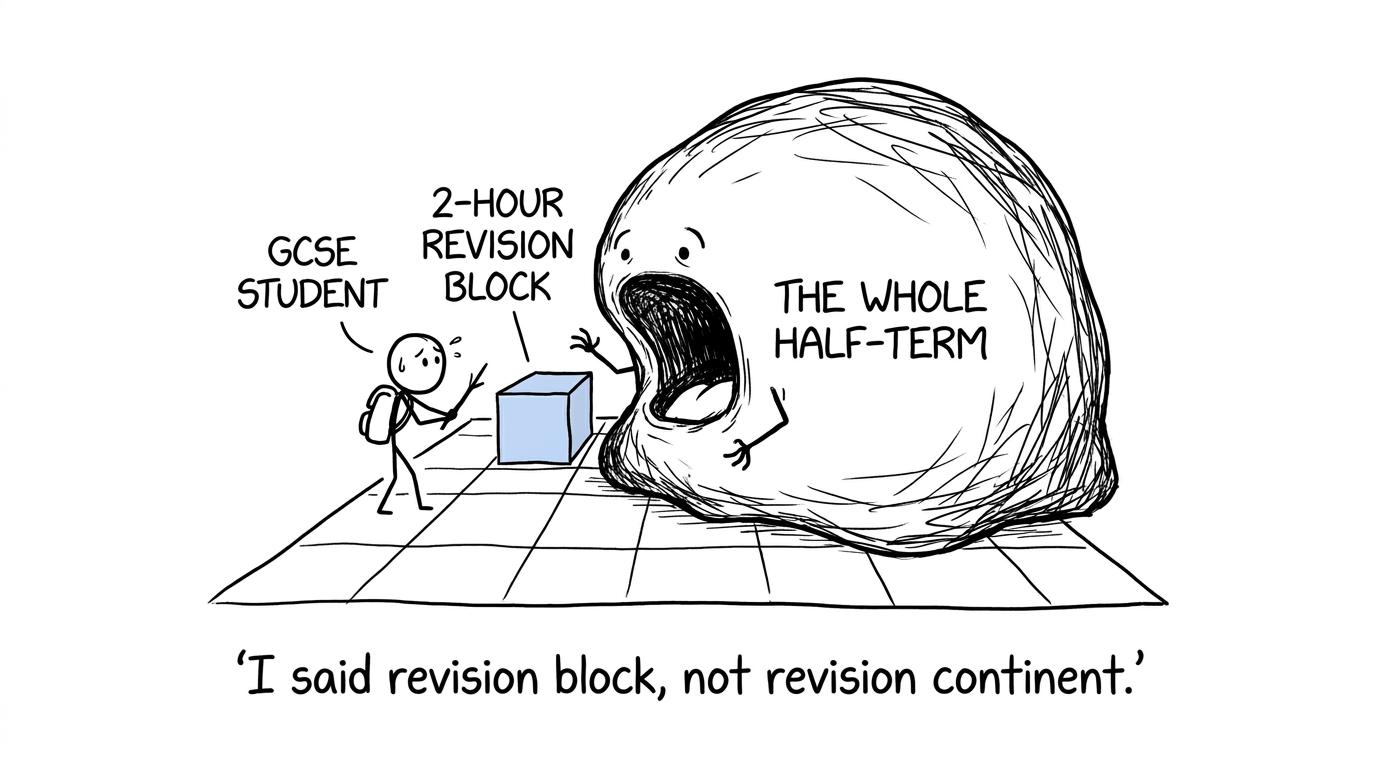 A student protecting a small revision block from the whole half-term
Begin with the course you are actually taking
“Revise History” is not a useful instruction. GCSE History courses vary considerably because schools select different options within the Edexcel, AQA, OCR or Eduqas specifications. Two students using the same exam board may not be preparing for exactly the same periods.
Start with your school's topic list, specification and assessment information. Write down the precise units you have covered, such as a thematic study, a British depth study, a wider-world or non-British depth study, a period study or a historic environment. The names and paper structures depend on the board, so do not copy a generic online timetable without checking it against your course.
Then divide each unit into manageable areas. A label such as “Weimar and Nazi Germany” is still too broad. Smaller areas might include political instability, economic change, the growth of Nazi support or life under dictatorship. Specific labels make it possible to begin.
Use a simple confidence rating:
- Secure: you can recall accurate knowledge and use it in an answer.
- Uncertain: you recognise the content but struggle without notes.
- Weak: you cannot yet explain the main events or connections.
Spend most of half-term on uncertain and weak areas. This is the same diagnostic principle used in MathsGenie's guide to finding your weakest GCSE topics: let evidence decide what deserves your time.
Build a plan that leaves room for a holiday
A revision plan should reduce negotiation. When a session begins, you should already know the topic, task and finishing time.
For many students, one or two focused blocks on selected days will be more realistic than an all-day timetable. A useful block could contain:
- ten minutes recalling previous content;
- twenty-five minutes repairing one knowledge gap;
- twenty minutes answering part or all of an exam question;
- ten minutes checking and recording corrections.
These timings are suggestions, not scientific laws. Shorten them if concentration is fading or extend an exam task when you need to practise realistic timing. What matters is that each block produces visible evidence: a recall sheet, completed question, marked paragraph or corrected timeline.
Plan your stopping time as carefully as your starting time. “Revise until dinner” expands into an unpleasant afternoon. “Finish this question and review it by half past eleven” creates a boundary. A protected boundary makes it easier to start because revision no longer threatens to consume the day.
Students balancing History with Maths can use the free GCSE Maths revision hub to choose board-specific lessons and questions rather than losing time searching for materials. Keep the same rule across both subjects: decide the exact output before opening your books.
Use retrieval instead of repeatedly reading notes
Reading has a role when you are first repairing understanding. It becomes less useful when it is the only thing you do.
Retrieval practice means attempting to bring knowledge to mind before checking your notes. Evidence reviewed by the Education Endowment Foundation supports carefully designed retrieval practice, particularly when students receive feedback and revisit material after a delay. The attempt matters, including the uncomfortable moment when you cannot immediately remember.
For History, you could close your materials and:
- reconstruct a timeline from memory;
- list causes or consequences of an event;
- explain why a development was significant;
- compare two periods within a thematic study;
- write everything you remember about a named individual;
- answer flashcards aloud before turning them over.
Check the result immediately against reliable class materials. Add missing details in another colour, but do not turn the correction stage into copying several pages. Your gaps are the useful part of the exercise.
Return to the same material later in half-term. Spacing recall across different days is generally more valuable than performing several identical tests in one sitting. One short attempt, feedback and a later retest form a better cycle than creating an enormous stack of cards that you never use.
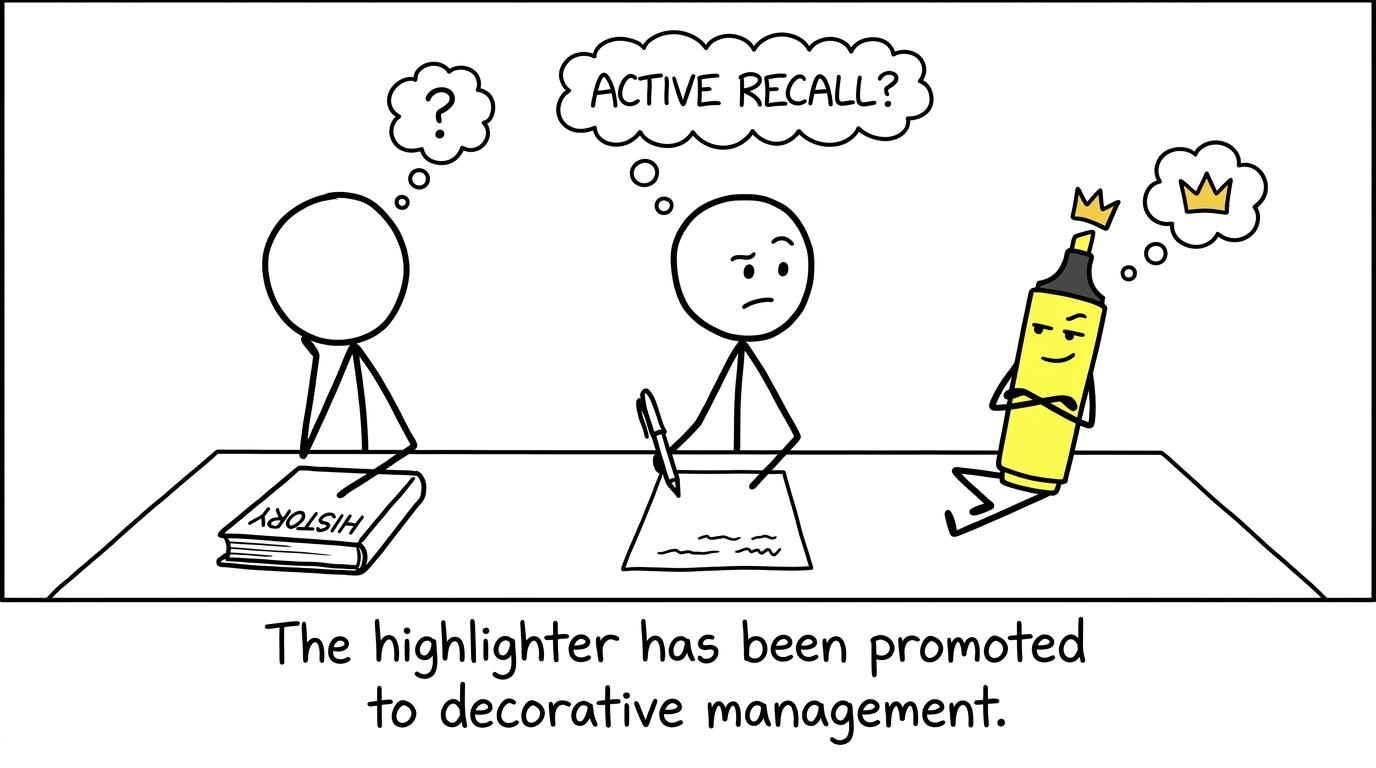 A highlighter discovers that active recall is doing the real work
Revise the four historical skills
Knowing the story of a period is necessary, but GCSE History also assesses how you use that knowledge. Ofqual's assessment objectives apply across GCSE History qualifications, although boards organise their papers and questions differently.
AO1 concerns knowledge and understanding and carries 35%35\%35% of the subject marks. AO2, also weighted at 35%35\%35%, covers explanation and analysis through concepts such as cause, consequence, change, continuity, similarity, difference and significance.
AO3 carries 15%15\%15% and concerns analysing, evaluating and using contemporary sources to make substantiated judgements. AO4 carries the remaining 15%15\%15% and assesses interpretations, including why accounts of the past may differ.
That means a sensible half-term plan should not consist entirely of memorising dates. It should include four kinds of work:
Knowledge and chronology
Retrieve precise people, developments, dates and features. Organise them into a sequence so that isolated facts become a coherent account.
Explanation and analysis
Practise connecting evidence to a historical concept. Do not merely list causes; consider their importance, interaction and relative weight where the question requires it.
Source analysis
Use the source's content, provenance and historical context in relation to the exact enquiry. Avoid treating provenance as a reason to dismiss a source automatically.
Interpretation analysis
Identify what an interpretation argues, support your analysis with its details and use contextual knowledge when the question requires evaluation. A difference between interpretations needs explanation, not just identification.
Use your board's current sample materials, past questions and mark schemes to confirm the command words and expected response structures. Paper formats are not interchangeable between AQA, Edexcel, OCR and Eduqas.
Turn knowledge into exam answers
The safest revision task often feels like making notes because it cannot expose a weak answer. Exam practice feels harder precisely because it reveals what is missing.
Choose questions from the units you have actually studied. Early in the week, you might plan an answer or complete one paragraph without timing. Later, answer a full question under the time available for that question on your paper.
Review it using the official mark scheme, teacher guidance or a model provided by your school. Ask:
- Did I answer the stated question throughout?
- Is my evidence precise and relevant?
- Did I explain how the evidence supports my point?
- Did I apply the right source or interpretation skill?
- Is my judgement supported rather than merely asserted?
Record one action for the next attempt. “Improve analysis” is too vague. “Explain why this cause made the other cause more important” gives you something concrete to practise.
This mark, fix and retest cycle works across subjects. MathsGenie's guide to using GCSE past papers properly explains how marking can become a diagnosis rather than simply a score. When you return to Maths revision, select papers matching your board and tier; for example, the Edexcel GCSE Maths past papers include official mark schemes and worked solutions where available.
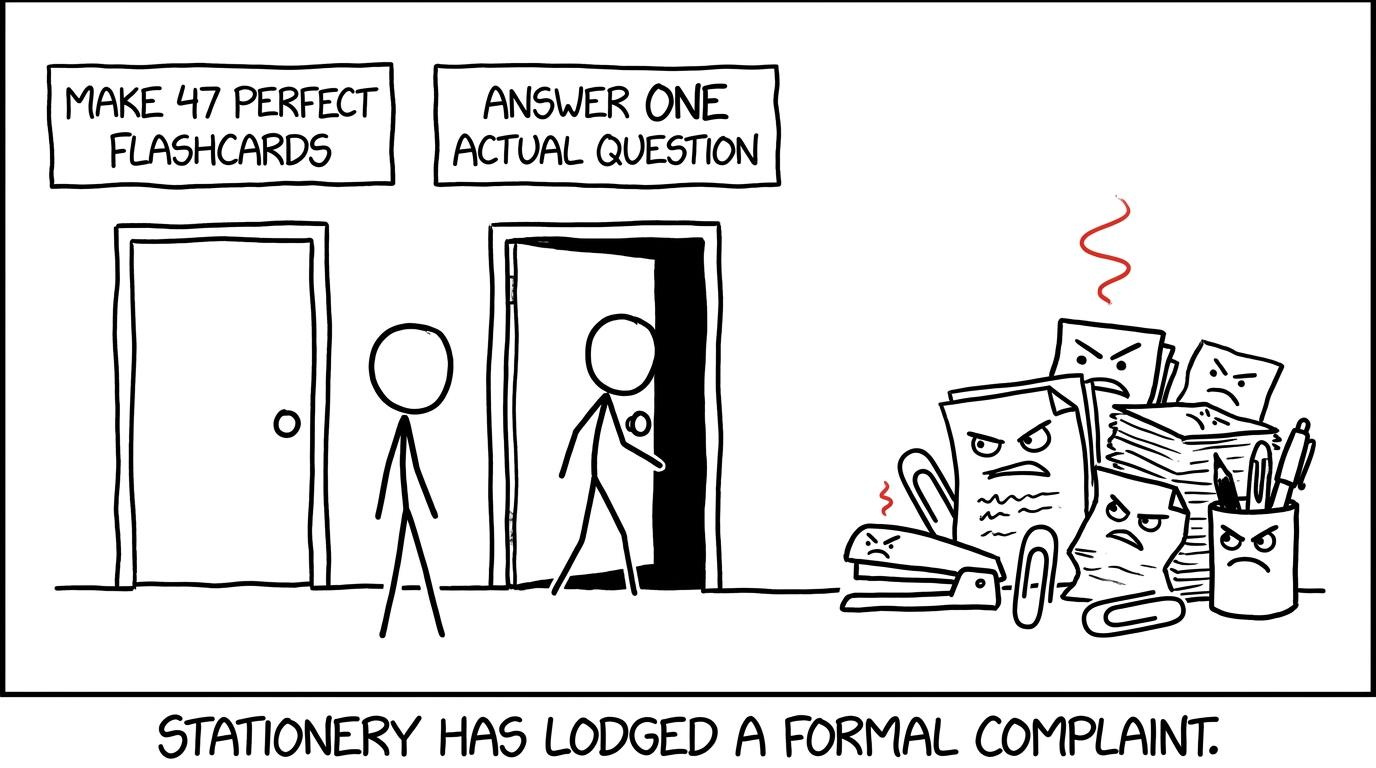 A student chooses one real question over a mountain of perfect flashcards
Common half-term revision mistakes
Planning every available hour
An overloaded timetable creates failure by lunchtime. Leave space for meals, plans, rest and unexpected interruptions. It is better to complete four defined sessions than abandon fourteen ambitious ones.
Revising favourite topics first
Familiar material feels fluent, which can be mistaken for progress. Begin with evidence from tests, teacher feedback and recall attempts. The weakest area does not always need the most hours, but it deserves an honest place in the plan.
Producing resources without using them
Timelines, flashcards and mind maps are tools, not finished revision. Test yourself with them. If creating a resource takes longer than retrieving the content or answering a question, simplify it.
Ignoring the exact exam board
A generic essay structure can mislead you if it does not match the question being asked. Check the current specification and materials for your board, option and paper. Ask your teacher when anything is uncertain.
Completing questions without feedback
Unreviewed practice can preserve the same mistake. Check content, technique and timing, then attempt a similar task after a gap. Feedback is what converts performance into learning.
Sacrificing the entire break
Exhaustion is not proof of serious revision. Set a finish line and keep it. If your wider GCSE plan feels unmanageable, the one-month GCSE revision framework offers a useful model for spreading diagnosis, practice and retesting across several weeks.
Finish half-term with proof, not promises
On the final revision day, do not measure success by hours at a desk. Look for evidence. Can you reconstruct the timeline more accurately? Can you explain the connection between two causes? Is your source analysis tied more closely to the enquiry? Did you correct and retest the weakness you found?
Write three next actions for the school week. Keeping the list short helps half-term work continue rather than disappear beneath new homework.
Then turn to the rest of your GCSE preparation with the same calm system: diagnose, learn, practise, mark and revisit. MathsGenie makes that cycle straightforward for Maths students through free revision lessons, practice questions, mini tests, past papers, predicted papers, mark schemes and video solutions. You can also read when to begin GCSE past papers before building them into your longer-term plan.
Half-term does not need to become a revision marathon. Choose the work that changes what you can recall and produce, complete it properly, and then close the books. That is not doing less. It is making the work count.