Can You Take GCSE History and Geography Together?
GCSE history and GCSE geography together is a realistic choice. Learn about workload, subject overlap, exam skills and balancing both with maths revision.
Choosing GCSE options can feel strangely permanent. One form asks you to compress your interests, future plans and tolerance for homework into a handful of boxes. If you enjoy understanding both past events and the modern world, you may wonder whether taking GCSE history and GCSE geography together is allowed and whether it is genuinely manageable.
The short answer is yes. There is no national rule preventing you from taking both subjects. The English Baccalaureate, or EBacc, refers to history or geography, but that does not stop a student choosing both. The practical decision depends on your school's option blocks, available teaching and individual entry rules.
Taking both is realistic for an organised student who enjoys reading, extended writing, evidence and learning detailed content. However, the overlap is smaller than it first appears, so you should treat them as two distinct GCSEs rather than one combined humanities course.
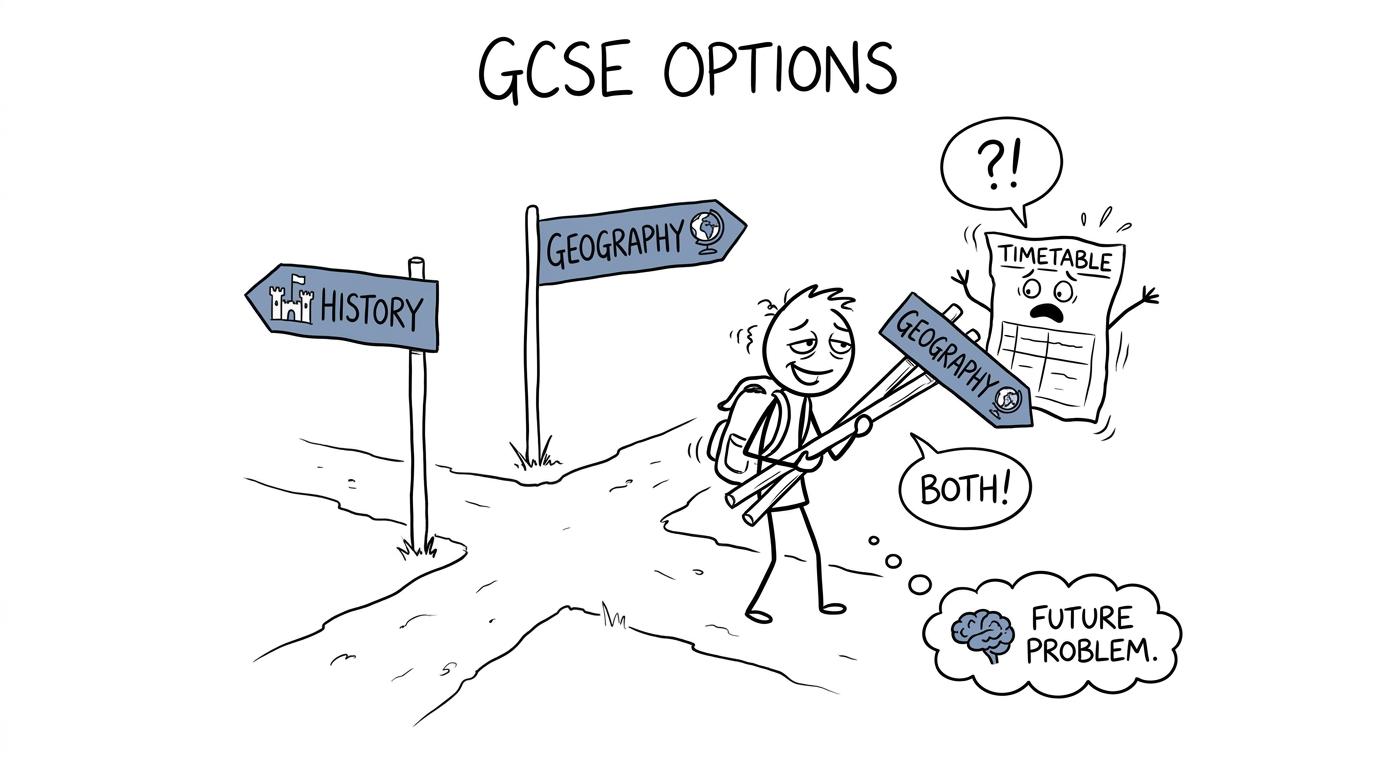 A student calmly choosing both History and Geography at the GCSE options crossroads
The quick decision checklist
Before choosing both subjects, check the following:
- Your school permits the combination. History and geography may appear in the same option block.
- You enjoy both courses as they are taught at GCSE. Look beyond your experience at Key Stage 3.
- You are comfortable with substantial content. Both specifications require secure knowledge of several topics and case studies.
- You can write analytical answers under time pressure. Both include extended responses, although they assess them differently.
- You are willing to practise maps and data. These are central to geography, not optional extras.
- You have room for your other interests. Taking both humanities may mean giving up an art, technology, language or practical subject.
- Your revision plan still protects English, science and maths. Your option choices should not leave compulsory subjects competing for whatever time remains.
Ask your history and geography teachers which exam board and specification your school follows. Edexcel, AQA, OCR and Eduqas organise content and assessments differently, so the answer should be based on your actual courses rather than a generic subject description.
Is taking both GCSEs realistic?
For many students, yes. The combination is demanding, but not unusual or inherently excessive. The important question is not whether two humanities subjects are "too hard" in the abstract. It is whether their particular demands fit the way you learn.
History tends to reward students who can build chronological knowledge, explain cause and consequence, assess significance and evaluate sources or interpretations. Geography combines written explanation with physical and human processes, case studies, maps, fieldwork, statistics and unfamiliar data.
You may be well suited to both if you:
- regularly keep up with notes rather than relying on last-minute revision;
- enjoy explaining why events or processes happen;
- can select evidence instead of writing everything you remember;
- are prepared to learn precise examples and case-study detail;
- can switch between essays, short responses, graphs and maps;
- respond constructively to mark schemes and teacher feedback.
The combination becomes less realistic when it is chosen only because the subjects sound respectable, friends are taking them, or you assume they substantially duplicate one another. Interest matters because both courses contain enough detail to make reluctant revision feel very long.
Your school has the final practical say. Even if the combination is academically suitable, timetable clashes, class sizes or local option rules may prevent it. Speak to the options lead before treating the choice as settled.
How much overlap is there between history and geography?
There is meaningful overlap in the questions the subjects ask, but much less overlap in the knowledge you must learn.
Both subjects investigate change, evidence and the relationship between people and places. Depending on your school's selected topics, you might encounter connected ideas such as:
- migration and population change;
- industrialisation and urban growth;
- conflict over territory or resources;
- inequality and economic development;
- political decisions affecting landscapes and communities;
- environmental pressures and society's responses;
- how places change over time.
This conceptual overlap can make each subject more interesting. Historical knowledge may help you understand why a city, border or economy developed in a particular way. Geography may add spatial, environmental and economic context to historical change.
But the shared theme is not the same as shared revision. A history question about migration may require precise period knowledge, causal analysis and evaluation of historical evidence. A geography question on migration could require population data, a named example, spatial patterns and consideration of social, economic and environmental effects.
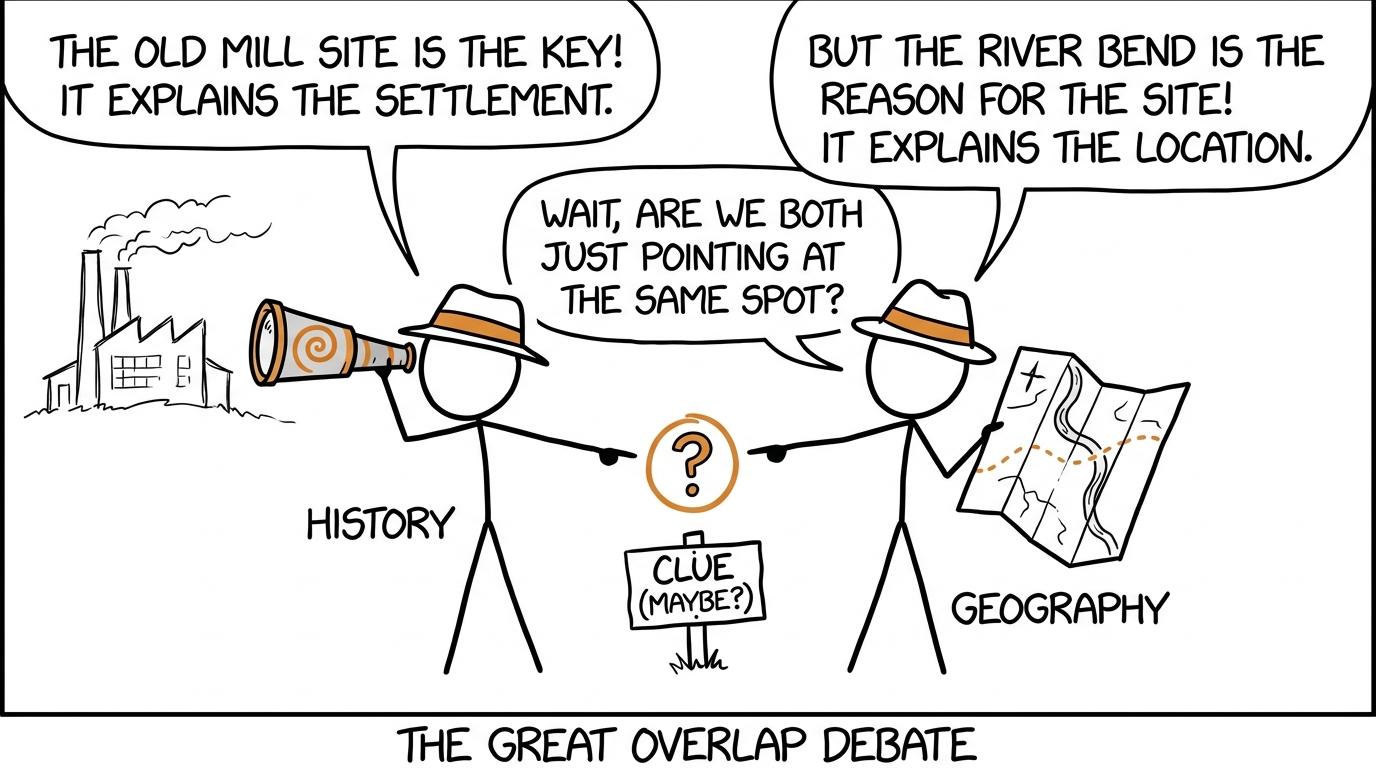 History and Geography investigate the same city using very different tools
Skills that transfer between the subjects
Several habits are useful in both:
- identifying the exact command word;
- constructing a clear argument;
- supporting claims with relevant evidence;
- comparing factors rather than listing them;
- evaluating evidence and reaching a justified judgement;
- writing accurately with appropriate subject terminology;
- managing time across questions carrying different marks.
These transferable habits reduce the cost of learning how to answer well. They do not remove the need to learn separate content.
Where the subjects remain different
GCSE history is built around periods, themes, depth studies and historical environments. National assessment objectives include knowledge and understanding, explanation through concepts such as change and consequence, source evaluation and analysis of interpretations.
Geography focuses on places, physical and human processes, relationships between people and environments, fieldwork and geographical skills. Official requirements allocate at least 10%10\%10% of GCSE geography marks to mathematical and statistical techniques. Students may need to work with scale, distance, ratio, percentages, averages, spread, graphs, maps and patterns in data.
Fieldwork is another major difference. GCSE geography specifications require opportunities for fieldwork in contrasting environments, and fieldwork understanding is assessed in the examinations. History can include a historic environment, but it does not use the same enquiry cycle of collecting, presenting and evaluating geographical data.
In short, the overlap is strongest in thinking and communication, moderate in certain themes, and limited in the exact material you revise.
How the combination affects GCSE maths revision
Taking two content-rich humanities subjects does not directly make GCSE maths harder. The risk is indirect: essays, case-study notes and content recall can absorb your revision time because they always offer something else to read.
Maths needs a different kind of consistency. Reading a method is not the same as being able to apply it independently. Protect short, regular sessions for questions even during busy humanities weeks.
A useful starting point is the GCSE maths revision hub, where you can select resources for boards including Edexcel, AQA, OCR and Eduqas. Revision lessons can rebuild a weak method, while practice questions show whether you can use it without notes.
If homework is heavy, the twenty-minute maths revision routine provides a manageable structure. The purpose is not to squeeze an entire topic into one sitting. It is to keep recall, question practice and feedback moving while longer history and geography tasks occupy other evenings.
Geography can also reinforce some maths skills. Interpreting graphs, calculating percentage change, using scale and discussing data reliability all reward numerical confidence. That does not replace GCSE maths practice, but it means the subjects are not competing in every respect.
Building a timetable for all three subjects
A strong timetable is built around the work each subject actually requires:
| Subject | Main revision demand | Useful regular task |
|---|---|---|
| History | Precise knowledge, chronology, sources and analytical writing | Retrieval followed by one planned or timed response |
| Geography | Processes, case studies, maps, data and fieldwork | Case-study recall followed by a data or exam question |
| Maths | Methods, accuracy and problem-solving | Focused questions followed by marking and correction |
Do not divide time equally simply because there are three subjects. Use evidence. If a maths mini test reveals a weakness, direct the next session towards that skill. If you cannot recall a geography case study, schedule retrieval. If a history answer lacks evidence, repair the relevant topic knowledge.
MathsGenie's guide to finding your weakest GCSE topics can help you make those decisions from marks rather than mood. For a broader weekly structure, use the GCSE maths revision timetable and adapt the available evenings around humanities homework.
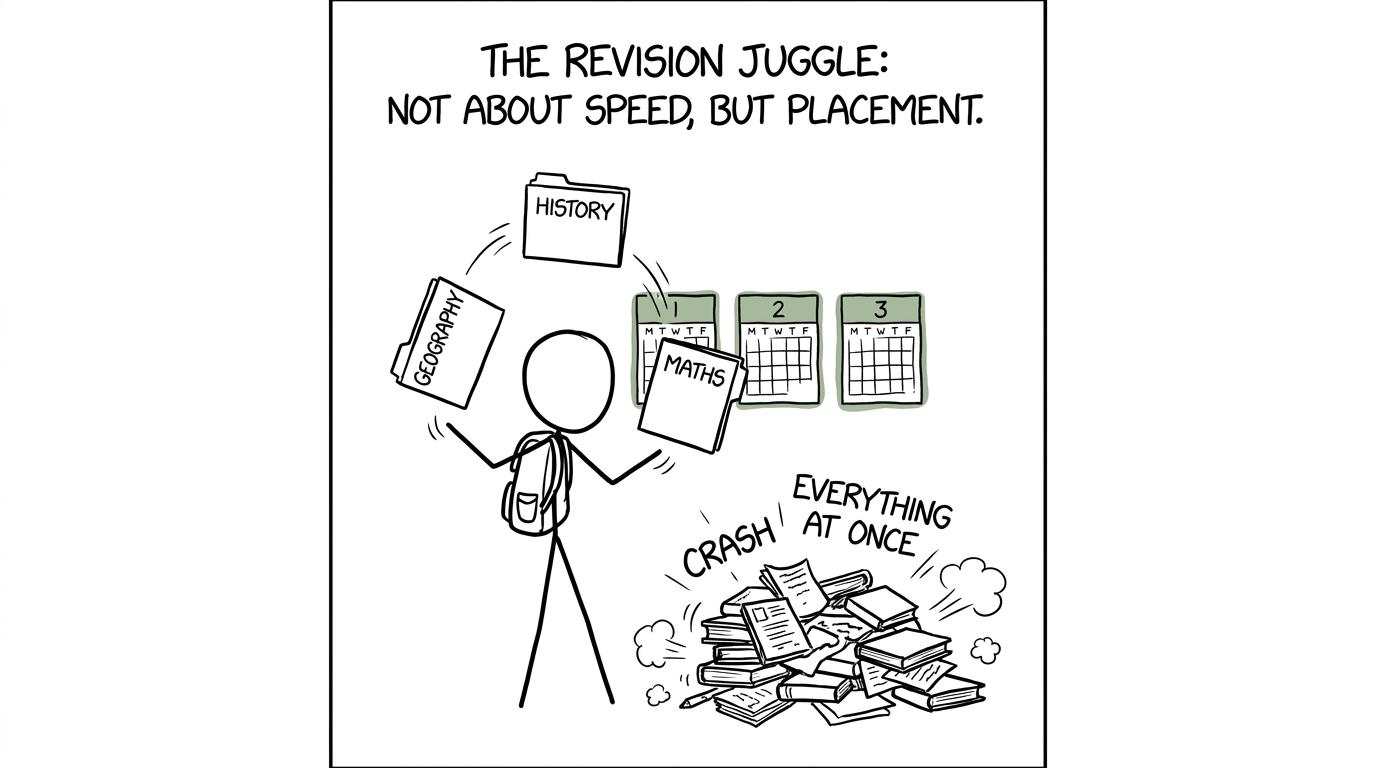 A student schedules History, Geography and Maths while the everything-at-once pile collapses
As exams approach, replace some topic sessions with timed practice. Learn how to use GCSE past papers properly, then mark them carefully and return to the skills responsible for lost marks. Edexcel students can begin with the Edexcel GCSE maths past papers; students following another board can select their board through the main revision hub.
When choosing both may not be the best decision
Being allowed to take both does not mean you must. One humanities subject may be the better choice if:
- the combination removes another subject that matters more to you;
- you strongly dislike extended writing or detailed content recall;
- you are choosing one subject mainly to satisfy someone else;
- your current workload already feels unmanageable;
- you prefer a broader mixture of academic, creative and practical assessment;
- the timetable would force an unsuitable reserve option.
Do not judge the subjects only by current grades. A grade reflects your performance so far; a choice concerns what you are willing to practise for the next two years. Look at specification topics, sample questions and the way each course is assessed. Then ask which work you can imagine doing repeatedly, including on an ordinary Wednesday when enthusiasm is not especially high.
Common mistakes when choosing both subjects
Assuming the courses contain the same material
Connected themes do not create interchangeable notes. Keep separate vocabulary, evidence banks, case studies and exam techniques for each specification.
Ignoring the option blocks
Check the timetable before planning your entire GCSE pathway. Schools decide which combinations can run, and national permission cannot resolve a local clash.
Underestimating geography's numerical content
Geography is not simply essay writing about places. Maps, graphs, fieldwork data and mathematical or statistical techniques form an assessed part of the qualification.
Revising by rereading
Familiar pages can create false confidence. Close the book, retrieve knowledge, answer questions and use mark schemes. The same principle applies to historical knowledge, geographical case studies and mathematical methods.
Letting maths disappear during essay-heavy weeks
Maths accuracy fades when practice stops. A small, protected routine is more useful than waiting for a completely free evening. The one-month GCSE maths revision plan can help restore structure when examinations are close.
Make the choice with evidence, not fear
You can take GCSE history and geography together if your school offers the combination. It is a realistic pathway for students who enjoy both subjects and can manage two substantial bodies of knowledge. The courses complement one another through analysis, evidence, judgement and themes such as migration or urban change, but their specifications, methods and revision materials remain distinct.
Before submitting your options, confirm the timetable, examine your school's specifications and consider what you may be giving up. Then make a simple revision plan that protects compulsory subjects alongside your choices.
For maths, begin at the MathsGenie GCSE revision hub. Use free revision lessons and practice questions to strengthen individual topics, mini tests to check recall, and past papers, predicted papers, mark schemes and video solutions to prepare for exam conditions. Two humanities subjects can broaden the way you see the world. A calm revision system ensures they do not crowd out the maths marks you are capable of earning.