

GCSE German Exam Time of Day: Does It Matter?
GCSE German exam time of day can affect alertness, but it does not decide your grade. Learn how to prepare well for morning or afternoon papers.
The time printed beside an exam can feel strangely important. A morning paper raises worries about tiredness; an afternoon paper leaves hours in which nerves can grow. So, does the GCSE German exam time of day actually affect performance?
It can influence how alert you feel, particularly if you naturally become focused later in the day. But it is unlikely to decide your grade by itself. Preparation, sleep, familiarity with the paper and a calm routine matter far more. You normally cannot choose the session, so the useful response is to prepare for the time you have been given.
That principle applies beyond German. If you are balancing languages with GCSE maths, the same routine can help you arrive ready for both.
The short answer
Here is what matters most:
- Research suggests that time of day can interact with your natural sleep pattern, or chronotype.
- Some students who naturally wake and focus later may find morning assessments harder.
- An afternoon exam is not automatically easier or better.
- Exam timetables are set nationally, while your school confirms your precise arrival and start time.
- You should train under realistic conditions rather than worry about a timetable you cannot change.
- Sleep, food, hydration and a familiar pre-exam routine are more controllable than the session itself.
The healthiest conclusion is not that timing is irrelevant. It is that timing is one variable among many, and one of the least controllable.
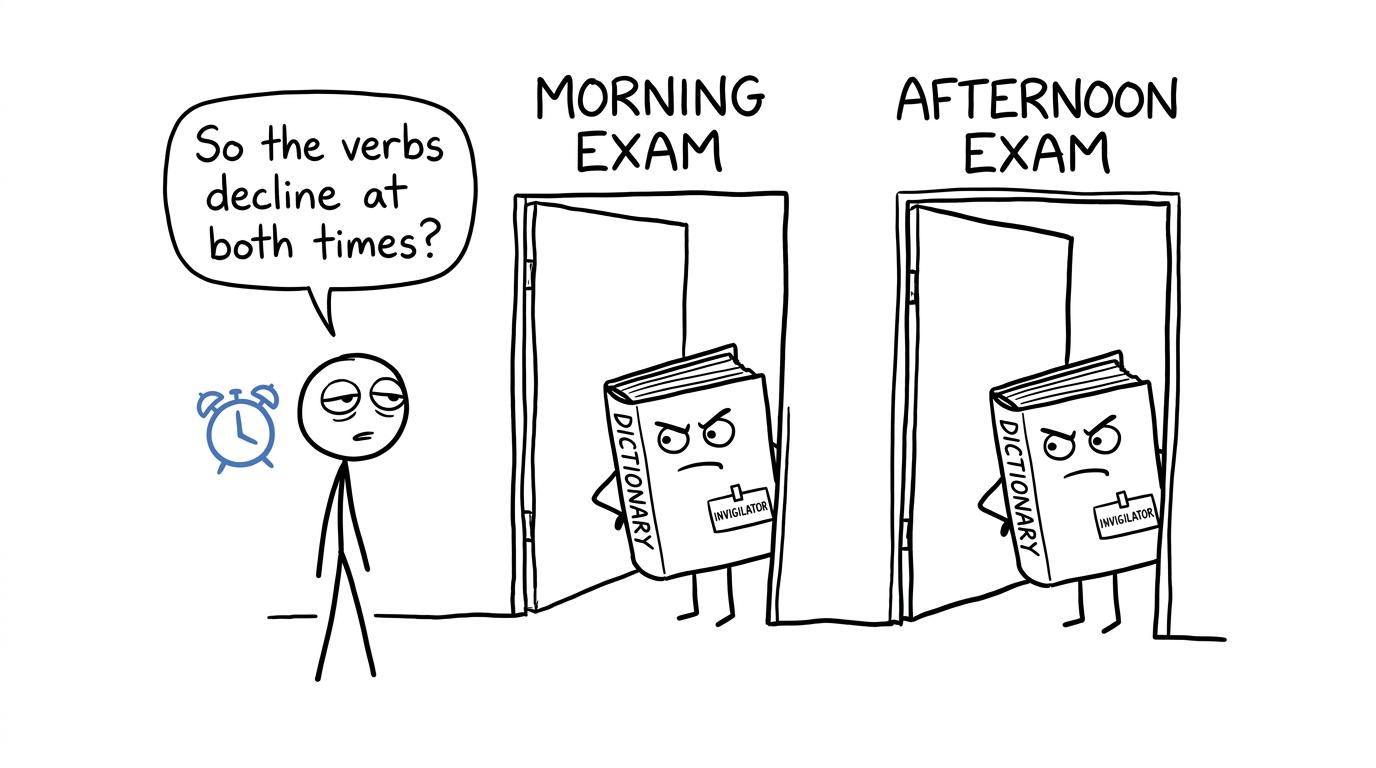 A sleepy student discovers that German verbs are equally serious in morning and afternoon exams
How GCSE exam sessions are scheduled
For awarding bodies following Joint Council for Qualifications rules, the published UK start times are normally 9.009.009.00 am for a morning examination and 1.301.301.30 pm for an afternoon examination. Centres can begin within a limited window around those published times, provided they follow the relevant security and supervision rules.
This means your school might ask you to arrive well before the published start. Your personalised school timetable is the document to follow because it confirms your room, seat, paper, tier where applicable and arrival instructions.
Written German components may include listening, reading and writing, depending on the specification used by your exam board. Speaking assessments work differently: schools arrange them within the board's permitted assessment window rather than treating them like a single national written-paper session.
Exact dates, components and sessions vary by year and specification. AQA, Pearson Edexcel and Eduqas students should therefore check the current final timetable and the component code rather than relying on a screenshot from another year. If two papers clash, speak to your exams officer. Do not attempt to create your own solution or assume that you may choose the more convenient session.
Can morning versus afternoon affect performance?
Research involving secondary-school students suggests that examination performance can vary with both time of day and chronotype. A chronotype is simply your tendency to feel alert earlier or later in the day.
In one study of Dutch secondary-school pupils, earlier chronotypes achieved stronger morning results than later chronotypes, while the difference between the groups disappeared in the early afternoon. Other research has also found interactions between school timing, sleep patterns and academic performance.
These findings deserve attention, but they should not be exaggerated. The studies were not tests of every UK GCSE German specification, and much of the evidence is observational or comes from different education systems. It does not prove that moving one particular German paper from morning to afternoon would raise every student's mark.
The evidence supports a narrower conclusion: when you feel alert can affect how easily you access what you know. It does not suggest that knowledge, vocabulary and exam technique stop mattering.
Why a morning paper may feel difficult
Teenagers often experience a natural shift towards later sleep and waking patterns. If you usually wake late at weekends, a morning examination may begin before you feel fully switched on.
German listening can make this especially noticeable. You must process speech, hold information briefly and select an answer without waiting for your concentration to arrive ten minutes later. Reading also punishes impulsive guesses when a negative word or change of tense is missed.
The answer is not a dramatic early start only on exam day. A sudden change can leave you more tired. Instead, move towards a stable routine in the preceding days and practise beginning focused work at the relevant hour.
Why an afternoon paper is not automatically easier
An afternoon session gives you longer to wake up, eat and travel. For a student with a later chronotype, that may feel helpful.
But afternoons create different problems. You may become mentally tired after lessons or another examination. A heavy lunch can leave you sluggish. Several hours of frantic vocabulary checking can turn manageable nerves into exhaustion.
There is also a psychological trap: more available time feels like more revision time. Often it is simply more waiting time. The aim is to arrive mentally fresh, not to use every minute before the examination.
Match your preparation to the session
You cannot normally move a nationally timetabled paper because you prefer mornings or afternoons. You can, however, reduce the surprise.
Preparing for a morning German exam
In the days before the paper:
- wake at roughly the time required on exam day;
- eat a familiar breakfast rather than experimenting;
- complete occasional listening or reading practice in the morning;
- prepare clothes, equipment and travel arrangements the night before;
- leave enough time to arrive without rushing;
- use a short warm-up rather than attempting a complete paper before school.
Your warm-up could involve recalling a few familiar words or reading a short paragraph. It should create readiness, not expose you to a difficult topic that damages confidence.
Students managing maths revision alongside German can apply the same approach through the GCSE maths revision hub. Choose a small, familiar activity for the morning and save demanding new learning for another time.
Preparing for an afternoon German exam
For an afternoon session:
- keep the morning structured but light;
- avoid completing a full, exhausting mock paper;
- eat a normal lunch that you know suits you;
- check when and where your school expects you to report;
- stop revising early enough to let your attention settle;
- stay away from classmates who are comparing predictions or spreading panic.
If you have another examination that morning, conserve energy between papers. Follow your centre's instructions carefully, particularly if supervision is required because of a clash.
 A suspicious giant coffee cup claims to be an exam revision strategy
Use practice to reduce the time-of-day effect
A student may say, “I am terrible in the morning,” when the more accurate statement is, “I have rarely attempted focused exam work in the morning.” Those are different problems.
Practising at the likely exam time cannot rewrite your body clock, but it can make the routine familiar. Sit selected practice sections under realistic conditions: phone away, correct time allowance and no interruptions. Afterwards, mark the work and identify whether mistakes came from knowledge, attention or rushing.
Do not move every revision session to the exam hour. One or two realistic rehearsals can be enough to reveal practical issues such as hunger, travel fatigue or slow concentration at the start.
This is particularly useful when German and maths papers sit close together. MathsGenie's guide to building a GCSE revision timetable that works can help you balance subjects without turning every day into a full mock examination.
For maths preparation, use board-specific GCSE revision resources and match practice to your foundation or higher tier. AQA students can go directly to the AQA GCSE Maths revision page. The point is the same in either subject: practise the task, review the evidence and fix a specific weakness.
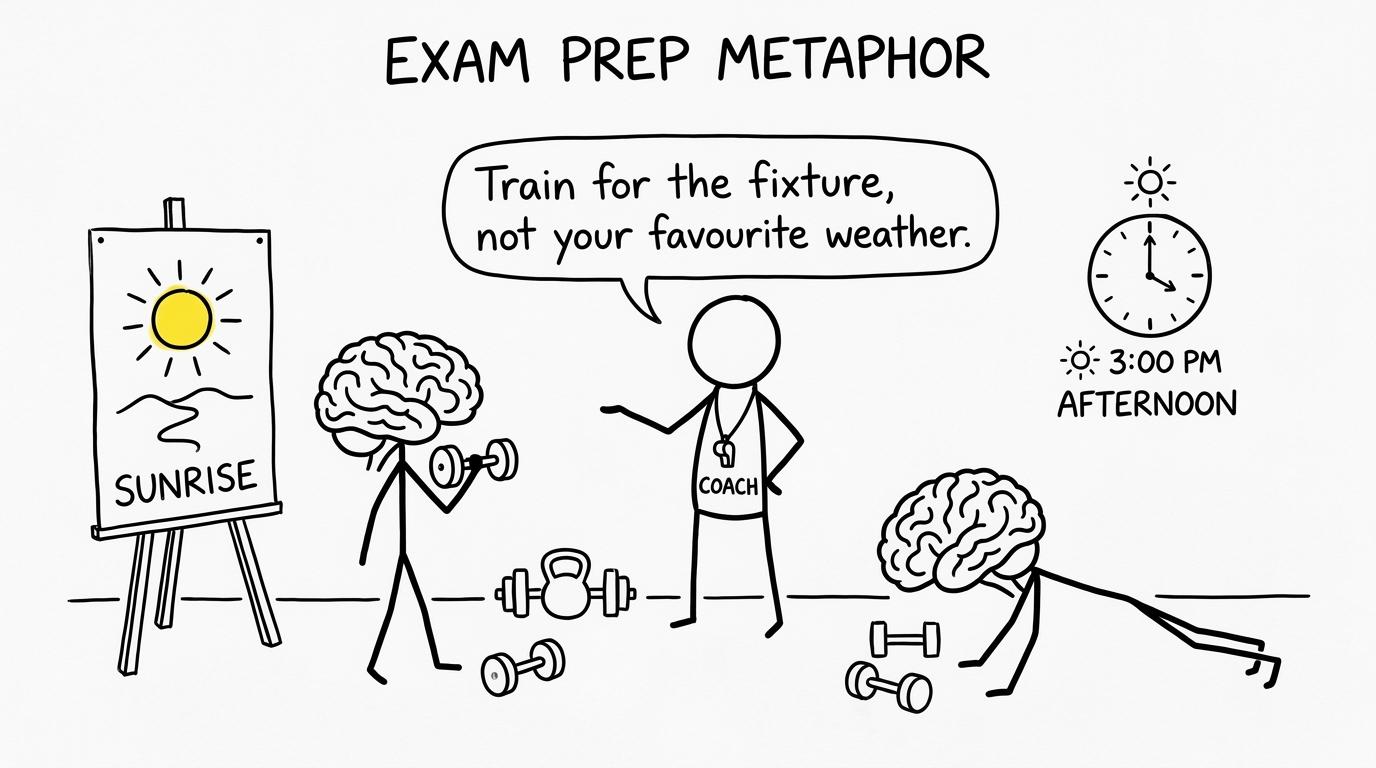 Two brains train at different times while a coach recommends preparing for the fixture
Protect the basics before either session
Students sometimes search for a perfect examination-hour routine because ordinary advice feels too simple. Yet ordinary things become powerful when several of them work together.
Sleep consistently
One unusually early night does not guarantee immediate sleep. A steadier pattern across several days is more practical than trying to repair weeks of tiredness at once. Avoid sacrificing sleep for one final revision marathon.
Keep food and caffeine familiar
Exam day is not the moment to test a new energy drink, supplement or enormous breakfast. Eat and drink in a way your body already recognises. If you normally use caffeine, avoid suddenly consuming much more because you are nervous.
Know the logistics
Check the subject, component, date, session, room and required arrival time. For maths, also confirm whether the paper is calculator or non-calculator and whether you are entered for foundation or higher tier.
The GCSE maths exam-week checklist offers a practical routine for equipment, timed practice and reviewing mistakes. If the evening before an exam is where anxiety grows, use the calm GCSE night-before plan rather than inventing a last-minute revision marathon.
Common mistakes about GCSE German exam timing
Assuming an afternoon paper guarantees a better mark
Later chronotypes may feel more alert in the afternoon, but tiredness, lunch, previous exams and anxiety can still affect performance. No session guarantees an advantage.
Trying to change your sleep pattern overnight
Going to bed several hours earlier than usual may simply create a long period of wakefulness. Make gradual, sensible adjustments and protect consistency.
Revising continuously until an afternoon exam
More revision is not always better revision. A short recall session followed by rest is usually more useful than spending the entire morning testing yourself.
Using an old or unofficial timetable
Exam dates and sessions can change between series. Confirm the current component code and follow the personalised timetable supplied by your school.
Treating one tired practice result as a prediction
A poor morning practice paper is information, not destiny. Review why marks were lost. Maths students can use the process in how to find weak GCSE topics: diagnose, mark, repair and retest.
Focus on what you can control
Morning versus afternoon can influence alertness, especially when the session conflicts with your natural rhythm. But the GCSE German exam time of day is not a verdict on your result. It is a condition to prepare for.
Confirm the correct session, rehearse focused work at a similar time, protect your sleep and keep the final hours calm. Then return your attention to the things that earn marks: knowledge, careful reading, listening closely and answering the question asked.
For the maths papers surrounding your German exam, make MathsGenie your free revision base. Start with GCSE maths revision, build confidence through revision lessons and practice questions, then use past papers, predicted papers, mini tests, mark schemes and video solutions to turn mistakes into a clear next step.











