GCSE German Exam Length: Your Real Time Breakdown
GCSE German exam length explained for AQA and Edexcel, including every paper, speaking preparation and a practical plan for energy and focus.
The odd thing about an exam is that the published duration rarely tells you how long the day will feel. A listening paper lasting 353535 minutes may involve arriving early, waiting for instructions and resetting your concentration before another assessment. The GCSE German exam length also depends on your exam board and tier.
For qualifications assessed from summer 202620262026, AQA and Pearson Edexcel divide GCSE German into four equally weighted components: listening, speaking, reading and writing. AQA’s timed assessments add up to roughly 157157157 to 192192192 minutes, excluding speaking preparation, while Edexcel’s add up to roughly 172172172 to 212212212 minutes. Your exact total depends on whether you take foundation or higher tier.
This guide separates official assessment time from the extra time you may spend in school, so you can plan your energy rather than simply count minutes.
GCSE German exam length at a glance
Check your statement of entry or ask your teacher which specification you are following. The timings below apply to the reformed AQA and Pearson Edexcel qualifications first assessed in 202620262026.
| Exam board and tier | Listening | Speaking | Reading | Writing |
|---|---|---|---|---|
| AQA Foundation | 353535 minutes | 777 to 999 minutes, plus 151515 minutes' preparation | 454545 minutes | 111 hour 101010 minutes |
| AQA Higher | 454545 minutes | 101010 to 121212 minutes, plus 151515 minutes' preparation | 111 hour | 111 hour 151515 minutes |
| Edexcel Foundation | 454545 minutes | 777 to 999 minutes, plus 151515 minutes' preparation | 454545 minutes | 111 hour 151515 minutes |
| Edexcel Higher | 111 hour | 101010 to 121212 minutes, plus 151515 minutes' preparation | 111 hour | 111 hour 202020 minutes |
These are assessment durations, not promises about how long you will be inside the exam room. Seating candidates, reading instructions, checking equipment and collecting papers can extend a session. Your school’s timetable is the final authority for arrival times and arrangements.
If you follow Eduqas or another qualification, use the current specification and your school’s timetable rather than borrowing timings from AQA or Edexcel. Paper structures can change, and similarly named components are not necessarily the same length.
How long is AQA GCSE German in total?
AQA has four components, each worth 25%25\%25% of the qualification. Foundation and higher candidates take all four components at the same tier.
AQA Foundation tier
The three written examinations total:
35+45+70=150 minutes35 + 45 + 70 = 150\text{ minutes}35+45+70=150 minutesAdding the assessed speaking time gives:
150+7=157 minutes150 + 7 = 157\text{ minutes}150+7=157 minutesat the lower end, or:
150+9=159 minutes150 + 9 = 159\text{ minutes}150+9=159 minutesat the upper end. Therefore, the total assessed time is 222 hours 373737 minutes to 222 hours 393939 minutes.
The supervised speaking preparation adds another 151515 minutes, taking your scheduled assessment-and-preparation time to approximately 222 hours 525252 minutes to 222 hours 545454 minutes across the exam series.
AQA Higher tier
The written papers total:
45+60+75=180 minutes45 + 60 + 75 = 180\text{ minutes}45+60+75=180 minutesWith the speaking assessment, the assessed total becomes 190190190 to 192192192 minutes, or 333 hours 101010 minutes to 333 hours 121212 minutes. Including the 151515 minutes of supervised preparation, the overall commitment is approximately 333 hours 252525 minutes to 333 hours 272727 minutes.
AQA listening includes 555 minutes of reading time at the beginning and 222 minutes of checking time at the end within the published paper duration. Treat those minutes as part of the assessment, not as extra time.
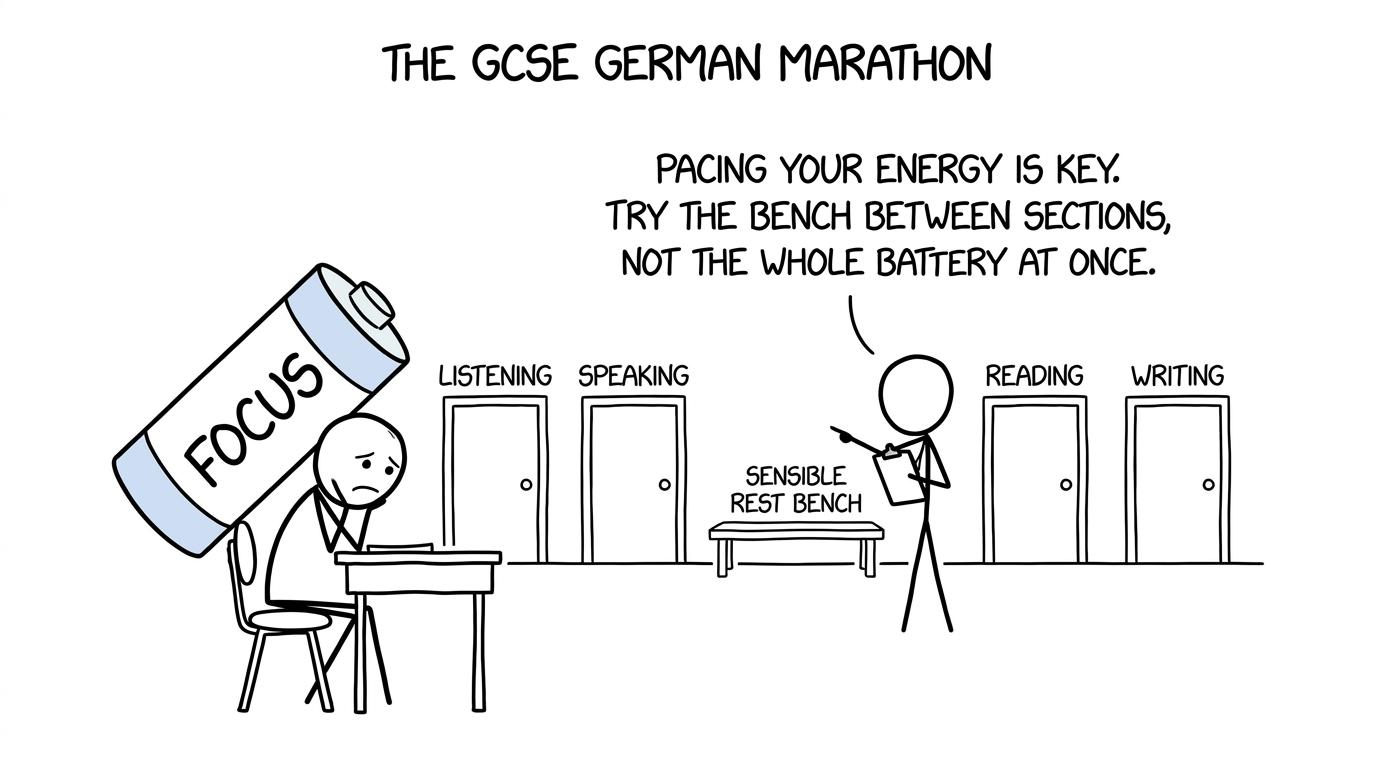 A student carries a focus battery through four GCSE German exam stages
How long is Edexcel GCSE German in total?
Pearson Edexcel also assesses speaking, listening, reading and writing separately, with each component worth 25%25\%25%.
Edexcel Foundation tier
The written examinations total:
45+45+75=165 minutes45 + 45 + 75 = 165\text{ minutes}45+45+75=165 minutesOnce the 777 to 999 minute speaking assessment is included, the assessed total is 172172172 to 174174174 minutes. That is 222 hours 525252 minutes to 222 hours 545454 minutes.
Add the 151515 minutes of formal speaking preparation and the planned total becomes 187187187 to 189189189 minutes, or 333 hours 777 minutes to 333 hours 999 minutes.
Edexcel Higher tier
The written papers total:
60+60+80=200 minutes60 + 60 + 80 = 200\text{ minutes}60+60+80=200 minutesThe speaking assessment raises this to 210210210 to 212212212 minutes, equivalent to 333 hours 303030 minutes to 333 hours 323232 minutes. Including preparation, allow for 333 hours 454545 minutes to 333 hours 474747 minutes across the series.
Edexcel’s listening duration includes 555 minutes of reading time. You may make notes during this period, so use it to inspect questions, anticipate the kind of information required and notice whether an answer must be given in English, German or non-verbally.
Why the real exam-day commitment feels longer
The four components are not taken as one continuous block. Speaking is arranged by your school within the permitted assessment period, while written papers follow the published summer timetable. Even when two papers occur on the same day, there may be a supervised break or a gap between sessions.
Your real commitment can include:
- arriving before the school’s stated registration time;
- waiting while candidate details and equipment are checked;
- listening to invigilator instructions;
- supervised preparation before speaking;
- pauses needed to start or check listening equipment;
- remaining seated while scripts are collected;
- approved access arrangements, where applicable.
There is no universal number of minutes to add. Schools organise candidates and rooms differently, and eligible access arrangements are individual. Plan around the arrival time on your school timetable, not merely the time printed on the paper.
The same distinction matters in maths. A 909090-minute practice paper measures writing time, but a useful revision session also includes marking and correcting. MathsGenie’s guide to using Edexcel GCSE Maths past papers properly explains how to separate performance from review rather than rushing both.
Plan your energy for each component
Different papers require different kinds of concentration. The best pacing plan reflects the task rather than treating every minute alike.
Listening: become alert before the recording starts
Listening is externally paced. You cannot slow the recording because one answer feels uncertain. Use the initial reading period actively: underline command words, identify the information each question requests and predict whether you are listening for an opinion, reason, tense, number or detail.
If you miss an answer, make the best note you can and mentally release it. Carrying one mistake into the next extract costs more than the original gap.
Speaking: treat preparation and performance differently
The speaking test itself is short, but it can feel intense because every response is immediate. The supervised preparation period is not general last-minute revision. It is formal preparation under exam conditions for the unseen material, and dictionaries are not permitted.
Before the day, practise moving between tasks without needing a long emotional reset. Short retrieval sessions can help; the principles in MathsGenie’s guide to turning revision notes into active recall transfer well to vocabulary, verb forms and flexible sentence structures.
Reading: spend time according to demand
Reading is self-paced, which creates a different danger: one difficult passage can absorb too much attention. Use the marks and available space as clues to the expected depth. If a question is blocking progress, mark it, continue and return later.
Do not assume that recognising a German word means you have understood the whole sentence. Negatives, time frames and contrasting connectives can reverse the meaning.
Writing: protect time for checking
Writing is the longest single component for most candidates. Before starting a longer response, identify every required bullet point. Leave enough time to check agreements, word order, verb placement, tense and whether you answered the actual question.
Checking is not the same as rereading passively. Look for one feature at a time. A first pass might check verbs; a second might check whether every task requirement has been covered.
 A GCSE student discovers that the wall clock is information rather than a threat
Build exam stamina without exhausting yourself
Knowing the timings is useful only if your revision teaches you to function within them. Begin with a single timed section, then build towards a full paper. The principle is the same one MathsGenie recommends in when to start GCSE past papers: start small while there is still time to act on what the paper reveals.
A sensible cycle is:
- complete one component or section under its official timing;
- mark it carefully using the relevant mark scheme;
- classify each lost mark as knowledge, misunderstanding, accuracy or timing;
- practise the weakest skill;
- repeat the timed task with fresh material.
For maths revision alongside German, use Edexcel GCSE Maths past papers to build concentration under realistic conditions. GCSE predicted papers can provide further unseen practice, while this guide to GCSE predicted topics explains why predictions should guide practice rather than replace broad revision.
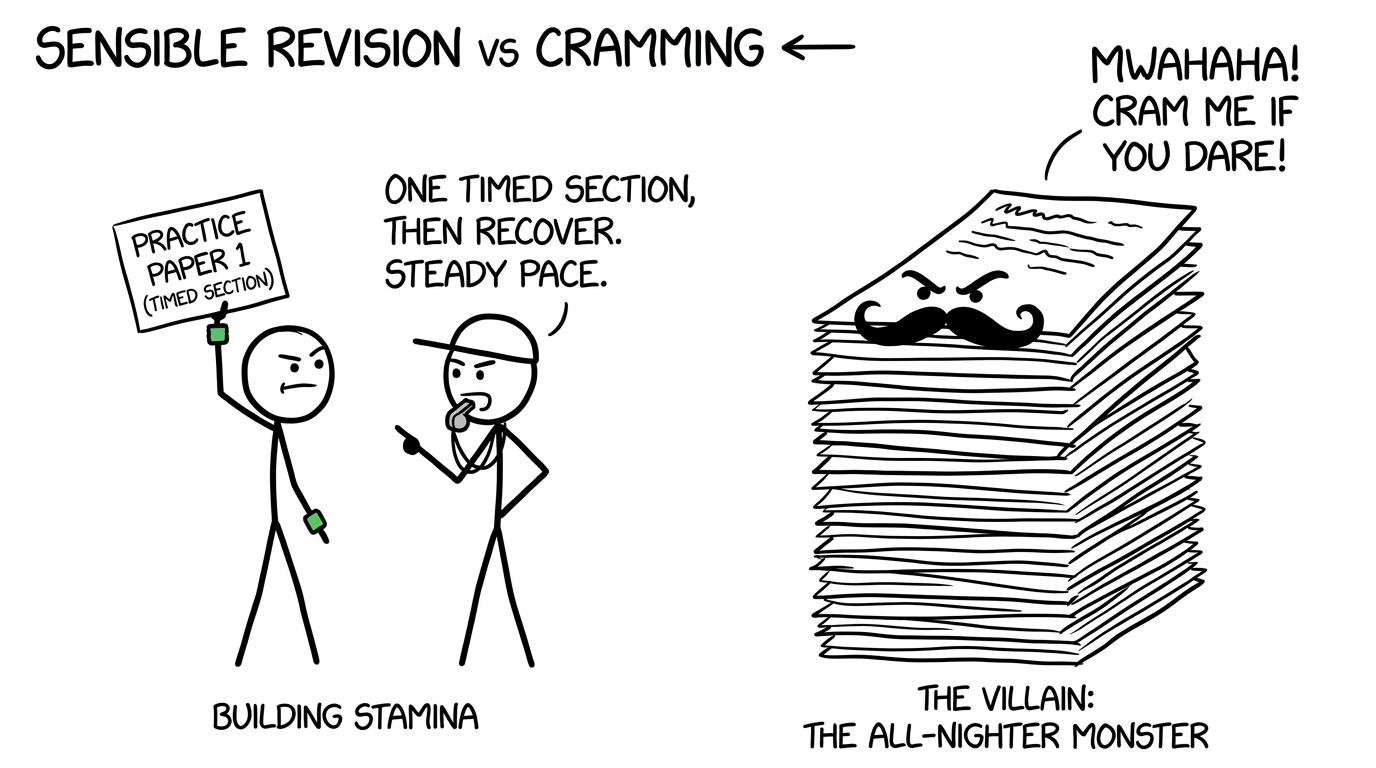 A student builds exam stamina with one paper while a huge stack wears a villain moustache
Common mistakes when planning for GCSE German
Using an old specification. Reformed AQA, Edexcel and Eduqas GCSE language qualifications are first assessed in summer 202620262026. Check that any timing sheet matches your qualification code and exam series.
Forgetting speaking preparation. The oral assessment may last only 777 to 121212 minutes, but you must also account for supervised preparation and your school’s arrival instructions.
Adding the papers and assuming they happen consecutively. The total qualification time is spread across different sessions. Consult your personal timetable for the real shape of each day.
Treating reading time as extra time. Where a listening paper includes 555 minutes of reading, that period is already contained within the published duration.
Practising without a clock until the final week. Untimed work builds knowledge, but it does not reveal whether your pace is sustainable. Introduce timed sections gradually.
Doing papers without reviewing them. Completion creates evidence; correction creates improvement. Mark schemes and careful error analysis matter as much as the timer.
Turn the timetable into a calm plan
Exam length is not just an administrative detail. It tells you what kind of concentration you must train. A short speaking assessment demands quick recovery and flexible recall. Listening requires sustained alertness at somebody else’s pace. Reading rewards controlled movement through difficulty. Writing asks you to preserve accuracy over the longest stretch.
Confirm your board, tier, qualification code and school arrival times. Then rehearse each component under the correct duration, leaving space afterwards to mark and improve.
MathsGenie can support the rest of your GCSE timetable with free revision lessons, practice questions, mini tests, past papers, predicted papers, mark schemes and video solutions. Start with one timed GCSE Maths past paper, identify where your focus or method weakened, and use the result to plan your next revision session. The clock becomes less intimidating once you have practised using it well.