GCSE Geography Tutor: Do You Really Need One?
GCSE geography tutor guidance: learn when tutoring helps, what to ask before hiring and how to protect your GCSE maths revision time and budget.

The difficult part is rarely admitting that geography feels hard. It is deciding what kind of help would actually change anything. A GCSE geography tutor may be worthwhile when a student has specific, persistent gaps that classroom teaching and focused independent revision have not resolved. But tutoring is not automatically the best answer. Sometimes the real problem is an unclear revision plan, weak exam technique or too little practice with unfamiliar sources.
That distinction matters even more if you are balancing geography with GCSE maths. Every extra lesson takes time and possibly money, so it should solve a problem you can name.
The quick decision checklist
A tutor is more likely to help if you:
- repeatedly struggle with the same geographical concepts;
- cannot turn knowledge into developed exam answers;
- find fieldwork, maps, graphs or data interpretation confusing;
- have tried structured independent revision without improvement;
- need regular feedback that school cannot currently provide;
- can explain what you want tutoring to change.
Try a focused revision plan first if you mainly:
- revise irregularly;
- read notes without answering questions;
- use resources for the wrong exam board;
- avoid marking your work;
- have not asked your teacher which weakness matters most.
The question is not simply, “Would tutoring be useful?” Almost any thoughtful teaching can be useful. The better question is, “Is tutoring the most effective next step for this particular difficulty?”
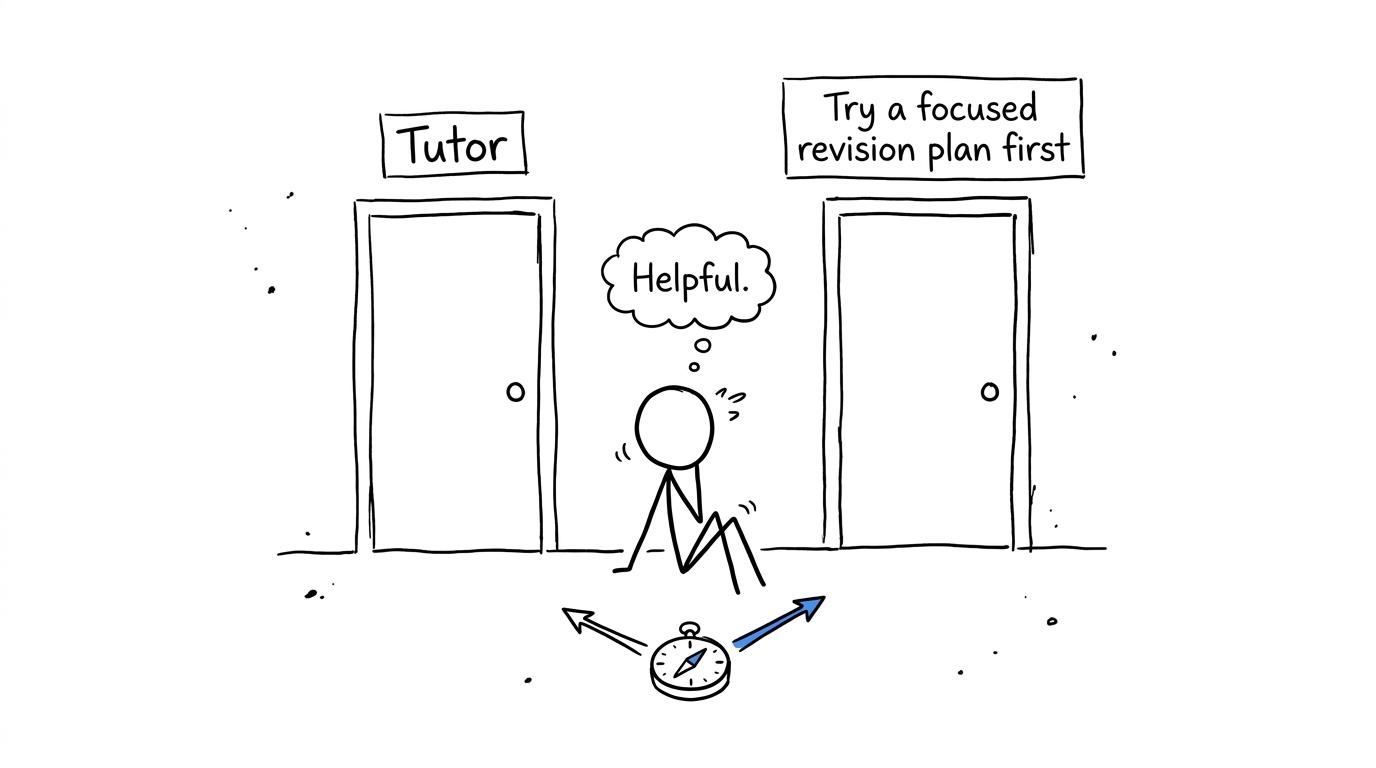 A student choosing between tutoring and focused revision while an unhelpful compass points both ways
What GCSE Geography actually assesses
Before choosing support, understand the shape of the qualification. The precise papers and content vary between AQA, Edexcel, OCR and Eduqas, so always check your current specification. Across GCSE Geography in England, however, assessment is not based on recalling case-study facts alone.
Ofqual's assessment objectives allocate approximately:
- 15%15\%15% to knowledge of places, processes, environments and scales;
- 25%25\%25% to geographical understanding;
- 35%35\%35% to applying, interpreting, analysing, evaluating and making judgements;
- 25%25\%25% to geographical skills and communication.
At least 10%10\%10% of the subject marks must assess mathematical and statistical techniques. Fieldwork is also important: the subject requirements allocate 15%15\%15% of the assessment to fieldwork contexts, combining application and geographical skills.
This explains why memorising a thick stack of notes can still lead to disappointing marks. A student may know the content but struggle to interpret a resource, select evidence, evaluate a method or sustain a justified conclusion. Those are performance problems, not simply memory problems.
There is also a useful connection with maths. Geography may involve percentages, averages, ratios, graphs, scales, coordinates, sampling and numerical comparisons. If these skills are slowing you down, use the free GCSE Maths revision hub to strengthen the underlying maths rather than paying a geography tutor to reteach every numerical skill in context.
Signs a GCSE geography tutor could genuinely help
Your gaps survive careful independent revision
One difficult mock does not automatically justify tutoring. First, diagnose the lost marks. Separate them into three categories:
- Knowledge: you did not know the relevant process, example or terminology.
- Application: you knew the topic but could not use it with the question's resource.
- Exam technique: you misread the command word, wrote too little or made an unsupported judgement.
If the same problem remains after lessons, teacher feedback and targeted practice, individual explanation may be valuable. A tutor can slow the process down, question your reasoning and identify the exact point where understanding breaks.
You need feedback on extended answers
Independent revision works well for recall, but students cannot always judge the quality of their own evaluative writing. A good tutor should explain why an answer reaches a particular level, show where evidence is missing and help you make a conclusion proportionate to the question.
The goal is not to give you model paragraphs to memorise. It is to make you less dependent on models because you understand how an argument is built.
Fieldwork and geographical skills remain unclear
GCSE fieldwork assessment can cover enquiry questions, sampling, data collection, presentation, analysis, conclusions and evaluation. Your school must provide the required fieldwork opportunities; private tutoring cannot replace that experience.
A tutor can, however, help you make sense of what you did. You should become able to justify a method, recognise limitations, identify anomalies and assess whether a conclusion is reliable. They should also prepare you for unfamiliar fieldwork contexts rather than rehearsing only your own investigation.
You work better with external structure
Some students understand the subject but struggle to begin, organise and review their revision. A weekly appointment may provide useful accountability. Yet structure alone is an expensive reason to hire a tutor if a timetable, teacher check-in or revision partner would achieve the same result.
Test the cheaper solution first. Maths students can adapt the routine in MathsGenie's GCSE revision timetable guide: diagnose a weakness, practise it, mark the work and schedule a retest. The subjects differ, but the learning cycle remains sound.
When tutoring may not be the answer
A tutor cannot compensate for passive revision between sessions. If you attend for an hour, listen carefully and then do nothing until the next lesson, progress will be limited. Effective tutoring creates actions outside the lesson: retrieval, timed questions, corrections and another attempt.
Tutoring is also unlikely to solve:
- using materials for the wrong exam board;
- missing homework through poor organisation;
- trying to revise every case study in one evening;
- avoiding questions because mistakes feel uncomfortable;
- severe stress that requires pastoral or professional support rather than more teaching.
If several subjects are slipping at once, the central problem may be workload rather than geography. Start with a realistic plan. MathsGenie's guide to catching up on GCSE revision shows how to turn a vague sense of being behind into a short list of next actions.
What to look for in a GCSE geography tutor
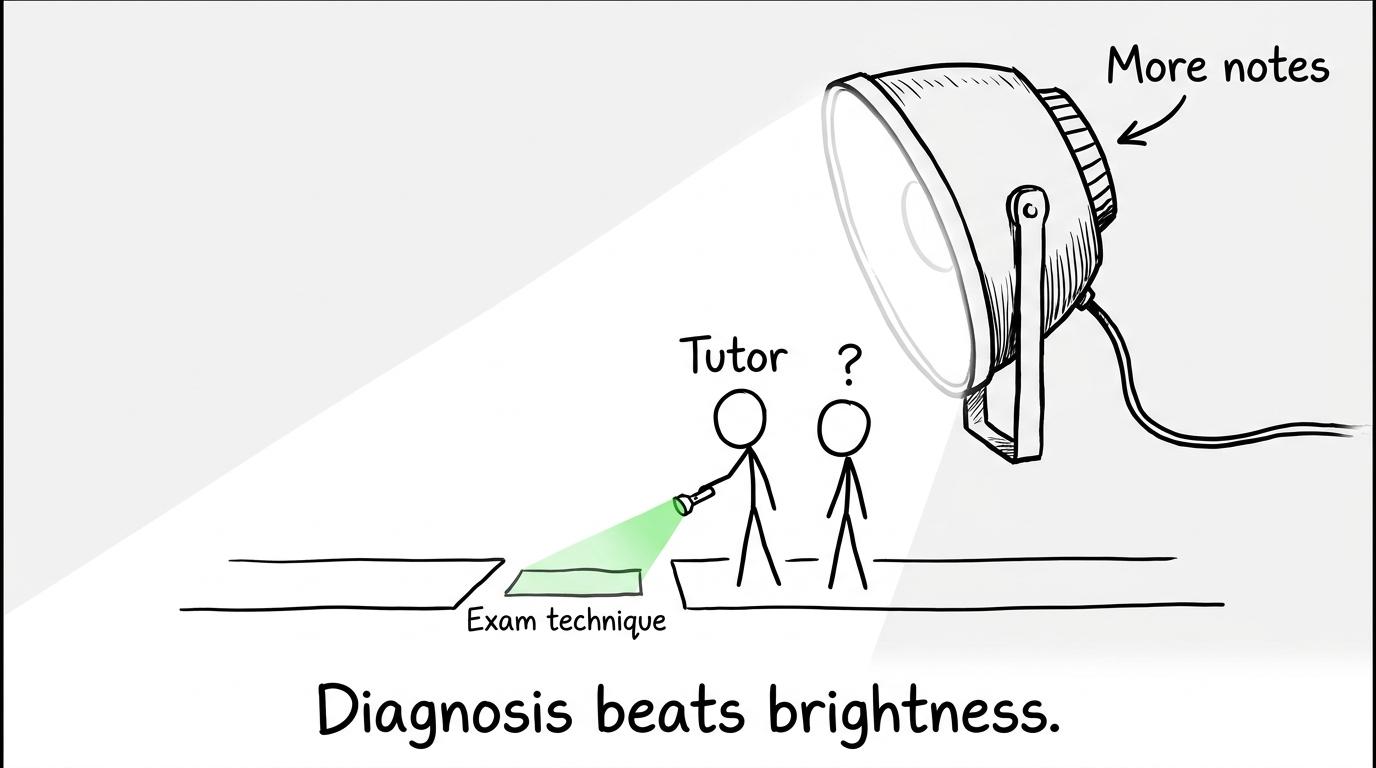 A tutor diagnosing one exam-technique gap while a giant floodlight of extra notes points elsewhere
Knowledge of your exam board and specification
A suitable tutor should ask whether you take AQA, Edexcel, OCR or Eduqas before planning lessons. They should understand your paper structure, prescribed and optional content, fieldwork expectations, command words and mark schemes.
Ask which version of the specification they use and how they keep resources current. Confidence is not the same as accuracy.
A diagnostic first lesson
The first session should reveal something. A tutor might review a mock, inspect several answers or ask you to explain a difficult process. Be cautious if the proposed solution is simply to work through the whole course from the beginning.
Good support is selective. It spends time where time has the highest value.
Clear explanations followed by student thinking
An impressive explanation can create the feeling of understanding without the reality of it. The student should answer questions, interpret resources, plan responses and explain decisions during the lesson.
A useful tutor gradually reduces support. If every answer depends on prompts after several weeks, the arrangement may be creating comfort rather than independence.
Mark-scheme literacy without formulaic writing
The tutor should understand how marks are awarded while recognising that extended responses are not produced by one universal paragraph formula. Strong geography answers respond to the specific command word, evidence and context.
Ask how they teach the difference between describing, explaining, assessing and evaluating. Their answer should be clearer than “write more detail”.
Safeguarding, communication and practical fit
A parent or carer should be involved in checking references, qualifications where relevant, safeguarding arrangements and the policies of any tutoring platform. Agree the lesson format, cancellation terms, communication boundaries and how progress will be reviewed before committing to a long block.
A tutor can be knowledgeable and still be the wrong fit. You need explanations you understand, feedback you can act on and a pace that requires genuine thought without leaving you lost.
How to test whether tutoring is working
Set a short review period and choose two or three outcomes before the first lesson. For example:
- improved accuracy when interpreting unfamiliar resources;
- stronger evaluation of fieldwork methods;
- more complete answers within the available time;
- fewer repeated errors on a defined topic.
Keep samples of work and compare like with like. A higher raw mark on an easier question proves little. Instead, look for better decisions: more relevant evidence, clearer chains of reasoning, justified conclusions and less prompting.
Use a simple loop:
- attempt a question independently;
- mark it using the official mark scheme or teacher feedback;
- identify the precise reason for each lost mark;
- address the gap with the tutor;
- attempt a similar question later without help.
This resembles the approach in MathsGenie's guide to using GCSE past papers properly. In maths, you can continue the same process with Edexcel GCSE predicted papers, mark schemes and video solutions.
If independent performance does not improve, discuss it openly. The lesson focus may need to change, another tutor may be more suitable, or tutoring may not be solving the real problem.
Protecting your GCSE maths revision time
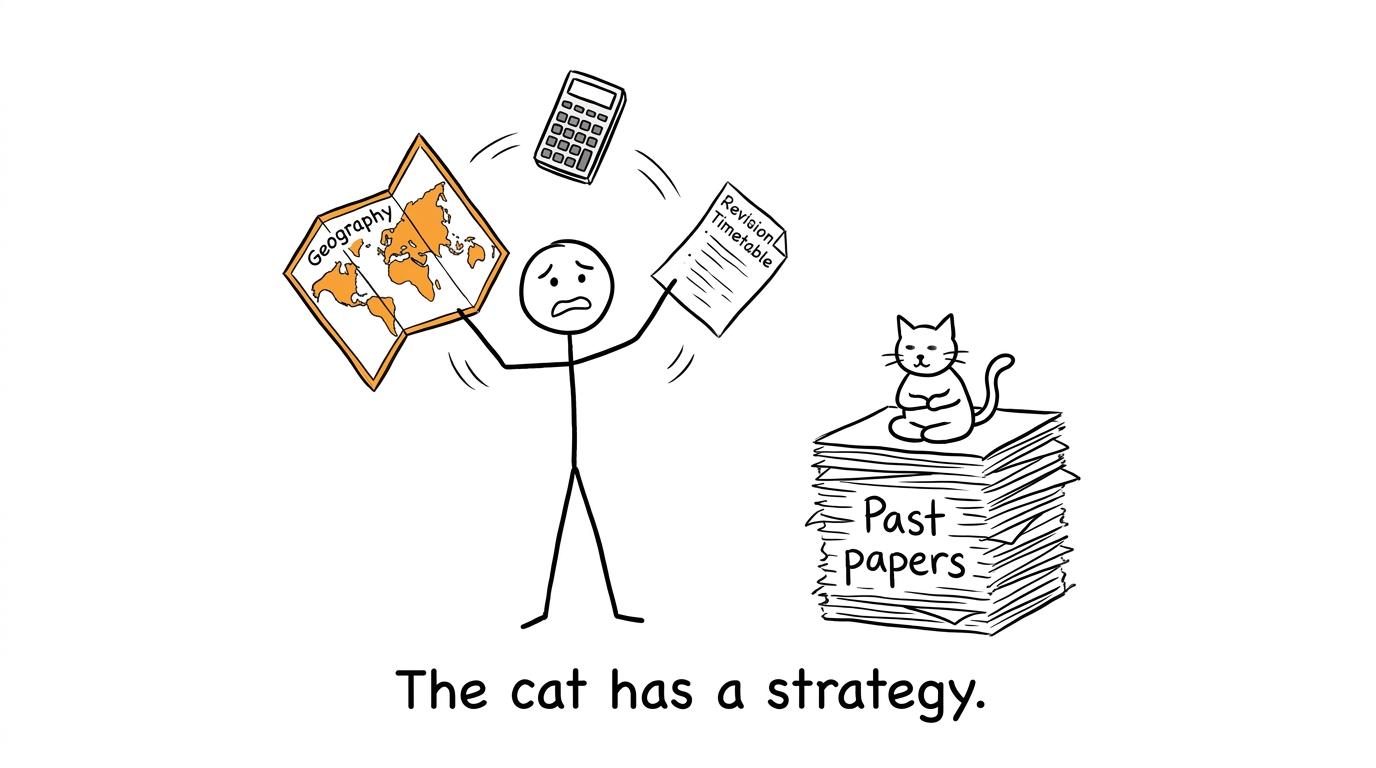 A student juggling a map, calculator and timetable while a cat chooses the past-paper pile
Geography support should not quietly consume the time needed for maths. Plan both subjects around evidence rather than whichever exam currently feels most alarming.
For maths, begin with topic-level diagnosis. MathsGenie's guide to the best order for learning GCSE maths topics can help you sequence number, algebra, ratio, geometry, statistics and exam practice. Use GCSE Maths 45-minute tests when a full paper would be too demanding.
A balanced week might contain short geography recall, one extended-answer session, several maths topic sessions and one timed paper section. Build these into a revision planner before adding tutoring. The appointment must fit the plan; it should not become the plan.
Common mistakes when deciding on a tutor
Hiring before identifying the problem
“Improve geography” is too vague. Name the topic, skill or question type that needs attention.
Choosing entirely on price or promises
Cost matters, but a cheap unsuitable tutor wastes money and revision time. Equally, a high fee or bold grade promise does not demonstrate quality. Look for diagnosis, specification knowledge and a credible teaching process.
Measuring success by confidence alone
Confidence matters, but it should eventually appear in independent work. Review marked answers and repeated question types, not just whether lessons feel reassuring.
Letting the tutor do the hard thinking
Watching someone produce excellent answers is not the same as learning to produce them. You should spend a meaningful part of each lesson retrieving, interpreting, planning and writing.
Neglecting other subjects
One subject can expand to fill every available evening. Protect regular maths practice, particularly if you are building towards foundation or higher-tier papers.
Make the next decision small and useful
You do not need to decide whether tutoring is good in general. Decide whether it solves your next clearly defined geography problem better than the available alternatives.
Start by reviewing a recent assessment, asking your teacher for the most important weakness and completing a short period of structured practice. If the gap remains, trial a tutor who knows your exam board, diagnoses before teaching and measures progress through independent work.
Meanwhile, keep maths revision moving. Use MathsGenie as your free revision base for lessons, practice questions, mini tests, past papers, predicted papers, mark schemes and video solutions. Choose one weak maths topic today, practise it and schedule a retest. Good revision rarely begins with doing everything. It begins with knowing what should happen next.