GCSE Geography Revision Environment: Does It Matter?
GCSE geography revision environment advice that separates useful changes from hype, helping you focus, remember case studies and revise effectively.
Revision advice can make your room sound like a laboratory. Find the perfect lamp. Buy matching stationery. Play exactly the right playlist. Never revise on your bed.
The honest answer is simpler: your GCSE geography revision environment does matter, but it is not the main thing determining how much you remember. A quieter, lower-distraction space can make concentration easier, particularly when you are learning case studies or writing extended answers. Yet an ordinary kitchen table with active self-testing will usually beat a beautiful desk used for passive rereading.
Your environment should support effective revision. It cannot replace it.
The short answer: what actually matters?
Use this checklist before changing your entire room:
- Reduce conversations, notifications and avoidable interruptions.
- Keep only the resources needed for the current task within reach.
- Use enough light to read maps, graphs and small labels comfortably.
- Choose a chair and surface that let you work without persistent discomfort.
- Decide what you will produce before the session begins.
- Test yourself rather than simply rereading notes.
- Recreate exam conditions sometimes, but not for every session.
- Change location if your usual space repeatedly encourages sleep, scrolling or conversation.
The best environment is not the most impressive one. It is the place where starting is easy and distraction is slightly inconvenient.
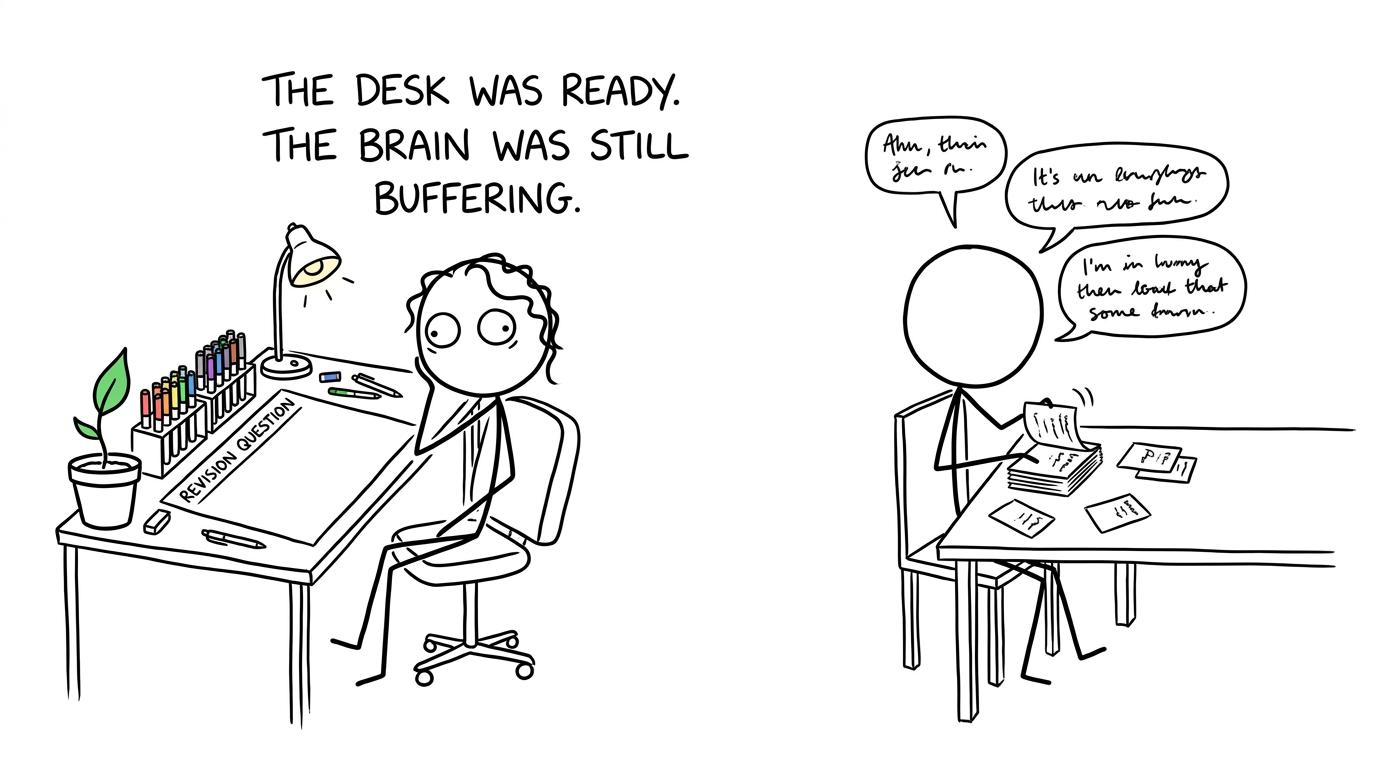 A polished revision desk waits while active revision happens at a plain table
Why your revision environment can affect learning
Attention is limited. Every conversation you follow, notification you check or lyric you mentally complete competes with the information you are trying to process.
This is particularly relevant to geography. Revision may require you to hold several connected ideas in mind: a physical process, its consequences, a named example and the evidence supporting an evaluation. Background speech can interfere with verbal working memory, and recent reviews of learning environments continue to associate intrusive noise with weaker attention, memory and reading performance in children and adolescents.
That does not mean absolute silence is compulsory. Research findings vary by task and by individual. Predictable background sound may feel manageable during simple organisation, while speech and lyrics are more likely to interfere with reading, recall and complex reasoning. If you enjoy music, compare your performance rather than trusting your preference. Can you recall more accurate detail afterwards, or did the session merely feel pleasant?
Interruptions create a hidden restart cost
A phone does not need to be in your hand to shape your attention. If it lights up beside your notes, part of the decision has already been made for you: look or resist.
Removing that decision is easier than repeatedly winning it. Put the phone in another room, inside a bag or beyond arm's reach. If you need it as a timer, use flight mode or a focus setting and close unrelated apps before beginning.
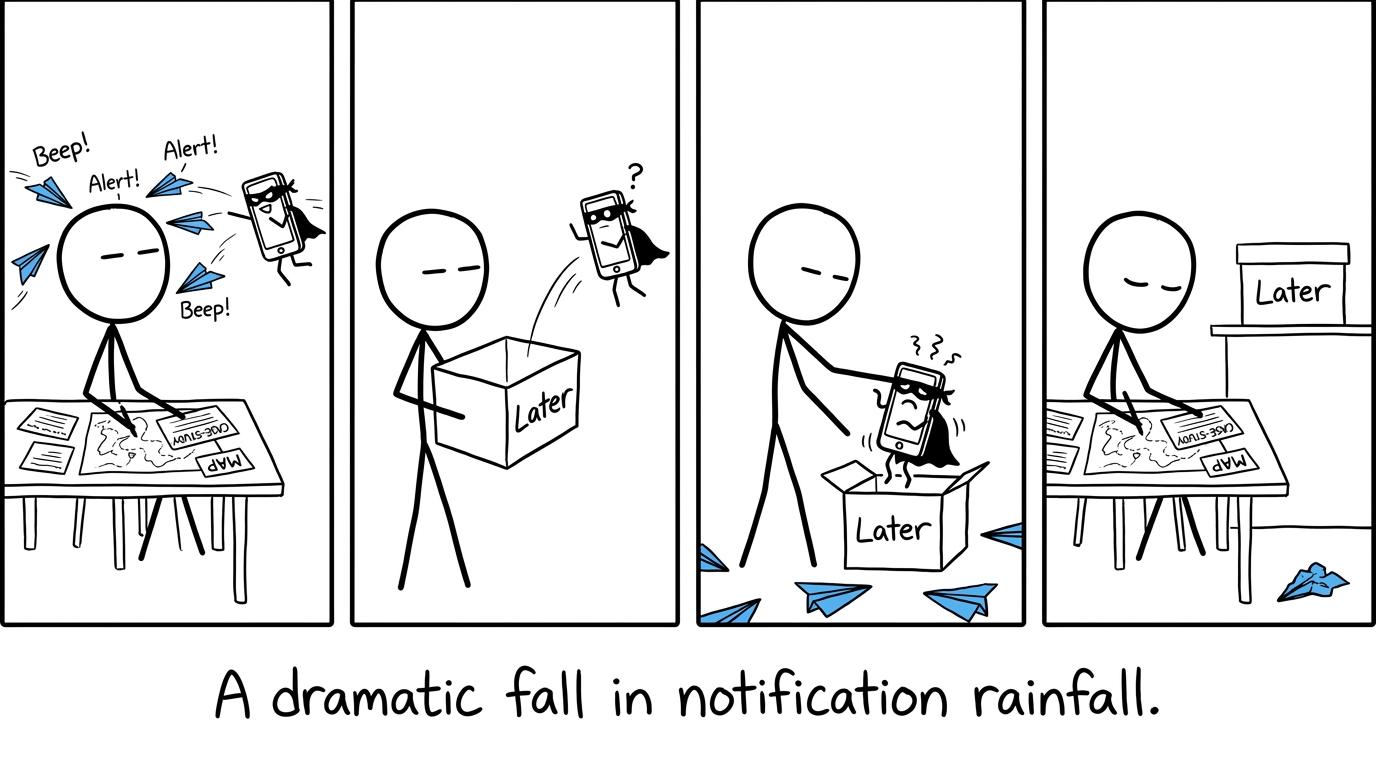 A notification villain is defeated by a simple phone box
Physical comfort matters, within reason
Poor lighting, an uncomfortable temperature or a chair that causes pain can pull attention away from revision. Fix obvious problems where you can: use a clear surface, face the light towards your work and keep water nearby.
But comfort has limits. A place designed mainly for sleep can keep inviting you to sleep. A sofa facing a television offers an obvious escape route. You do not need an expensive ergonomic set-up, but you do need somewhere that allows alert, deliberate work.
Method matters more than location
A revision environment has value only because it changes what you do inside it.
Imagine two hypothetical sessions. In the first, a student spends an hour quietly highlighting a textbook. In the second, a student at a less elegant table closes the book, reconstructs a case study from memory, answers an exam question and checks the response against a mark scheme. The second environment may look worse, but the learning process is stronger.
Evidence on metacognition and self-regulated learning consistently supports planning, monitoring and evaluating learning within subject content. In practical terms, every geography session should have a visible loop:
- Plan: choose one precise outcome, such as recalling coastal management evidence.
- Attempt: retrieve the information or answer a question without notes.
- Check: compare your response with reliable notes or a mark scheme.
- Correct: add the missing detail and explain the error.
- Retest: return to the same knowledge later without support.
This resembles the approach MathsGenie recommends for maths: attempt, mark, diagnose and repair. The guide to finding your weakest GCSE topics explains why evidence from questions is more useful than guessing what you know.
Build an environment for GCSE Geography tasks
Geography revision is not one activity. Your set-up should change with the task.
For case studies and examples
Remove your notes from immediate view. Use a blank page, flashcards or spoken recall to retrieve the location, causes, effects, responses and supporting evidence. Check only after committing to an answer.
A silent or low-speech environment is helpful because the task depends heavily on verbal recall. Keep one case study pack on the desk rather than surrounding yourself with the entire course.
For maps, graphs and geographical skills
Use a flat, well-lit surface with a ruler, pencil and calculator available where appropriate. GCSE geography specifications require students to interpret cartographic, graphical, numerical and statistical information, so equipment friction matters. Five minutes spent searching for a ruler is five minutes in which the session can collapse.
Maths supports these skills. The free GCSE maths revision hub provides topic lessons, practice questions and solutions for graphs, averages, percentages and other quantitative techniques that can also strengthen geographical confidence.
For extended answers
Use a timer and write by hand if that matches your exam. Work somewhere quiet enough to sustain an argument without checking notes halfway through. Afterwards, evaluate whether your answer used accurate knowledge, developed links and responded to the command word.
The environment should make completion visible. A finished answer gives you evidence. Twenty minutes of thinking about an answer does not.
For realistic exam practice
Occasionally recreate the conditions you will face: a clear desk, permitted equipment, no phone, no notes and a fixed time. You do not need to make every revision session feel like an exam. Learning sessions can include feedback and corrections; assessment sessions should reveal what you can do independently.
MathsGenie's guide to using GCSE past papers properly makes this distinction clear. A paper identifies gaps; the improvement happens when you mark, correct and revisit them. The same principle applies to geography papers from AQA, Edexcel, OCR or Eduqas.
Is revising in your bedroom a bad idea?
Not automatically. A bedroom can work well if it is quiet, available and easy to organise. The real question is what behaviour the room triggers.
If sitting at your desk reliably leads to focused work, keep using it. If you repeatedly move to the bed, open entertainment tabs or abandon the session, try a library, school study area or shared table. Treat the change as an experiment rather than a judgement about discipline.
Run several comparable sessions in each place. Use similar tasks and record something observable: questions completed, facts recalled or marks gained. Your feeling about a room matters, but your output is better evidence.
A practical schedule matters too. The GCSE maths revision timetable guide shows how short topic sessions, marking and timed practice can fit together without turning revision into an endurance contest.
Should you always revise in the same place?
Consistency reduces the effort needed to begin. When the same cue leads to the same routine, you spend less time negotiating with yourself.
However, you should not become dependent on perfect conditions. Your actual exam room may contain movement, coughing or an unfamiliar clock. Once knowledge is becoming secure, practise retrieving it in more than one sensible location. You are not trying to make revision difficult; you are making recall more portable.
Build a small repeatable kit:
- the exact notes or questions for the session;
- pens, pencil and ruler;
- water;
- a simple timer;
- headphones or ear defenders if they safely reduce unavoidable noise;
- an error log for what to revisit.
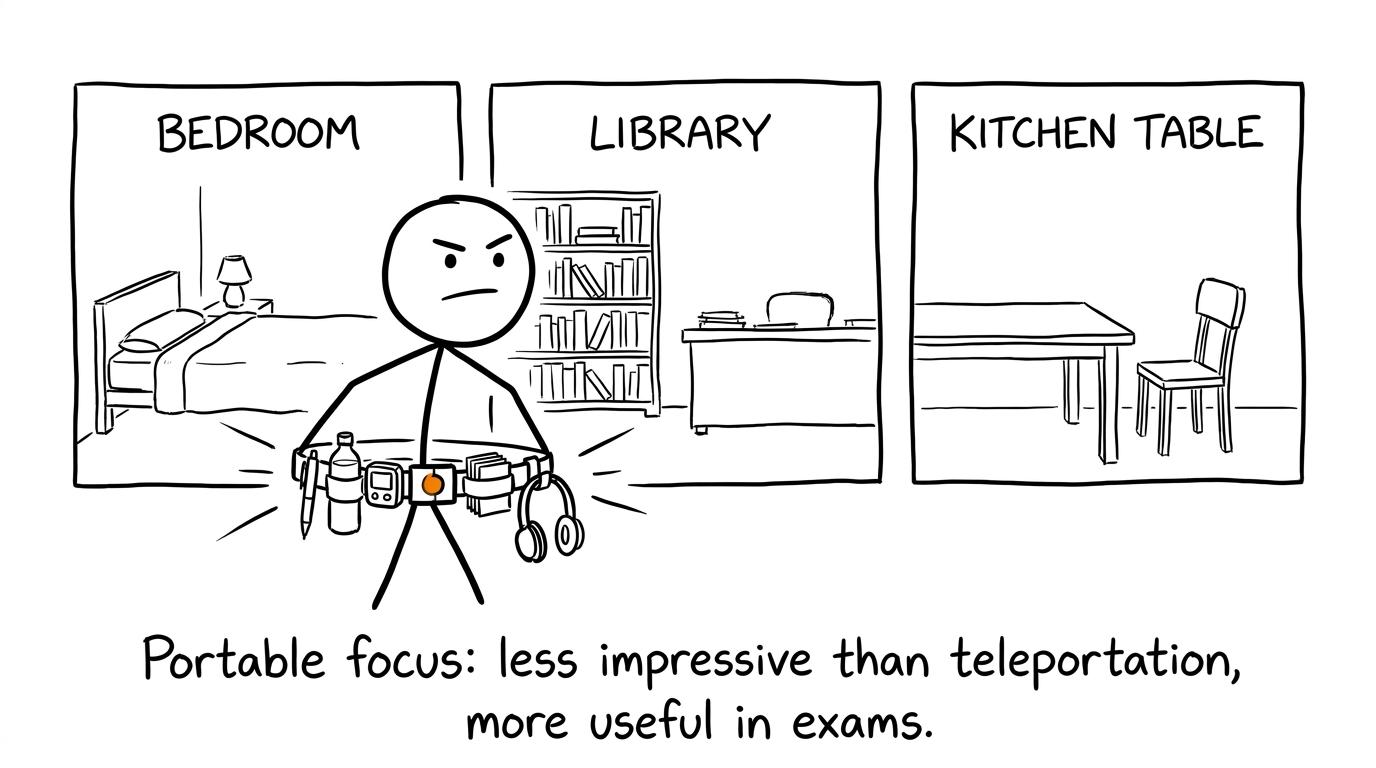 A student carries portable focus between several ordinary revision locations
A practical revision-environment reset
Do not redesign everything. Make the smallest change that improves the next session.
Before you begin
Write one outcome: “Recall my urban case study and complete one comparison question.” Open the necessary page, collect your equipment and remove unrelated materials. Put your phone away.
If choosing tasks is the obstacle, borrow the diagnostic approach in MathsGenie's one-week GCSE revision plan: identify a short fix list, practise it, mark it and use the result to choose tomorrow's work.
During the session
Work on one task at a time. If distracting thoughts appear, note them on scrap paper rather than acting on them. Take a brief break when attention genuinely fades, then restart with a specific prompt.
Avoid turning timing into a superstition. A 252525-minute block can be useful, but it is not inherently better than 202020 or 404040 minutes. Choose a duration that lets you finish a meaningful unit of work.
After the session
Record what you could not retrieve and what the mark scheme required. Leave tomorrow's first resource ready if possible. This small step lowers the cost of starting again.
For maths sessions alongside geography, AQA GCSE maths past papers provide papers, mark schemes and worked solutions, while Edexcel GCSE maths predicted papers offer fresh exam-style practice near the exams.
Common revision-environment mistakes
Optimising the room instead of revising
Tidying can help, but repeated organisation is often avoidance wearing sensible clothes. Set a short limit, clear the working area and begin.
Treating background music as harmless by default
Music can affect tasks differently. Lyrics are particularly capable of competing with reading and verbal recall. Test quiet, instrumental sound and your usual playlist using comparable retrieval tasks.
Keeping every resource open
Too many books, tabs and worksheets create choices. Choose one task and one checking source. Everything else can wait.
Confusing time at the desk with learning
Hours are inputs, not proof. Questions answered, knowledge retrieved and errors corrected provide stronger evidence. MathsGenie's advice on learning GCSE topics in a sensible order similarly moves from learning to practice, mini tests and exam questions.
Copying someone else's perfect set-up
Some students need more quiet than others. Homes and responsibilities differ too. Build the best workable arrangement available to you, not the room shown in somebody else's revision video.
Your environment is a lever, not the engine
So, does where you revise for GCSE Geography change how much sticks? Yes, especially when noise, phones, discomfort or interruptions repeatedly divide your attention. But the effect is often overstated. A perfect room cannot rescue passive revision, while a modest space can support excellent learning when you retrieve, answer, mark and correct.
Start with one environmental change today: move the phone, reduce speech, clear the desk or prepare a portable revision kit. Then improve the method taking place inside that environment.
For the maths part of your GCSE timetable, make MathsGenie GCSE revision your free starting point. Use revision lessons to rebuild understanding, practice questions and mini tests to expose gaps, then past papers, predicted papers, mark schemes and video solutions to turn a calm workspace into marks you can actually measure.