GCSE Geography Grade 8 Meaning Explained
GCSE geography grade 8 meaning explained: discover the ability it represents, how it compares with A and A*, and what strong answers need to show in exams.
A mock result can look precise while leaving you with a surprisingly vague feeling. You see Grade 8 beside Geography, know it is excellent, then wonder what it actually says about your work.
The GCSE geography grade 8 meaning is straightforward: it represents very strong geographical knowledge, perceptive understanding of complex relationships, convincing evidence-based arguments and effective use of geographical skills. It sits immediately below Grade 9 and within the part of the current scale that replaced the old A and A* range. It is not, however, an exact translation of one old letter grade.
For students balancing Geography with GCSE maths revision, there is another useful point. Grade 8 Geography depends partly on the same habits that improve mathematical performance: interpreting unfamiliar information, selecting relevant evidence, handling data accurately and explaining what the evidence shows.
Grade 8 Geography at a glance
A Grade 8 student can typically:
- recall relevant, detailed knowledge without turning every answer into a fact dump;
- explain interactions between people, places, processes and environments;
- apply knowledge to unfamiliar maps, photographs, graphs and data;
- analyse evidence rather than merely describe it;
- evaluate competing arguments and reach supported judgements;
- use fieldwork methods and geographical techniques effectively;
- construct sustained conclusions that answer the precise question.
The important word is consistency. One outstanding essay does not determine the final grade. Your marks are combined across the qualification, so strong knowledge must be supported by sound skills, application and judgement throughout the papers.
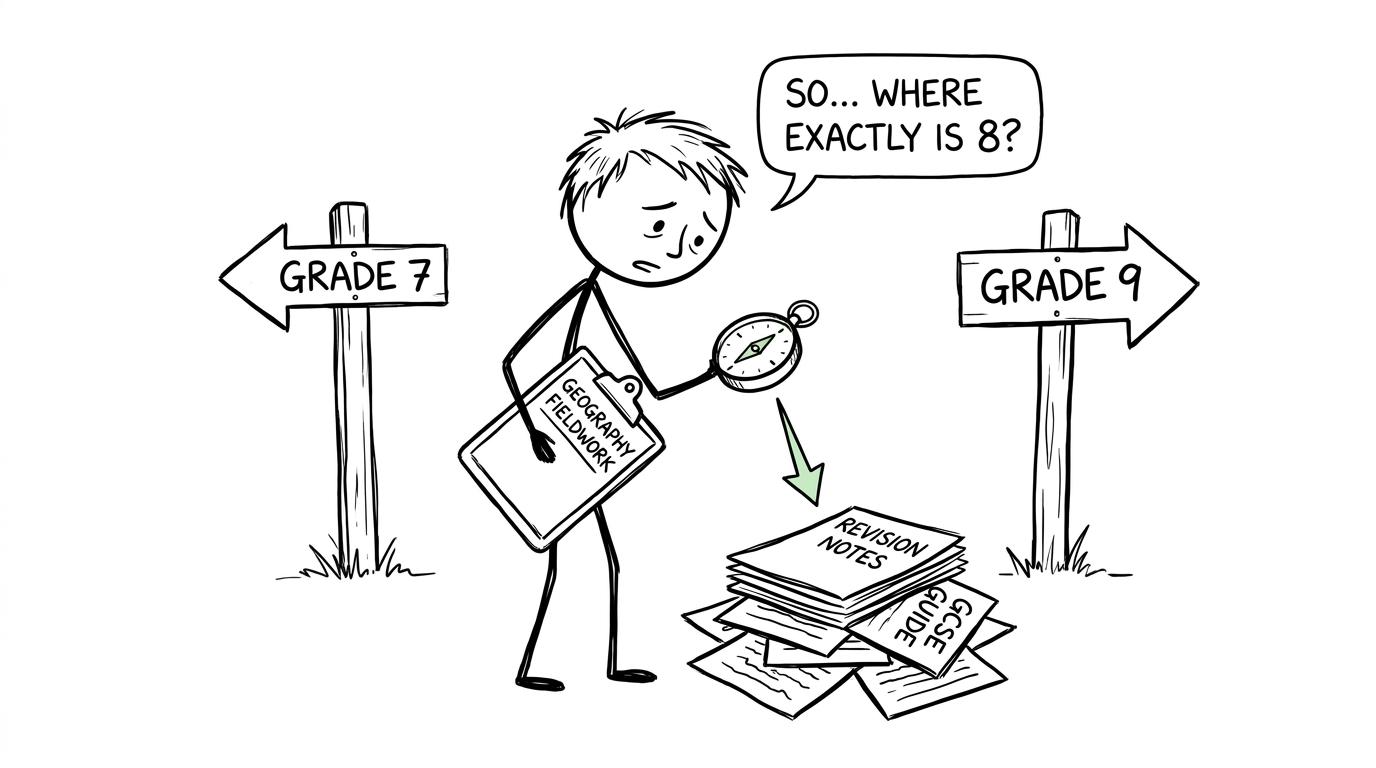 A student asks a compass where Grade 8 is between Grades 7 and 9
What does a Grade 8 represent in terms of ability?
Ofqual's official Geography descriptor says that Grade 8 candidates demonstrate relevant and comprehensive knowledge, perceptive understanding of complex interactions, sustained and convincing arguments, well-evidenced conclusions, and effective use and evaluation of a wide range of geographical skills.
That description matters more than any guessed percentage. Grade boundaries change between exam series and specifications because papers are not identical in difficulty. Exam boards set boundaries after marking, using evidence and expert judgement to maintain a comparable standard over time.
The official descriptor is also an overall picture, not a mark scheme. You do not receive Grade 8 simply by including a particular number of case-study facts or connective phrases. The grade emerges from the quality of your performance across different questions and assessment objectives.
Comprehensive knowledge
At this level, knowledge is accurate, relevant and sufficiently detailed. You understand physical and human processes, locations, environments and different scales. You can use case studies selectively rather than reproducing everything you memorised.
The distinction is subtle but important. A long answer may contain more information; a strong answer contains more useful information.
Perceptive geographical understanding
Grade 8 performance goes beyond saying that two factors are connected. It explains how and why they interact, perhaps recognising that an effect varies over time, between social groups or across locations.
For example, geographical issues rarely have one isolated cause or one universally successful solution. Strong candidates recognise systems, feedback, trade-offs and differences in perspective without losing sight of the question.
Application and analysis
An unfamiliar resource should not make your knowledge disappear. Grade 8 students can connect what they know to a new graph, map, photograph, fieldwork result or decision-making context.
This is where Geography begins to resemble higher-tier mathematical problem-solving. The surface of the question may look unfamiliar, but the underlying skills remain stable: identify what is given, choose relevant information, process it accurately and communicate a justified conclusion.
Evaluation and judgement
A convincing judgement is not an opinion placed at the end of an answer. It follows from evidence considered throughout the response.
High-level evaluation may consider scale, time, reliability, sustainability, affected groups and the relative importance of different factors. The conclusion then answers the exact question and explains why the evidence supports that position.
How Grade 8 compares with the old letter grades
England has used the GCSE scale from Grade 9 to Grade 1 since the reformed qualifications were introduced. The numerical and old letter scales are not directly equivalent.
The official anchor points are:
- the bottom of Grade 7 aligns with the bottom of the old Grade A;
- the bottom of Grade 4 aligns with the bottom of the old Grade C;
- the bottom of Grade 1 aligns with the bottom of the old Grade G.
Grades 7, 8 and 9 together provide greater differentiation across the old A and A* range. Grade 8 is therefore commonly understood as sitting between an old A and A*, with substantial overlap towards A* performance. Calling it simply “an A*” is too definite because no exact one-to-one conversion exists.
| Current grade | Broad comparison with the old scale |
|---|---|
| Grade 9 | The very top of the former A* range |
| Grade 8 | Within the former A/A* range, commonly described as between A and A* |
| Grade 7 | Its lower boundary aligns with the lower boundary of the old A |
| Grade 4 | Its lower boundary aligns with the lower boundary of the old C |
The safest interpretation is that Grade 8 is an excellent result showing performance securely above the Grade 7 standard, but below the exceptionally high threshold for Grade 9.
What examiners are assessing
Across GCSE Geography specifications in England, including AQA, Pearson Edexcel, OCR and Eduqas, the regulated assessment objectives cover four broad areas. Paper structures and topic choices differ, so always use the specification for your own board.
| Assessment objective | What it assesses | Overall weighting |
|---|---|---|
| AO1 | Knowledge of locations, places, processes, environments and scales | 15%15\%15% |
| AO2 | Understanding concepts and geographical interrelationships | 25%25\%25% |
| AO3 | Applying knowledge to interpret, analyse, evaluate and make judgements | 35%35\%35% |
| AO4 | Selecting and using geographical skills and techniques | 25%25\%25% |
This balance explains why memorising alone has a ceiling. Knowledge remains essential, but AO3 and AO4 together account for:
35%+25%=60% 35\% + 25\% = 60\% 35%+25%=60%A large part of the qualification therefore rewards what you can do with information. Fieldwork contexts contribute within AO3 and AO4, so method choice, data interpretation, conclusions and evaluation of limitations deserve serious revision.
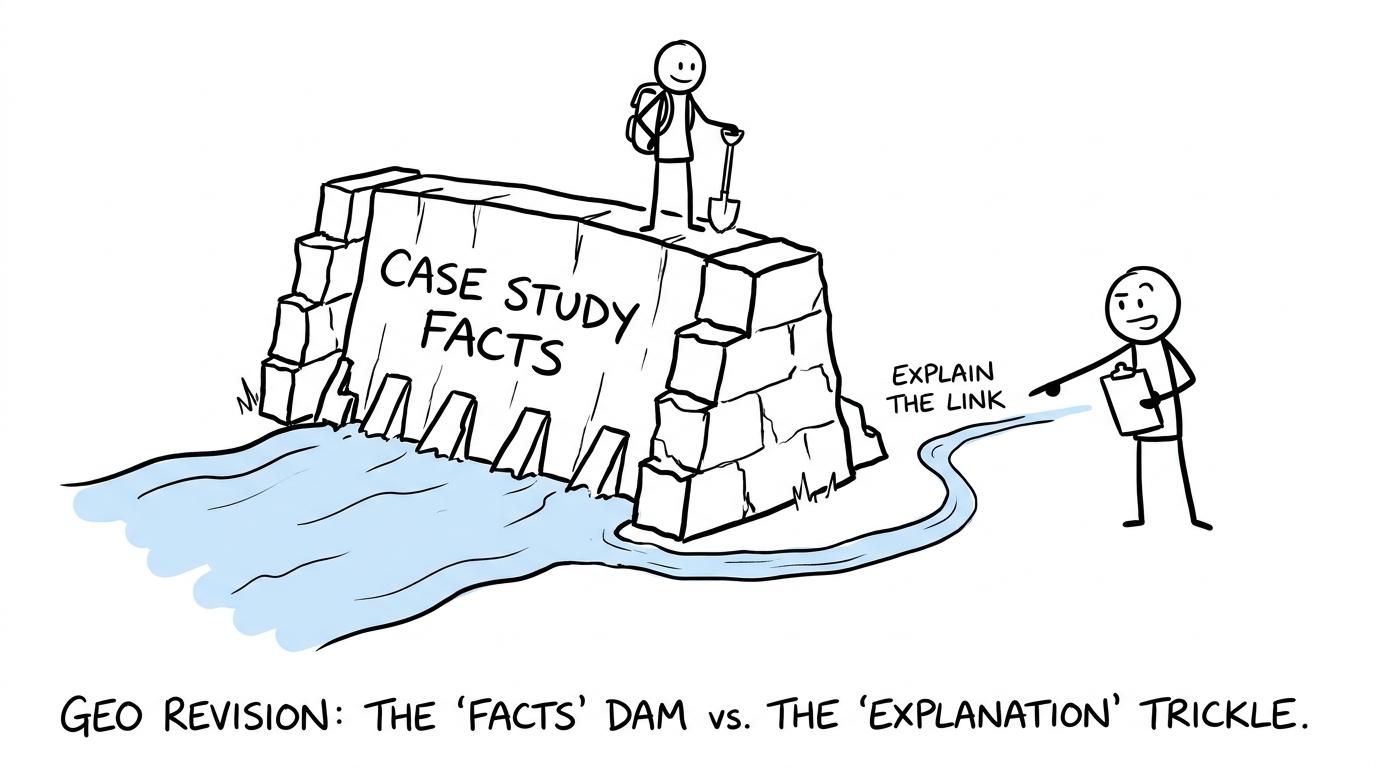 An examiner points past a dam of case-study facts towards a stream labelled explain the link
The mathematical skills behind high-grade Geography
Geography is not GCSE maths in disguise, but confident numeracy removes avoidable barriers. You may need to interpret scales, compare rates, calculate percentages, use averages, read coordinates or analyse graphs and tables.
A student who can calculate accurately but cannot interpret the result has only completed half the task. Equally, a sophisticated explanation can be weakened by mishandled data. Grade 8 performance brings the two together.
If numerical questions are costing you marks, use the free GCSE Maths revision hub to strengthen the underlying topic. Students following AQA Maths can access AQA GCSE Maths revision lessons and questions, while the methods themselves remain useful regardless of your Geography exam board.
Build particular confidence in:
- percentages and percentage change;
- ratios and proportional comparisons;
- mean, median, mode and range;
- interpreting statistical and time-series graphs;
- scale, distance, area and units;
- sampling, anomalies and the reliability of data.
These are not isolated calculations. In Geography, they become evidence. Your written interpretation should identify the pattern, support it with appropriate data and explain its geographical significance.
How to revise towards Grade 8
Grade 8 revision should alternate between knowledge and performance. Reading notes can build familiarity, but only retrieval and exam practice reveal whether you can use that knowledge independently.
Start from your specification
Confirm your exam board and list every required topic, case study, fieldwork element and skill. Avoid revising from a generic checklist that may omit part of your course or include material you do not need.
For each area, ask four questions:
- What facts and processes must I know?
- What relationships must I explain?
- What unfamiliar information might I have to interpret?
- What judgement could I be asked to make?
Practise command words deliberately
“Describe”, “explain”, “assess” and “evaluate” do not request the same kind of response. Before writing, identify the command word, topic and geographical context.
An explanation needs developed causal links. Analysis requires you to break down information and identify meaningful relationships. Evaluation weighs evidence before reaching a reasoned judgement. More writing cannot compensate for answering the wrong command.
Use past papers as evidence
Complete questions under realistic conditions, then mark them carefully. Record whether lost marks came from missing knowledge, weak application, inaccurate skills, incomplete chains of reasoning or an unsupported conclusion.
This feedback loop is familiar to students using Edexcel GCSE Maths past papers: attempt, mark, diagnose, repair and retest. The guide to using Edexcel past papers properly explains how to turn a mark scheme into a revision plan rather than treating the total as a verdict.
For a wider strategy, read when to start GCSE past papers. Save enough unseen material to test genuine progress later.
Keep a marks-leak list
After each paper, group lost marks by reason. A short list might include weak data interpretation, vague evidence, inaccurate terminology, conclusions that introduce new ideas or fieldwork evaluations without specific improvements.
The MathsGenie guide to finding weak GCSE topics offers a practical diagnostic method. Although designed around maths revision, its central principle travels well: fix the recurring cause, not merely the latest question.
Common mistakes when interpreting or chasing Grade 8
Treating Grade 8 as a fixed percentage
There is no permanent national Grade 8 percentage for GCSE Geography. Boundaries can differ by year, board and specification. Use historical boundaries to understand broad standards, never as a guaranteed prediction.
Calling Grade 8 exactly equivalent to A*
Grade 8 lies within the part of the scale covering the former A and A* grades, but the systems do not match grade by grade. “Between A and A*” is a useful broad description, not an official exact conversion.
Memorising case studies without answering the question
Specific evidence strengthens an argument only when it supports the point being made. Select evidence. Do not unload it.
Describing when the question requires analysis
Repeating values from a graph may earn limited credit. Analysis identifies patterns, contrasts, anomalies or relationships and considers what they mean geographically.
Assuming every answer must be perfect
A Grade 8 is based on the combined mark across the qualification. You can lose marks and still achieve it. The practical aim is not perfection but consistently strong performance and fewer repeated errors.
Turn the grade into a revision direction
Grade 8 Geography represents more than remembering many facts. It shows that you can think geographically: connect processes, handle evidence, evaluate uncertainty and communicate a convincing judgement.
That is also why the grade is useful preparation beyond Geography. Data interpretation, structured reasoning and careful conclusions support GCSE maths, A Level subjects and any course where evidence matters.
Keep your next step small. Choose one weak skill, complete one timed set, mark it and correct the cause of each lost mark. For the mathematical side of your exams, make MathsGenie your free revision base. Use its GCSE Maths lessons and practice questions, past papers, mark schemes, video solutions, mini tests and predicted papers to turn uncertainty into a clear plan. If time is short, the one-week GCSE maths revision plan will help you prioritise calmly.