GCSE Geography 5 to 8: A Practical Grade Plan
GCSE geography 5 to 8: improve application, case studies, data skills, fieldwork and evaluation to turn secure knowledge into higher exam marks.
A grade 5 often means you know a reasonable amount of geography. You can recall processes, recognise case studies and describe patterns. Yet the same student may open a results sheet and wonder why all that revision did not produce a higher grade.
The journey from GCSE geography 5 to 8 is not mainly about memorising three times as many facts. It is about using knowledge more precisely: applying it to unfamiliar resources, building chains of explanation, analysing data and reaching judgements supported by evidence. In short, you must move from knowing geography to thinking like a geographer.
There is no fixed mark that always guarantees a grade 8. Grade boundaries vary by exam board, paper and examination series. Your aim should therefore be to improve the quality and consistency of your answers rather than chase an assumed percentage.
Your grade improvement checklist
Focus your revision on these changes:
- Check the exact specification for your exam board: AQA, Edexcel, OCR or Eduqas.
- Replace vague case-study notes with precise, usable evidence.
- Practise applying familiar knowledge to unfamiliar places and resources.
- Develop explanations through linked causes, effects and consequences.
- Use figures, maps and graphs as evidence rather than background decoration.
- Revisit fieldwork methods, data presentation and evaluation.
- Answer the command word and make supported judgements.
- Mark responses honestly, record lost marks and retest the weakness.
The difference is rarely one dramatic breakthrough. It is usually a collection of small upgrades repeated until they become normal.
What separates a grade 5 from a grade 8?
A grade 5 response may contain correct knowledge but leave the examiner to make the connections. A grade 8 response normally makes those connections explicit.
| Grade 5 tendency | Grade 8 tendency |
|---|---|
| Describes what happened | Explains how and why it happened |
| Names a case study | Selects case-study evidence that answers the question |
| Makes several separate points | Builds connected chains of reasoning |
| Copies information from a resource | Interprets the resource and combines it with knowledge |
| Gives a one-sided opinion | Weighs evidence and reaches a justified judgement |
| Knows the fieldwork method | Evaluates whether the method produced dependable evidence |
| Completes calculations | Uses the result to support a geographical conclusion |
This is not a promise that a particular writing style automatically earns a grade. Examiners award marks against question-specific mark schemes. However, the pattern is clear: stronger answers are more selective, applied, analytical and supported.
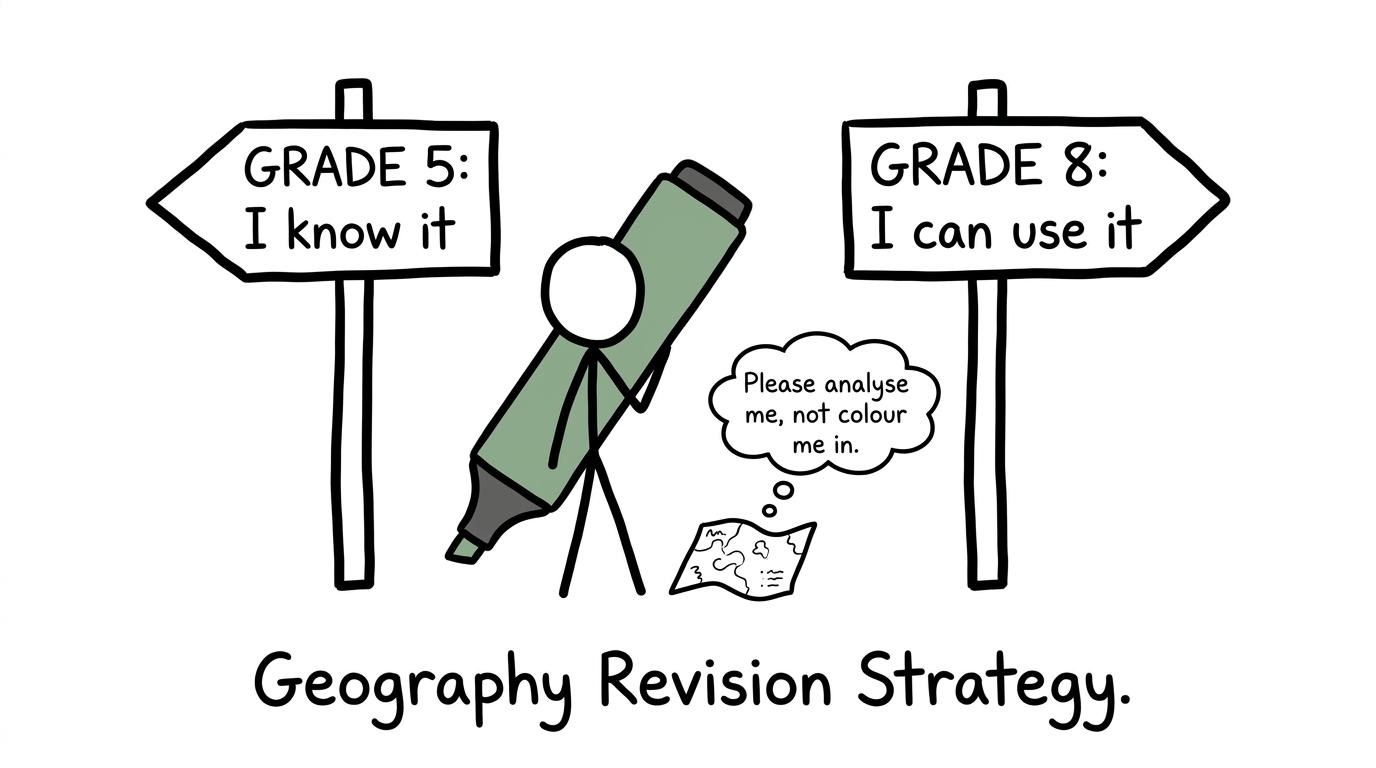 A student choosing between knowing geography and applying it
Revise for the assessment objectives
Current GCSE Geography qualifications in England assess four broad abilities. Across the qualification, AO1 covers knowledge, AO2 geographical understanding, AO3 application, interpretation, analysis, evaluation and judgement, while AO4 covers geographical skills and techniques.
The Ofqual weightings are approximately 15%15\%15% for AO1, 25%25\%25% for AO2, 35%35\%35% for AO3 and 25%25\%25% for AO4. At least 10%10\%10% of subject marks must assess mathematical and statistical techniques. This explains why factual recall alone has a ceiling: most marks reward what you can do with your knowledge.
Turn facts into explanations
Do not stop after stating a cause. Extend it by asking:
- What process does this begin?
- Why does that process create the stated outcome?
- Who or what is affected?
- Does the effect change over time or across different scales?
Useful connective language includes because, therefore, which leads to and as a consequence. These phrases do not earn marks by themselves. Their value is that they encourage you to expose the reasoning that might otherwise remain in your head.
Apply knowledge instead of reciting it
Unfamiliar resources test whether your understanding travels. Read the title, key, axes, units, scale and source before deciding what the information shows. Then bring in only the geographical knowledge that helps explain or evaluate that evidence.
A memorised paragraph about flooding may be accurate yet poorly applied if the question is about the relative importance of urban land use. Selection matters. The best answer is not the longest fact dump; it is the one most tightly fitted to the question.
Make case studies work harder
Students sometimes revise case studies as pages of disconnected statistics. That creates a large memory burden and does not guarantee application.
Build a compact case-study bank under consistent headings:
- location and geographical context;
- causes or processes;
- immediate and longer-term effects;
- responses or management strategies;
- named evidence;
- groups that gained or lost;
- limitations, conflicts or questions of sustainability.
Prioritise a small number of secure, specification-matched details. A statistic becomes useful only when it supports an argument. Avoid inventing a figure when your memory is uncertain. A correct named detail used analytically is safer than an impressive-looking number that may be wrong.
For each case study, practise answering three questions from memory: Why did this happen? Why did its effects vary? How successful was the response? That converts notes into reasoning.
Strengthen geographical maths and data skills
The mathematical side of geography can quietly separate grade bands. You may need to interpret scales, calculate averages, compare rates, describe scatter graphs or work with percentage change.
Keep the core relationships secure:
mean=sum of valuesnumber of values\text{mean}=\frac{\text{sum of values}}{\text{number of values}}mean=number of valuessum of values range=highest value−lowest value\text{range}=\text{highest value}-\text{lowest value}range=highest value−lowest value percentage change=new value−original valueoriginal value×100\text{percentage change}=\frac{\text{new value}-\text{original value}}{\text{original value}}\times 100percentage change=original valuenew value−original value×100The calculation is only the first layer. A higher-quality response also interprets the result geographically, uses the correct unit and considers whether the evidence is representative.
MathsGenie’s GCSE Geography statistical skills revision guide covers averages, spread, percentage change, cumulative frequency and scatter graphs in a geographical context. If the underlying calculations remain fragile, use the AQA GCSE Maths revision hub for focused lessons and questions. Students following another board can use the GCSE maths topics by exam board guide to locate the relevant transferable skills.
Always check:
- Have you used the original value as the denominator for percentage change?
- Have you included a unit?
- Have you read the graph scale accurately?
- Have you identified anomalies as well as the overall pattern?
- Have you avoided claiming that correlation proves causation?
Treat fieldwork as an argument about evidence
Fieldwork revision should go beyond remembering what your class did. You need to understand the enquiry process: question, method, sampling, presentation, analysis, conclusion and evaluation.
For every method, consider its purpose and limitations. Was the sampling strategy suitable? Was the sample large enough? Could the time, weather, location or researcher influence the results? Would repeating the investigation improve reliability? Did the data actually address the enquiry question?
Avoid automatic statements such as “collect more data”. Explain what should change and why. More observations across several sites or times may make findings more representative, but merely repeating a weak method more often will not remove its bias.
Your own fieldwork remains important, but the examination may also ask you to interpret unfamiliar fieldwork contexts. Secure understanding is therefore more useful than memorising one scripted evaluation.
Improve extended answers and judgements
Long answers are not marked by length alone. Before writing, identify the command word, topic, scale, location and any resource you must use.
For an evaluative answer, a dependable structure is:
- state a relevant argument;
- support it with geographical knowledge or resource evidence;
- explain why that evidence matters;
- consider a limitation, alternative factor or contrasting perspective;
- reach a judgement that answers the precise question.
A conclusion should not suddenly introduce a new idea. It should decide which argument is strongest and state the conditions behind that decision. Significance may depend on timescale, spatial scale, wealth, vulnerability or the group affected.
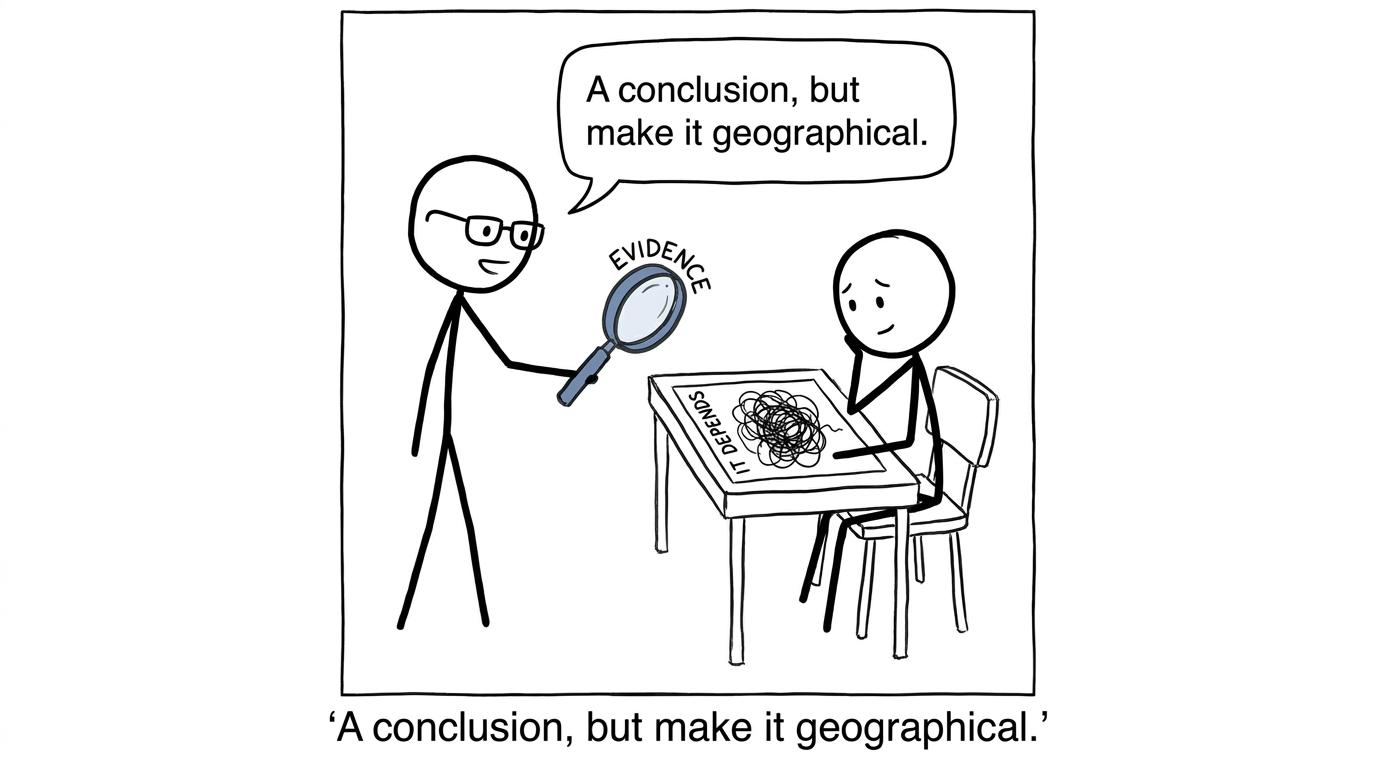 An examiner asks a vague conclusion for evidence
Build a revision cycle that changes your marks
Passive rereading can feel fluent because the page looks familiar. The exam asks for something harder: retrieval and application without the page.
Use this cycle:
- Retrieve: write what you know about one specification point without notes.
- Check: compare it with your class materials and specification.
- Apply: answer a short or extended exam question.
- Mark: use the relevant board’s mark scheme and teacher guidance.
- Diagnose: label the lost marks as knowledge, application, data skill, fieldwork, judgement or exam technique.
- Retest: answer another question targeting the same weakness later.
A revision timetable should name tasks, not just subjects. “Geography for one hour” is vague. “Retrieve coastal management case-study evidence, answer one evaluation question and correct it” creates a measurable outcome. The principles in MathsGenie’s GCSE revision timetable guide transfer well to geography, while the one-month revision plan shows how to combine retrieval, targeted repair and timed practice.
Practise full papers only after you have begun repairing topic-level weaknesses. Official geography papers and mark schemes should come from your awarding organisation or school. If a result is lower than expected, the GCSE Geography next-steps guide explains how to review component marks and decide what to do next.
Common mistakes when aiming for grade 8
Revising the wrong specification
Topics, optional units and paper structures differ between AQA, Edexcel, OCR and Eduqas. Confirm your board and current specification before building resources.
Memorising model answers word for word
A changed location, command word or resource can make a memorised response poorly matched. Learn flexible knowledge and reasoning instead.
Describing when the question asks for explanation
Description identifies a pattern. Explanation gives reasons and processes. Check every paragraph against the command word.
Using resources without analysing them
Quoting one figure is not enough. Identify a pattern, comparison or anomaly, support it with accurate evidence and explain its significance.
Writing generic evaluations
“Human error” and “more data” are incomplete. Identify the particular limitation, explain its effect and propose a realistic improvement.
Ignoring small skills questions
Map, graph, numerical and fieldwork marks accumulate across papers. Short, regular skills practice is more effective than leaving them until the final week.
Turn secure knowledge into higher-level performance
Moving from grade 5 towards grade 8 is less about becoming a walking atlas and more about becoming selective. Know the specification, retrieve precise evidence, apply it to the question, analyse what the resource actually shows and make judgements that acknowledge context.
Start with one recent response. Find the first mark you lost and classify the reason. Then repair that specific weakness. Tomorrow, do it again.
MathsGenie can support the quantitative side with free revision lessons, statistical guides, practice questions, worksheets and mini tests. Use OCR GCSE Maths topic worksheets or your own board’s hub to strengthen percentages, ratio, scale and data handling. As maths exams approach, add MathsGenie past papers, predicted papers, mark schemes and video solutions. For geography-specific papers and specification details, use the materials supplied by your school and awarding organisation.
Better grades are usually built quietly, one better explanation, one accurate calculation and one properly supported judgement at a time.