GCSE Further Maths Study Planner: Work Backwards
GCSE further maths study planner: work back from exam day, prioritise weak topics, schedule past papers and build a calm revision routine.
The hardest part of Further Maths revision is often not calculus, matrices or algebra. It is deciding what to do tonight when every topic seems important and the exam still feels distant.
A GCSE further maths study planner solves that problem by beginning with the one date that cannot move: exam day, and working backwards. You reserve the final weeks for realistic paper practice, place topic repair earlier, and build in enough flexibility for ordinary school life. Instead of guessing from week to week, every session has a reason.
This guide shows you how to create that plan, adjust it using evidence and connect each stage to MathsGenie's free revision resources.
Your backward-planning checklist
Before filling a calendar, collect five pieces of information:
- Your exact qualification and exam board
- The date, time and calculator rules for every paper
- The topics listed in your specification
- Your available revision sessions each week
- Evidence of your current strengths and weaknesses
Then build four phases:
- Learn and repair: revisit unfamiliar or fragile topics.
- Practise and revisit: complete targeted questions and return to topics later.
- Perform: attempt mixed questions and papers under timed conditions.
- Taper: correct recurring errors, protect sleep and avoid last-minute overload.
The MathsGenie revision planner gives you a practical place to organise these commitments once you have decided what each phase must achieve.
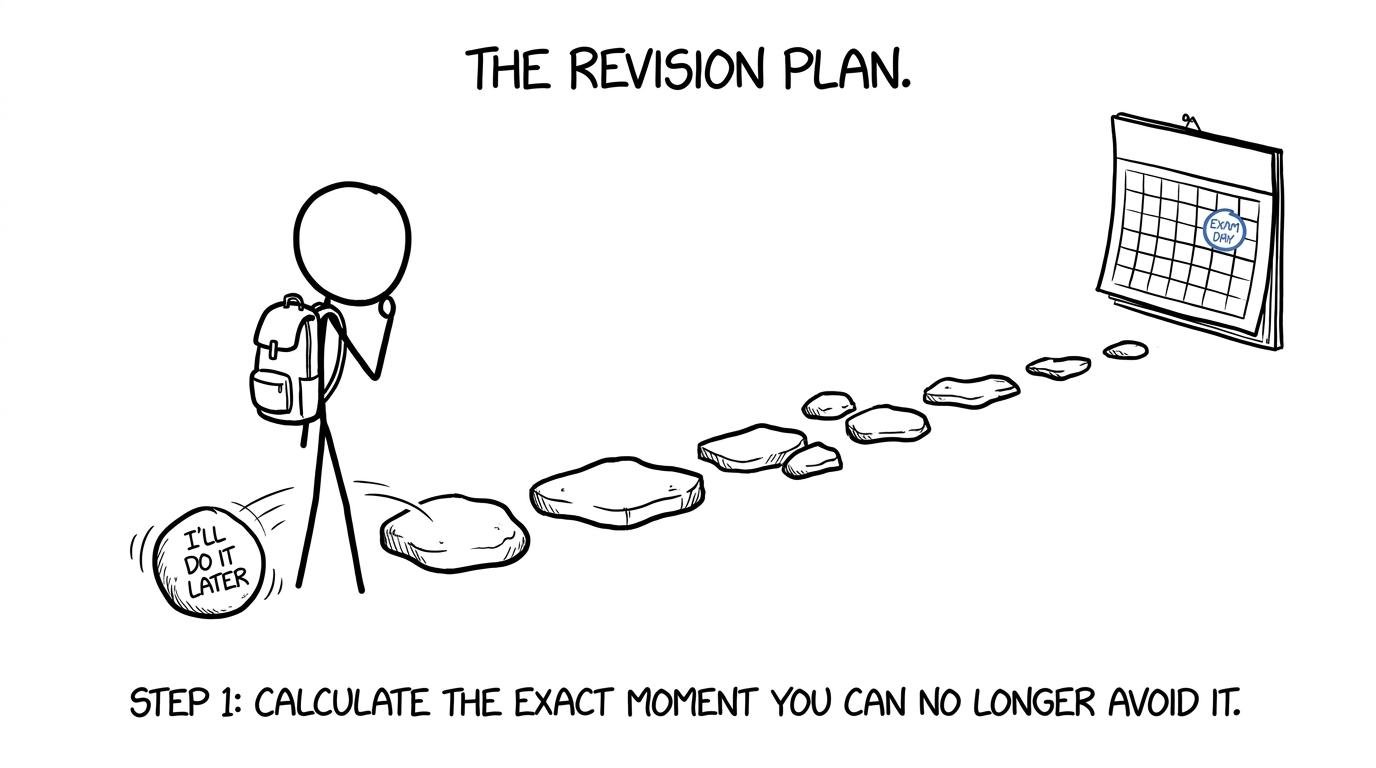 A student building stepping stones backwards from exam day
Start with the qualification, not a generic timetable
“GCSE Further Maths” is often used as a broad label, but schools may enter students for different qualifications. These are not interchangeable. AQA offers the Level 2 Certificate in Further Mathematics, while some schools use alternatives such as OCR Additional Mathematics or Pearson's Level 2 Extended Mathematics Certificate.
Check the title, specification code and paper details with your teacher or exams officer. Do not assume that your ordinary GCSE Maths exam board is also your Further Maths board.
For AQA Level 2 Further Mathematics, the official specification describes an untiered, linear qualification with two papers taken in the same series. Its main content areas are number, algebra, coordinate geometry, calculus, matrix transformations and geometry. MathsGenie's AQA GCSE Further Maths revision hub brings the relevant lessons, questions, past papers and mark schemes together.
Further Maths is an additional qualification rather than a replacement for GCSE Maths. Your plan must therefore preserve your core higher-tier skills too. Weaknesses in rearranging formulae, quadratics, graphs, trigonometry or algebraic fractions will make extension topics harder than they need to be. Use the GCSE Maths revision hub when a Further Maths mistake points back to an underlying GCSE method.
Fix exam day on the calendar
Use the personalised timetable issued by your school or college. Official national exam windows are useful for general planning, but your own timetable confirms the paper code, date, session and any approved access arrangements.
Write down each paper separately. Beside it, record:
- whether a calculator is allowed;
- the duration and total marks;
- topics or skills that need special equipment;
- other exams taking place in the same week;
- the final date on which you intend to complete a full paper.
Your revision endpoint should usually be the evening before the exam, not the moment you enter the hall. That final evening is for a short review, preparing equipment and resting. It is not a sensible place for your first encounter with a difficult topic.
Count the sessions you genuinely have
A plan measured only in weeks can be misleading. Two students may both have eight weeks, but one has five usable sessions each week while the other has two.
Estimate your capacity with:
available sessions=weeks remaining×realistic sessions per week.\text{available sessions}=\text{weeks remaining}\times\text{realistic sessions per week}.available sessions=weeks remaining×realistic sessions per week.Then subtract sessions affected by mocks, trips, coursework, family commitments and clusters of other exams. Keep roughly one session in every five unallocated. This buffer is not wasted time. It stops one difficult week from destroying the entire plan.
A realistic weekday session may last around 303030 to 505050 minutes. A weekend paper session will often need longer because it includes completion, marking and correction. The best duration is the one you can repeat without sacrificing sleep or abandoning every other subject.
Divide the countdown into four phases
The exact dates depend on how much time remains, but the sequence should stay stable.
| Time before the first paper | Main purpose | Typical activity |
|---|---|---|
| About 888 to 121212 weeks | Diagnose and rebuild | Specification audit, lessons and targeted questions |
| About 555 to 888 weeks | Strengthen and revisit | Mixed topic sets, mini tests and delayed retesting |
| About 222 to 555 weeks | Build exam performance | Timed sections, full past papers and detailed marking |
| Final 777 to 141414 days | Taper and sharpen | Error repair, selected unseen questions and light recall |
Treat these ranges as planning guidance rather than official rules. If you begin later, compress the phases without deleting the diagnose, practise, mark and retest cycle.
The learning and repair phase
Turn the specification into small, teachable units. “Algebra” is too broad for one session. A useful task names an action, such as manipulating algebraic fractions, solving equations involving powers, interpreting a function or differentiating an expression.
Label each unit:
- Secure: you can complete unfamiliar questions without notes.
- Developing: you understand the method but make errors or need prompts.
- Priority: you cannot reliably begin an exam question.
Give priority topics more sessions, but do not abandon secure skills completely. Maths becomes fragile when it is left untouched for weeks. If you need to check where an extension topic sits beside ordinary higher-tier content, consult the GCSE Maths topics by board and tier.
The practice and revisit phase
A lesson can create recognition without creating independence. After reviewing a method, close the explanation and complete questions without help. Mark them promptly, record the precise error and schedule a different question on the same skill several days later.
A strong session has four parts:
- brief retrieval from an older topic;
- focused learning or review;
- independent exam-style practice;
- marking and one scheduled retest.
Your planner should therefore contain topic names and actions, not vague entries such as “revise maths”. If diagnostics are difficult, the guide to finding your weakest GCSE topics explains how to turn lost marks into a useful priority list.
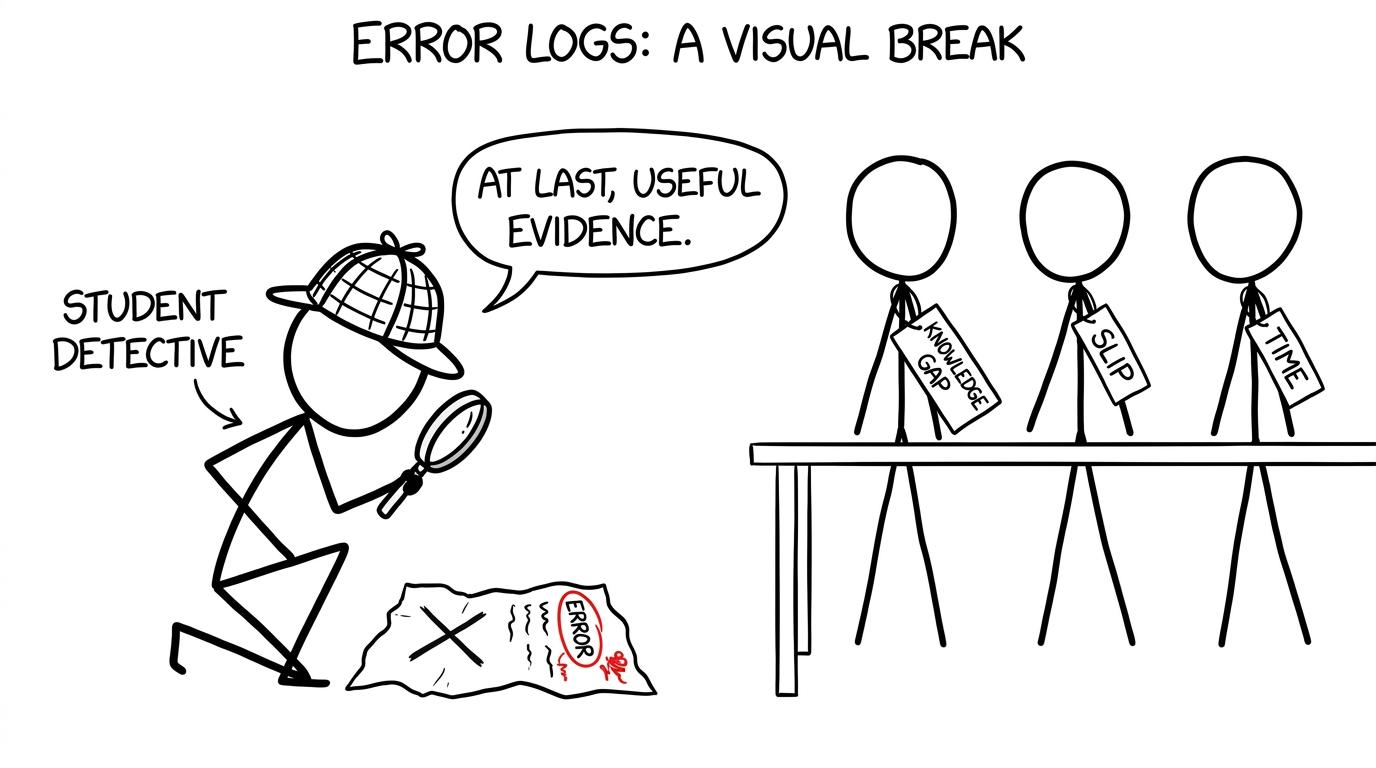 A revision detective investigating three kinds of mistakes
The performance phase
Full papers matter because they combine knowledge, selection, accuracy and time management. But a completed paper is only evidence. Improvement comes from what you do after marking it.
Follow this loop:
- Sit the correct paper under the stated conditions.
- Mark it strictly with the mark scheme.
- Separate knowledge gaps from slips and timing problems.
- Relearn the two or three skills responsible for the greatest loss.
- Complete fresh questions on those skills.
- Retest them before attempting another paper.
MathsGenie's guide to using GCSE past papers properly explains this paper, mark, repair rhythm. The AQA GCSE Maths past-paper collection can also support the core higher-tier techniques underpinning Further Maths, although your principal paper practice must match your exact Further Maths qualification.
Do not use every available paper too early. Preserve some unseen material for the final performance phase, when it can test whether your improvements survive mixed questions and time pressure.
The taper phase
Near exam day, the temptation is to increase everything: more hours, more papers and more new content. The better approach is narrower.
Review your error log. Reattempt selected questions. Practise the calculator or non-calculator conditions relevant to the next paper. Use predicted or practice papers as additional mixed material, never as a promise about what will appear.
The final day should be deliberately light. MathsGenie's GCSE maths exam-week checklist can help you organise equipment, short review sessions and the gaps between papers without turning every evening into a marathon.
Let marks change the planner
A revision plan is a forecast, not a contract. It should change when evidence changes.
Keep an error log with the topic, marks lost, cause and next action. A simple priority measure is:
priority score=marks recently lost×frequency of the error.\text{priority score}=\text{marks recently lost}\times\text{frequency of the error}.priority score=marks recently lost×frequency of the error.This is not an exam-board formula. It is a planning device. Its purpose is to stop a repeated algebra error being treated as equal to an isolated arithmetic slip.
Review the log once a week and move sessions accordingly. If matrices are now secure but coordinate geometry continues to cost marks, the calendar should reflect that. Good plans are firm about the destination and flexible about the route.
Balance Further Maths with the rest of GCSE revision
Further Maths can absorb unlimited time because challenging questions rarely feel completely finished. Set boundaries.
Place your most demanding Further Maths session where your concentration is strongest. Use shorter sessions for retrieval, corrections and core GCSE maintenance. When another subject has an imminent paper, reduce Further Maths temporarily rather than pretending every subject can receive maximum attention at once.
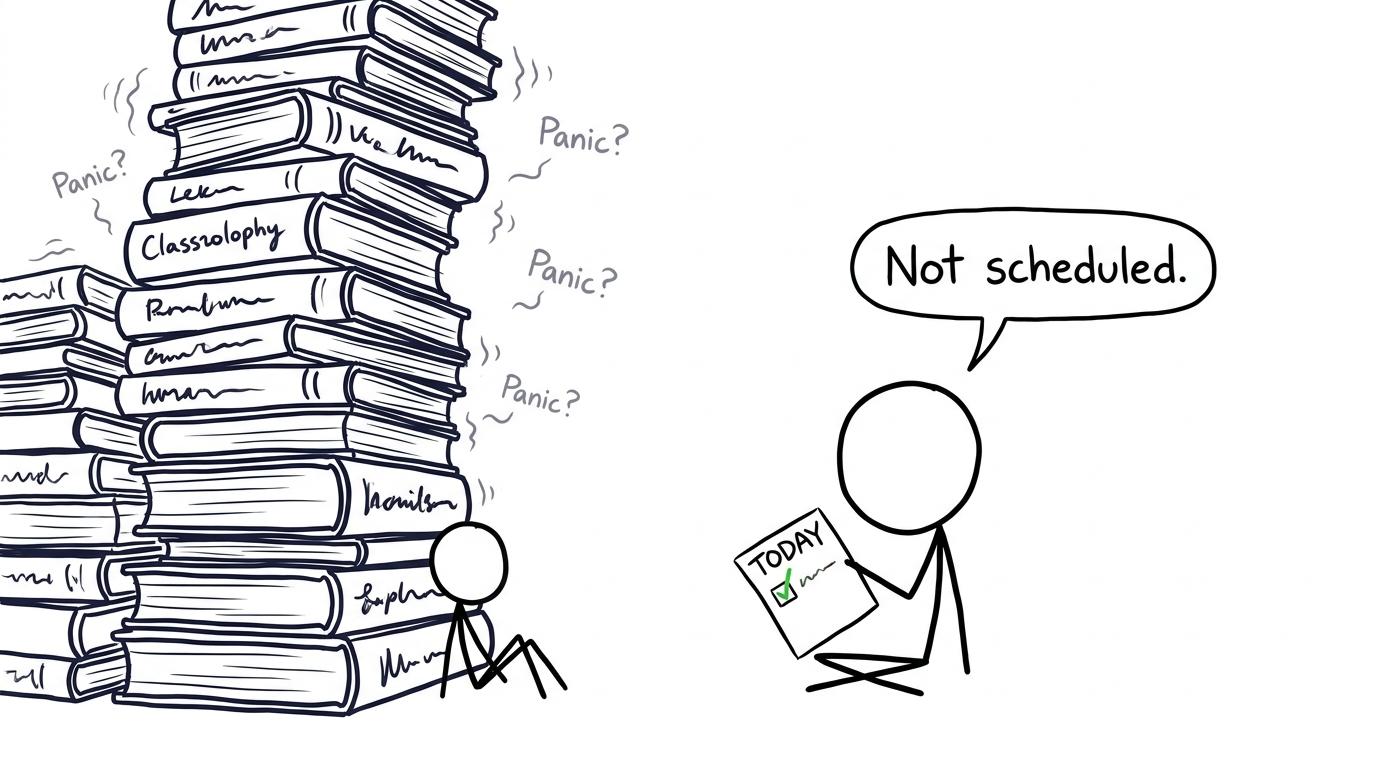 A calm student refusing to schedule panic
A weekly structure might include one learning session, one targeted practice session, one mixed or timed session and one short correction session. The allocation should be driven by your timetable and diagnostic evidence, not copied blindly from someone else's calendar.
Common mistakes when building the planner
Planning topics but not paper practice
Knowing methods individually does not guarantee that you can recognise them in a mixed paper. Reserve timed work before filling the earlier weeks.
Revising favourite topics first
Comfort creates the feeling of progress. Marks expose the reality. Begin with diagnostic evidence and allocate more time to repeated weaknesses.
Writing tasks that are too broad
“Do calculus” gives you no finish line. Name one skill, a question set and the resource you will use to mark it.
Counting completion instead of correction
A paper marked and forgotten changes little. Schedule correction and retesting as real sessions, not optional extras.
Ignoring the exact specification
AQA, OCR and Pearson qualifications differ in content and assessment. Always match your resources to the qualification named on your entry.
Filling every available hour
A calendar without buffers breaks at the first interruption. Leave catch-up space and protect sleep, meals and normal school commitments.
Turn exam day into today's next action
Working backwards makes revision calmer because it replaces a large, distant worry with a small present decision. Exam day tells you when performance practice must happen. Performance practice tells you when topics must be repaired. Your diagnostic evidence tells you what to repair first.
Open the MathsGenie AQA Further Maths hub, confirm your specification and place the exam dates in the revision planner. Then schedule your first diagnostic session.
From there, let MathsGenie support the whole journey: revision lessons when understanding is missing, practice questions and mini tests when a skill needs strengthening, past papers and predicted papers when performance matters, and mark schemes or video solutions when an error needs explaining. Do not try to predict every difficult day. Build a plan capable of surviving one.