Active Recall GCSE Business: Does It Actually Work?
Active recall GCSE Business strategies that beat rereading. Test definitions, apply case contexts, use feedback and build stronger exam-ready answers.
There is a familiar revision trap: you reread a page on cash flow, recognise every term and close the book feeling prepared. The next morning, however, the definition of net cash flow has disappeared.
If you searched for active recall GCSE Business, the short answer is yes; it usually works better than rereading because you practise bringing information out of memory rather than repeatedly putting it in. But GCSE Business is not simply a memory test. Effective recall must move from definitions to application, analysis and judgement.
That distinction matters. Active recall can help you remember what market segmentation means. To earn stronger marks, you must also use that knowledge in a specific business context and explain why it matters.
Your active recall checklist
A useful GCSE Business routine should include all of the following:
- Close the book before answering.
- Recall definitions, calculations and advantages or disadvantages.
- Check every answer against reliable notes or a mark scheme.
- Correct errors immediately rather than merely recording a score.
- Apply ideas to unfamiliar businesses and case-study information.
- Practise chains of reasoning and justified conclusions.
- Revisit the material after a gap.
- Combine recall with timed exam questions.
The principle transfers well to maths. MathsGenie's GCSE Maths revision hub uses lessons, active-recall flashcards, topic questions and papers to help students move from recognition to independent performance.
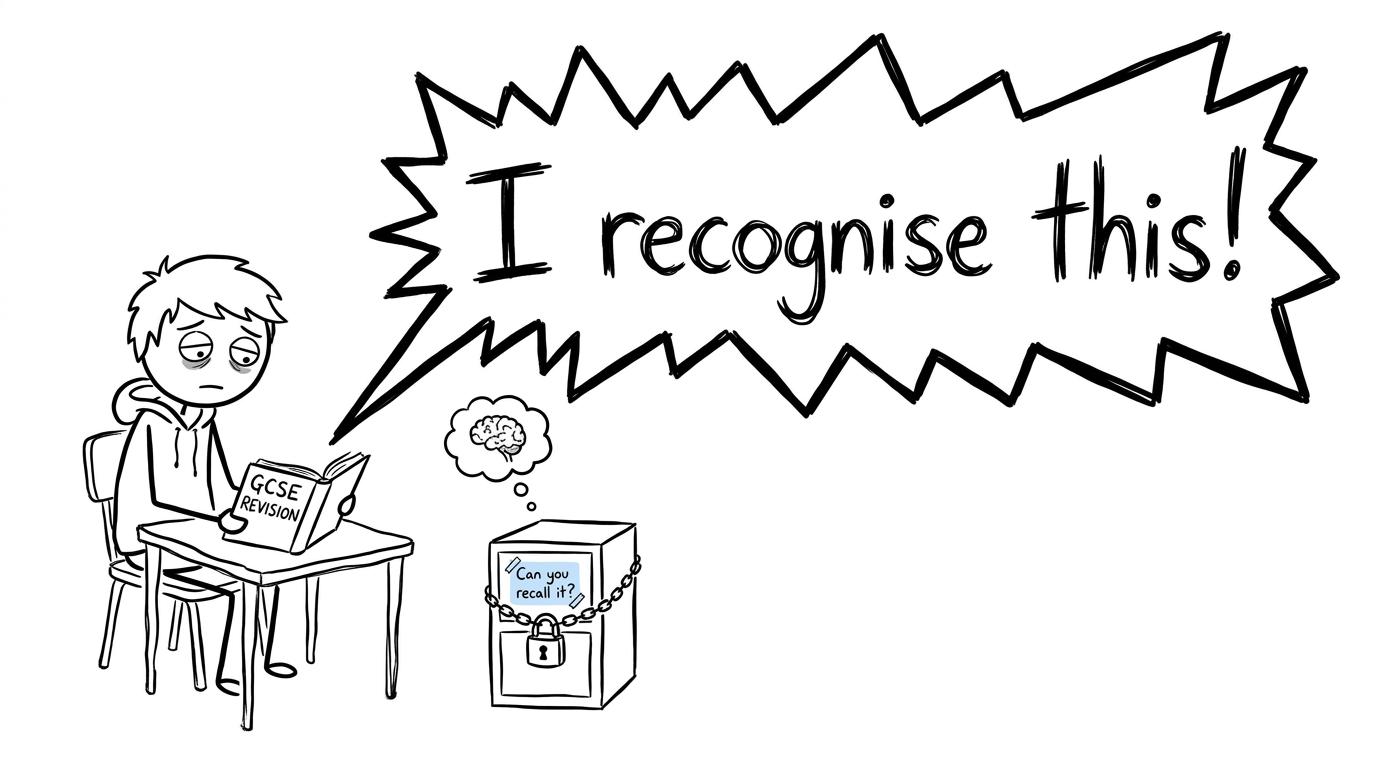 A student discovers that recognising a page is not the same as recalling it
Why active recall tends to beat rereading
Rereading is not useless. You need an initial explanation before you can retrieve anything, and a concise review can repair misunderstandings. The problem begins when rereading becomes the entire revision method.
Words look familiar after several passes. That familiarity can feel like knowledge, even when you cannot explain the idea without the page in front of you. The exam does not ask whether a sentence looks recognisable. It asks you to produce relevant knowledge under pressure.
Active recall removes the cue. You might cover your notes and answer a question, complete a blank mind map or write everything you remember about sources of finance. The attempt exposes what is genuinely available in memory.
Evidence reviews of retrieval practice generally find that recalling previously learned material improves later retention compared with restudying or rereading. However, effects vary between settings and tasks. Retrieval is not magic, and questions that only test simple facts will not automatically create sophisticated analytical answers.
Three ingredients make it more useful:
- Effort: answer before looking at your notes.
- Feedback: check what was missing or inaccurate.
- Spacing: retrieve the idea again on a later day.
This is why practice questions are powerful. An unsuccessful attempt followed by a careful correction tells you more than another comfortable pass through a textbook.
What GCSE Business exams actually require
Across regulated GCSE Business specifications, the assessment objectives are broadly divided into:
- AO1: knowledge and understanding, weighted at approximately 35%35\%35%.
- AO2: applying knowledge and understanding to business contexts, weighted at approximately 35%35\%35%.
- AO3: analysing and evaluating information, making judgements and drawing conclusions, weighted at approximately 30%30\%30%.
The precise paper structures differ between AQA, Edexcel, OCR and Eduqas, so always follow your own specification and teacher's guidance. The larger lesson is common to all boards: remembering terminology matters, but recall on its own does not cover the whole qualification.
Think of active recall as the first link in a chain:
knowledge⟶application⟶analysis⟶judgement\text{knowledge} \longrightarrow \text{application} \longrightarrow \text{analysis} \longrightarrow \text{judgement}knowledge⟶application⟶analysis⟶judgementIf the knowledge is unavailable, the rest of the chain is harder to build. Yet memorising a perfect definition without learning how to apply it leaves the chain unfinished.
How to apply active recall to GCSE Business
Turn the specification into questions
Do not revise from a vague instruction such as “do marketing”. Break each specification point into prompts that demand an answer.
Useful question types include:
- What does this term mean?
- What is its purpose?
- Which businesses might use it?
- What is one possible benefit and one possible drawback?
- Which factors affect whether it is suitable?
- Which quantitative skill could appear with this topic?
- How could this decision affect another business function?
Keep prompts on one side of a flashcard and concise answers on the other. Your task is to answer aloud or in writing before turning the card over. Copying the answer while it is visible is note-making, not recall.
Build recall in layers
Begin with short factual prompts, but do not stop there. A strong set should contain three layers.
Knowledge prompts retrieve definitions, purposes, formulae and characteristics. These support AO1.
Context prompts give a short business situation and ask which idea is relevant or how an effect might differ for that business. These develop AO2.
Reasoning prompts ask for a consequence, a counterargument or the most important factor in a decision. These begin to prepare you for AO3.
This layered structure prevents flashcards from becoming a collection of isolated definitions. Business concepts interact: a marketing decision can affect finance, operations and human resources. Your questions should eventually reflect those connections.
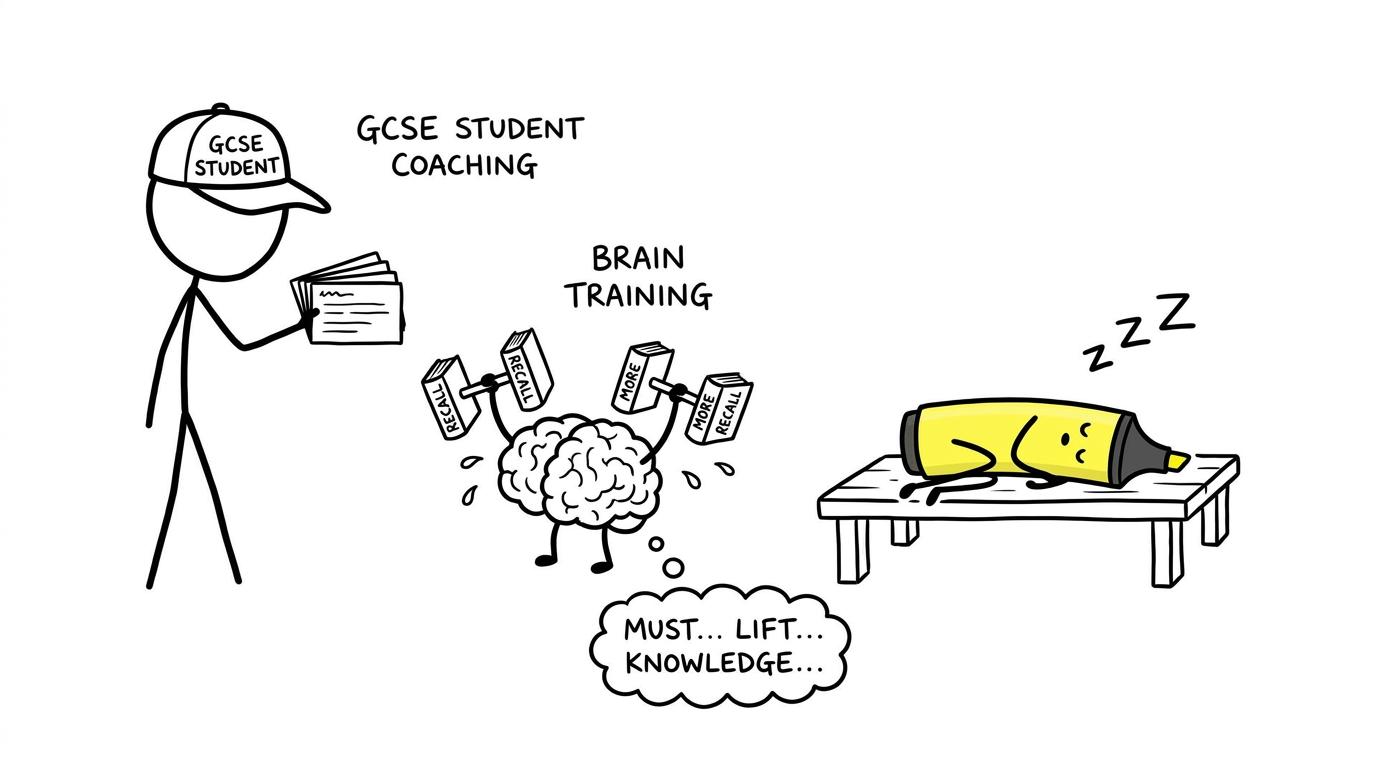 A cartoon brain trains with recall cards while a highlighter takes a nap
Use blurting carefully
Blurting means choosing a topic, closing your materials and writing what you can remember. It works best when the topic is narrow enough to check accurately.
Instead of blurting “all of finance”, choose a defined area such as cash-flow forecasting, break-even analysis or sources of finance. Then compare your page with your notes or specification.
Use a different colour to add:
- omitted knowledge;
- inaccurate terminology;
- missing connections;
- calculations or formulae you could not retrieve;
- points that need application practice.
The coloured corrections are the useful part. Without checking, blurting can rehearse mistakes or reward an incomplete answer.
Recall quantitative Business skills
GCSE Business includes the use and interpretation of quantitative information. Depending on the specification, this may involve revenue, costs, profit, percentages, averages, cash flow or break-even information.
Do not use flashcards only to memorise formulae. Recall what each value means, identify the information needed and practise choosing the correct operation from an unfamiliar question. Calculations should then be checked through exam-style practice.
This is close to effective maths revision: first retrieve the method, then use it. Students balancing Business with maths can use MathsGenie's exam-board and tier topic guide to organise their mathematical gaps, while the AQA GCSE Maths revision area provides board-specific lessons and questions.
Practise retrieval from case studies
Real Business questions often provide stimulus material. Train yourself to retrieve knowledge after reading a short context rather than answering only abstract flashcards.
Choose an unfamiliar business scenario and ask:
- Which specification topics are relevant?
- Which detail could support application?
- What is the likely short-term effect?
- What could change the outcome?
- What evidence would support a judgement?
Do not memorise one universal paragraph about a business concept. Context changes whether a decision is affordable, practical or worthwhile.
Use mark schemes as feedback
A mark scheme should enter the process after your attempt, not before it. Compare your response with what was rewarded, then record a specific correction.
“Revise marketing” is too broad. “I defined segmentation but did not connect the chosen group to the business's product” is actionable.
Maths revision follows the same feedback loop. The guide to using GCSE past papers properly explains how an attempt, mark, repair and retest cycle turns errors into the next revision task.
A simple weekly active recall routine
Active recall works best as a repeatable system rather than an occasional marathon.
At the start of the week
Select one narrow topic from your GCSE Business specification. Learn or review it from class materials, then create a small set of questions covering knowledge, context and reasoning.
After a short gap
Answer the prompts closed-book. Mark them immediately and rewrite only the inaccurate or incomplete parts. Add weak items to an error list.
Later in the week
Retrieve the topic again, but change the format. If you first used flashcards, try a blank mind map, a short case-study plan or an exam question. Changing the surface of the task helps reveal whether you understand the concept or merely remember the wording of a card.
At the weekend
Complete a timed question and use the relevant mark scheme. Schedule another attempt for a later date rather than assuming one correct response means the topic is secure.
Use the free MathsGenie revision planner to protect these short recall sessions alongside your maths work. For maths retrieval, GCSE mini tests provide quick checks without requiring a full paper.
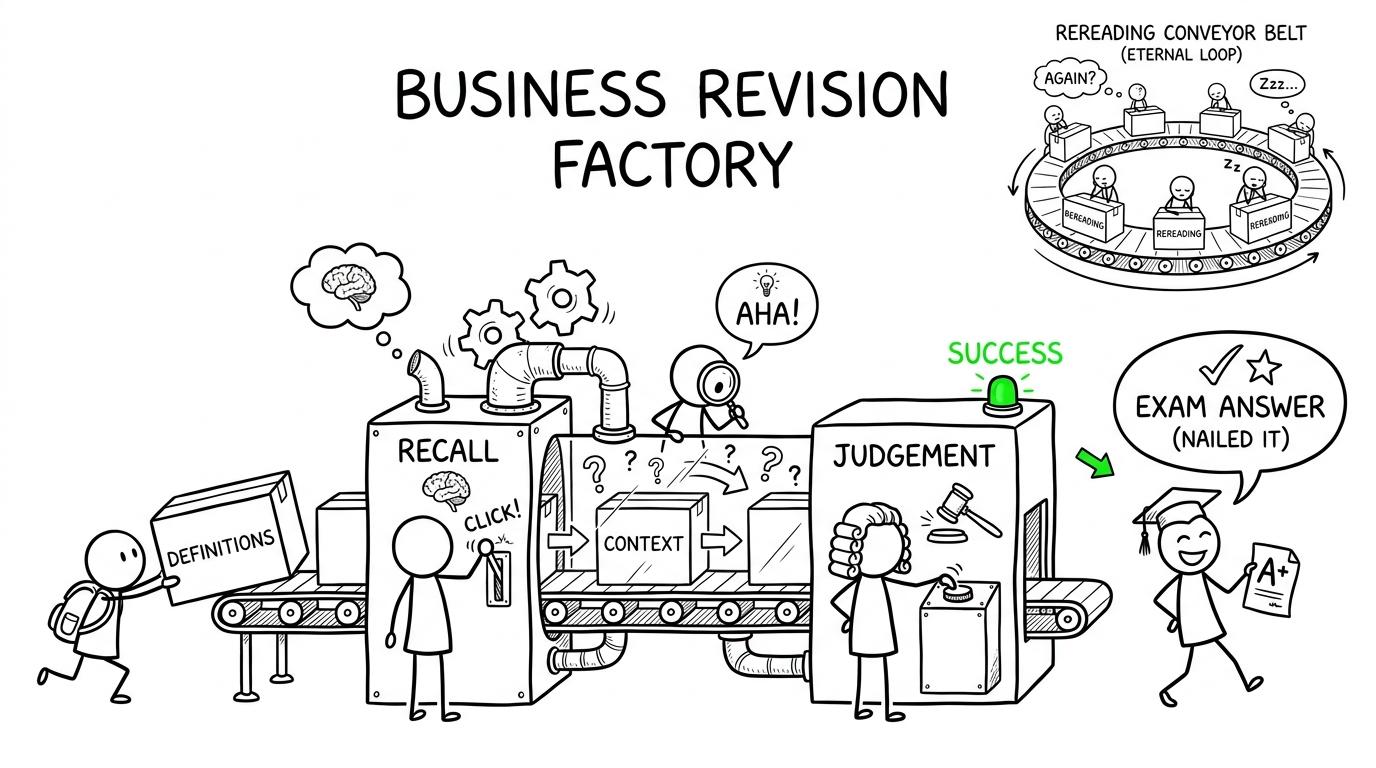 A business revision factory turns recall, context and judgement into an exam answer
Common active recall mistakes
Looking too soon
A brief struggle is part of retrieval. If you reveal the answer immediately, you return to recognition. Make a genuine attempt first, then check.
Testing only definitions
Definitions create a foundation, but GCSE Business also rewards application, analysis and evaluation. Include contextual prompts, connected consequences and judgement questions.
Using incorrect homemade answers
Flashcards can preserve errors remarkably efficiently. Check cards against your specification, trusted class resources and mark schemes before repeatedly using them.
Treating recall as a score
A low score is information, not a verdict. Record why the answer failed, repair the gap and retest it later. MathsGenie's guide to finding your weakest GCSE topics shows how evidence from mistakes can direct the next session.
Cramming every card in one sitting
A huge deck encourages shallow, rushed answers. Use smaller groups and revisit them across several days. The GCSE one-month revision plan demonstrates how retrieval, targeted practice and paper feedback can fit into a sustainable schedule.
Replacing exam practice with flashcards
Flashcards cannot fully reproduce extended writing, unfamiliar data or time pressure. Use them to secure knowledge, then move into case studies, timed responses and full papers.
The verdict: active recall works when it grows up
Active recall tends to beat passive rereading because it tests the ability the exam eventually demands: producing knowledge without the answer in sight. For GCSE Business, however, effective retrieval must grow beyond definitions. It should ask you to apply concepts, interpret context, build reasoning and justify decisions.
Use a simple rhythm: learn, retrieve, check, correct, apply and revisit. Keep Business revision aligned with your own AQA, Edexcel, OCR or Eduqas specification, and use official-style questions and mark schemes to test whether your knowledge survives the exam format.
For the maths beside your Business course, make MathsGenie your free revision base. Start with Edexcel GCSE Maths past papers, or choose your board from the main GCSE hub. Combine revision lessons and practice questions with mini tests, past papers, predicted papers, mark schemes and video solutions.
The goal is not to make every page feel familiar. It is to make the right knowledge available when the page is gone.