

Evening Classes GCSE Arabic: Are They Worth It?
Evening classes GCSE Arabic guide: compare teaching, feedback, speaking practice, costs and self-study before choosing the right route for you.
A new qualification can look manageable from a distance. Then the week fills up: work, family commitments, Arabic vocabulary, speaking practice and the GCSE maths revision you already meant to finish. At that point, evening classes GCSE Arabic courses are not simply competing for money. They are competing for your most limited resource: focused time.
The short answer is that adult evening classes can be worth it if you need structured teaching, regular speaking practice, expert correction and accountability. Self-study may offer better value if you already read and write Standard Arabic confidently, understand the exam format and can maintain a consistent routine. The right choice depends less on whether classes are “good” and more on which obstacles are currently stopping you from becoming exam-ready.
The quick decision checklist
Before enrolling, ask:
- Does the course teach the exact GCSE Arabic specification you will sit?
- Does it cover listening, speaking, reading and writing rather than general conversation alone?
- Will a teacher mark writing and correct spoken Arabic regularly?
- Is the class suitable for your present level and chosen tier?
- Are the course fee, materials and exam entry included or separate?
- Can the provider arrange your examination, including the speaking assessment?
- Will weekly travel and lessons leave enough time for maths and your other subjects?
- Could a structured self-study plan solve the same problem more cheaply?
If you cannot get clear answers, do not pay yet. A convenient timetable is not evidence of a suitable course.
What GCSE Arabic actually requires
For the Pearson Edexcel GCSE Arabic qualification, candidates are assessed through four compulsory components: listening, speaking, reading and writing. Each contributes 25%25\%25% of the qualification.
That balance matters. Someone who speaks Arabic at home may still need substantial preparation in formal reading, accurate writing, translation and examination technique. Equally, a learner who can complete written exercises may struggle to respond naturally during a timed speaking assessment.
The qualification is offered at foundation and higher tier. Candidates enter one tier across all four papers, rather than mixing tiers by skill. Dictionaries are not permitted in the assessments, including preparation time for the speaking paper. The speaking assessment is conducted face to face by the centre and marked externally by Pearson.
These details explain why an ordinary language club is not automatically a GCSE course. A useful evening class should connect language development to the specification, question types, timing and mark schemes.
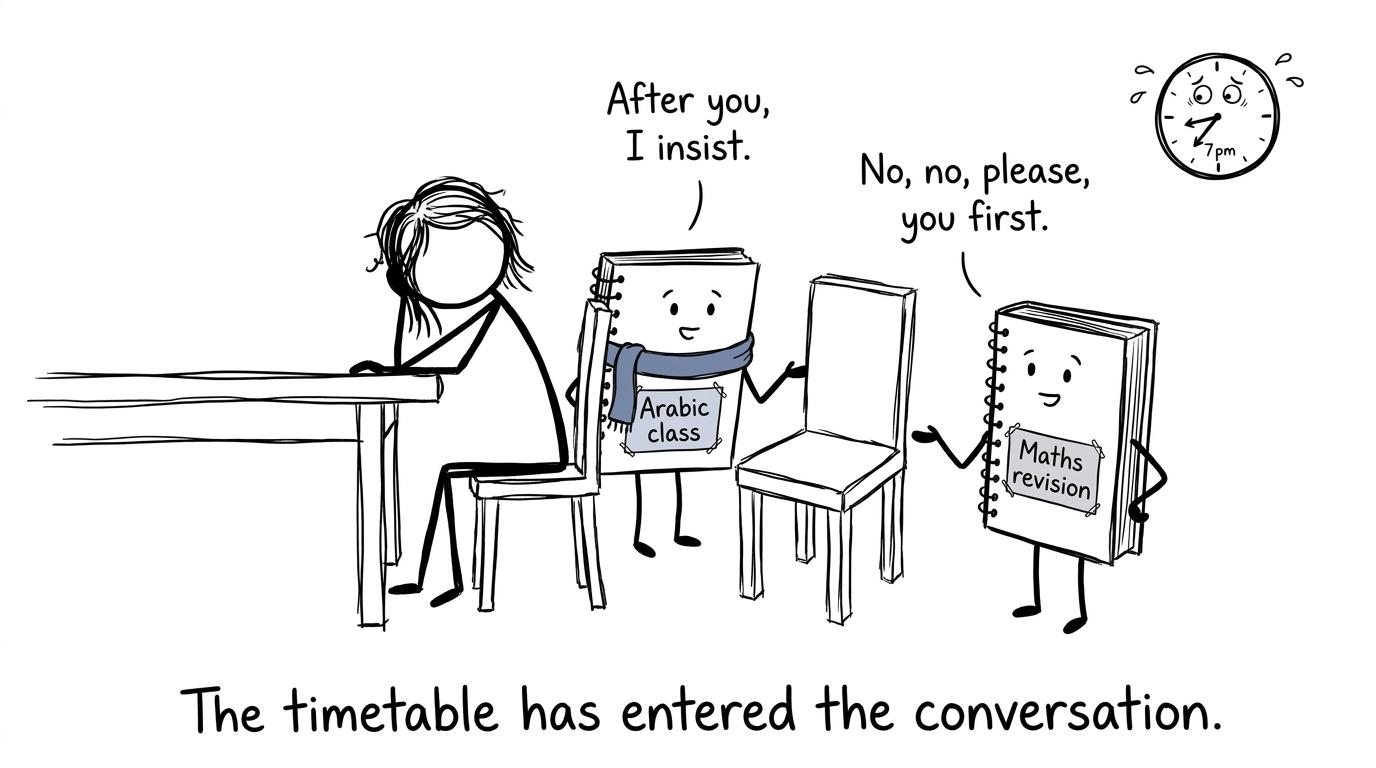 Two revision notebooks negotiating over one evening chair
When evening classes for GCSE Arabic are worth it
You need feedback that self-study cannot provide
Some mistakes are difficult to see from inside your own work. You may repeatedly use an unsuitable register, miss grammatical agreement or write an answer that communicates the basic idea without enough range or accuracy.
A capable teacher can identify the pattern, explain it and check whether you have corrected it later. This feedback loop is one of the strongest reasons to pay for a class. It is particularly valuable for writing and speaking, where an answer cannot always be judged reliably with a vocabulary list and an answer sheet.
You need regular speaking practice
Reading Arabic silently does not prepare you fully for interaction. The Edexcel speaking assessment includes a role play, a picture-based task and a conversation. You must listen, process and respond under controlled conditions.
A class creates scheduled opportunities to speak and receive corrections. That can be hard to reproduce alone, even for learners who hear Arabic regularly. Home conversation may involve a regional dialect, while the qualification assesses Standard Arabic. Familiarity with one does not automatically create confidence in the other.
You benefit from external structure
Self-study is flexible, but flexibility has a hidden weakness: every session can be moved. Then moved again.
An evening course puts a fixed point in the week. There is a teacher expecting work and a group moving through the syllabus. For adults balancing employment or family life, this structure may be worth more than the lesson materials themselves.
The same principle helps with maths. A realistic GCSE maths revision timetable gives each subject a protected place rather than relying on whatever energy remains at the end of the day.
You are beginning from a limited foundation
If the script, core grammar and high-frequency vocabulary are not yet secure, learning independently can become fragmented. A properly sequenced class can prevent gaps from being carried forward.
However, check the starting level carefully. “Beginner Arabic” and “GCSE Arabic preparation” are not interchangeable. A true beginner may need longer than one examination cycle, while a fluent speaker may find an elementary class too slow.
When self-study may offer better value
You already have strong language knowledge
A learner who speaks Arabic confidently, reads Standard Arabic and writes accurately may primarily need to learn the assessment format. In that situation, a full year of weekly teaching could repeat knowledge already held.
Targeted tuition, occasional writing feedback and deliberate past-paper practice may be more efficient. The key is honest diagnosis. Fluency in everyday conversation does not guarantee secure spelling, formal grammar or translation skills.
The course is not specification-led
A class can be enjoyable and still be poor exam preparation. Warning signs include vague promises, no named awarding organisation, no past-paper practice and little information about speaking assessment arrangements.
A useful provider should be able to explain what is taught, how work is assessed and how progress is monitored. If it cannot distinguish a UK GCSE from an International GCSE or a general Arabic course, self-study using the correct specification may be safer.
Attendance damages your wider revision plan
The true time cost is larger than the advertised lesson. Let weekly commitment be
T=L+J+H,T = L + J + H,T=L+J+H,where LLL is lesson time, JJJ is total travel time and HHH is homework and review. A class lasting 222 hours can occupy much more of an evening once those extra demands are included.
That does not make the class wasteful. It simply means the comparison should be honest. If Arabic lessons repeatedly displace essential maths practice, the qualification may be gained at the expense of another result.
Use the GCSE maths revision hub to identify the lessons, exam questions and papers your maths preparation requires before committing several evenings each month elsewhere.
Comparing cost rather than just the course fee
There is no single national price for adult GCSE Arabic evening classes. Providers set their own tuition charges, and private candidate examination costs vary between centres. Ask for a written breakdown covering:
- tuition and registration;
- books or digital materials;
- mock assessments;
- examination entry;
- administration and speaking assessment;
- late-entry charges;
- refunds or transfers if the course is cancelled.
Private candidates must enter through an approved examination centre. The centre sets its own processes, internal deadlines and charges. Crucially, not every centre accepting private candidates will necessarily offer GCSE Arabic or be able to conduct its speaking component. Confirm the qualification title, specification code, tier and all four assessments before paying for tuition.
Cost should be compared with the support received. A cheaper course with no marked writing or individual speaking practice may provide less value than a smaller number of focused sessions. Conversely, paying for weekly classes makes little sense if you rarely complete the independent practice between them.
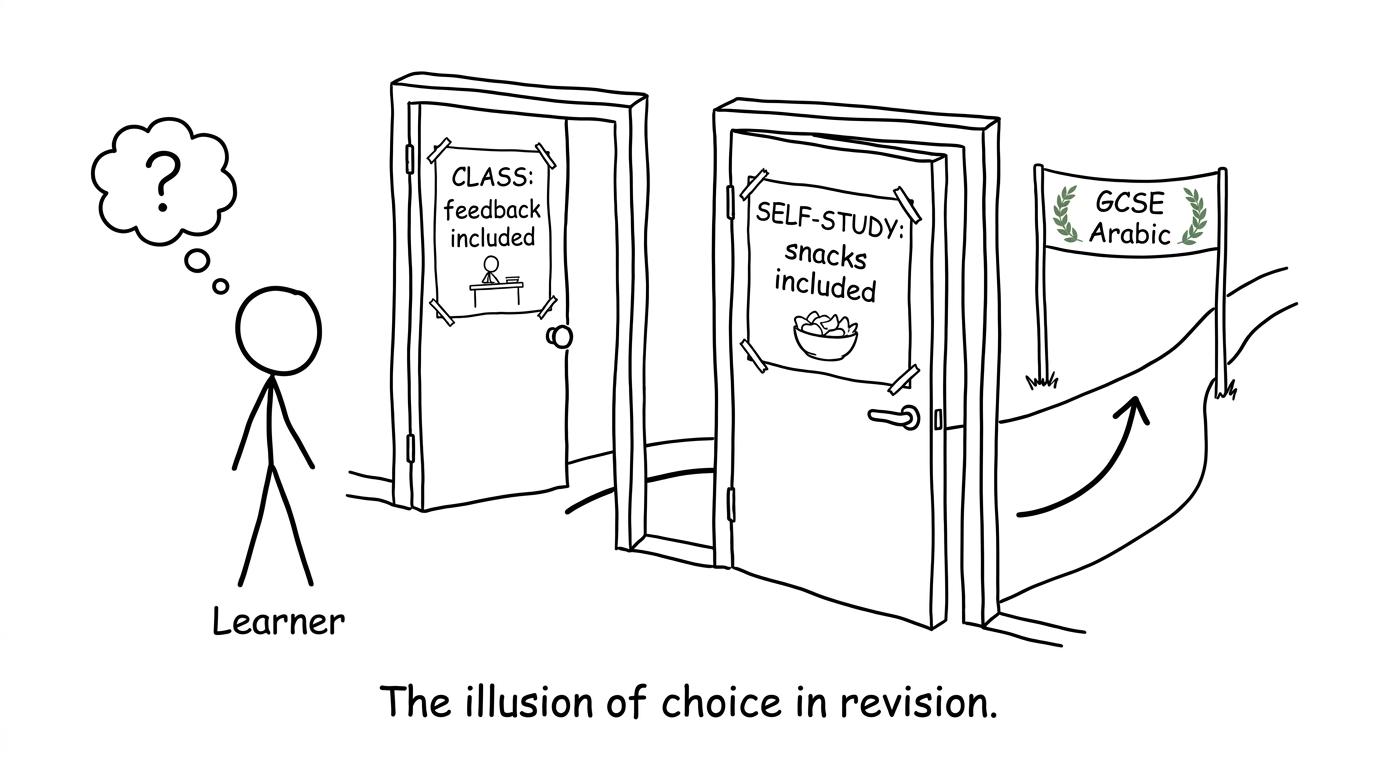 A learner choosing between feedback and snacks on two routes to GCSE Arabic
A hybrid route can be the sensible middle ground
The decision is not limited to a full course or complete independence. A hybrid plan might combine:
- independent vocabulary and reading practice;
- periodic teacher-marked writing;
- scheduled speaking sessions;
- official sample materials and past papers;
- a short exam-technique course near the assessment window.
This approach buys expert help where feedback matters most while keeping routine learning flexible. It can suit adults with irregular work patterns and students protecting time for other GCSEs.
Borrow the same revision cycle used effectively in maths: diagnose, learn, practise, mark, correct and retest. MathsGenie’s guide to finding your weakest GCSE maths topics shows how diagnosis prevents revision time being spent on comfortable material. The principle transfers well to language skills: identify whether listening, speaking, reading or writing is actually limiting your result.
Protecting GCSE maths while learning Arabic
For a student already preparing for maths exams, the best Arabic plan is one that remains sustainable during busy weeks. Start by reserving fixed maths sessions, then fit Arabic around them.
A balanced routine could contain short topic sessions during the week and a timed maths section at the weekend. Use MathsGenie’s one-month GCSE revision plan when exams are approaching, and introduce full papers only when you can review them properly.
The review matters. A paper without correction mainly measures your current level. A paper followed by targeted practice can change it. The guide to when to start GCSE past papers explains how to build from shorter diagnostic work towards timed papers.
If you sit Edexcel maths, GCSE maths predicted papers can provide fresh exam-style practice near the final run-in. They should complement official past papers, revision lessons and practice questions rather than replace them.
Common mistakes when choosing an Arabic evening course
Assuming spoken fluency guarantees a high grade
The qualification assesses four distinct skills equally. Diagnose each one separately, especially formal writing and translation.
Choosing by location alone
A nearby class saves travel, but convenience cannot compensate for the wrong qualification, level or teaching focus.
Failing to arrange an exam centre early
Tuition enrolment does not necessarily include examination entry. Private candidates should confirm a centre, its deadline, total fees and speaking arrangements directly.
Ignoring the full weekly workload
Count travel, homework and recovery time as well as classroom hours. A schedule that works in October may become difficult during mocks and the final exam period.
Paying before seeing the course outline
Ask which specification is followed, how each skill is taught, how often work is marked and whether mock speaking assessments are included.
Treating attendance as revision
Being present is not the same as learning. Vocabulary retrieval, listening practice, writing corrections and speaking rehearsal must continue between lessons.
The final verdict
Evening classes for GCSE Arabic are worth the time and cost when they solve problems that independent study cannot solve efficiently: expert feedback, formal writing support, regular speaking practice, sequencing and accountability. They are less compelling when the teaching is generic, the level is unsuitable or the course consumes time without improving the four assessed skills.
Before enrolling, confirm the exact qualification and exam centre, request the complete cost, assess your current Arabic honestly and map the weekly workload alongside maths. If full classes feel excessive, consider a hybrid route with targeted teaching and structured self-study.
Then protect the subjects already on your timetable. Make MathsGenie’s free GCSE maths resources your revision base: use revision lessons and practice questions to repair weak topics, mini tests to check recall, and past papers, predicted papers, mark schemes and video solutions to build exam readiness. A good plan does not ask one subject to defeat another. It gives each one enough deliberate attention to move forward.










