Catch Up GCSE Chemistry After Absence: A Plan
Catch up GCSE chemistry after absence with a realistic plan covering missed lessons, practicals, calculations, exam questions and teacher support.
Missing several weeks of school can make GCSE Chemistry feel as if the class has moved into another language. New equations appear on the board, practical results are discussed as though everyone was there, and your maths revision still needs attention.
If you need to catch up GCSE chemistry after absence, the answer is not to recreate every missed lesson in one exhausting weekend. First identify exactly what your class covered. Then rebuild the essential knowledge, recover the practical work safely through your school, and use short batches of exam questions to check what you can actually do.
That is the route back: map, learn, practise, correct. Calmly and in order.
Your GCSE Chemistry catch-up checklist
Start with these actions:
- Confirm your exam board, course and tier: AQA, Edexcel, OCR or Eduqas; separate Chemistry or Combined Science; foundation or higher tier where applicable.
- Ask your teacher for the precise specification sections, worksheets and practical activities you missed.
- Divide missed content into small subtopics rather than counting whole lessons.
- Prioritise foundational ideas that later topics depend upon.
- Arrange support for missed practical work instead of trying to reproduce experiments at home.
- Complete exam-style questions after each short content review.
- Track errors under knowledge, application, practical skills, exam writing and maths.
- Keep your existing maths revision moving with shorter maintenance sessions.
Your absence created a gap in coverage, not evidence that you cannot understand Chemistry. Those are very different things.
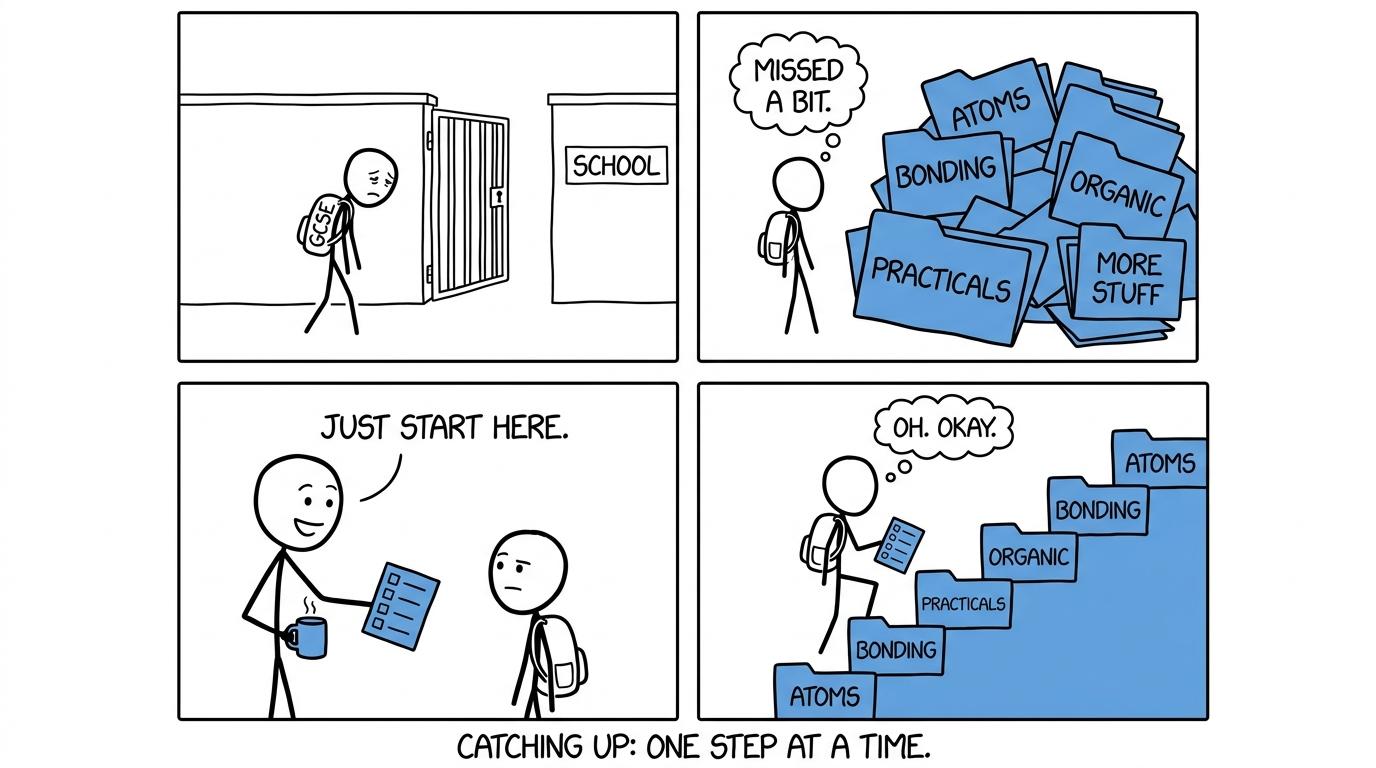 A student turns a mountain of missed chemistry into a manageable staircase
Find out what you actually missed
Students often begin by writing “catch up Chemistry” on a to-do list. It sounds responsible, but it is too vague to guide the next hour.
Ask your teacher for four pieces of information:
- the specification points covered during your absence;
- the relevant textbook or lesson sections;
- any required or core practical activities completed;
- upcoming assessments and their content.
Also check whether your class moved between topics. Three missed weeks might contain one connected unit, or several unrelated pieces taught around practical availability. Your teacher’s sequence matters more than a generic online checklist.
Use the correct board-specific resources. MathsGenie provides dedicated hubs for AQA GCSE Chemistry revision, Edexcel GCSE Chemistry revision and OCR GCSE Chemistry revision, bringing lessons, questions and paper resources together. Eduqas students should check each resource against their current specification and their teacher’s topic list.
Build a traffic-light catch-up map
Label each missed subtopic:
- Red: unfamiliar and needed for later work;
- Amber: partly understood but not secure;
- Green: already understood or quickly recoverable.
Start with red topics that unlock other ideas. Atomic structure supports bonding and periodicity. Formulae and equations support quantitative chemistry. Particle models support explanations of rates, states and separation.
Do not automatically start with the first page you missed. Start with the idea that makes the greatest amount of later work understandable.
Use a realistic four-week recovery plan
A catch-up plan should fit around current lessons, homework, maths revision and recovery from illness. If your health or attendance is still affected, agree a reduced plan with your teacher, pastoral team or family rather than forcing an unrealistic timetable.
Week one: map and rebuild
Use 333 short Chemistry sessions of roughly 252525 to 353535 minutes.
In each session:
- review one small specification section;
- close the notes and recall the main ideas;
- answer a short set of topic questions;
- record one or two specific gaps.
The aim is not to finish everything. It is to restore the foundations and discover which gaps are real. Reading may make material look familiar, but questions reveal whether you can retrieve and apply it.
Week two: connect knowledge to questions
Continue with 333 focused sessions, but give more time to exam-style practice. Use this cycle:
Learn; attempt; mark; correct; reattempt.
Mark schemes matter because GCSE Chemistry assesses more than recall. Across regulated GCSE science assessment objectives, approximately 40%40\%40% concerns knowledge and understanding, 40%40\%40% concerns application, and 20%20\%20% concerns analysis and evaluation. Knowing a definition is useful, but you must also use scientific ideas in unfamiliar situations and interpret evidence.
The guide to GCSE Chemistry revision without wasting time explains how question-led revision can prevent catch-up work from becoming endless note copying.
Week three: recover practical and calculation skills
By now, your teacher should have helped you identify any practical work missed. Learn:
- the purpose of the investigation;
- independent, dependent and control variables;
- apparatus and method;
- safety considerations;
- expected observations or measurements;
- sources of uncertainty and possible improvements;
- how results are presented and interpreted.
Practical knowledge is assessed in written examinations. Watching a demonstration, reviewing class data or completing a supervised catch-up may help, but your school decides how missed practical experience is recovered. Never attempt laboratory procedures independently at home.
Alongside this, identify calculation weaknesses such as ratio, percentages, graph interpretation, unit conversion, standard form and rearranging formulae. These are often maths gaps wearing a laboratory coat. MathsGenie’s ratio revision guide can strengthen proportional reasoning used in chemical calculations.
Week four: test and close the loop
Complete a mixed question set or a manageable section of a paper. Full papers are useful later, but they are not compulsory while you are still rebuilding several missing topics.
Mark the work and classify every lost mark:
- K: missing knowledge;
- A: difficulty applying knowledge;
- P: practical-method weakness;
- E: incomplete exam wording;
- M: maths, units or graph error.
Then choose the 333 most important weaknesses and repair those first. A test is valuable only when its results change what you do next.
Keep Chemistry catch-up from consuming maths revision
The temptation after an absence is to give every available evening to the missed subject. That can create a second problem: your GCSE maths skills begin to fade just as they are needed inside Chemistry.
Use a two-track week. A realistic pattern might contain:
- 333 Chemistry catch-up sessions;
- 222 normal maths topic sessions;
- 111 short mixed maths test or paper section;
- 111 rest or flexible recovery period.
The exact pattern should reflect your health, school timetable and exam proximity. The important principle is continuity. A small amount of regular maths practice is easier to maintain than rebuilding lost fluency later.
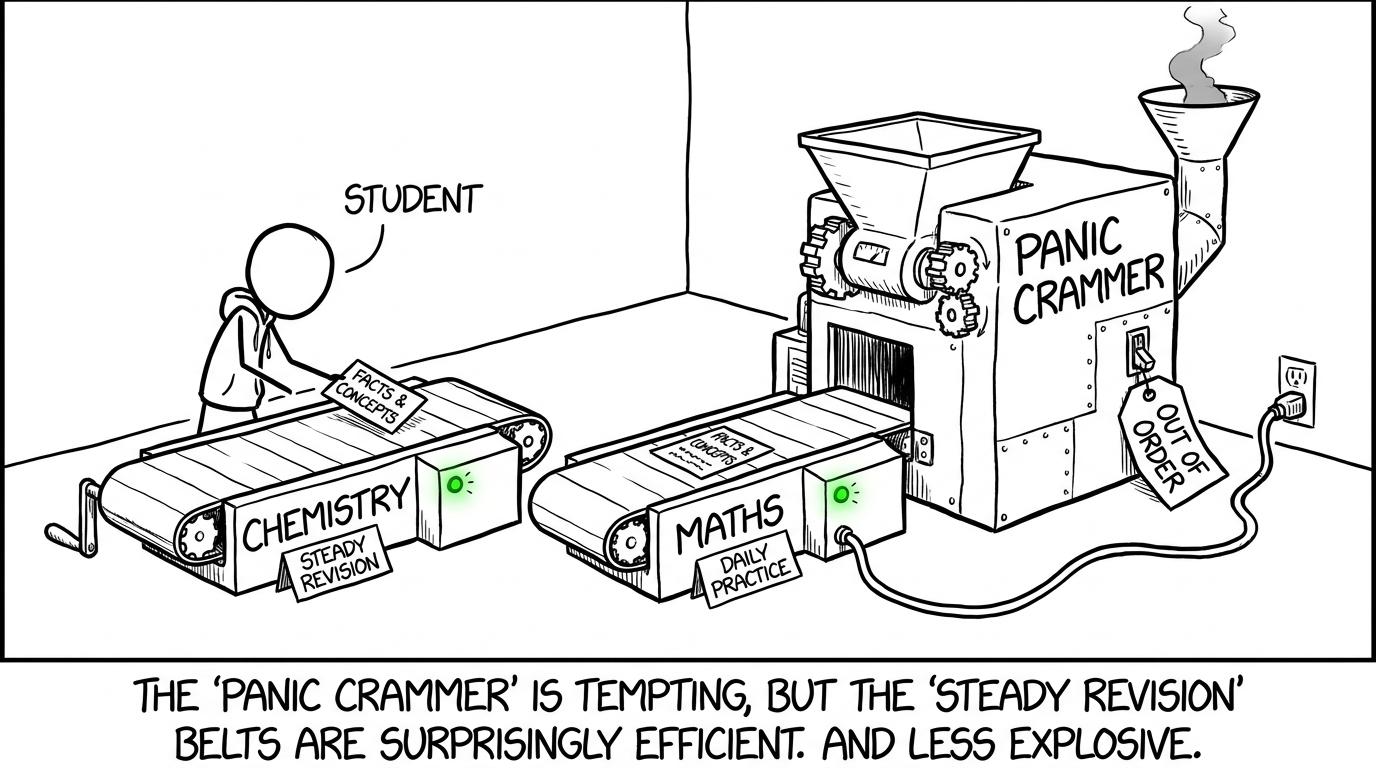 A student chooses steady Chemistry and maths sessions while the panic crammer remains unplugged
For calculation-heavy Chemistry topics, strengthen the underlying maths separately. Practise:
- ratios and proportional relationships;
- percentages and percentage change;
- substituting into formulae;
- changing the subject of a formula;
- standard form;
- gradients and graph interpretation;
- significant figures and sensible rounding.
This separation is powerful. If you struggle with a concentration question because of rearranging, rereading the Chemistry chapter may not solve the actual problem. Repair the algebra, then return to the scientific context.
MathsGenie’s free GCSE maths revision resources let you move from revision lessons to practice questions and solutions without losing time searching across different platforms.
Treat missed practicals differently from missed notes
A copied method is not the same as understanding an investigation. If you missed a practical, ask for the practical title, the question being investigated and what evidence the class collected.
Then create a compact practical record containing:
- the scientific purpose;
- a labelled apparatus reminder;
- the variable structure;
- the sequence of method decisions;
- the expected pattern in the results;
- one limitation and a justified improvement.
Specifications differ. For example, AQA refers to required practical activities, while Edexcel identifies mandatory core practicals. OCR and Eduqas organise their practical requirements in their own specifications. Work from the correct current document rather than assuming another board’s list is interchangeable.
If a teacher offers a catch-up laboratory session, attend if your health permits. Some understanding comes from handling apparatus, judging measurements and seeing why apparently small procedural decisions affect data.
Make each session produce evidence
A useful revision session leaves something measurable behind. That might be:
- a marked question set;
- a completed retrieval grid;
- a corrected practical plan;
- a short mistake log;
- a reattempted question;
- a list of points to ask your teacher.
A beautiful page of notes can still hide uncertainty. A marked response cannot.
If you feel stuck around a pass grade, use the strategies in GCSE Chemistry revision when you are stuck to distinguish knowledge gaps from application, exam-writing and calculation problems.
Common mistakes when catching up after absence
Trying to complete everything chronologically
Later lessons may rely on only part of what you missed. Prioritise prerequisite ideas and current classwork, then return to lower-priority gaps.
Copying another student’s notes without testing yourself
Notes can restore coverage, but they do not prove understanding. Follow every review with retrieval or exam questions.
Ignoring missed practical work
Practical methods, variables, observations, data and evaluation can all appear in written papers. Tell your teacher exactly which activities you missed.
Beginning with full papers too early
A full paper can become a long list of predictable blanks when several units remain untaught or unrecovered. Begin with topic questions, then mixed sections, mini tests and finally complete papers.
Letting Chemistry replace every maths session
Quantitative Chemistry depends on mathematical fluency. Protect some regular maths practice, particularly ratio, formulae, units and graphs.
Marking answers without repairing them
Writing the correct answer beside an error is not enough. Explain why the mark was lost, practise the missing skill and reattempt the question without notes.
Catch up without trying to erase the absence
You do not need to pretend the missed weeks never happened. You need a reliable route from today’s gaps to exam-ready understanding.
Begin with your teacher’s topic list and the correct specification. Rebuild prerequisite ideas, recover practical knowledge safely, practise in short batches and let mark schemes decide what needs attention next. Keep maths moving beside Chemistry, because the two subjects meet whenever you work with formulae, ratios, graphs, units and data.
Use MathsGenie as your free revision base: open the relevant Chemistry hub for revision lessons, practice questions and mark schemes, then use maths topic resources to repair calculation weaknesses. As your coverage improves, move towards mini tests, past papers, video solutions and GCSE predicted papers, guided by a simple revision planner.
Choose one red topic today. Learn it, test it and correct it. Catching up begins when the first vague worry becomes one finished action.