Feeling Behind in GCSE Business? How to Catch Up
Feeling behind GCSE Business revision? Learn why it happens and follow a calm, practical catch-up plan covering knowledge, exam skills and calculations.

It can happen quietly. One lesson feels confusing, a few definitions remain unfinished, and then someone nearby appears to know the entire specification. Suddenly, feeling behind GCSE Business becomes less like a temporary problem and more like a verdict on your ability.
It is not a verdict. Feeling behind usually means that your knowledge, recall or exam technique has become uneven, all of which can be improved. The answer is not to panic-revise every topic at once. It is to identify where marks are leaking, prioritise the weakest areas and follow a repeatable cycle of learning, practice, marking and correction.
This guide explains why the feeling is more common than it appears, how to build a manageable catch-up plan and where MathsGenie can strengthen the numerical skills that GCSE Business requires.
Your GCSE Business catch-up checklist
Start with these actions:
- Confirm your exam board: AQA, Edexcel, OCR or Eduqas.
- Download or ask for your current specification and topic list.
- Separate missing knowledge from weak exam technique.
- Prioritise a small number of topics rather than revising everything.
- Practise calculations alongside written business questions.
- Mark your work and record why each mark was lost.
- Revisit weak material after a gap instead of completing it once.
- Ask your teacher for help with any topic you cannot repair alone.
The aim is not to feel completely caught up before you begin. Action comes first. Confidence tends to follow evidence.
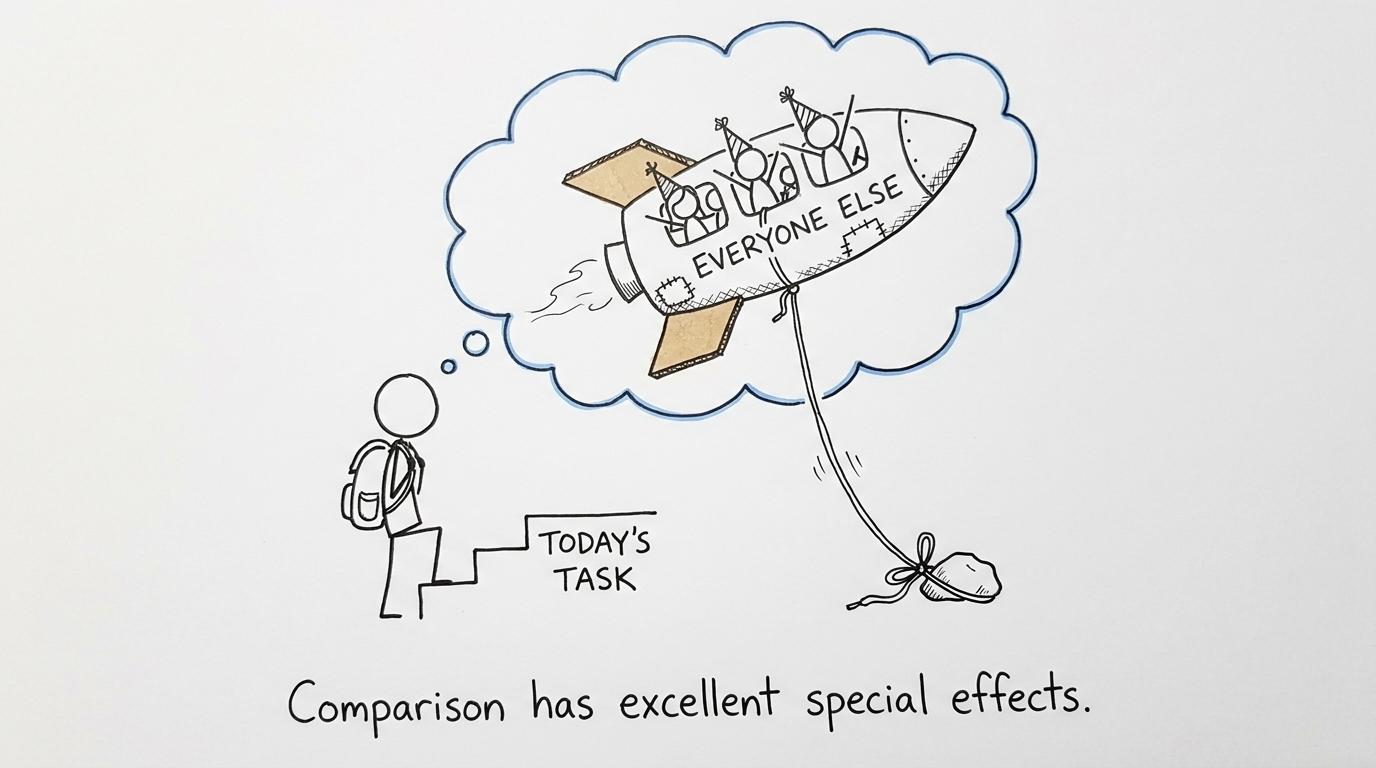 A student imagines everyone else racing ahead on a rocket
Why feeling behind GCSE Business is so convincing
GCSE Business contains several kinds of learning at once. You must know terminology, understand relationships between business decisions, apply ideas to unfamiliar organisations, interpret data and construct justified conclusions. A student can be comfortable with marketing but uncertain about finance; another may remember definitions yet struggle to apply them to a case study.
That unevenness creates a misleading impression. You notice the classmate who answers a finance question quickly, but you do not see the human resources topic they find difficult. Visible confidence is not a complete measure of preparation.
Progress is also difficult to judge from lesson notes. A full folder can hide weak recall, while a student with shorter notes may be able to analyse a case study effectively. The useful question is therefore not, “Am I ahead of everyone else?” It is, “Which skill is costing me marks, and what is my next action?”
Understand what the Business exam actually rewards
Across GCSE Business qualifications, the assessment objectives broadly reward three things:
- knowledge and understanding,
- application to a particular business context,
- analysis, evaluation, judgement and conclusions.
Ofqual sets weightings of 35%35\%35% for knowledge and understanding, 35%35\%35% for application, and 30%30\%30% for analysis and evaluation. This matters because memorising a textbook is not the whole course. You also need to use your knowledge in context and explain why a decision may help or harm the business described.
Quantitative skills account for at least 10%10\%10% of the total qualification marks. They are assessed inside business contexts rather than as isolated maths exercises. Official subject content includes percentages and percentage change, averages, revenue, costs, profit, profitability ratios, average rate of return and cash-flow forecasts. It also requires interpretation of graphs, charts and financial or market data.
Exact paper structures and topic organisation differ between AQA, Edexcel, OCR and Eduqas, so use the specification and assessment materials for your board. Unlike GCSE maths, GCSE Business is not normally divided into foundation and higher tier. Do not organise your Business revision around maths tiers; organise it around your specification and its command words.
Diagnose what “behind” means for you
“Behind” is too broad to revise. Turn it into a short, factual diagnosis.
Check knowledge gaps
Take your specification or class topic list and label each area:
- secure: you can explain it without notes,
- developing: you recognise it but cannot use it reliably,
- priority: you cannot yet explain or apply it.
Be strict but not dramatic. A priority label is an instruction, not a judgement.
Check application and written technique
Look at previously marked questions. Did you lose marks because you did not know the concept, or because your answer stayed generic? Application means connecting an idea to the business in the question. Analysis requires a developed chain of reasoning. Evaluation requires a supported judgement, often considering the context, limitations or alternative outcomes.
A weak answer may therefore reflect technique rather than missing content. Rewriting notes will not necessarily fix that problem; studying model structures and attempting fresh questions will.
Check quantitative skills
Create a separate list for calculations and data interpretation. The core relationships commonly include:
Revenue=selling price×quantity sold\text{Revenue}=\text{selling price}\times\text{quantity sold}Revenue=selling price×quantity sold Profit=total revenue−total costs\text{Profit}=\text{total revenue}-\text{total costs}Profit=total revenue−total costs Percentage change=changeoriginal amount×100\text{Percentage change}=\frac{\text{change}}{\text{original amount}}\times 100Percentage change=original amountchange×100 Gross profit margin=gross profitrevenue×100\text{Gross profit margin}=\frac{\text{gross profit}}{\text{revenue}}\times 100Gross profit margin=revenuegross profit×100Do not merely memorise formulae. Practise identifying the required figures, selecting the correct operation, showing working and interpreting the result in context. MathsGenie’s percentages practice questions and GCSE averages revision can help rebuild the underlying maths without introducing unnecessary Business content.
Build a catch-up plan that does not depend on panic
Panic encourages ambitious plans: six chapters tonight, every flashcard tomorrow and a complete paper at the weekend. Such plans can feel productive when written and impossible when attempted.
A better plan is smaller and repeatable.
Choose three priorities
Select no more than three immediate weaknesses:
- one knowledge area,
- one exam skill,
- one quantitative skill.
For example, your categories might be finance terminology, contextual analysis and percentage change. This gives each revision session a clear purpose while preventing the entire course from competing for your attention.
Use the learn-practise-mark-fix cycle
For each priority:
- Learn: review the relevant lesson, specification point or class material.
- Recall: close the material and write what you remember.
- Practise: answer an exam-style question.
- Mark: compare your answer carefully with the mark scheme.
- Fix: write one precise correction.
- Retest: attempt related material on another day.
This is more demanding than rereading, but it produces useful evidence. You discover what you can retrieve independently and what still needs attention.
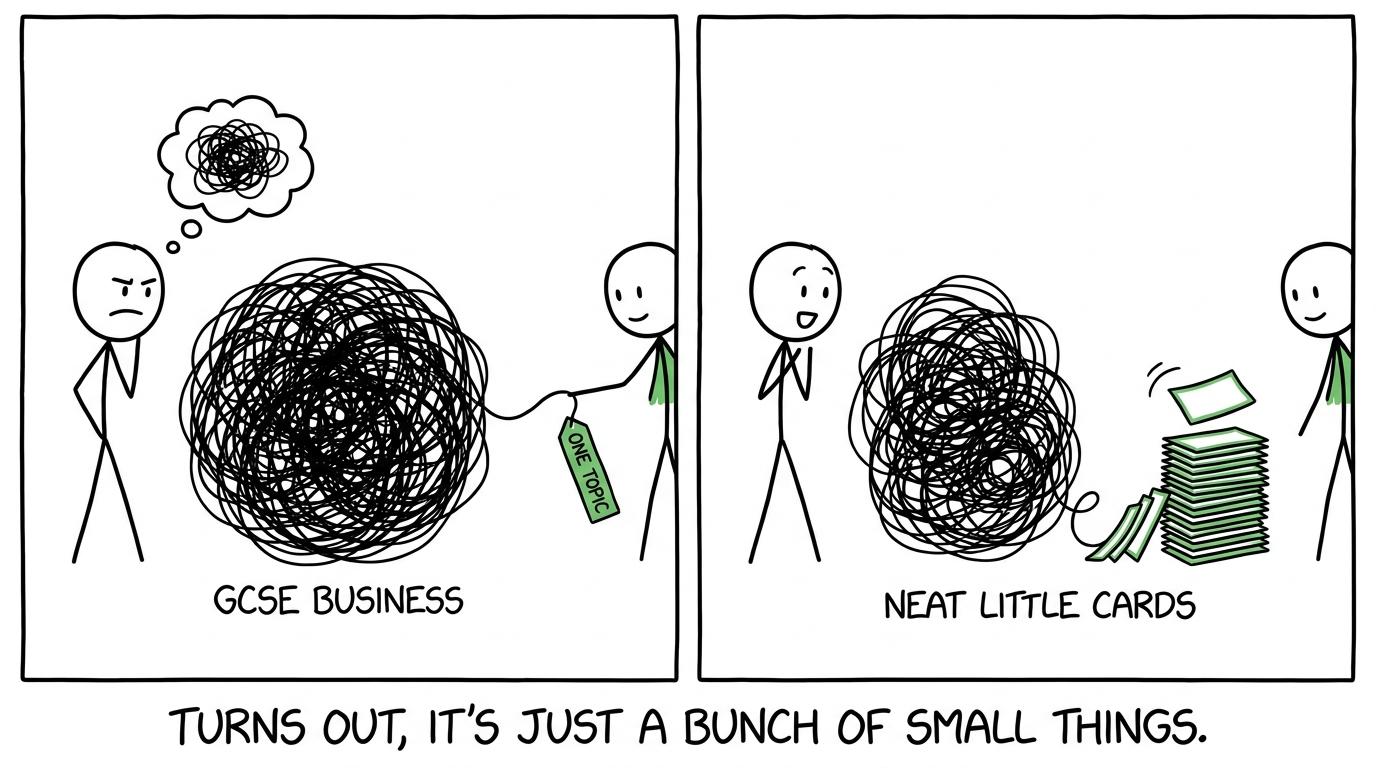 A huge GCSE Business tangle becomes manageable when one thread is pulled
Plan around available time
If exams are still some distance away, focus first on topic coverage and short questions. Introduce mixed and timed practice as your knowledge becomes more secure. If time is limited, prioritise specification gaps and recurring mistakes rather than trying to create perfect notes.
The structure in MathsGenie’s one-month GCSE revision plan is written for maths, but its central rhythm transfers well: diagnose weaknesses, practise focused material, mark honestly and revisit it. Adapt the topics and timings to Business rather than copying a maths timetable unchanged.
Use maths revision to recover Business marks
Numerical questions can become a useful part of a catch-up plan because the underlying skills are finite. They may appear through different businesses and datasets, but percentages, averages and graph interpretation remain recognisable.
Use MathsGenie’s free GCSE maths revision resources to repair the mathematical method first. Then return to a Business question and practise interpreting what the answer means for that organisation.
That final interpretation matters. A calculated increase, margin or profit figure is evidence, not a complete business conclusion. Ask:
- Is the result favourable or unfavourable?
- Compared with what previous figure, target or competitor?
- What decision might it support?
- What information is still missing?
For broader preparation, the guide to GCSE maths topics that recur regularly can help you reinforce percentages, ratio, averages and graphs for your maths exams too. One carefully chosen session can therefore support both subjects.
Use papers as diagnosis, not punishment
A paper is useful because it exposes gaps. It is not a label for your final grade.
When marking practice, classify every lost mark as one of the following:
- missing knowledge,
- weak application,
- incomplete analysis,
- unsupported judgement,
- calculation or calculator error,
- misread command word,
- poor timing.
Then choose the two or three patterns that occur most often. MathsGenie’s guide to using past papers properly explains the same principle for maths: a paper creates progress only when its mistakes lead to targeted practice.
Predicted papers can provide fresh practice in maths, but they should supplement official past papers rather than replace them. Maths students can use the Edexcel GCSE maths predicted papers once topic weaknesses have been addressed. For Business, use materials matched to your own board and current specification.
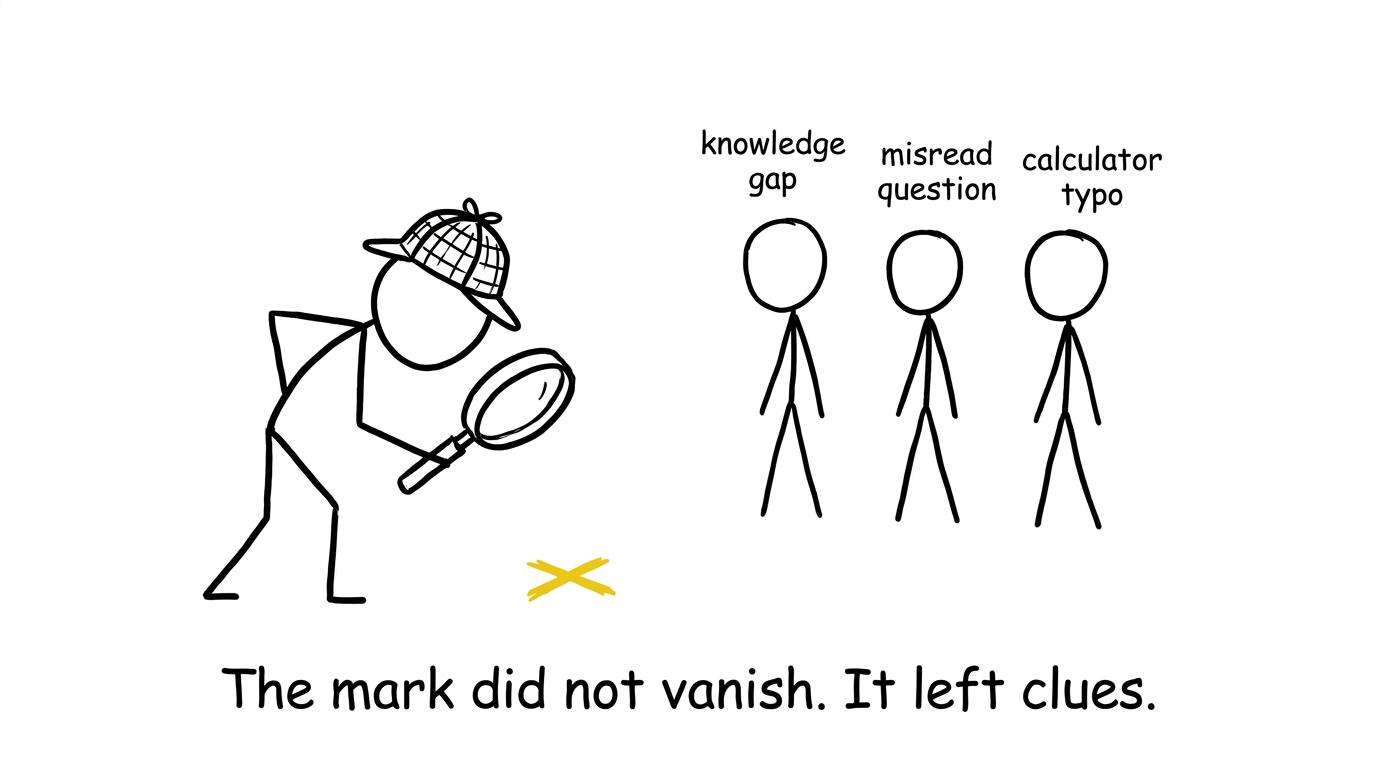 A student detective investigates where an exam mark went
Common mistakes when trying to catch up
Revising everything equally
Secure topics feel comfortable, so they attract revision time. A catch-up plan should give more attention to weak, high-value skills while still revisiting stronger material occasionally.
Copying notes instead of testing recall
Neat notes can support learning, but copying is not evidence that you can retrieve an idea under exam conditions. Close the page and explain the concept before checking what you missed.
Ignoring command words
“Identify”, “explain”, “analyse” and “evaluate” require different depths of response. Study how your exam board uses them and let the available marks guide the detail of your answer.
Treating calculations as separate from Business
A correct figure may need interpretation. Always return to the case study, identify what the result suggests and recognise any limitation in the available data.
Waiting to feel confident
Confidence is unreliable at the beginning of a catch-up process. Start with one priority topic and let completed questions, corrected errors and improving recall provide more dependable evidence.
You do not need to catch up all at once
Feeling behind becomes frightening when GCSE Business is viewed as one enormous task. It becomes manageable when converted into a sequence: check the specification, identify three priorities, learn one area, practise it, mark it and return later.
MathsGenie can support the numerical side of that journey with free revision lessons, practice questions, mini tests, mark schemes and video solutions. Use past papers to diagnose your GCSE maths gaps, then use predicted papers to test whether those improvements hold under pressure.
Start with one small action today. Open MathsGenie’s GCSE and A Level revision hub, choose the percentage, average or graph skill causing difficulty, and complete a focused set of questions. Being behind is a description of where you are beginning, not where you have to finish.