GCSE Further Maths Study Group That Actually Works
GCSE Further Maths study group advice: create a focused weekly routine with clear roles, timed practice, mark schemes and accountability that lasts for exams.
A study group can look productive long before it becomes productive. Someone creates a group chat. Everyone sends enthusiastic messages. A date is suggested, moved and eventually forgotten.
A GCSE Further Maths study group works differently. Keep it small, meet at the same time each week and arrive with one agreed topic. Spend most of the session answering questions independently, then compare methods, mark the work and record what needs revisiting. The group chat should organise the meeting, not replace it.
This matters particularly in Further Maths because the subject rewards precision. You may understand differentiation, matrices or algebra while watching somebody else, yet still struggle to produce a complete solution alone. A useful group exposes that gap early.
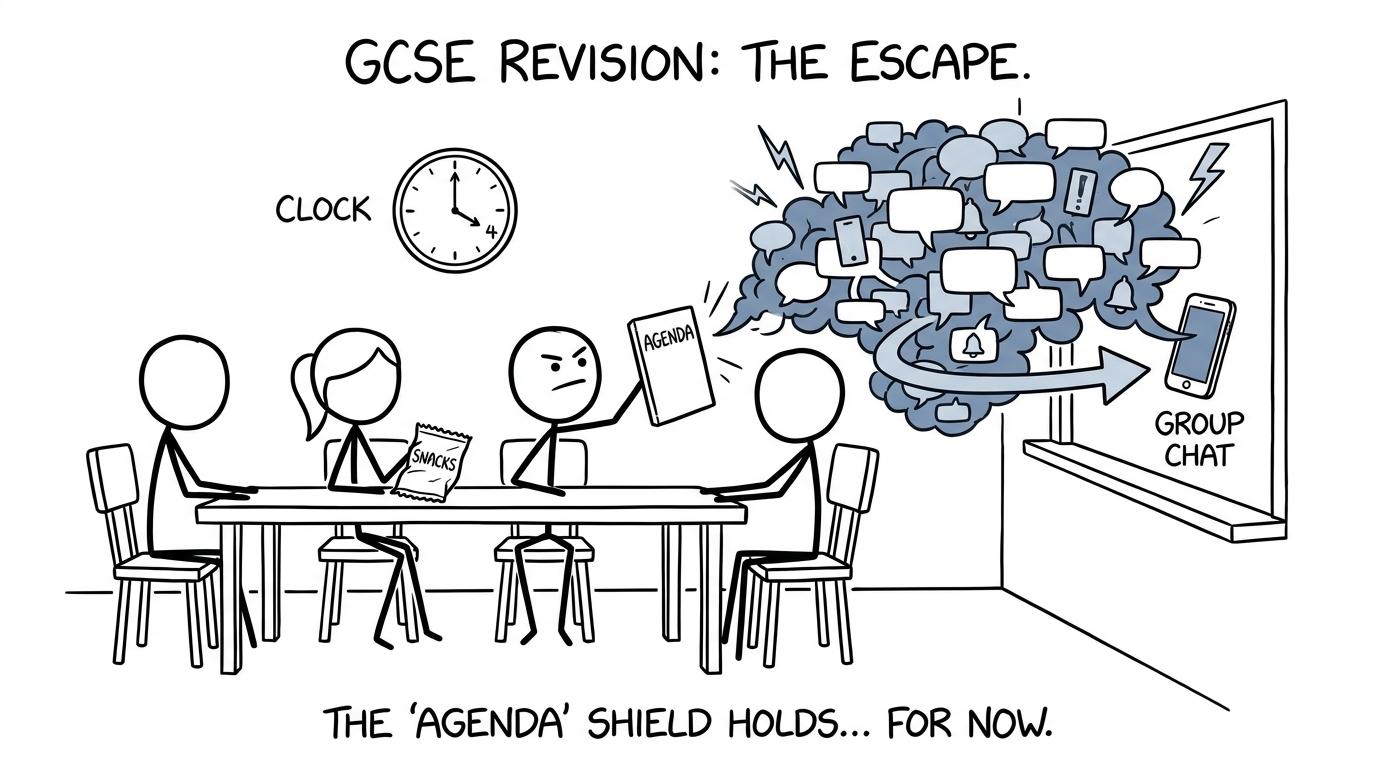 A focused study group escaping a storm of group-chat notifications
The study group checklist
Before inviting anyone, agree on the following:
- three or four committed members;
- the same qualification and specification where possible;
- a fixed weekly meeting lasting about 606060 to 757575 minutes;
- one topic and one question set announced beforehand;
- rotating roles for chair, timekeeper and checker;
- independent question time before discussion;
- mark schemes or video solutions for resolving uncertainty;
- a shared mistake log and a date for retesting;
- a clear rule that social conversation waits until the work is finished.
You can build the academic side of this system around the free AQA GCSE Further Maths revision hub, which brings together lessons, questions and past-paper resources.
Start with the exact qualification you are taking
“Further Maths” does not always mean the same course. The AQA Level 2 Certificate in Further Mathematics, specification 836583658365, is commonly described as GCSE Further Maths. It is an additional, untiered Level 2 qualification designed for students who are expected to achieve grades 777, 888 or 999 in GCSE Mathematics and may continue to A Level.
Its main content areas are number, algebra, coordinate geometry, calculus, matrix transformations and geometry. Assessment consists of two equally weighted written papers: one non-calculator paper and one calculator paper. Each lasts 111 hour 454545 minutes and can assess content from across the specification.
Other schools may offer a different extension qualification, such as OCR FSMQ Additional Mathematics or an Edexcel alternative. Content and assessment arrangements differ, so ask your teacher for the awarding body, qualification title and specification code. Eduqas and WJEC arrangements should also be checked directly rather than assumed from ordinary GCSE Mathematics.
This is more than administration. A group revising matrices is no help to a student whose specification does not assess them, while calculator practice will not prepare an AQA student for the non-calculator paper. Ideally, every member should take the same course. If not, label shared and specification-only topics before planning sessions.
Choose people for reliability, not friendship alone
A good group does not need the four strongest mathematicians in the year. It needs students who will attend, attempt questions and admit when they are unsure.
Three or four members is usually practical. Two can work, but one absence cancels the meeting. A much larger group makes it easier to hide, drift into separate conversations or wait for somebody else to think.
Before committing, hold one trial session. Afterwards, ask:
- Did everyone bring the agreed materials?
- Did everyone attempt the questions?
- Could disagreement stay mathematical rather than personal?
- Did the meeting finish with a clear next action?
Friendship can make meetings enjoyable. Reliability makes them happen.
Give every meeting a repeatable structure
Motivation changes from week to week. A routine does not have to.
Prepare before the session
The chair posts one short message at least a day beforehand containing:
- the topic;
- a link or question set;
- the start and finish time;
- any calculator or non-calculator condition;
- what each person must bring.
Keep the scope narrow. “Revise algebra” invites confusion. “Complete the selected inequalities questions, mark them and identify one recurring error” gives the group a finish line.
Use the wider MathsGenie GCSE and A Level revision resources to locate free revision lessons, practice questions, mini tests, past papers, predicted papers, mark schemes and video solutions. A GCSE maths revision timetable can help members fit the meeting around their independent revision rather than treating it as a substitute.
Open with retrieval
Spend the first 555 to 101010 minutes recalling definitions, formulae or methods from the previous session without notes. Each member can write what they remember, then check it.
This gives the meeting continuity. It also reveals whether last week’s understanding survived beyond the table. If a method has vanished, record it for another short review rather than restarting the entire lesson immediately.
Work independently before talking
Give everyone 202020 to 303030 minutes to attempt the same questions in silence. Phones stay away except when they are genuinely needed for the resource or timer.
This is the most important rule. If discussion begins immediately, the quickest student can become the group’s unpaid narrator while everyone else mistakes recognition for understanding. Independent work makes each person commit to a method first.
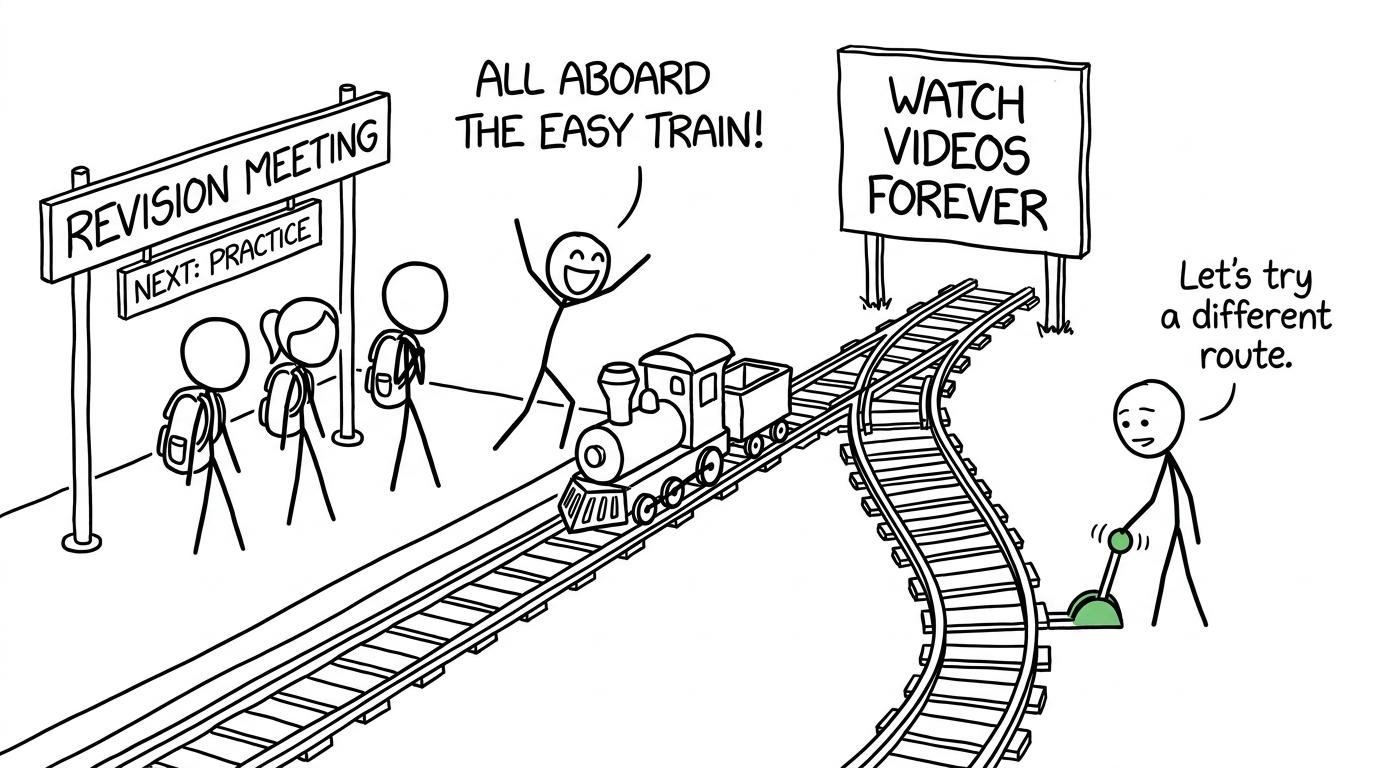 Students switching the revision train from endless videos towards practice
Compare methods, not just answers
After independent practice, choose questions that produced different answers or caused difficulty. One student explains the first step. Another checks the algebra. A third compares the reasoning with the mark scheme.
Useful prompts include:
- What information told you to use that method?
- Where could a method mark be earned?
- Which line first became incorrect?
- Is the final form what the question requested?
- Could this be completed efficiently without a calculator?
Explaining should remain brief. The goal is not to perform a miniature lesson but to make the decision-making visible. If nobody can justify a method confidently, use a MathsGenie revision lesson or video solution rather than allowing the loudest guess to become group knowledge.
Mark, diagnose and retest
Do not stop at a total. Label each lost mark as one of the following:
- knowledge: the fact or method was unknown;
- choice: the wrong approach was selected;
- accuracy: arithmetic or algebra went wrong;
- communication: working, notation or justification was insufficient;
- timing: the question was unfinished or rushed.
Finish by choosing one repair action per student and setting a retest date. The advice in Should You Redo Past Papers? explains why correction and targeted practice should happen before a full paper is repeated.
Use roles without creating a hierarchy
Roles prevent awkward moments when everyone expects somebody else to lead.
- Chair: chooses the agreed resource and keeps the agenda moving.
- Timekeeper: starts independent work and ends discussions that overrun.
- Checker: opens the mark scheme and confirms accepted reasoning.
- Recorder: updates the shared mistake log and next-session plan.
Rotate roles every meeting. The strongest student should not permanently become the teacher, and the quietest should not permanently become the note-taker. Everyone needs practice explaining, checking and making decisions.
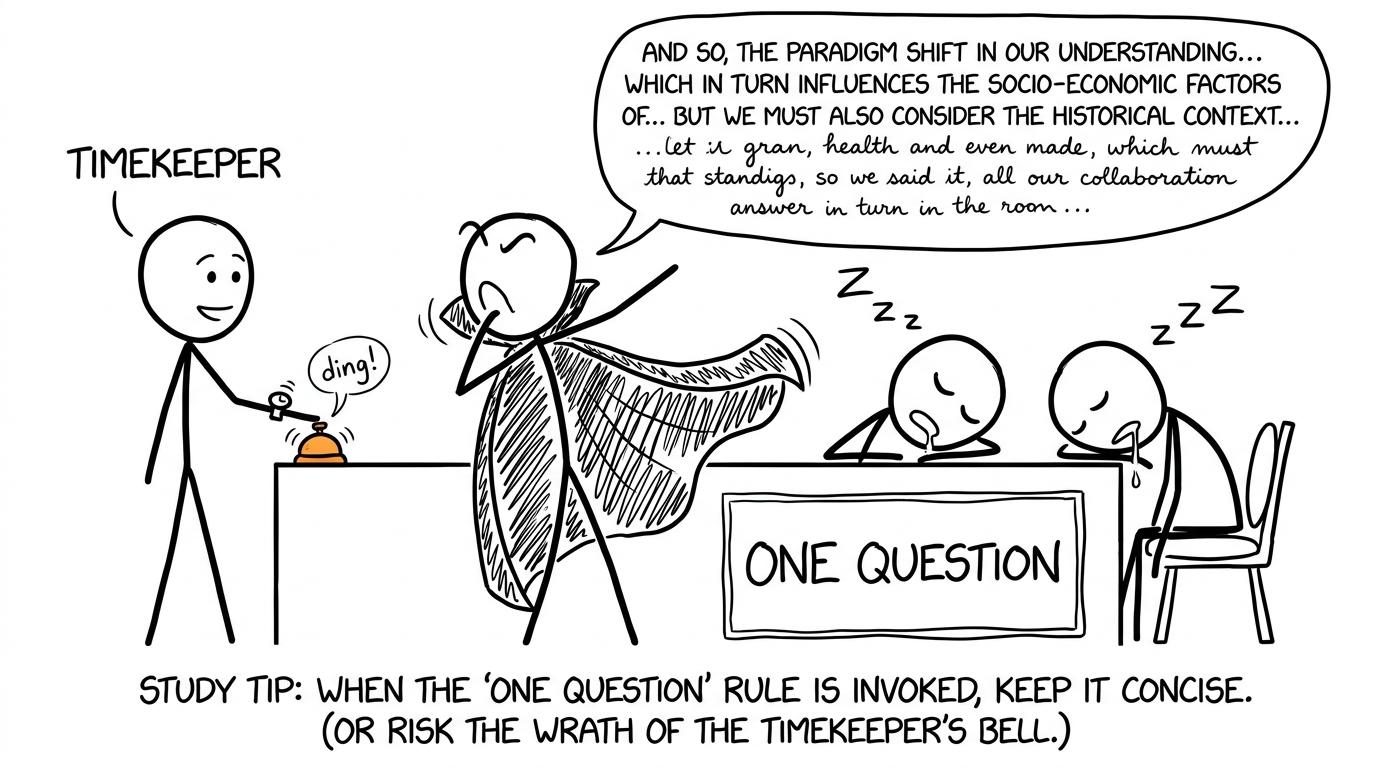 A timekeeper rescuing the group from an unnecessarily epic explanation
Build the group around exam practice
Topic sessions should eventually lead to timed mixed work. Begin with short sets or mini tests, then introduce paper sections and complete papers as the exams approach. The guide to when to start GCSE past papers explains how paper practice can develop alongside topic revision.
Complete timed work individually under the correct conditions. Marking can then be collaborative, but each student must keep their own score, error categories and repair list.
Predicted papers can provide fresh practice near the exam, but they should supplement official past papers rather than replace them. Mark schemes show how credit is awarded; video solutions reveal how a complete method develops. Both are more useful when consulted after a genuine attempt.
Further Maths also sits beside ordinary GCSE Mathematics, not above it. Protect time for the correct foundation or higher-tier GCSE papers as well as the additional qualification. If exams are close, the one-month GCSE maths revision plan offers a useful rhythm for balancing topic repair and timed practice.
Keep the group chat deliberately boring
A successful revision chat is mostly logistics. Use it for the topic, meeting time, resource link and absence notice. Move general conversation elsewhere.
A pinned template helps:
- Topic: one precise area;
- Resource: one agreed link or paper section;
- Meeting: place, start and finish time;
- Condition: calculator, non-calculator or untimed practice;
- Preparation: one task each member completes beforehand.
If a meeting is cancelled, rearrange it once. Repeated negotiation drains more energy than the revision itself. A fixed weekly slot removes the need to vote every time.
Common mistakes that stop study groups working
Turning every session into tutoring
One confident student explains while everybody else watches. Require silent attempts first and rotate the person who explains.
Choosing topics by comfort
Groups often revisit material everyone likes. Use recent questions, mini tests and mistake logs to choose the topic responsible for lost marks.
Debating answers without a reliable check
An argument can make an error feel sophisticated. Resolve uncertainty with the relevant mark scheme, lesson, video solution or teacher.
Spending longer planning than practising
Colour-coded schedules can feel safe because they contain no difficult algebra. Set the next topic in the final five minutes, then stop planning.
Treating attendance as revision
Being present earns no marks by itself. Each meeting should produce attempted questions, corrections and one scheduled retest.
Using the group as the night-before rescue plan
Collaborative revision works best as a steady routine. Immediately before an exam, individual preparation, accurate materials and sleep matter more than a frantic late meeting. Use the GCSE maths night-before plan to keep that final evening controlled.
Make the next meeting real
A productive study group is not built by enthusiasm alone. It is built by small promises that survive contact with an ordinary week: the same time, one topic, independent attempts, honest marking and a planned retest.
Start today. Invite three reliable students, confirm the exact specification and book one trial session. Open the MathsGenie AQA GCSE Further Maths hub, select a focused topic and arrive ready to write.
Then keep MathsGenie as the group’s shared base: learn through free revision lessons, practise with exam questions and mini tests, check work using mark schemes and video solutions, and build towards past papers and predicted papers. The group provides accountability. The questions provide evidence. Together, they turn good intentions into revision that actually gets done.