

GCSE Further Maths Revision Drop-In Sessions: Worth It?
GCSE further maths revision drop in sessions can expose misconceptions quickly. Learn when school support beats solo practice and how to combine both.
There is a particular kind of frustration that comes from being stuck on Further Maths. You understand most of the chapter, your notes look sensible, and yet one step in a matrix transformation or algebraic proof refuses to make sense. You could spend another hour alone. Or you could take the question to school tomorrow.
For most students, gcse further maths revision drop in sessions are worth attending when they provide targeted help with specific weaknesses. They are less valuable if you arrive without questions, passively copy solutions or use them instead of independent practice. The best approach is not drop-ins or solo revision. It is a deliberate combination of both.
The quick verdict
A school revision drop-in is probably worth your time if:
- you have identified a precise topic or question that is causing trouble;
- a teacher familiar with your course will be available;
- the session is small enough for you to ask questions;
- you will attempt questions rather than simply watch;
- you plan to practise the corrected method independently afterwards.
Solo revision may be the better choice if:
- you already understand the topic and mainly need repetition;
- the session is crowded or unfocused;
- travelling or waiting would consume most of your available time;
- you work more effectively with a timed paper and mark scheme;
- you are avoiding independent practice because it feels harder.
Before deciding, check the exact qualification your school teaches. What students casually call GCSE Further Maths may be the AQA Level 222 Certificate in Further Mathematics, while some schools offer a different course such as OCR Level 333 FSMQ Additional Mathematics. The content and assessment structure are not identical, so ask your teacher rather than assuming.
Why Further Maths makes drop-ins particularly useful
Further Maths tends to expose small gaps in understanding. In ordinary practice, an incorrect line may still produce an answer that looks plausible. With more advanced algebra, functions, calculus and matrix transformations, one misunderstood idea can affect the entire solution.
For example, knowing that differentiation involves expressions such as
dydx\frac{dy}{dx}dxdyis not the same as understanding what the derivative represents, when to evaluate it or how it connects to the gradient of a curve. These are conceptual questions. A teacher can often diagnose the misunderstanding more efficiently by asking you to explain your thinking aloud.
That is the main advantage of a good drop-in: diagnosis. A video can explain a method, and a mark scheme can show what earns marks, but neither can immediately ask why you chose the wrong step.
Broader educational evidence supports targeted small-group tuition and clear feedback, although this evidence is not specific to school Further Maths drop-ins. The important condition is targeting. A room containing a teacher and several students is not automatically effective; the session needs to respond to actual gaps.
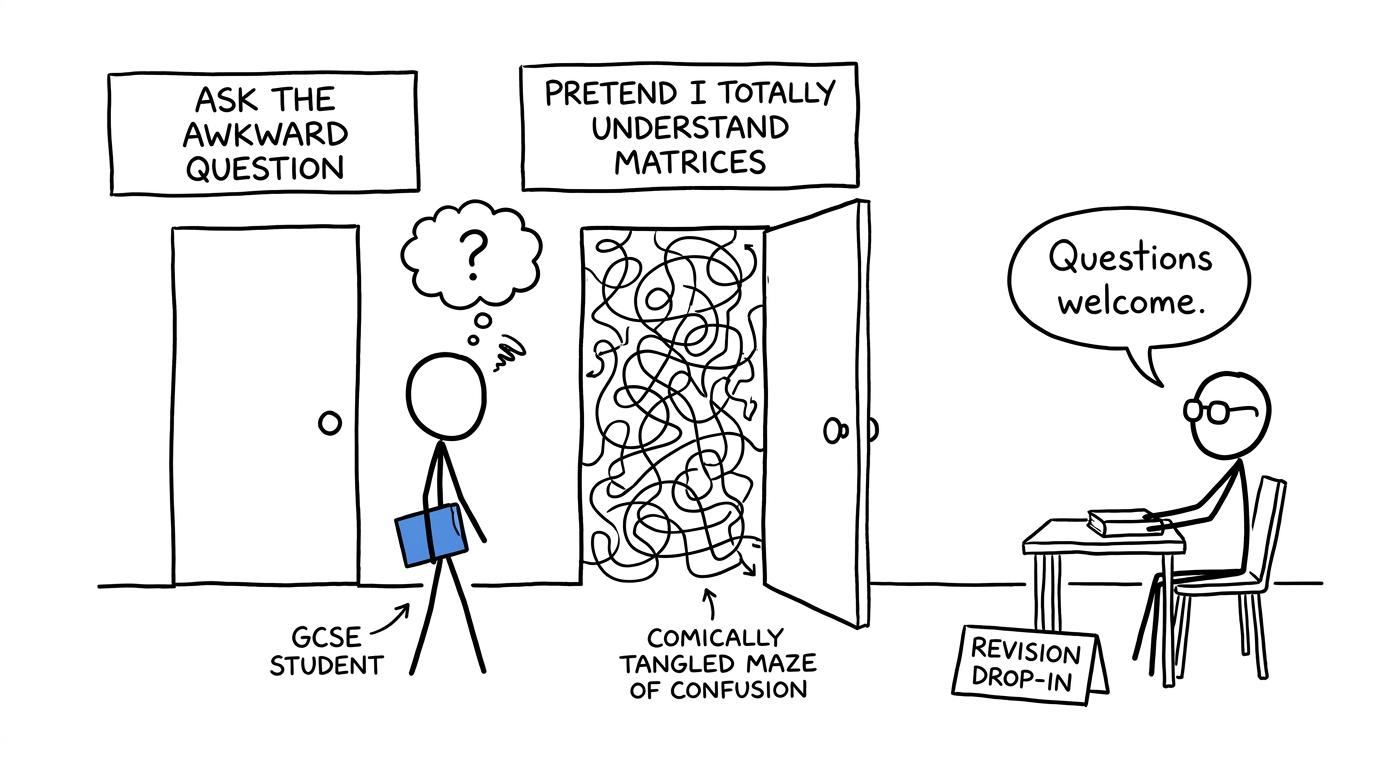 A student chooses between asking a question and pretending to understand matrices
When GCSE Further Maths revision drop in sessions beat revising alone
When you cannot locate the mistake
Sometimes you know that an answer is wrong but cannot see where the method failed. Repeating the same process may simply reinforce the error. Bring the original question, your full working and the mark scheme to the session. Ask the teacher to identify the first incorrect decision, not merely to show the finished solution.
This works especially well for algebraic manipulation, proof, functions and multi-step geometry, where the final error may have begun several lines earlier.
When the mark scheme feels too compressed
Mark schemes are written to explain how marks are awarded, not to provide a complete lesson. A line that appears obvious to an examiner may hide an idea you have not yet understood.
Use the AQA GCSE Further Maths past papers to find authentic questions, then take difficult ones to your drop-in. Afterwards, return to the mark scheme and check whether its shorthand now makes sense. MathsGenie's guide to using GCSE mark schemes as a revision coach can help you turn each lost mark into a clear next action.
When you need to explain your reasoning
A strong teacher may ask, “Why does that step follow?” This can feel less comfortable than quietly reading notes, but the discomfort is useful. Explaining a method reveals whether you understand the structure or have memorised a pattern.
Research on metacognition emphasises planning, monitoring and evaluating your own learning. In practical terms, that means asking:
- What is the question testing?
- Why did I choose this method?
- At what point did I become uncertain?
- How will I recognise a similar question next time?
These questions make a drop-in more than an emergency repair session. They teach you how to become more independent.
When solo revision is the better investment
Teachers are valuable, but not every problem requires a teacher. Once a method is understood, progress usually depends on doing enough questions to make it reliable.
If your issue is speed, accuracy or remembering a process, you may gain more from a quiet block of independent practice. Start from the GCSE Maths revision hub to strengthen overlapping higher-tier skills, then use board-appropriate questions for your Further Maths course.
Solo revision is also better for testing whether support has worked. Help can make a question feel easy because someone else is guiding the route. Only a fresh question, completed without hints, proves that the method is now yours.
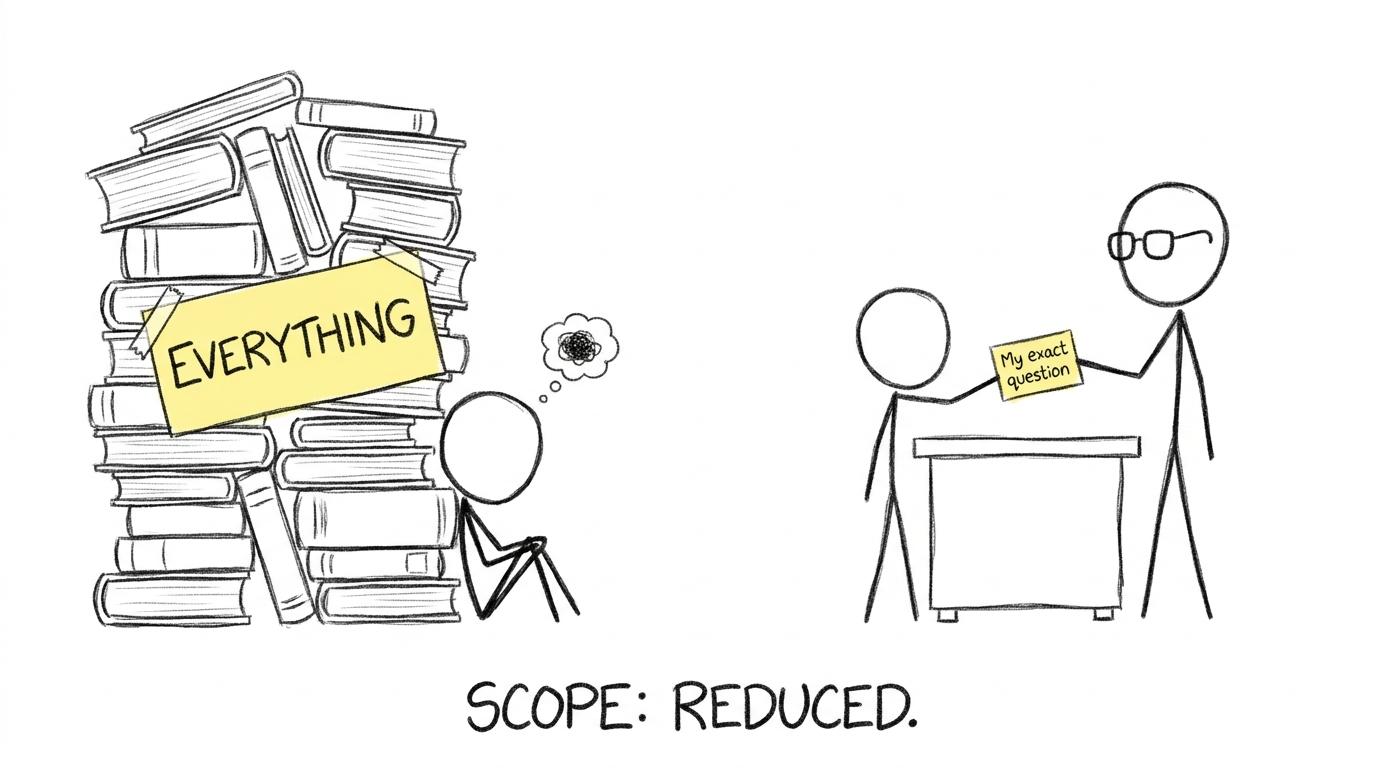 A huge pile called everything is replaced by one exact question
A better strategy: use drop-ins and independent revision together
Think of a drop-in as one stage in a revision loop rather than a complete revision plan.
Before the session
Complete a short set of questions or part of a paper without notes. Mark it carefully and classify each error:
- knowledge gap: you did not know the relevant fact or method;
- method gap: you knew the topic but could not organise the solution;
- execution slip: the approach was right but the algebra or arithmetic failed;
- exam technique issue: you misread the demand, omitted working or used time poorly.
The guide to finding your weakest GCSE topics provides a practical diagnostic routine. Although your Further Maths specification requires its own questions, the process of logging and prioritising errors is the same.
Choose no more than three questions to bring. “I do not understand calculus” is too broad. “I can differentiate, but I do not understand how the derivative identifies a stationary point” gives the teacher something precise to address.
During the session
Show your attempt before asking for the solution. A blank page gives the teacher little information; imperfect working reveals your decisions.
Write down a short correction in your own words. It could be a recognition cue, a warning about notation or a sentence explaining why a method works. Do not spend the whole session producing beautiful copied notes. The goal is to change what you can do.
If there is spare time, attempt a similar question while the teacher is nearby. That creates a useful bridge between guided and independent practice.
After the session
Within the next few days, complete a fresh question on the same skill without notes. Mark it strictly. If the same error returns, the topic is not secure yet.
You can use shorter Edexcel GCSE Maths mini tests to reinforce overlapping GCSE skills, but remember that ordinary GCSE resources do not replace qualification-specific Further Maths papers. For full-paper technique, follow the MathsGenie method for using past papers properly: attempt, mark, diagnose, repair and retest.
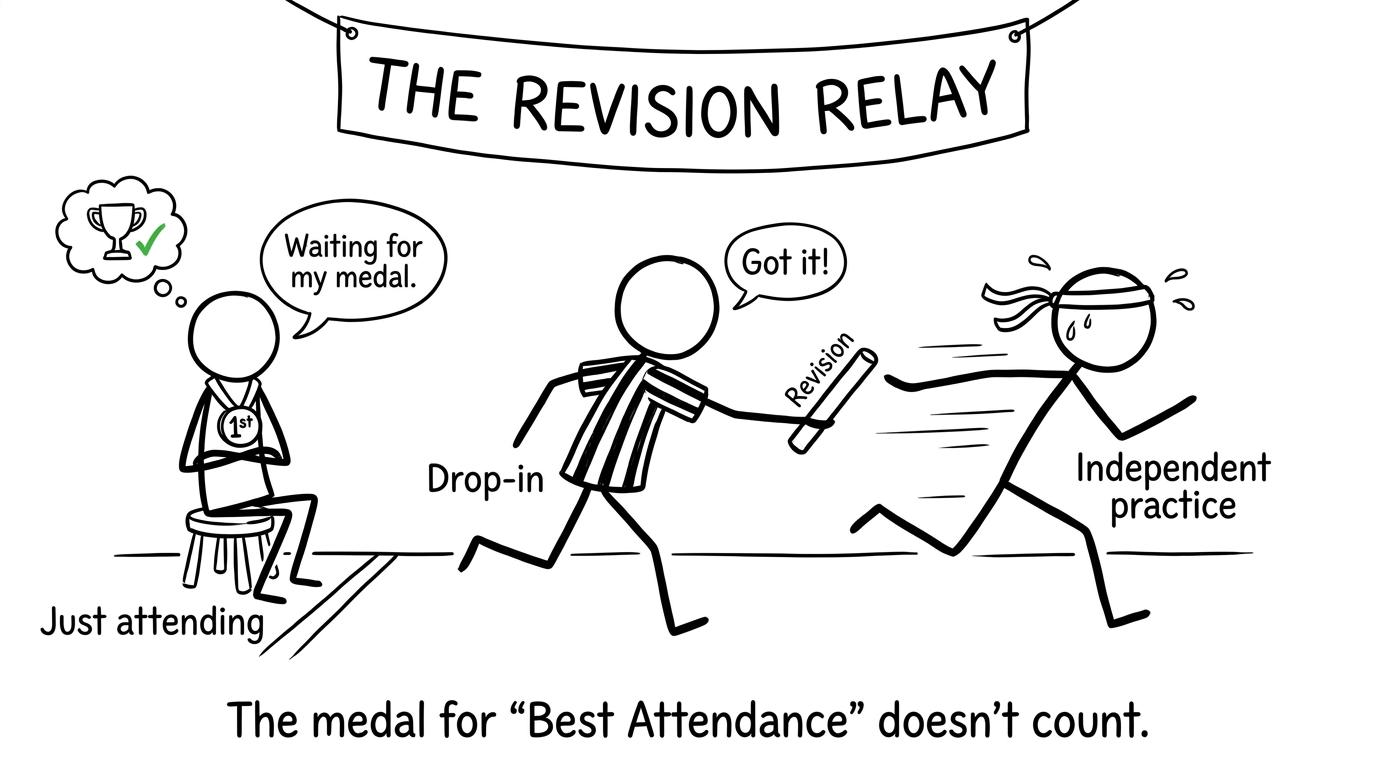 The revision baton passes from a drop-in to independent practice
How to judge whether a session was actually worthwhile
Attendance is easy to measure. Learning is harder. Instead of asking whether the session felt helpful, look for evidence.
After each drop-in, record:
| Check | Evidence to look for |
|---|---|
| Understanding | You can explain the corrected idea without copying the teacher |
| Independence | You can start a similar question without a prompt |
| Accuracy | The original type of error does not reappear |
| Exam value | You can identify where method marks are earned |
| Retention | You can still use the method several days later |
If those things are happening, continue attending. If you mostly sit quietly while the teacher helps other students, change your approach: arrive earlier, bring sharper questions or ask whether a smaller session is available.
A simple weekly plan might include one drop-in for difficult concepts, two focused practice sessions and one timed paper section. Adapt the balance to your workload. MathsGenie's GCSE maths revision timetable guide can help you build a realistic routine around school and other subjects.
Common mistakes that waste the session
Arriving without evidence
Do not rely on memory and say, “I was stuck on something about functions.” Bring the exact question, your working and any marking. Specific evidence leads to specific feedback.
Asking for the answer too quickly
A completed solution can create the illusion of understanding. Ask for the smallest useful hint first, then continue the question yourself.
Treating attendance as revision completed
Sitting in the room is not the same as retrieving knowledge or solving problems. The session becomes valuable only when it changes your subsequent independent work.
Using the wrong resources
AQA Level 222 Further Mathematics, OCR Additional Mathematics and GCSE Maths are different qualifications. Confirm your specification and paper rules with your school. Use GCSE higher-tier material to repair shared foundations, but use papers matched to your actual qualification for final preparation.
Never retesting the topic
A method can feel clear while the explanation is fresh. Revisit it later under independent conditions. This is where learning becomes dependable rather than temporary.
Make every drop-in earn its place
School revision sessions are not automatically better than revising alone. Their value comes from something solo revision cannot always provide: rapid diagnosis, responsive explanation and feedback on your particular reasoning. Independent work then supplies the repetition, recall and exam stamina that a drop-in cannot provide for you.
Use both deliberately. Start with a question, seek the smallest piece of help you need, and finish by proving that you can solve a fresh problem alone.
MathsGenie can support the entire cycle for free. Use revision lessons and practice questions to rebuild weak skills, mark your work carefully, then move into Further Maths past papers and video solutions. As your wider GCSE exams approach, add mini tests and predicted papers from the MathsGenie GCSE revision resources. Let the evidence from each question decide whether your next step is another school drop-in or a quiet session of focused practice.











