GCSE Further Maths Paper 1: What to Expect
GCSE Further Maths Paper 1 explained: timing, non-calculator demands, question styles, topic coverage and a practical revision plan for AQA students.
The unsettling thing about a Further Maths paper is not always the difficulty. It is the uncertainty. You may know how to differentiate, manipulate matrices and factorise a cubic, yet still wonder what will appear when the booklet opens.
Here is the useful answer early: GCSE Further Maths Paper 1, meaning AQA Level 2 Certificate in Further Mathematics Paper 1, is a non-calculator paper lasting 111 hour 454545 minutes. It is worth 808080 marks and contributes 50%50\%50% of the qualification. Any part of the specification can be assessed, so there is no official list of topics reserved for Paper 1.
What makes it different is the way you must handle those topics. Without a calculator, exact values, fluent algebra, clear reasoning and reliable arithmetic matter more. The paper contains short questions and longer multi-step problems, with mathematical demand generally increasing as you move through it.
Paper 1 at a glance
Before revising, make sure you know the paper you are actually sitting:
- Qualification: AQA Level 2 Certificate in Further Mathematics, specification 836583658365
- Paper code: 8365/18365/18365/1
- Time: 111 hour 454545 minutes, or 105105105 minutes
- Marks: 808080
- Weighting: 50%50\%50%
- Calculator: not permitted
- Topic coverage: any content from the specification
- Question style: short questions through to extended, multi-step problems
- Tier: there is no separate foundation or higher tier paper
This article focuses on AQA because that is the qualification usually meant by this paper name. Do not assume that an Edexcel Extended Mathematics paper or OCR FSMQ Additional Mathematics assessment has the same structure. Check the qualification title and code supplied by your school before downloading practice material.
You can find the correct course resources in the AQA GCSE Further Maths revision hub.
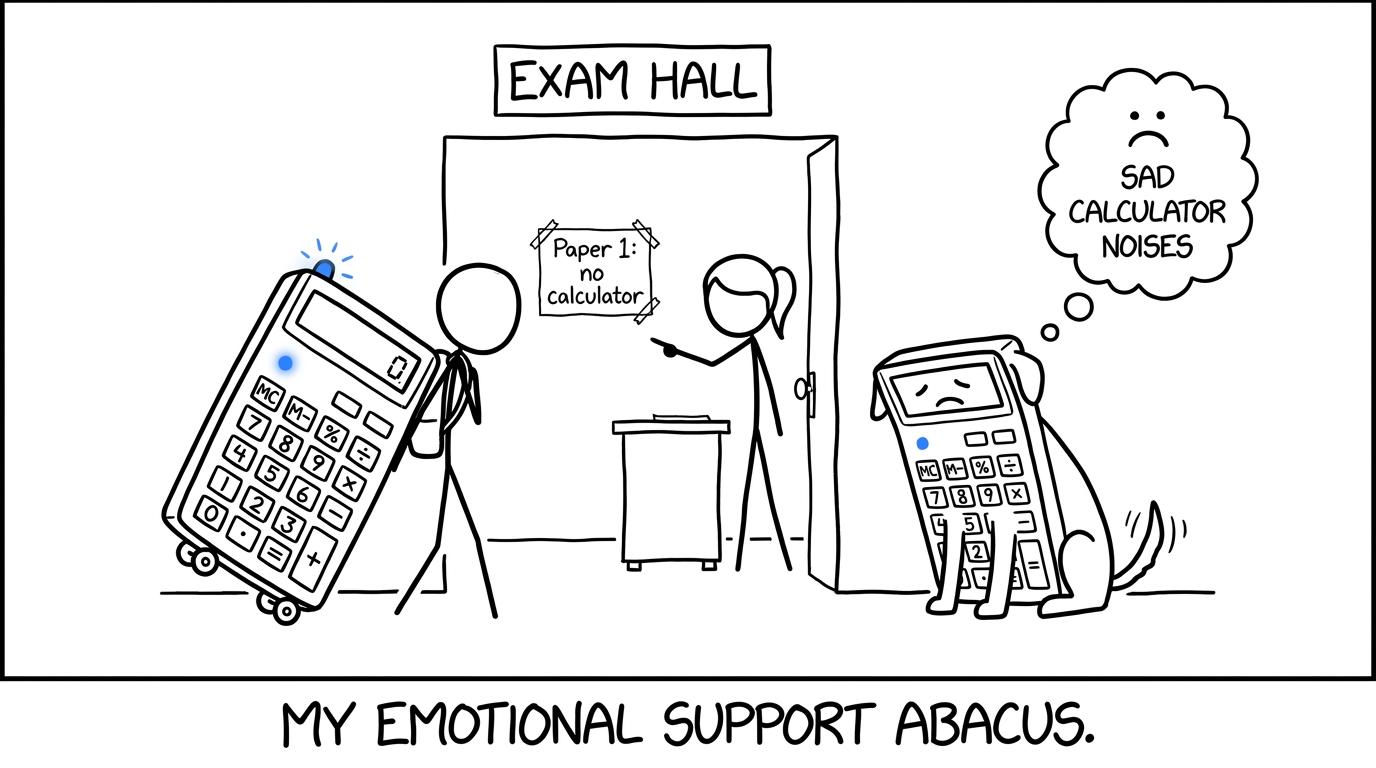 A calculator waits outside the non-calculator exam
What is actually different about Paper 1?
It is a test of mathematical control
Paper 2 allows a calculator, but Paper 1 asks you to maintain control of the mathematics yourself. That does not make every question harder. It changes where mistakes are likely to occur.
You may need to preserve exact forms involving fractions, surds or π\piπ rather than replace them with decimals. Algebraic manipulation must be secure because a calculator cannot rescue a sign error, expand brackets for you or reveal that a factorisation is wrong.
The non-calculator condition tends to reward skills such as:
- simplifying expressions efficiently
- factorising and solving equations
- working accurately with fractions and negative numbers
- using exact trigonometric values where required
- rearranging formulae
- writing coherent proofs and justifications
- checking results through substitution or reverse operations
This is not an official promise that Paper 1 contains more algebra than Paper 2. AQA can assess every specification area on either paper. It is better understood as a difference in method, not a separate syllabus.
The numbers are usually designed to be handled by hand
Non-calculator does not mean calculation-free. It means the arithmetic should be approached intelligently.
Look for cancellation before multiplying fractions. Keep square roots exact. Factorise before expanding if that reduces the work. Where an expression contains several operations, write an additional line rather than trying to process everything mentally.
A line of working may feel slower, but it often saves time by preventing an invisible error. Paper 1 rewards the student who can leave a trail that is easy to check.
Difficulty builds across the paper
AQA states that mathematical demand increases as students progress through the paper. The opening is therefore an opportunity to collect marks calmly, not a warm-up to be rushed.
Later questions are more likely to connect ideas or require several decisions. A question might combine coordinate geometry with algebra, or differentiation with the interpretation of a stationary point. The challenge is not necessarily a new technique. Often, it is recognising which familiar techniques belong together.
Which topics can appear?
The AQA specification is organised into six broad areas:
- number
- algebra
- coordinate geometry in two dimensions
- calculus
- matrix transformations
- geometry
All six are eligible for Paper 1. There is no dependable rule saying matrices belong on one paper or calculus belongs on the other.
Algebra remains especially important because it supports much of the course. Functions, equations, inequalities, sequences, polynomial work and algebraic proof can also appear inside questions labelled mentally as geometry or calculus. If your algebra is fragile, several topics can become fragile at once.
Typical preparation should cover:
- algebraic manipulation, equations and inequalities
- functions and graphs
- polynomial division and the factor theorem
- coordinate geometry, including lines and circles
- differentiation and its applications
- matrix multiplication and transformations
- trigonometric identities and exact values
- geometric reasoning and proof
Use the AQA Further Maths past-paper collection to see how these areas are mixed in real papers. Patterns can guide revision, but previous appearances cannot tell you what must appear next.
What types of questions does Paper 1 favour?
Paper 1 does not have a secret question template. However, its non-calculator format makes certain demands particularly natural.
Exact-answer questions
If a question asks for an exact answer, a rounded decimal is not equivalent. Expressions involving x\sqrt{x}x, fractions or π\piπ should normally remain in exact form unless the question tells you otherwise.
The ability to simplify an exact expression matters too. An answer can be exact without being fully simplified, and the command word determines how far you need to go.
Structured algebra
Further Maths often expects more than obtaining a final value. You may be asked to show an identity, prove a result, factorise fully or establish why a statement is true.
For a proof or a “show that” question, each line should follow logically from the previous one. Avoid starting from the result and merely rearranging it unless that direction creates a valid equivalence and is clearly presented.
Multi-step problem solving
Longer questions may not name the method. You have to identify the structure, choose a route and connect intermediate results.
When stuck, write down the facts supplied by the question and identify what the final answer requires. A useful intermediate expression, gradient, coordinate or derivative can earn method marks and reveal the next step.
Questions where notation matters
Matrices, functions and calculus use notation that communicates meaning. Confusing f−1(x)f^{-1}(x)f−1(x) with 1f(x)\frac{1}{f(x)}f(x)1, reversing matrix order, or substituting into the original function instead of its derivative can undermine an otherwise sensible method.
Notation is not decoration. In Further Maths, it is part of the answer.
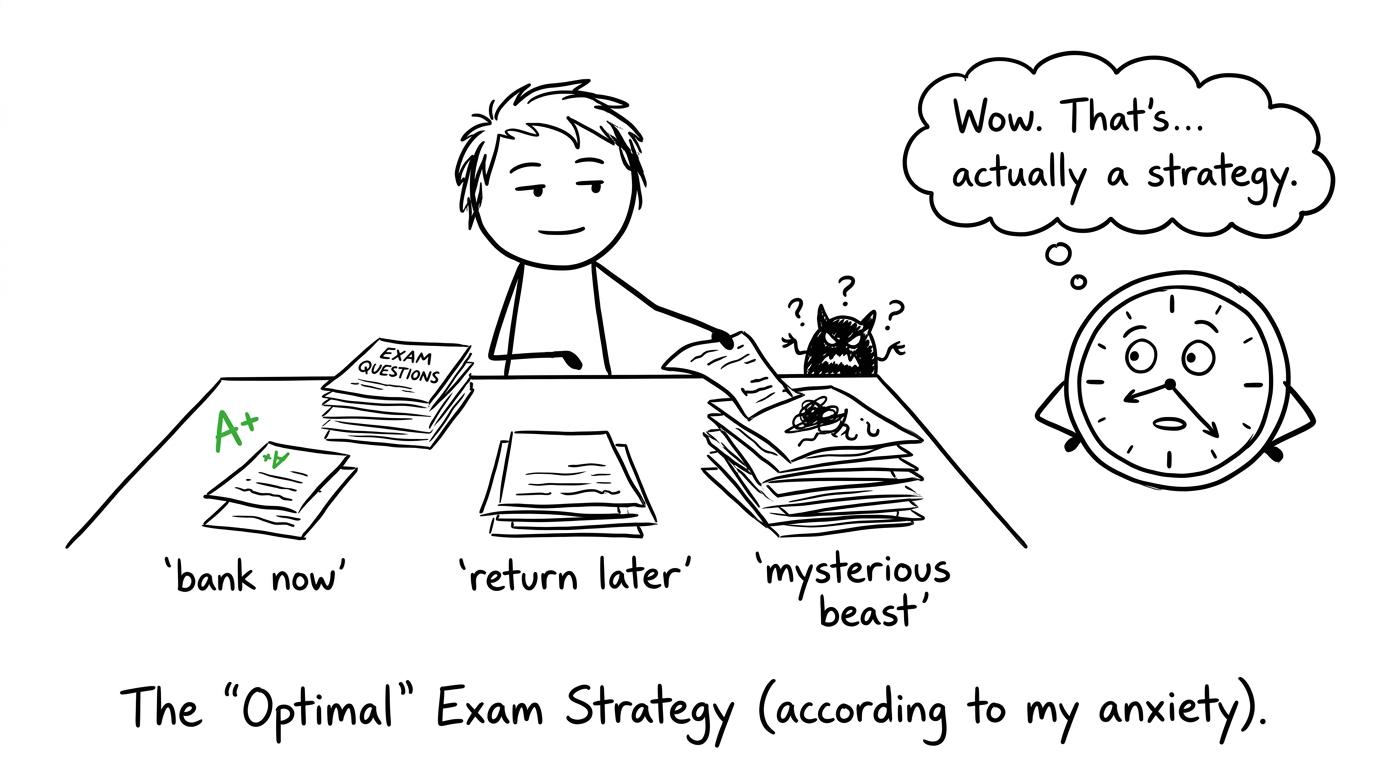 A student sorts exam questions by when to attempt them
How to manage the timing
With 105105105 minutes for 808080 marks, the overall rate is
10580≈1.31 minutes per mark.\frac{105}{80}\approx 1.31 \text{ minutes per mark}.80105≈1.31 minutes per mark.That is about 111 minute 191919 seconds per mark, but it should be treated as a guide rather than a rigid timetable. A one-mark fact may take seconds, while a demanding proof deserves longer.
A practical approach is:
- First pass: answer questions whose route is clear and bank accessible marks.
- Second pass: return to questions that need more thought or longer algebra.
- Final check: inspect signs, exact forms, copied values and unanswered parts.
If you have made no progress after a reasonable attempt, move on. Leaving space is better than letting one problem consume the time needed for several later marks.
For a broader method of turning papers into useful revision, read how to use AQA past papers properly.
How to revise for the non-calculator demand
Begin with one timed Paper 1 from the correct specification. Complete it without notes, pauses or a calculator, then mark it carefully. This gives you evidence rather than a vague feeling about your ability.
Classify every lost mark as one of four types:
- Knowledge: you did not know the required method.
- Recognition: you knew the method but did not identify it.
- Accuracy: the approach was sound but arithmetic or algebra failed.
- Communication: the reasoning, proof or notation was incomplete.
The category determines the repair. A knowledge gap needs a revision lesson. An accuracy problem needs short non-calculator practice. A communication problem needs comparison with the mark scheme and a rewritten solution.
The MathsGenie resources area brings together practice materials, tests and predicted papers. You can also use the guide to finding your weakest GCSE topics to build a more focused error log.
A simple weekly routine
Use two or three short sessions to repair individual topics, then one longer session for mixed practice. A sustainable cycle is:
- revisit a revision lesson
- complete practice questions without looking at solutions
- mark the work immediately
- record one precise correction for each lost mark
- reattempt the skill after a short gap
- test it later within a timed paper
If time is limited, the 20-minute maths revision routine provides a manageable structure. Full papers should become more frequent as the examination approaches; the guide to when to start GCSE past papers can help you plan that transition.
Formula sheets and what they do not solve
AQA has confirmed a formula sheet for Level 2 Further Mathematics examinations in 202620262026 and 202720272027. If you are taking the qualification after that period, check the current examination arrangements rather than assuming the same support continues.
A formula sheet reduces the burden of recalling certain formulae, but it does not choose a formula or apply it. You still need to recognise the relevant relationship, substitute accurately and manipulate the result without a calculator.
Practise with the formula sheet that applies to your examination series. Familiarity matters: exam day should not be the first time you search it for a circle equation or trigonometric identity.
Common mistakes on GCSE Further Maths Paper 1
Revising a guessed topic list
There is no official Paper 1-only topic list. Predictions may provide useful unseen practice, but they should not replace full specification coverage.
Turning exact answers into decimals
If no approximation is requested, preserve exact values. Decimalising a fraction, surd or expression involving π\piπ can lose accuracy and may fail to answer the question asked.
Doing too much mentally
Complex sign changes and fraction arithmetic deserve written lines. Clear working supports checking and may secure method marks even when the final answer is incorrect.
Treating proof like ordinary calculation
A few disconnected equations do not automatically establish a result. State the chain of reasoning and finish with a conclusion that answers what had to be proved.
Spending too long on one late question
The final questions can be absorbing. Protect the rest of the paper by moving on and returning later.
Marking only the final answer
The mark scheme shows where method, accuracy and reasoning marks are awarded. A wrong answer can hide a mostly successful method; a correct answer can hide an unreliable shortcut.
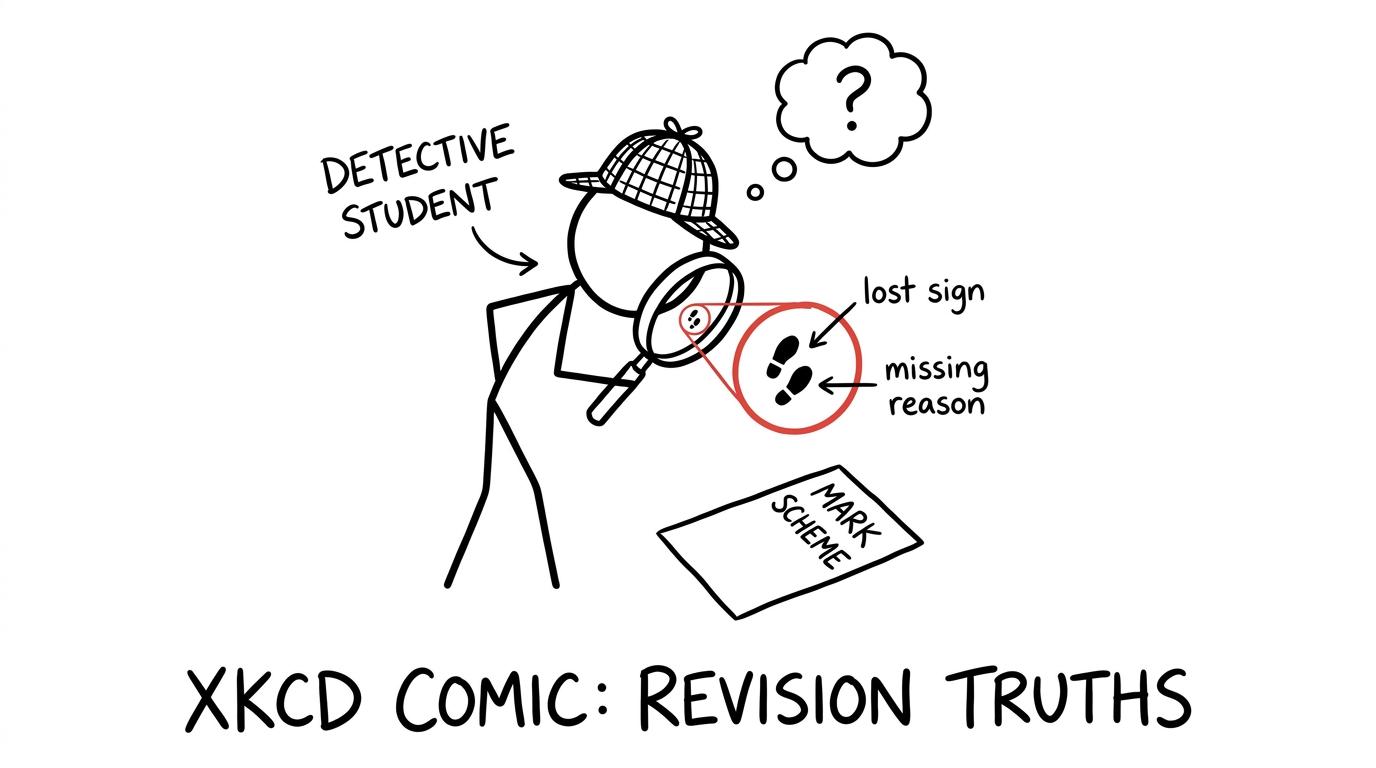 A revision detective investigates marks lost through small errors
Make Paper 1 feel familiar
Paper 1 is not a collection of calculator-paper questions with the calculator removed. It is a test of fluency: exact arithmetic, algebraic control, notation, reasoning and the judgement to know when to move on.
The most useful preparation is not guessing the next paper. It is making the format ordinary. Use MathsGenie’s free AQA Further Maths revision lessons, practise individual weaknesses, then complete Paper 1 past papers under realistic conditions. Mark them with the supplied mark schemes and use video solutions where available to understand methods you could not complete.
As the exam gets closer, add mini tests and predicted papers from the resources hub, but keep past papers at the centre of your plan. Open a Paper 1 today, set a timer for 105105105 minutes and let the result tell you what to revise next.