

Is GCSE Arabic Harder Than Before? A Clear Answer
GCSE Arabic harder than before? Discover what changed, what stayed the same, why it can feel tougher, and how to revise alongside GCSE maths exams.
A paper can feel harder for two very different reasons. The questions may genuinely demand more, or the exam may simply demand something different from the way you learnt the subject.
So, is GCSE Arabic harder than before? Compared with the qualification examined before 2019, parts of it are more demanding. The current Pearson Edexcel course uses grades 9-1, external assessment, translation, authentic reading material and one tier across all four skills. However, GCSE Arabic has not recently been made harder again for the 2026 exam series. The latest major reform affecting French, German and Spanish does not currently replace the Arabic specification.
For students balancing Arabic with GCSE maths, that distinction matters. You need to prepare for the exam you will actually sit, not for a rumoured new one.
The short answer and revision checklist
Here is the practical answer:
- GCSE Arabic changed substantially when the reformed qualification was first assessed in 2019.
- Listening, speaking, reading and writing each contribute 25%25\%25% of the qualification.
- Students enter either foundation or higher tier across all four papers.
- Translation and unfamiliar material can make the course feel less predictable.
- Grade boundaries changing between years do not, by themselves, prove that the qualification is becoming harder.
- The revised language GCSEs first examined in 2026 apply to French, German and Spanish, not automatically to Arabic.
- Your best evidence is the current specification, recent papers, mark schemes and feedback from your teacher.
Before revising, confirm your qualification with your school. GCSE Arabic, International GCSE Arabic and Arabic studied as a first language are not interchangeable courses.
 A student comparing the old and new GCSE specification folders
Why GCSE Arabic became harder in some ways
The clearest comparison is between the older GCSE and the reformed Pearson Edexcel GCSE introduced for teaching from 2017, with its first assessment in 2019.
Assessment became fully external
Under the current course, all four components are set by the awarding organisation. The speaking assessment is conducted by a teacher but externally marked. The older qualification included controlled assessment, so students could prepare for parts of the course in a different way.
This can make the present qualification feel less forgiving. Performance must be produced within controlled exam conditions, and strength in one carefully prepared task cannot compensate as easily for uncertain performance elsewhere.
The four skills now have equal weight
Listening, speaking, reading and writing each carry 25%25\%25% of the final qualification. Before the reform, their weightings were not exactly equal.
The present structure is easy to understand but exposes neglected skills. A student who writes confidently but rarely practises listening is leaving a quarter of the qualification vulnerable.
| Skill | Weighting | Main demand |
|---|---|---|
| Listening | 25%25\%25% | Understanding standard spoken Arabic in different settings |
| Speaking | 25%25\%25% | Role play, picture-based responses and conversation |
| Reading | 25%25\%25% | Understanding varied texts and translating into English |
| Writing | 25%25\%25% | Extended responses and translation into Arabic |
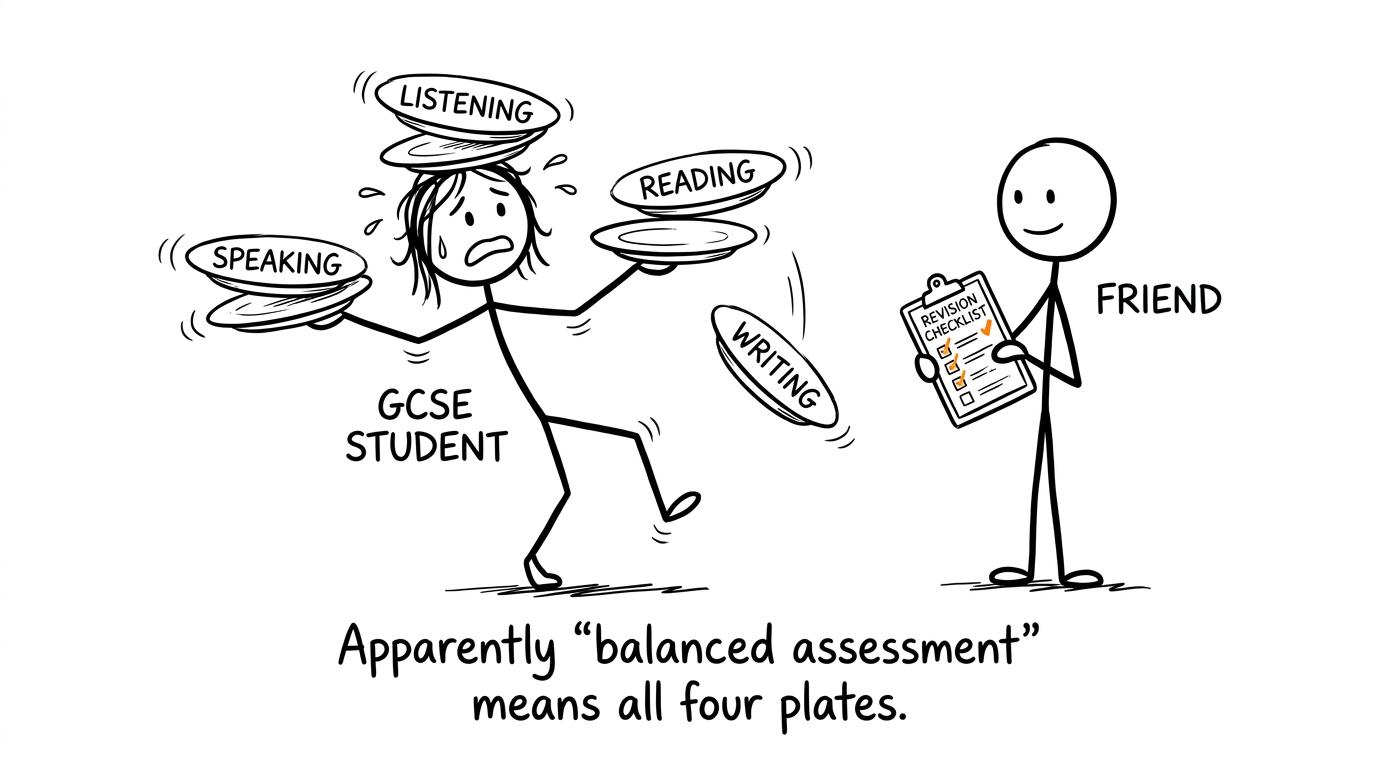 A student balancing the four GCSE Arabic assessment skills
Translation and unfamiliar texts increased the demand
The reformed course added short translations from Arabic into English and from English into Arabic. Reading can also include authentic material and adapted or abridged literary texts.
These tasks test flexible understanding rather than recognition of a memorised paragraph. Knowing a topic such as school or holidays is not enough if you cannot adapt vocabulary, identify tense or infer meaning from context.
Some listening and reading questions are also set in Arabic. That adds a layer of processing: you must understand both the source material and exactly what the question requires.
One tier applies to every paper
Students must enter foundation or higher tier for the whole qualification. They cannot take higher reading but foundation listening, for example.
Foundation targets grades 1-5. Higher targets grades 4-9, with a possible grade 3 for a mark narrowly below the grade 444 boundary. Tier decisions therefore need to reflect performance across all four skills, not merely a student's best area.
Why it may feel harder even when it has not changed
An exam can stay structurally stable while feeling more difficult. Three effects often explain the gap.
Classroom Arabic and examined Arabic are different
A student may speak Arabic confidently at home but have less experience with formal written Arabic, grammatical terminology or the standard language used in assessment. Another student may write accurately but struggle to process an unfamiliar speaker at exam speed.
Fluency is valuable, but it does not automatically provide every examination skill. This is similar to GCSE maths: understanding a topic in class is not the same as recognising it inside an unfamiliar multi-step question.
Recent papers feel harder because they are unseen
A familiar past paper often feels manageable on a second attempt. The live paper does not offer that comfort. New wording, unfamiliar contexts and time pressure can create the impression of a rising standard even when the assessment model has not changed.
The cure is not endless rereading. It is retrieval and timed practice. Maths students can use the same process through the free GCSE maths revision hub, where lessons lead into exam questions, mark schemes and paper practice.
Revision pressure is shared across subjects
Arabic does not exist in isolation. During the final months of Year 11, it competes with maths, English, science and other options. A subject can feel harder simply because less uninterrupted time is available for it.
A realistic GCSE maths revision timetable helps protect time for every subject. Schedule short Arabic sessions around fixed maths sessions rather than waiting for a perfectly free evening that may never arrive.
Has GCSE Arabic changed again for 2026?
This is where understandable confusion arises. Revised GCSE specifications in French, German and Spanish began teaching in September 2024, with first examinations in summer 2026. Those reforms use new vocabulary and assessment requirements.
The Department for Education's earlier modern foreign language subject content remains current for other languages, including Arabic. Pearson's GCSE Arabic qualification remains the specification first assessed in 2019.
Therefore, students should not assume that every headline about a “new language GCSE” applies to Arabic. Check the qualification code and current specification supplied by your school. For Pearson Edexcel GCSE Arabic, the qualification code is 1AA0.
The present GCSE Arabic structure has four compulsory components completed within one exam series. Dictionaries are not permitted, including during preparation for the speaking assessment.
Do grade boundaries show that Arabic is getting harder?
Not reliably. Grade boundaries show the raw marks required for grades in a particular exam series. They do not provide a simple difficulty scale.
The published Edexcel GCSE Arabic grade boundaries illustrate why caution is needed:
| Exam series | Higher grade 777 | Higher grade 444 | Foundation grade 444 |
|---|---|---|---|
| June 2019 | 167167167 | 114114114 | 130130130 |
| June 2022 | 173173173 | 878787 | 101101101 |
| June 2023 | 166166166 | 929292 | 112112112 |
| June 2024 | 168168168 | 103103103 | 136136136 |
| June 2025 | 179179179 | 112112112 | 144144144 |
Each total is out of 280280280 marks. The numbers move, but that does not mean examiners simply turned up the difficulty each year. Awarding organisations set boundaries after papers have been marked, using statistical and qualitative evidence. A harder paper can receive lower boundaries, while an easier paper can receive higher ones.
There were also exceptional grading arrangements during and after the pandemic, making direct comparisons with some recent years especially hazardous.
Treat a boundary as a historical result, not a guaranteed target. The same principle applies when reading Edexcel GCSE maths grade boundaries: aim above a previous threshold and focus on securing marks rather than predicting the exact boundary.
How maths students can revise both subjects efficiently
Arabic and maths look different, but strong revision for both follows the same loop: diagnose, practise, mark, correct and retest.
Separate knowledge gaps from exam mistakes
After an Arabic task, label each lost mark. Was the cause missing vocabulary, weak grammar, misunderstanding the instruction, poor timing or an incomplete response?
Do the same in maths. The Edexcel GCSE maths mini tests are useful for finding narrow weaknesses without sitting a complete paper every evening.
Practise the actual format
Vocabulary knowledge alone will not prepare you for timed listening or spontaneous speaking. Formula recall alone will not prepare you for a mixed maths paper.
Use short skill practice early, then introduce timed sections and complete papers. The guide to when you should start GCSE past papers explains how to move from topic work to exam conditions without using up every paper too soon.
Review more carefully than you score
A total mark tells you where you are. The correction tells you how to move.
Use mark schemes to identify precisely what was missing, then revisit the same skill after a gap. The advice in should you redo GCSE past papers? applies beyond maths: a repeated task becomes useful when you can explain why your second response is better.
 Arabic and maths exam papers sharing the same advice
Common mistakes when judging GCSE Arabic difficulty
Comparing GCSE with International GCSE
These qualifications can have different papers, skill weightings and target candidates. Always compare like with like before deciding that one year's course was harder.
Assuming home fluency guarantees a top grade
Spoken fluency does not replace accurate formal writing, reading unfamiliar passages, translation or careful response to the assessment criteria.
Treating one grade boundary as proof
A higher boundary can indicate that students found a paper more accessible. It does not prove that the subject became easier or that your future boundary will be similar.
Revising only comfortable skills
Equal weighting means every neglected skill matters. Revision time need not be perfectly equal, but it should respond to evidence from marked work.
Using papers without correcting them
Completing more material feels productive, yet improvement happens during review. If time is tight, a carefully marked section is better than a rushed full paper. The one-week GCSE maths revision plan offers a practical model for short, focused sessions.
The fairest conclusion
GCSE Arabic is genuinely harder in several respects than the qualification examined before 2019. It is fully externally assessed, includes translation and authentic material, and gives equal importance to four distinct skills. But there is no sound basis for saying it has continuously become harder every year, nor should Arabic students assume that the 2026 French, German and Spanish reforms apply to their course.
What often changes fastest is not the specification but the student's experience: unfamiliar questions, limited time and revision spread across many subjects.
That is encouraging, because those pressures can be managed. Confirm your course, practise its precise tasks, mark honestly and revisit weaknesses. For maths, make MathsGenie your free revision base: begin with revision lessons and practice questions, check progress with mini tests, then build towards past papers, predicted papers, mark schemes and video solutions. A difficult exam becomes less mysterious when your preparation starts to resemble it.











