

Remote Learning GCSE Arabic Results: What Changed?
Remote learning GCSE Arabic results explained: what closures, teacher-assessed grades and later exam data reveal, and what students can learn today.
A results graph can look certain while hiding a complicated story. That is especially true when comparing GCSE grades before, during and after the pandemic.
The clearest answer about remote learning GCSE Arabic results is this: school closures almost certainly disrupted Arabic learning, but the unusually high grades awarded in 2020 and 2021 cannot be treated as proof that remote teaching improved performance. Exams were cancelled, assessment methods changed and grading became more generous. Later results reflect both the return of examinations and the gradual restoration of pre-pandemic grading standards.
For students preparing for GCSE maths, this matters beyond Arabic. It is a lesson in statistics: a change in results does not automatically reveal its cause.
The evidence at a glance
Before interpreting the data, keep these points in view:
- Most pupils in England experienced substantial periods of remote learning in 2020 and early 2021.
- Government research concluded that learning was generally disrupted, although experiences varied considerably.
- Normal summer GCSE exams did not take place in 2020 or 2021.
- Grades in those years were based principally on teacher judgements rather than identical national examination papers.
- Exams returned in 2022, with deliberately more generous grading than before the pandemic.
- England returned towards pre-pandemic grading standards in 2023.
- Changes in Arabic entry numbers, candidate backgrounds and access to the language can affect subject-level percentages.
- Official results show outcomes, not a controlled experiment proving that remote learning caused a particular change.
That final distinction is the most important one.
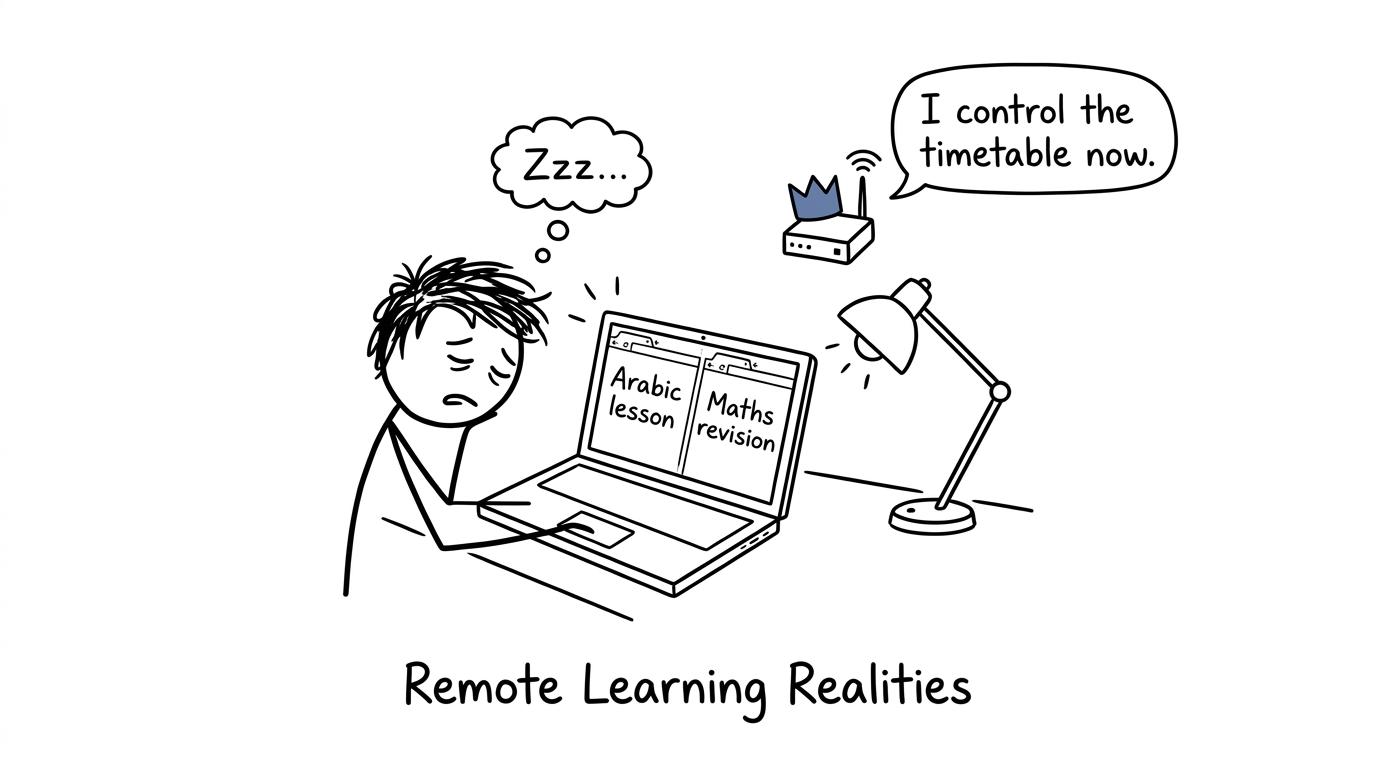 A GCSE student discovers that Wi-Fi controls the remote-learning timetable
What happened to learning during school closures?
Schools in England closed to most pupils in March 2020, with teaching moving largely online. A further national period of remote education followed in early 2021.
An official government review of more than 200200200 sources concluded that the pandemic had a detrimental effect on learning overall. It found that the quantity and quality of education often fell during the first closure. Remote provision improved during the second period as teachers gained experience and access to devices and digital resources became somewhat better, but disruption remained uneven.
Arabic faced several plausible difficulties. Vocabulary and grammar can be practised independently, but speaking and listening depend heavily on regular interaction and feedback. Handwriting, pronunciation and spontaneous conversation may also be harder for a teacher to monitor through a screen.
However, students did not all begin from the same position. Some regularly used Arabic at home or in their community, while others encountered it mainly in school. Some had reliable technology and a quiet place to work; others did not. Remote learning was therefore not one uniform treatment applied equally to every candidate.
The same principle applies to maths. A recorded explanation can teach a method, but improvement normally comes from attempting questions, receiving feedback and correcting errors. The free GCSE Maths revision hub brings those stages together through lessons, exam-style questions, papers and solutions.
Why the 2020 and 2021 Arabic grades need caution
The greatest trap is to place annual GCSE percentages beside one another as though every cohort completed the same assessment.
Exams were cancelled in 2020
Summer GCSE exams did not take place in 2020. Following controversy over the original standardisation system, final grades were generally based on centre assessment grades, unless the calculated grade was higher.
Those results represented teachers' judgements about likely performance rather than marks achieved on common national papers. Across GCSE subjects, the proportion of higher grades increased substantially compared with 2019.
An increase in GCSE Arabic grades during this period therefore does not demonstrate that pupils learnt more Arabic remotely. The outcome measure itself had changed.
Teacher-assessed grades were used in 2021
Exams were cancelled again in 2021. Schools submitted teacher-assessed grades using evidence such as tests, classwork and assessments based on content that students had been taught. Ofqual required internal quality assurance, head-of-centre approval and exam-board checks.
This approach recognised that coverage had varied between schools. It was designed for an exceptional year, not to produce a direct comparison with a normal examination series.
If the percentage receiving grade 777 or above rose, at least four explanations would need consideration:
- a different assessment system;
- more generous national grading;
- changes in the candidates entered;
- differences in actual knowledge and performance.
The published percentage alone cannot separate them.
What changed when GCSE exams returned?
Summer 2022 was the first full examination series since 2019. Ofqual explicitly warned against comparing 2022 directly with 2020 or 2021 because the assessment methods differed.
Grading in 2022 was set as a transition between 2019 and 2021 standards. Overall GCSE outcomes were consequently higher than in 2019 but lower than in 2021. Some subjects also received temporary assessment support, although the precise arrangements depended on the qualification and specification.
In 2023, England returned to grading broadly aligned with pre-pandemic standards, with protection built into the awarding process for a disrupted cohort. Subsequent series have again been based on national examinations rather than centre-assessed or teacher-assessed grades.
This means the post-pandemic fall from the exceptional 2021 peak should not automatically be described as a collapse in Arabic ability. Part of it reflects the restoration of examinations and grading standards.
For a cleaner long-term comparison, 2019 and later normal-exam years are usually more informative reference points than 2020 or 2021. Even then, differences in entries and cohort composition remain relevant.
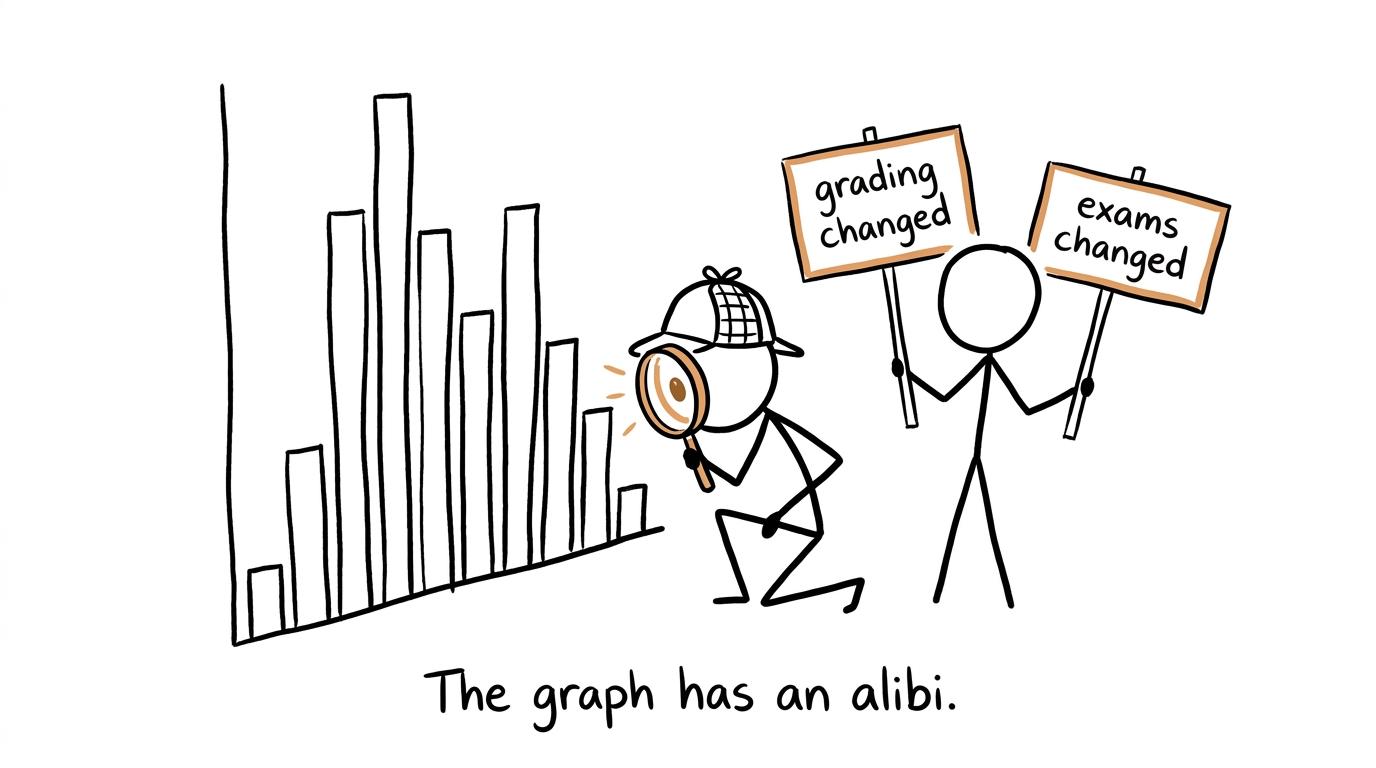 A student detective investigates an exam-results graph with several alibis
What the Arabic results data can actually tell us
Official JCQ and Ofqual datasets allow readers to examine subject entries and cumulative grade outcomes. A cumulative grade rate is calculated as
grade rate=entries awarded the grade or highertotal entries×100%.\text{grade rate}=\frac{\text{entries awarded the grade or higher}}{\text{total entries}}\times 100\%.grade rate=total entriesentries awarded the grade or higher×100%.Suppose an official table reports the percentage at grade 777 or above. A movement from p1%p_1\%p1% to p2%p_2\%p2% is a change of
p2−p1p_2-p_1p2−p1percentage points. It is not automatically a percentage increase of the same size.
Arabic also has fewer entries than the largest GCSE subjects, so changes in the entry population can have a more noticeable effect on percentages. Candidates may include pupils with very different levels of previous exposure to the language. If the balance between home speakers, school-only learners and other candidates changes, the result distribution can change without teaching quality being the sole cause.
The defensible conclusion is therefore measured: remote education created genuine barriers, particularly where interaction, feedback or technology was limited, but annual GCSE Arabic outcomes do not isolate the size of that effect.
A maths student's guide to reading the results
This story contains several GCSE statistics lessons.
Check whether the measurement stayed the same
Comparisons are strongest when the same type of examination, grading approach and candidate population are used. The 2020 and 2021 GCSE grades fail that comparability test because normal exams were cancelled.
Separate correlation from causation
Remote learning happened at the same time as changing grades. That is correlation. To claim causation, researchers would need to account for assessment arrangements, prior attainment, entry patterns, home language, disadvantage and access to technology.
Look at entries as well as percentages
A high grade rate does not tell you how many candidates entered. Always read the denominator. This is the same discipline required in GCSE probability, frequency and percentage questions.
Students can strengthen these skills through the lessons and question sets on the MathsGenie GCSE Maths homepage or choose a board-specific route such as AQA GCSE Maths revision. The GCSE topics by exam board and tier guide also helps students match practice to Edexcel, AQA, OCR or Eduqas requirements.
What students can do about disrupted learning now
A national results trend cannot diagnose an individual student's gaps. A marked question can.
Whether the weakness began during remote learning or last Tuesday is less important than the next revision action. Use a short loop:
- identify one weak topic;
- revisit the revision lesson;
- answer exam-style questions without notes;
- check the mark scheme or video solution;
- record the exact reason for each lost mark;
- retest the skill after a short gap.
MathsGenie's one-month GCSE maths revision plan turns this into a manageable weekly routine. Once individual topics are more secure, use past papers to develop timing and decision-making. Predicted papers are useful for additional practice, but the guide to GCSE predicted topics explains why they should not replace broad specification coverage.
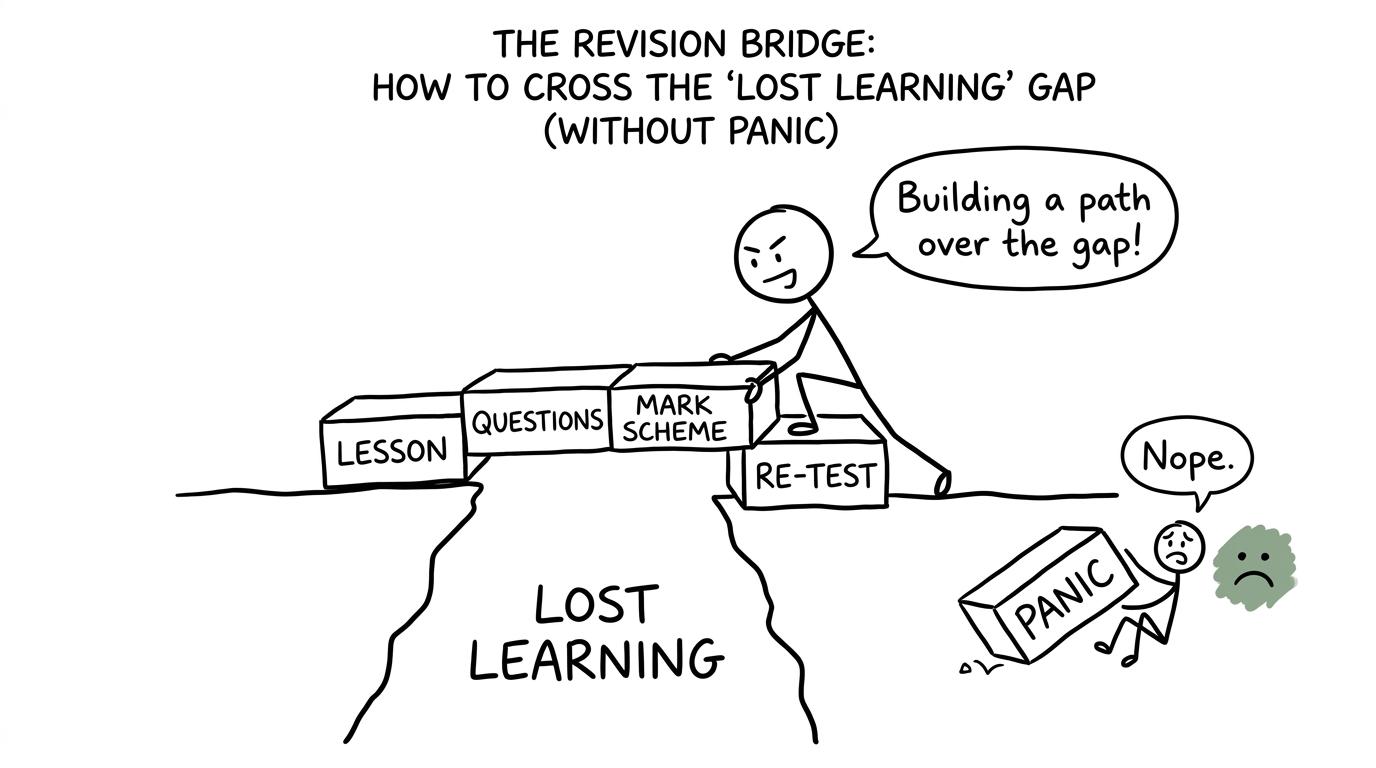 A student builds a revision bridge from lessons, questions, marking and retesting
Common mistakes when interpreting GCSE Arabic performance
Treating 2020 and 2021 as normal exam years. They used exceptional awarding arrangements, so direct comparisons can mislead.
Assuming higher grades mean better remote learning. More generous grading and teacher assessment influenced outcomes across GCSE subjects.
Calling every later fall a decline in knowledge. The return to exams and pre-pandemic standards naturally changed grade distributions.
Ignoring who entered the qualification. Entry numbers and candidates' previous exposure to Arabic can affect the percentages.
Using UK-wide figures as if every nation followed identical rules. Education and qualification arrangements differ across England, Wales and Northern Ireland. The specification and regulator behind a dataset must be checked.
Confusing percentage change with percentage-point change. These are different calculations and should be labelled accurately.
Turning population data into a personal prediction. National subject outcomes cannot determine one student's future grade. Current performance on appropriate questions is far more useful.
The lasting lesson from remote learning
The pandemic affected education, but its imprint on GCSE Arabic results cannot be read from one rising or falling line. The years of school closure combined disrupted learning with cancelled exams, teacher-assessed grades and temporary grading policies. Since then, national examinations and pre-pandemic standards have returned, making recent results more comparable with ordinary exam years, though never perfectly identical.
For a maths student, the practical lesson is reassuring. Data needs context, and lost learning is not a permanent label. Start with the GCSE Maths revision resources, use revision lessons and practice questions to repair weak topics, then test yourself with mini tests, past papers, predicted papers, mark schemes and video solutions. As exams approach, the GCSE maths exam-week checklist will help turn preparation into a calm, repeatable plan.
Historical results explain what happened to a cohort. Deliberate practice changes what happens next.










