

Comparing GCSE Computer Science Progress With Friends
Comparing GCSE Computer Science progress with friends can distort your view. Learn what to measure instead and build an evidence-led revision plan today.
A friend finishes a programming task while you are still finding the error in your first loop. Someone announces that they barely revised and still scored highly. Suddenly, your own work feels smaller than it did five minutes ago.
The worry behind the search “comparing GCSE Computer Science progress friends” is understandable. But constantly ranking yourself against classmates usually gives you an unreliable picture of your progress. You may be studying different weaknesses, learning topics in a different order or beginning from a different level of experience.
The better comparison is between what you could do before and what you can do now. Use questions, teacher feedback and corrected mistakes as evidence. Friends can still help, but they should be collaborators rather than measuring sticks.
A quick checklist for healthier progress
When comparison starts distracting you, return to these questions:
- Can I recall more without notes than I could last week?
- Can I apply knowledge to an unfamiliar question?
- Are repeated errors becoming less frequent?
- Can I explain why an answer or algorithm works?
- Am I following the specification for my exam board?
- Do I know the next small skill I need to improve?
These questions produce actions. “Am I better than my friend?” rarely does.
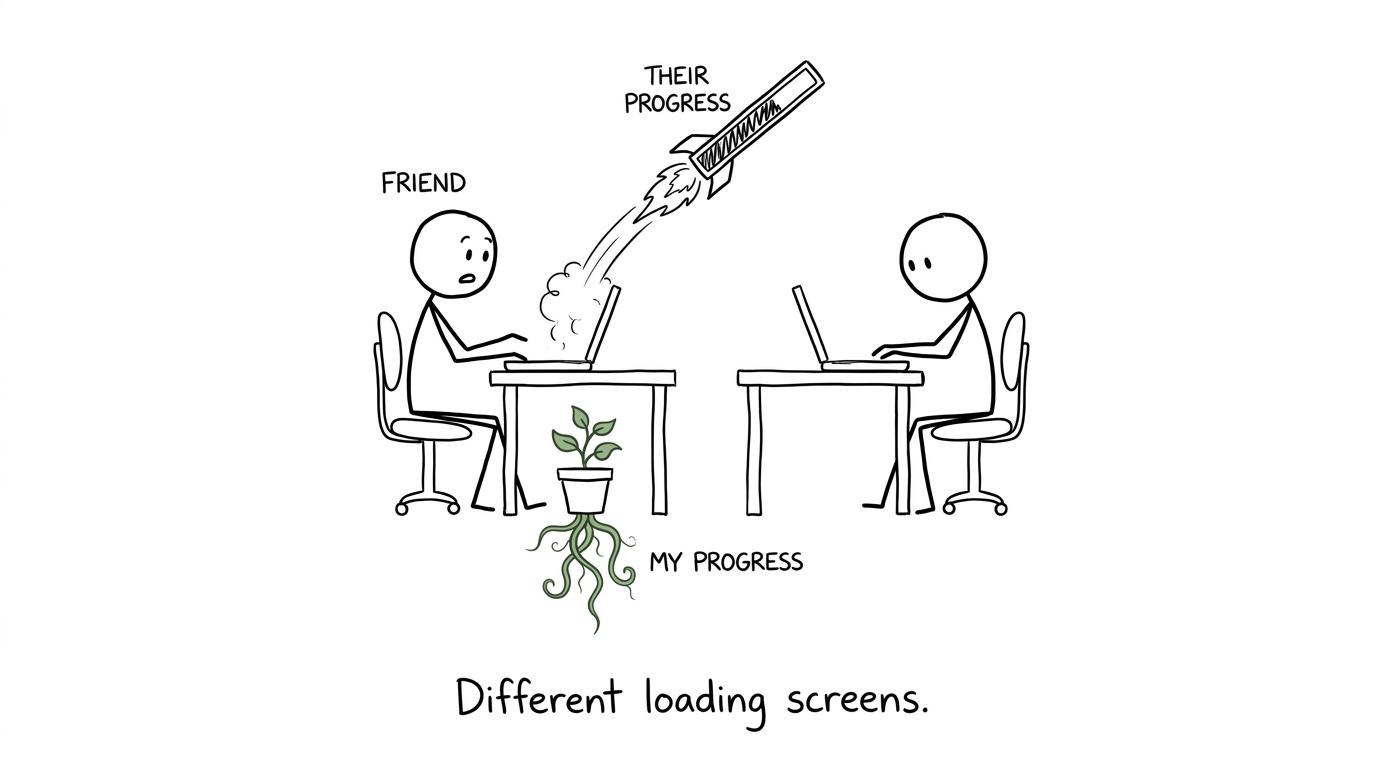 A student's progress bar quietly grows roots while a friend's shoots off the screen
Why comparing progress feels so convincing
Comparison offers a quick answer to an uncomfortable question: Am I doing enough? Unfortunately, quick answers are not always accurate answers.
You can see that your friend finished the task. You cannot see how much programming they did before GCSE, whether they received help or which parts of the course they find difficult. You see the visible result while missing most of the process behind it.
Computer Science makes this particularly noticeable. Progress is uneven across knowledge and skills. A student may write confident code but struggle to explain networks. Another may remember technical vocabulary accurately but find algorithmic problem-solving difficult. GCSE specifications assess more than recall: students must also apply knowledge, analyse computational problems and design or refine solutions.
A single classroom moment therefore cannot measure the whole subject.
Research into classroom social comparison also presents a nuanced picture. Looking towards a stronger peer can sometimes encourage effort or reveal a useful strategy. Yet upward comparison can also produce negative feelings and weaken academic self-concept. The difference often lies in what you compare.
Comparing methods can teach you something. Comparing identity, “they are naturally good, so I must be bad”, tends to close down useful thinking.
Your friend is not a controlled experiment
In a fair experiment, you try to keep important variables consistent. Comparing two students does the opposite.
Your revision time, prior knowledge, confidence, attendance and access to support may differ. Schools can teach specification topics in different sequences. Students may also be taking AQA, OCR, Pearson Edexcel or Eduqas, whose specifications organise and assess content differently.
Even the statement “we both revised for an hour” hides important differences. One person might have reread notes. The other might have completed questions, checked answers and corrected errors. The time is equal, but the learning activity is not.
That principle matters in maths too. A classmate completing a Higher paper quickly tells you little if you are repairing a specific Foundation skill, working through a different exam board or marking more carefully. Start from the appropriate GCSE Maths revision hub and measure yourself against resources that match your course.
Progress needs a stable benchmark. Another person is rarely stable enough.
What to focus on instead of your classmates
Measure competence, not appearances
Useful progress can be demonstrated. Choose a small topic and test whether you can:
- retrieve the key facts without looking;
- answer an exam-style question independently;
- explain the reasoning clearly;
- identify and correct an error;
- repeat the skill later without prompts.
This is more reliable than asking who finished first. Speed can matter under exam conditions, but it should be measured after understanding and accuracy. Fast incorrect work is not stronger progress.
You can record a simple accuracy measure:
Accuracy rate=marks earnedmarks available×100%\text{Accuracy rate}=\frac{\text{marks earned}}{\text{marks available}}\times 100\%Accuracy rate=marks availablemarks earned×100%Use it only to compare equivalent tasks completed under similar conditions. A result on a short binary test should not be treated as directly comparable with a longer programming assessment.
Keep a personal error log
After a test or revision session, record:
- the topic;
- the specific mistake;
- why it happened;
- the action that should prevent it next time;
- the date you will retest it.
Avoid vague entries such as “bad at algorithms”. A useful entry identifies the exact gap: misunderstanding iteration, tracing a variable incorrectly or failing to select suitable test data.
The same approach can protect your maths revision from comparison. MathsGenie’s guide to finding your weakest GCSE topics explains how lost marks can become a focused practice list rather than a judgement about ability.
Plan, monitor and evaluate
Evidence-informed guidance on metacognition describes a practical cycle: plan the task, monitor your understanding while working and evaluate what helped afterwards.
For Computer Science, that might mean choosing one specification statement, testing yourself and deciding whether the next session should involve retrieval, programming practice or an exam question. For maths, the MathsGenie revision planner can turn that same cycle into scheduled, manageable work.
The important shift is subtle. You stop asking, “Where are they?” and begin asking, “What does my evidence say I should do next?”
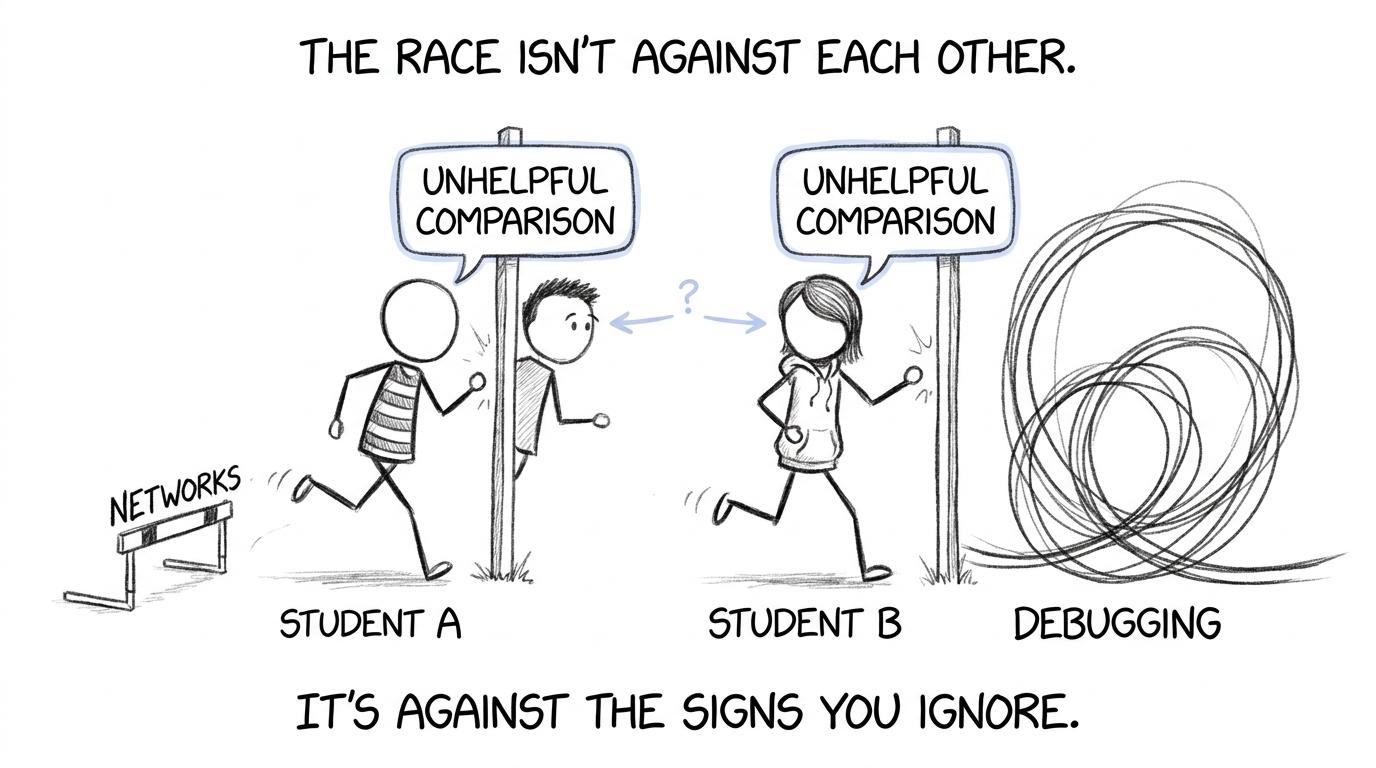 Two students look sideways during completely different obstacle courses
How to use friends without turning revision into a race
The answer is not to avoid classmates. Good peer discussion can expose misconceptions and introduce better strategies. The aim is to change the purpose of the conversation.
Ask questions such as:
- How did you recognise what the question required?
- Which part of the mark scheme did you miss?
- How did you test the program?
- Can we explain this topic to each other without notes?
- Which revision method helped you remember it?
These questions compare processes rather than personal worth.
You can also work together while keeping individual accountability. Each person attempts a question alone, then you compare reasoning and check the mark scheme. If one person explains everything while the other listens, the session may feel productive without proving that both students can answer independently.
Finish shared revision with a closed-book check. What you can produce alone is the evidence that matters.
Protecting maths progress during Computer Science revision
Computer Science and maths can both reward logical structure, careful interpretation and the ability to apply familiar ideas in unfamiliar settings. They can also create the same comparison traps: speed, mock marks and confident-sounding classmates.
Keep the subjects separate enough to diagnose accurately. A difficult programming lesson should not become evidence that you are “falling behind in everything”. Likewise, one weak algebra paper should not dictate how you feel about your entire GCSE programme.
For maths, use resources matched to your board and tier. MathsGenie provides dedicated pathways for Edexcel GCSE Maths, AQA GCSE Maths and OCR GCSE Maths, including Foundation and Higher material.
A short routine can keep maths moving when another subject needs more attention. The 20-minute GCSE maths revision routine uses retrieval, questions and immediate correction without demanding a long session.
Consistency is less visible than a dramatic mock result, but it is usually more useful.
Common mistakes when comparing GCSE progress
Comparing raw marks from different assessments
Two tests may cover different topics, contain different question styles or have different mark totals. Raw scores are meaningful only when the assessment context is understood.
Treating speed as proof of intelligence
Some students begin programming with prior experience. Others work slowly because they are checking carefully. Measure whether your accuracy and independent completion improve before making speed the priority.
Believing confident post-exam talk
Students remember and report exams imperfectly. “That was easy” is not a mark scheme, and it says nothing reliable about your result.
Copying a friend’s revision plan
A plan built around someone else’s weaknesses may neglect your own. Borrow useful techniques, but choose content from your error log and specification.
Tracking only total marks
A total can rise or fall because the paper suited particular strengths. Record the topics and error types underneath it. When using Edexcel GCSE Maths past papers, mark carefully and turn every lost mark into a next action.
Making comparison your motivation
Competition can create a brief burst of effort, but it is fragile. If your motivation depends on staying ahead, another person’s success becomes threatening. A personal target, completing planned retrieval, fixing a recurring error or improving accuracy, remains under your control.
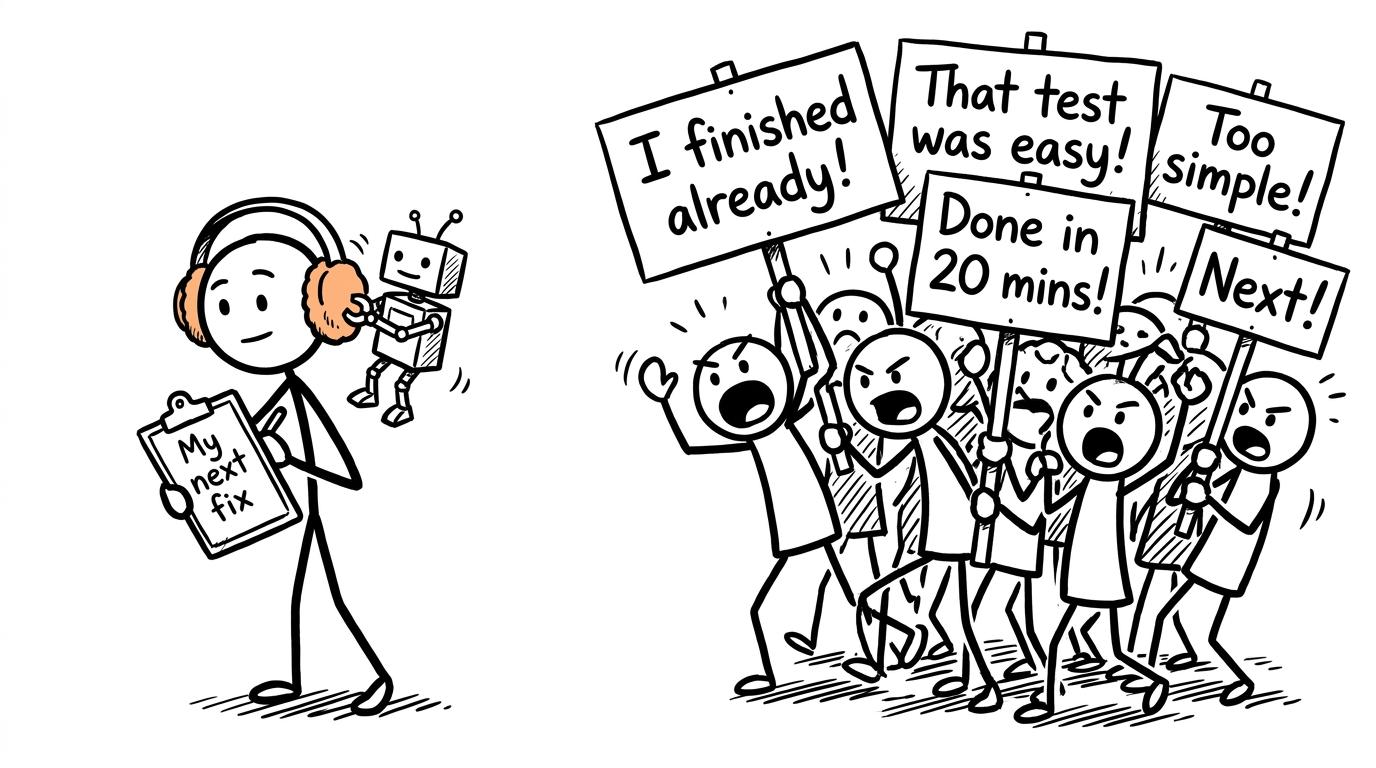 A calm student follows a personal fix list while a robot blocks noisy comparison claims
Build a record that belongs to you
Comparing GCSE Computer Science progress with friends is not automatically harmful. It becomes harmful when a partial glimpse of somebody else’s performance replaces evidence about your own learning.
Let classmates show you strategies, alternative explanations and mistakes worth avoiding. Do not let them become the scale on which you weigh your ability.
Your next step is simple: choose one Computer Science weakness, test it independently and record the next fix. Then give your maths revision the same treatment. Open MathsGenie, select the right board and tier, and move through revision lessons, practice questions and mini tests before checking progress with past papers or predicted papers. Use the mark schemes and video solutions to understand mistakes rather than merely counting them.
A useful revision system makes progress visible. More importantly, it makes the next action clear, and that is something no comparison with a friend can do for you.










