

Do Documentaries Help GCSE Arabic? Honest Answer
Documentaries help GCSE Arabic when viewing is active and exam-focused. Learn what improves listening, vocabulary and grades, and what does not.
The documentary finishes. You understood the general story, recognised a few useful expressions and enjoyed an hour of Arabic without opening a revision guide. But a slightly uncomfortable question remains: do documentaries help GCSE Arabic, or did revision simply become television for the evening?
The honest answer is yes, they can help, particularly with listening confidence, vocabulary recognition, cultural awareness and following meaning from context. However, documentaries do not directly rehearse every task found in a GCSE Arabic examination. They are best used as a supplement to specification-based revision, not as a replacement for listening questions, speaking practice, translation and timed papers.
For students balancing Arabic with GCSE maths, that distinction matters. Enjoyable exposure has value, but exam practice remains the activity most closely connected to marks.
The short answer: when documentaries help GCSE Arabic
A documentary is useful revision when you:
- choose content connected to a GCSE theme
- listen to Modern Standard Arabic where possible
- use Arabic captions at an appropriate level
- pause and replay short, difficult sections
- record a small number of reusable words and phrases
- summarise what you understood afterwards
- combine viewing with exam-style listening, reading and writing
- keep it within a realistic revision timetable
It is mainly entertainment when it plays in the background, the language is far beyond your level, or you finish without retrieving or using anything you heard.
That does not make entertainment worthless. Enjoyment can help you maintain contact with a language over time. It simply means that watching and exam preparation are not automatically the same activity.
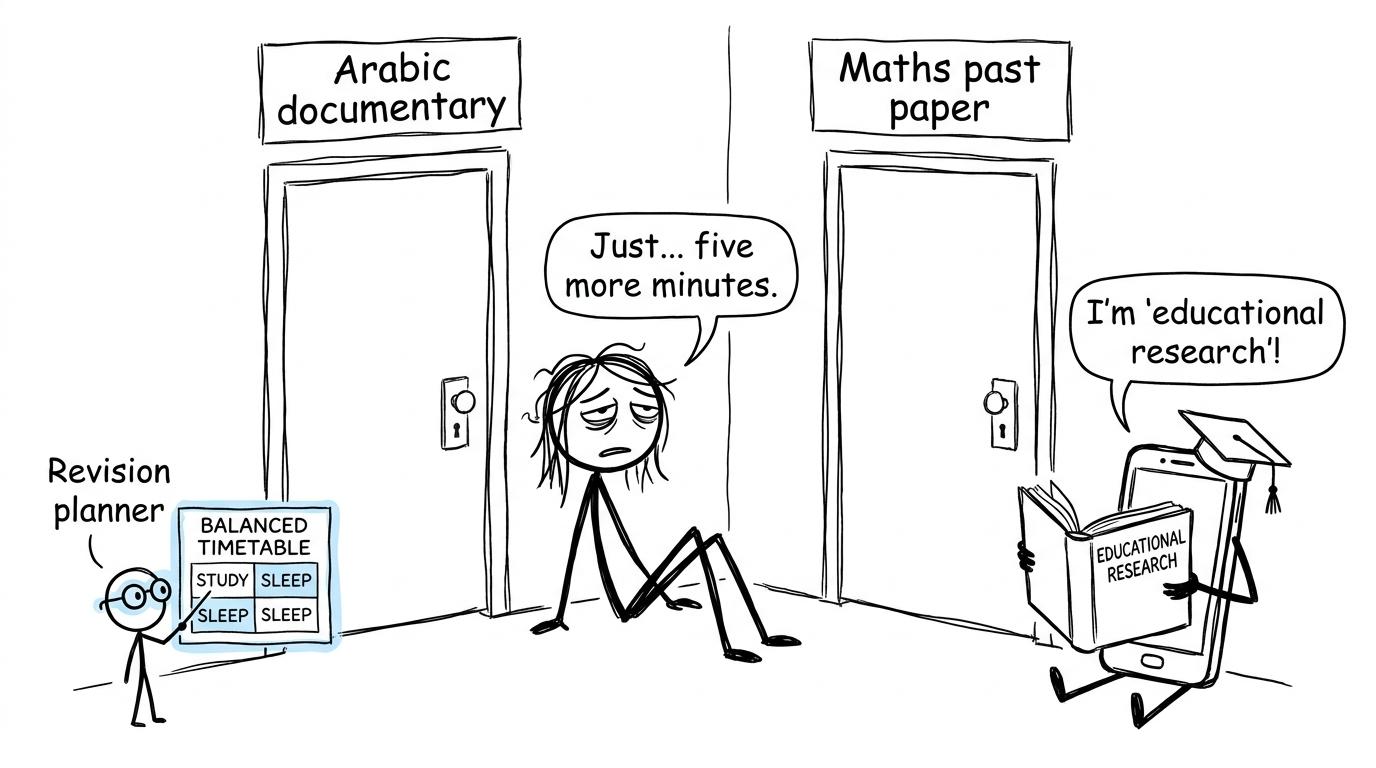 A GCSE student balancing an Arabic documentary and a maths past paper
What the GCSE Arabic exam actually rewards
For Pearson Edexcel GCSE Arabic, the qualification contains four externally examined skills: listening, speaking, reading and writing. Each contributes 25%25\%25% of the qualification. Students enter either foundation or higher tier across the papers.
Documentaries align most directly with listening. They expose you to connected speech, different voices, changes in pace and the need to infer meaning without understanding every word. Depending on the programme and captions, they may also support reading and provide ideas for speaking or writing.
Yet the examination requires more than broad understanding. Students need to identify key details, respond to questions, translate, control grammar and communicate accurately. Speaking tasks also demand active production rather than silent recognition.
This leads to a useful principle:
Documentaries provide language input. GCSE questions test what you can understand and produce under specific conditions.
Both matter, but they do different jobs.
Modern Standard Arabic and regional varieties
GCSE Arabic assessment uses Modern Standard Arabic. Documentaries may include formal narration in Modern Standard Arabic, which can be helpful, but interviews may feature regional varieties or informal speech.
That variation is culturally valuable and can sharpen your ear. It can also confuse learners who have not yet secured the vocabulary and grammar required by their specification. Before choosing a programme, check the language used. If much of it is dialectal, treat it as broader exposure rather than your main source of exam vocabulary.
Why active viewing is more effective than passive viewing
Research into second-language learning generally supports the use of captioned and subtitled video for vocabulary development and listening comprehension. Reviews have found positive effects from captioned video, with same-language captions often particularly useful because learners can connect the sound of a word with its written form.
There is an important limitation: much of this evidence concerns languages other than Arabic and does not measure GCSE Arabic grades directly. It supports the learning mechanism, not a promise that watching a certain number of documentaries will produce a particular grade.
The strongest benefit comes when viewing becomes active.
Preview the topic
Choose a documentary related to a specification theme such as identity and culture, travel, school, future ambitions, work, environmental issues or international events. Familiar subject matter makes it easier to infer unfamiliar language.
Before watching, predict several words that might appear. This activates relevant vocabulary and gives your attention somewhere useful to go.
Watch in manageable sections
A full hour can contain more language than you can process productively. Watch a short section, pause and decide:
- What was the main point?
- Which details did I catch?
- Which words appeared repeatedly?
- What did the images help me infer?
Replaying a difficult sentence is not cheating. It is deliberate listening practice.
Use subtitles strategically
English subtitles make the story easier to follow, but they can pull your attention away from Arabic. Arabic captions help connect pronunciation with spelling, although they may be demanding for less confident readers.
A sensible progression is:
- use English subtitles initially if the content is otherwise inaccessible
- move to Arabic captions for selected short sections
- replay familiar sections without captions
Do not turn subtitle choice into a test of pride. Choose the support that keeps the material understandable while still making you attend to Arabic.
Retrieve something afterwards
When the video stops, close your notes and recall the main ideas. Write a short summary, say it aloud or list the useful vocabulary from memory. Then check what you missed.
Retrieval changes the session from exposure into practice. Without it, familiar words may feel known merely because you have just seen them.
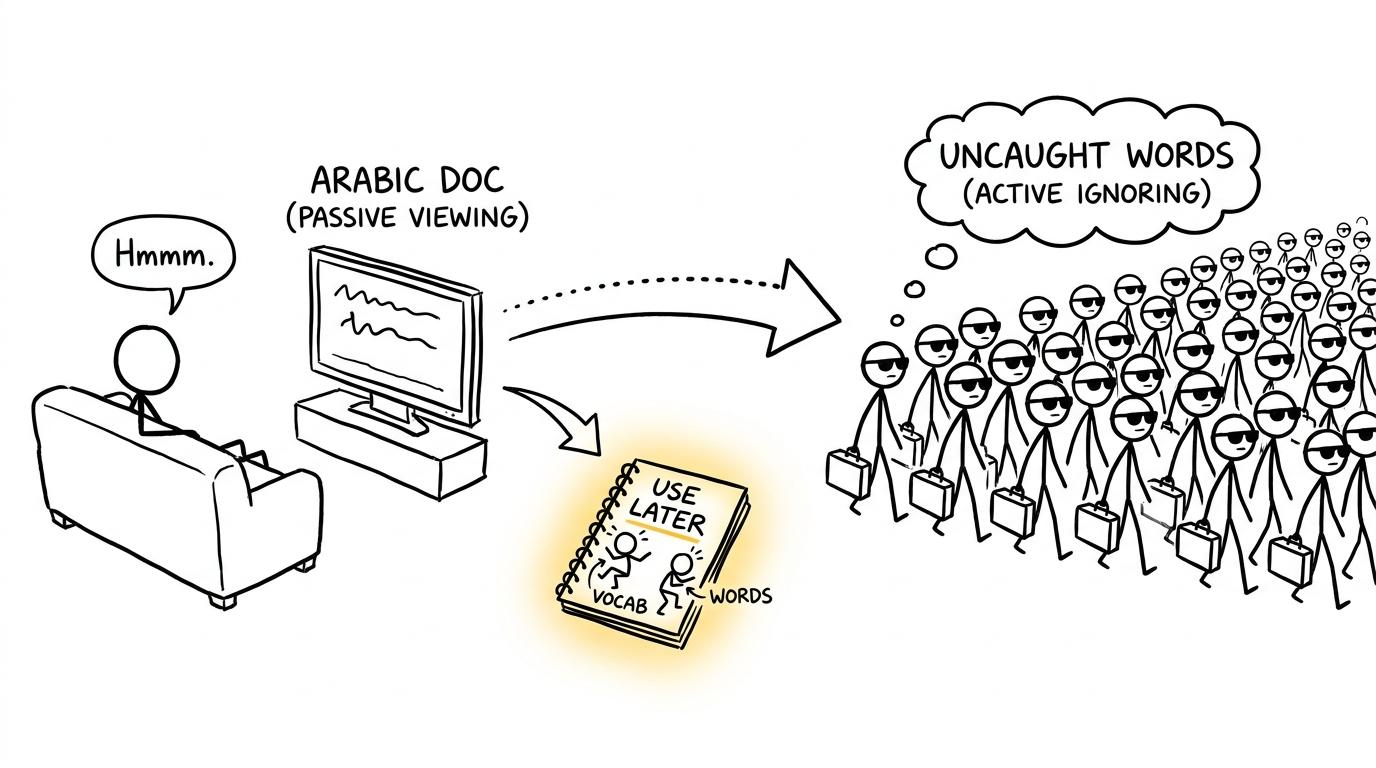 Vocabulary escaping from passive viewing while useful words enter a notebook
Does reading around GCSE Arabic help too?
Yes. Reading around a topic can widen vocabulary, improve cultural understanding and make unfamiliar passages feel less intimidating. Short news reports, age-appropriate articles, museum descriptions and factual texts can all be useful if their language is accessible and relevant.
Reading also gives you more time than listening. You can inspect word patterns, notice connectives and study how opinions or explanations are structured. That can support reading comprehension and provide language for writing.
But the same rule applies: reading becomes stronger revision when it produces an action. After reading, you might:
- identify the main message and three supporting details
- underline familiar grammatical structures
- collect a few phrases that fit GCSE themes
- explain the text aloud without looking
- compare your understanding with a reliable translation afterwards
Reading endlessly without checking comprehension can create the same illusion as passive viewing: the page feels familiar, but little is available from memory.
A balanced revision routine for Arabic and maths
Many students asking this question are not revising Arabic in isolation. Maths still needs regular problem-solving, and watching a documentary cannot replace that practice.
A balanced evening might include a focused maths session, a break and a shorter piece of active Arabic viewing. The precise order matters less than protecting direct practice in both subjects.
For maths, begin with the GCSE Maths revision hub, where lessons, questions and revision tools are organised by exam board and tier. Students following Pearson can use the Edexcel GCSE Maths revision area, while separate hubs support OCR GCSE Maths revision and Eduqas GCSE Maths revision.
A practical weekly pattern is:
- direct Arabic exam practice on several days
- one or two short documentary sessions linked to current themes
- regular maths topic questions
- one timed paper section or mini test
- a review session for mistakes in both subjects
If organising that feels difficult, use the GCSE maths revision timetable guide to build a week that you can actually maintain. A plan should not fill every spare minute. Its purpose is to stop the easiest or most enjoyable activity quietly taking all the available time.
How to tell whether viewing is improving your Arabic
Do not measure progress by the number of programmes completed. Measure what you can do afterwards.
Look for evidence such as:
- recognising previously learned vocabulary at natural speed
- identifying the main point without English subtitles
- recalling useful phrases a few days later
- understanding more detail on official listening practice
- using relevant vocabulary accurately in speech or writing
The final check must come from GCSE-style tasks. If documentary viewing feels easier but listening-paper performance remains unchanged, the problem may be insufficient question practice, vocabulary gaps or difficulty identifying precise details.
The same feedback principle is central to maths. Use Edexcel GCSE Maths past papers or AQA GCSE Maths past papers, mark them carefully and turn each lost mark into a specific revision action. The guide to using GCSE past papers properly explains why the real learning happens after the paper, when mistakes are diagnosed and repaired.
Common mistakes when using documentaries for revision
Treating background noise as listening practice
If you are scrolling, messaging or doing unrelated homework, you are unlikely to process the language deeply. A shorter attentive session is more useful than a long distracted one.
Choosing material that is too difficult
Constantly hearing unfamiliar language may build tolerance for ambiguity, but it offers limited GCSE preparation if you cannot identify the subject or recurring ideas. Choose material where visuals, prior knowledge or captions make the overall meaning accessible.
Collecting too many new words
Writing down every unknown word turns viewing into transcription. Select a small group of frequent, relevant expressions and revisit them later.
Ignoring the specification
An interesting historical documentary may enrich your Arabic without covering the themes, grammar or task types you currently need. Broader reading and viewing should sit beside your specification, not replace it.
Avoiding speaking and writing
Recognition is easier than production. You may understand a phrase on screen but be unable to use it independently. Follow viewing with a spoken summary, written response or conversation practice.
Letting enjoyable revision replace demanding revision
Documentaries feel smooth because the story carries you forward. Past papers expose gaps. Students naturally prefer the first experience, but grades depend partly on facing the second.
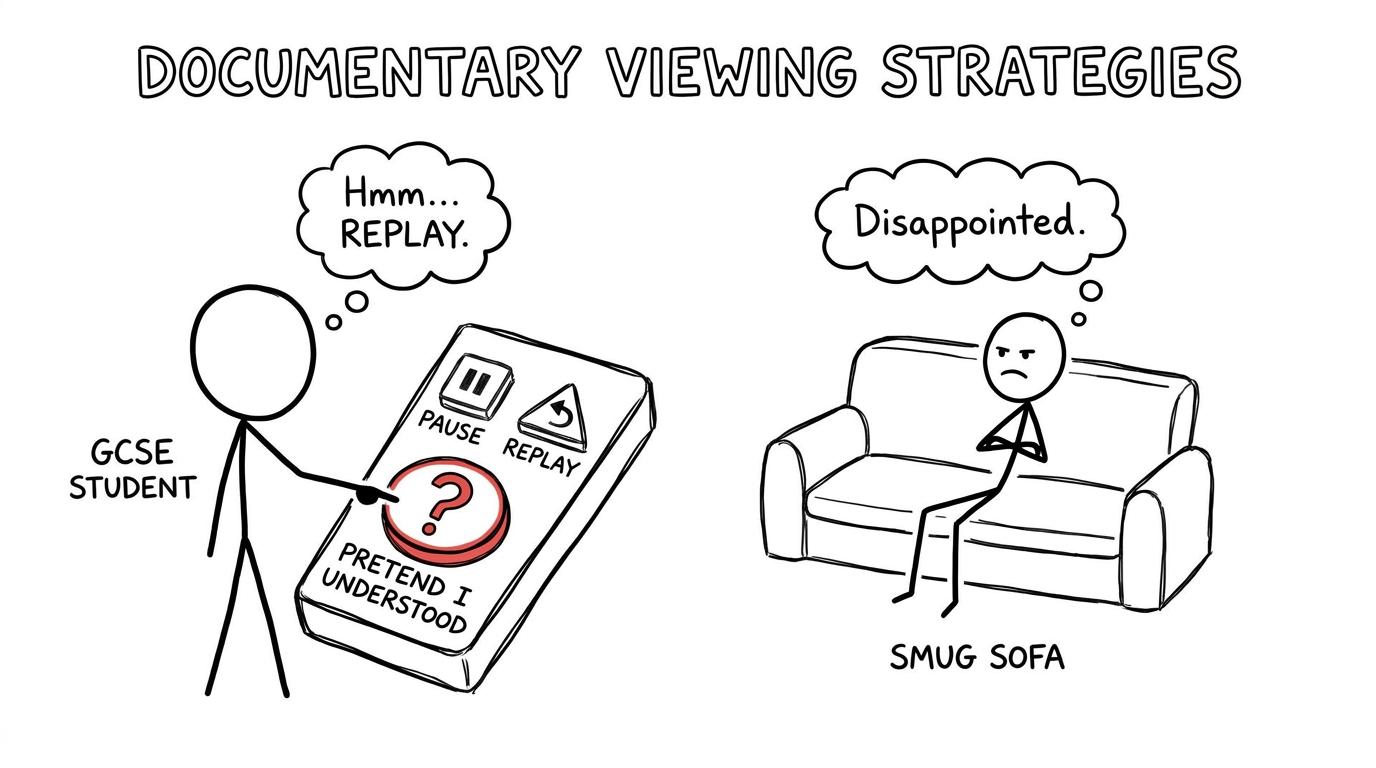 A student choosing replay rather than pretending to understand
Enjoyment and effectiveness can coexist
Revision does not become ineffective merely because you enjoy it. In fact, an activity you willingly repeat may be more valuable than an ideal routine you abandon after two days.
The distinction is between enjoyment with attention and enjoyment disguised as complete exam preparation. A documentary can help you stay curious about Arabic, hear the language beyond the classroom and encounter perspectives that a vocabulary list cannot provide. Those are genuine benefits.
It becomes grade-focused when you connect that curiosity to retrieval, specification vocabulary and examination tasks.
Turn interest into marks
Documentaries can help GCSE Arabic, but they are supporting players. Use them to strengthen listening familiarity, vocabulary and cultural context. Then prove that learning through speaking, writing, translation and official exam-style questions.
Apply the same honest approach to maths. Watching a clear explanation is the beginning; attempting questions independently is what reveals whether the method is secure. Use MathsGenie as your free revision base for revision lessons, practice questions, mini tests, past papers, predicted papers, mark schemes and video solutions.
Choose one useful Arabic documentary section, one weak maths topic and one clear action for each. Curiosity keeps revision moving. Practice is what turns it into marks.











