GCSE French Paper 1 Exam Date 2026
GCSE French Paper 1 exam date 2026 by exam board, with confirmed timings, speaking arrangements, equipment and a practical checklist for students.
There is a particular kind of exam-season worry that has little to do with how much you know. It begins with a simple question: When is the exam? Then you notice that different websites call different assessments “Paper 1”.
The GCSE French Paper 1 exam date 2026 depends on your exam board. For AQA, Paper 1 was the listening examination on the morning of Wednesday 20 May 2026. For Pearson Edexcel, OCR and Eduqas, the first French assessment is speaking, so your school or college assigns your individual appointment within the relevant speaking window rather than every student sitting it at one nationally fixed time.
That distinction matters. Before adding anything to your revision timetable, confirm your exam board, specification code, tier and school-issued start time.
GCSE French Paper 1 date at a glance
| Exam board | What Paper 1 or Component 1 assesses | Date arrangement for 2026 |
|---|---|---|
| AQA | Listening | Wednesday 20 May 2026, morning |
| Pearson Edexcel | Speaking in French | Individual appointment arranged by the school within the official assessment window |
| OCR | Speaking | Individual appointment arranged by the school within the official assessment window |
| Eduqas | Speaking | Individual appointment arranged by the school within the official assessment window |
The official AQA summer timetable lists both foundation and higher listening papers on 20 May. The duration was 35 minutes for foundation tier and 45 minutes for higher tier, including the periods built into the assessment for reading and checking.
Pearson’s final timetable confirms that Edexcel Paper 1 is speaking, while its nationally timetabled listening examination is Paper 2. OCR and Eduqas also begin with a speaking assessment under their relevant specifications. Because schools organise speaking appointments, two students taking the same board may have different Paper 1 dates.
Your school’s candidate timetable is therefore the final practical source for your personal arrangements.
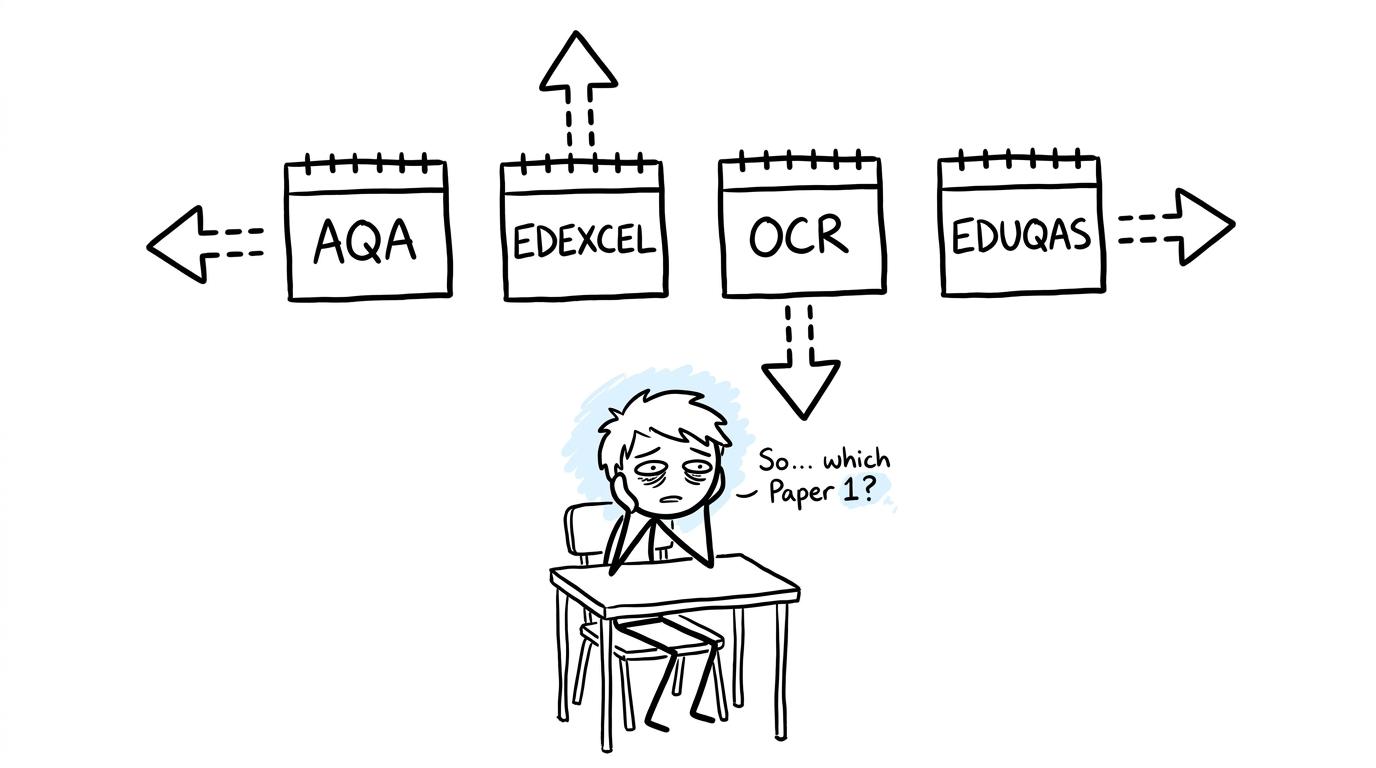 A student tries to make sense of four different exam-board calendars
Your essential Paper 1 checklist
Before the assessment, make sure you can answer each of these questions:
- Which exam board am I taking: AQA, Edexcel, OCR or Eduqas?
- What is my specification or entry code?
- Is Paper 1 listening or speaking for my board?
- Am I entered for foundation or higher tier?
- What date, arrival time and room appear on my candidate timetable?
- Do I know where to register if the assessment is held outside my usual classroom?
- Have I checked my school’s rules about equipment, water bottles and electronic devices?
- If it is speaking, do I understand the tasks and preparation arrangements for my specification?
Do not rely on a friend’s timetable. They might take another board, have a different speaking slot or receive approved access arrangements.
Why Paper 1 means different things across exam boards
“Paper 1” sounds universal, but it is only a label within a particular specification.
Under AQA’s current GCSE French specification, Paper 1 is listening. Reading is Paper 3, while speaking is conducted within a separate test window. Under Pearson Edexcel’s current specification, Paper 1 is speaking, Paper 2 is listening, Paper 3 is reading and Paper 4 is writing.
This explains why searching for one national French Paper 1 date can produce apparently contradictory answers. The pages may all be accurate, but they are describing different specifications.
The safest sequence is:
- check your candidate timetable;
- match the board and specification code;
- confirm the skill being assessed;
- use the official date or your school-assigned speaking appointment;
- ask your exams officer or French teacher if anything is unclear.
A timetable is useful only when it belongs to the qualification you are actually taking.
What to have ready for AQA French Paper 1
AQA candidates sitting Paper 1 on Wednesday 20 May needed to prepare for listening rather than speaking.
Administrative details
Have your candidate number or identification information available in the form required by your centre. Know the room, arrival time and seating arrangements. Morning sessions have an awarding-body start period, but your school tells you when to arrive and when your examination begins.
Arrive early enough to follow registration and seating instructions without rushing. If you have access arrangements, such as extra time or supervised rest breaks, check how your centre will apply them.
Permitted equipment
Bring at least two black pens in a clear pencil case, unless your centre supplies writing equipment. A transparent water bottle may be allowed if labels and other unauthorised material have been removed, but follow your school’s instructions.
Dictionaries are not permitted in the AQA listening assessment. Phones, smartwatches, earbuds and other unauthorised electronic devices must not be taken into the examination room or must be handed in according to centre rules.
The centre provides and controls the listening audio. You do not need to bring headphones unless your school has specifically instructed you to do so.
Listening preparation
Revise the vocabulary, grammatical structures and sound patterns in your specification rather than attempting to memorise isolated model answers. Practise identifying:
- negatives and changes of opinion;
- past, present and future time frames;
- numbers, dates and quantities;
- who is speaking and who is being discussed;
- distractors where a speaker corrects an earlier statement;
- details required by the precise wording of the question.
Read each question before the relevant audio begins where the paper allows it. Use the final checking time to inspect unanswered questions and make sure your responses are written in the required language.
What to have ready for a speaking Paper 1
For Edexcel, OCR or Eduqas candidates, the most important “date” is the individual appointment issued by the school. Put it into your calendar as soon as it is confirmed, including the time you must report for supervised preparation.
Know the task structure for your own board. Current speaking assessments can include activities such as a role play, reading aloud, discussion or conversation, but the exact combination and timing must come from your specification and teacher.
Before the appointment:
- practise responding without scripting every sentence;
- revise questions as well as answers so that you recognise what is being asked;
- prepare flexible language for opinions, reasons and different time frames;
- practise pronunciation aloud rather than revising silently;
- check the rules for supervised preparation and permitted notes;
- do not bring pre-written material unless your centre has expressly confirmed that it is allowed.
For a speaking examination, communication matters more than sounding like a native speaker. Listen carefully, answer the question asked and recover calmly if you need something repeated or clarified within the permitted rules.
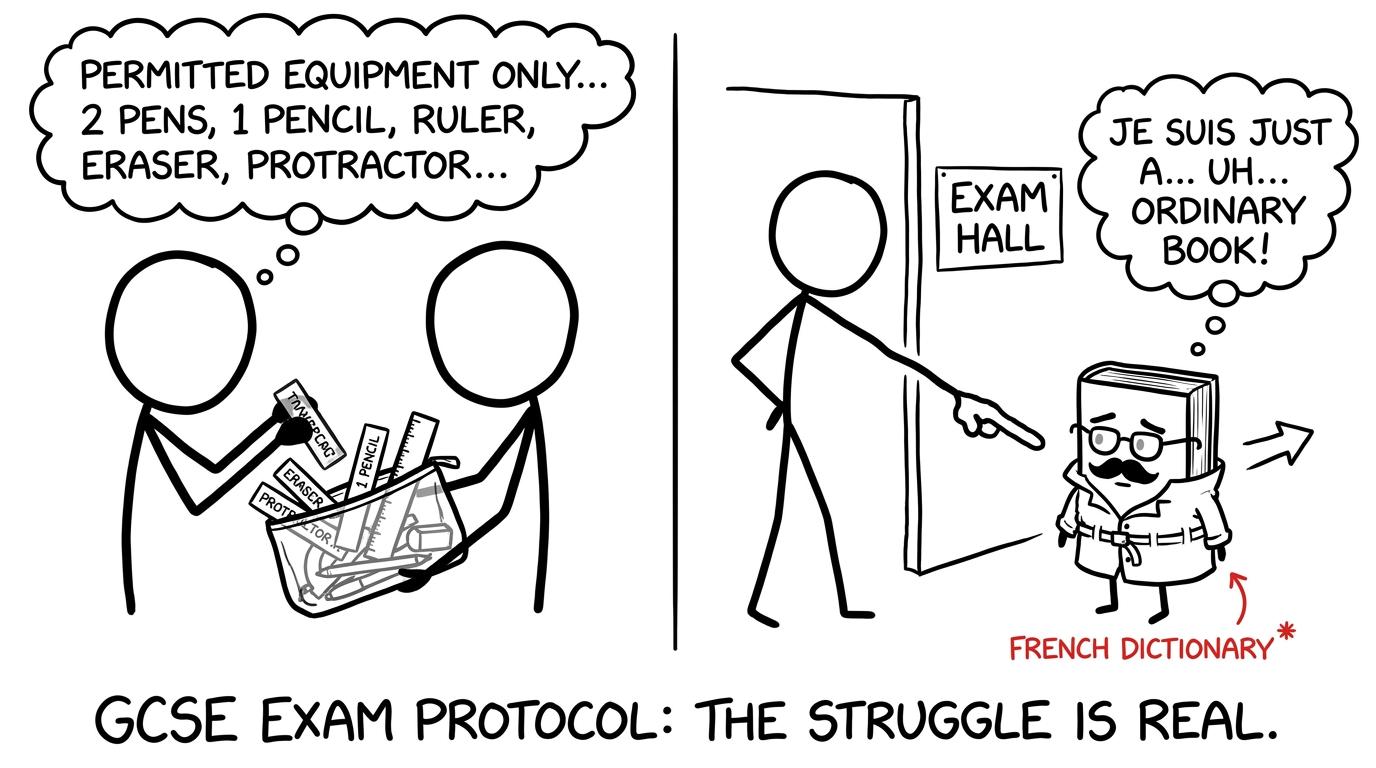 A dictionary in disguise tries to sneak into the exam room
Building French into a busy GCSE timetable
The hidden difficulty is rarely one French paper. It is the cluster of examinations around it. Language revision must coexist with English, science and maths without allowing one subject to consume every evening.
Start by placing all confirmed examinations and speaking appointments on one calendar. Then work backwards, giving each session a specific purpose. “Revise French” is vague. “Complete one listening task and review errors” is actionable.
The same principle strengthens maths revision. Use the free GCSE Maths revision hub to select your board and move between lessons, exam questions and papers. If your week feels crowded, the GCSE maths revision timetable guide helps turn available time into realistic sessions.
A balanced routine might contain:
- a short French vocabulary or pronunciation session;
- one listening or speaking task under realistic conditions;
- a focused GCSE maths topic session;
- a timed paper section later in the week;
- time to mark, correct and revisit mistakes.
Revision becomes manageable when each session has an ending. You are not trying to “finish French” or “finish maths”. You are completing the next useful task.
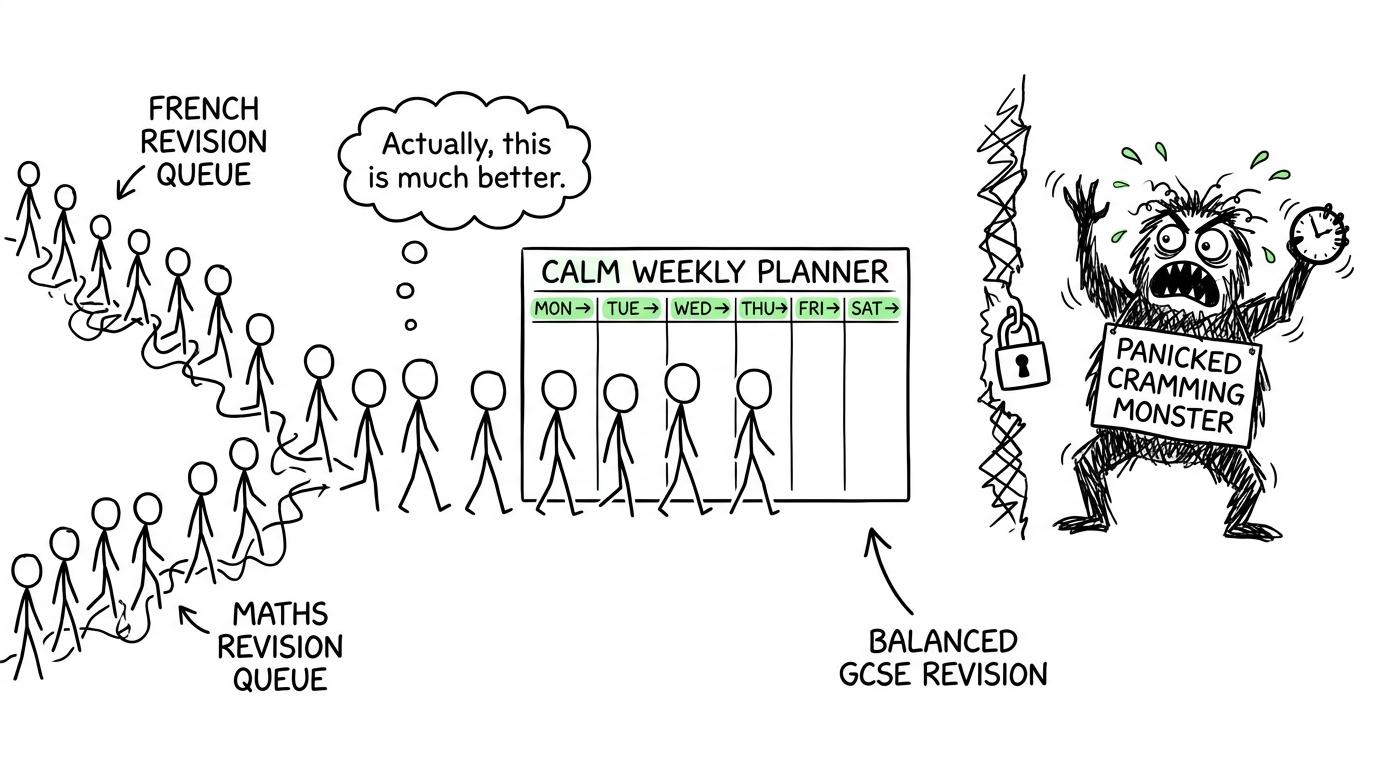 French and maths revision calmly merge into one weekly planner
What to do in the final week
The final week should reduce uncertainty, not create it. Confirm your logistics first. Then use short, deliberate practice.
For French, complete tasks in the format used by your board. Review mistakes immediately and return to recurring weaknesses. For speaking, practise aloud with unpredictable prompts. For listening, use complete extracts without pausing whenever you are simulating examination conditions.
Keep maths moving with a small daily commitment. The GCSE one-week maths revision plan provides a structured approach when several examinations are competing for attention. You can use GCSE predicted papers for fresh maths practice, but mark every attempt and repair the topics responsible for lost marks.
If you are unsure when to move from topic work to timed papers, read the guide to starting GCSE past papers. The goal is not to collect completed papers. It is to discover what needs fixing while there is still time to fix it.
Common mistakes to avoid
Assuming every board has the same Paper 1
AQA Paper 1 is listening, while Edexcel Paper 1 is speaking. Search using your board and specification code, not only the subject name.
Treating the speaking window as your personal date
An assessment window gives schools flexibility. Your appointment comes from your centre and may be earlier than another school’s appointment.
Confusing French listening papers across boards
Edexcel listening took place on the morning of Wednesday 20 May 2026, but it was Paper 2 rather than Paper 1. The shared date does not mean the paper numbers are shared.
Forgetting the contingency date
JCQ designated Wednesday 24 June 2026 as the contingency day for national or significant local disruption. Candidates were required to remain available up to and including that date. A contingency session is not an opportunity to rearrange an examination missed for an ordinary personal reason.
Cramming one subject and abandoning the rest
An approaching French assessment does not require maths revision to stop completely. A mini test or focused topic session preserves momentum. The efficient GCSE maths revision guide explains how to learn, practise, mark and fix without filling every evening.
Packing for the wrong assessment
A listening examination and a speaking appointment have different practical requirements. Read your centre’s instructions rather than copying a generic online checklist.
Keep the date useful
Knowing the date is not the finish line. It is the point at which an uncertain examination becomes a plan.
Confirm your board, paper type, tier and personal start time. Prepare only the permitted equipment. Practise in the correct format, and keep the rest of your GCSE timetable balanced rather than waiting for panic to choose your priorities.
For maths, make MathsGenie your free revision base. Use revision lessons and practice questions to strengthen individual topics, mini tests to check progress, and past papers, predicted papers, mark schemes and video solutions to develop examination technique. If the evening before an assessment feels difficult to organise, follow the GCSE maths night-before plan and make the next decision a small, useful one.